The .22 Rimfire · Volume 3
How a Rimfire Is Made — and the Six Levers of Quality
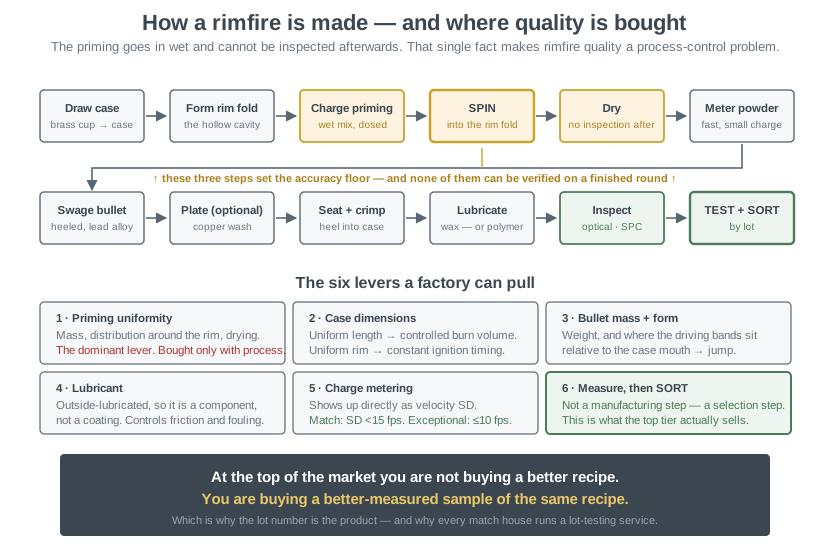
Everything about .22 LR quality follows from one fact: the primer is part of the case, and it goes in wet. There is no primer pocket, no separately manufactured and separately inspected primer cup, and no way to check afterwards whether the compound went where it was supposed to. A finished rimfire cartridge is opaque to inspection in the exact place where consistency matters most. That is why rimfire quality is purely a process-control problem — and why the answer to “what does Lapua do that Remington doesn’t” is much less exciting and much more expensive than most people expect.
3.1 The Sequence
Case forming. A brass cup is drawn through progressive dies into a thin-walled, rimmed case. The rim is formed as a hollow fold — the cavity that will hold the priming compound. Case length and rim thickness are set here, and both matter later: rim thickness is the cartridge’s headspace datum, so variation in it is variation in firing-pin indent and therefore in ignition timing.
Priming. Wet priming mix is dosed into the case mouth, and the case is spun so centrifugal force drives the compound out into the rim fold and distributes it around the circumference. Then it is dried. The mix is not one chemical but a mechanical blend — typically lead styphnate as the explosive, antimony sulfide as fuel, barium nitrate as oxidiser, plus a sensitiser such as tetracene and a frictionator such as finely ground glass.1 Lead-free rimfire priming exists and is the subject of an active patent literature, but lead styphnate remains the mainstream chemistry.2
That spin step is the whole ball game. If the compound bands unevenly around the rim, ignition begins at a slightly different place and a slightly different instant from round to round. Everything downstream — powder burn onset, peak pressure timing, muzzle velocity — inherits that variance.
Charging. Powder is metered in. .22 LR uses a fast-burning charge sized to be essentially complete within the first several inches of bore, which is the root cause of the barrel-length behaviour in Volume 4.
Bullet forming and seating. The bullet is swaged from lead alloy — typically antimony-hardened — into a heeled profile: full case diameter on the bearing surface, a reduced heel that enters the case. It is lubricated on the outside because the bearing surface is outside the case, then seated and the case mouth crimped or taper-formed onto the heel.
Finishing. Plated bullets get a copper wash before seating. Everything gets lubricated. Match ammunition gets packed in moulded trays so the bullet noses never contact anything in transit — Eley says so explicitly, and it is not a marketing flourish: a soft lead nose deformed in shipping is a flyer.3
3.2 The Six Levers
Given that sequence, there are exactly six places a factory can spend money to make the round shoot better.
3.2.1 Lever 1 — Priming uniformity
The dominant one. Uniform compound mass, uniform distribution around the rim, uniform drying. There is no post-hoc inspection that can verify it on a finished round, so it is bought entirely with process control: clean mix chemistry, tight dosing, controlled spin, controlled drying, and small enough lots that a drift is caught before it becomes a hundred thousand rounds.
3.2.2 Lever 2 — Case dimensional control
Uniform case length so that each charge burns in a controlled volume; uniform rim thickness so headspace and firing-pin indent are constant; uniform wall thickness so obturation is even. Eley describes forming cases “to uniform length to a tightly controlled brass alloy” and ties it directly to consistent energy delivery.3
3.2.3 Lever 3 — Bullet mass and form
Weight consistency, and — less obviously — form consistency. Overall bullet length varies even within a grade, and where the driving bands sit relative to the case mouth determines how far the bullet jumps before it engages the rifling.4 Two rounds of identical weight with different band placement have different jump, and jump is a first-order accuracy variable.
Profile is a design choice rather than a quality one, but it belongs here. Eley’s flat-nose EPS profile is claimed to pull the centre of pressure forward, aerodynamically stabilising the projectile — Eley’s own description, and it should be read as a manufacturer’s claim rather than an independent finding.3 The flat nose has a second, uncontested virtue for target work: it cuts a clean, gaugeable hole in paper.
3.2.4 Lever 4 — Lubricant
Because the .22 LR bullet is outside-lubricated, the lubricant is a functional component, not a coating. It controls bore friction, fouling behaviour, and the barrel’s “seasoning” — the reason a rimfire barrel often needs a few fouling shots after cleaning to return to its best grouping. Match houses treat their wax formulations as proprietary. It is also, as Volume 10 covers, a large part of why .22 LR is punishing on suppressors.
3.2.5 Lever 5 — Charge metering
Powder charge variance shows up directly as velocity variance. The industry benchmark: match ammunition typically runs a standard deviation below 15 fps, with SD at or below 10 fps considered exceptional.4 For calibration, that is a tighter velocity spread than most handloaded centerfire.
3.2.6 Lever 6 — Measurement, and then sorting
This is the lever that separates the top tier from everything else, and it is not a manufacturing step at all — it is a selection step.
Eley’s published protocol: high-speed electronic visual inspection on the line, Six Sigma statistical process control, and a test regime of four test barrels firing five 10-shot groups, scored by mean radial dispersion and radial standard deviation from x-y plotting, with a cited record of 2.64 mm mean radius. Match grades are deliberately made in small lots so anomalies can be caught and corrected.3
Lapua’s arrangement is the clearest illustration of what “sorting” means. Lapua and SK rimfire are made in the same plant — Nammo Schönebeck, Germany — on different lines. Within the Lapua match range, Center-X, Midas+ and X-Act reportedly use the same bullets, cases, priming compound and propellant; the grades are separated by measured performance in factory test rifles, with Midas+ being the Center-X lots that shot better on average.5
That claim deserves a flag: it is the consistent account given by the shooting community and by Lapua’s distributor, but it is not a Lapua engineering document, and this series treats it as the community/distributor account rather than as established fact. If it is even approximately right, though, it explains the entire structure of the match rimfire market. You are not buying a better recipe. You are buying a better-measured sample of the same recipe.
3.3 Why This Makes Lot Testing an Industry
Follow the logic through. The product cannot be reloaded or tuned. Its most important variable is invisible after assembly. The top grades are defined by test-fired performance rather than by formulation. And rimfire barrels are individually idiosyncratic about what they like.
The result is that the ammunition and the specific rifle form a pair, and the only way to find the good pairing is to shoot it. So the industry built the infrastructure. Lapua runs Rimfire Performance Centers — the western US facility has operated in Mesa, Arizona since 2012, run by Capstone Precision Group and modelled on the Schönebeck service centre. You bring (or ship) your rifle, and they test lots at 50 and 100 metres simultaneously, typically eight lots per rifle, re-shooting the promising ones to confirm.6 Eley offers an equivalent batch-testing service: a 10-shot screening per batch, then 30-shot confirmation on the selected batches, yielding a 40-shot group and consolidated score through proprietary analysis software.3
Then you buy that lot number, in quantity, and you guard it.
3.4 The Thing Shooters Argue About: Hand Sorting
If the factory sorts, should you sort further? Rim thickness gauges and precision scales are cheap, and the practice is widespread.
The case for: sorting quality ammunition by both weight and rim thickness maximises uniformity and is reported by its practitioners to cut down unexplained flyers.
The case against: high-end production lines already gauge weight and rim thickness — more precisely, and on every round, rather than in a batch on a bench.4
This series does not adjudicate it. Both positions are held by people who shoot well, the effect size if any is small, and nobody consulted has produced a controlled test at a sample size that would settle it. What can be said without controversy is the ordering: buying the right lot is a larger effect than sorting the wrong one.
3.5 What This Means for Bulk Ammunition
Nothing above says bulk ammunition is badly made. It says bulk ammunition is made to a different objective function: rounds per day at an acceptable defect rate, rather than dispersion minimised at any cost. CCI’s Lewiston, Idaho rimfire plant — a 37,000 sq ft facility producing roughly four million .22 rounds per day on proprietary in-house equipment — is a genuinely impressive piece of industrial engineering.7 It is simply solving “cheap and reliable,” not “smallest group.”
The practical consequence for a buyer is Volume 9’s whole argument: match the grade to the job, and stop expecting a two-cent round to do a four-dollar round’s work — or paying four dollars to knock over a can.
3.6 Bibliography
Footnotes
-
Rimfire priming: wet mix dosed into the case and distributed into the rim fold by spinning; mixture of lead styphnate, antimony sulfide, barium nitrate plus a sensitiser (tetracene) and a frictionator (ground glass). https://nij.ojp.gov/nij-hosted-online-training-courses/firearms-examiner-training/module-05/primer-manufacture ; https://archive.gfjc.fiu.edu/firearms/module05/fir_m05_t07.htm ; https://en.wikipedia.org/wiki/.22_BB (confidence: high). ↩
-
Lead-free and heavy-metal-free rimfire priming compositions in the patent literature. https://image-ppubs.uspto.gov/dirsearch-public/print/downloadPdf/5993577 (confidence: high that the patents exist; no claim is made here about their commercial share). ↩
-
Eley’s published account of its match manufacturing and QC: tightly controlled brass alloy and uniform case length; the EPS flat-nose centre-of-pressure claim; small lot quantities; high-speed electronic visual inspection; Six Sigma; four test barrels firing five 10-shot groups, scored by mean radius (record 2.64 mm) and radial standard deviation; moulded packaging protecting bullet noses; batch-testing service of 10-shot screening plus 30-shot confirmation for a 40-shot score. https://eley.co.uk/how-eley-achieve-olympic-accuracy-with-its-22lr-ammunition/ (confidence: high that this is Eley’s stated process; it is the manufacturer’s own marketing-adjacent description and is presented as such). ↩ ↩2 ↩3 ↩4 ↩5
-
Match ammunition SD typically below 15 fps, at or below 10 fps exceptional; priming distribution, powder charge and seating depth as the accuracy-limiting variances; bullet form and overall length variation and driving-band placement determining jump; the contested status of hand weight/rim-thickness sorting. https://www.accurateshooter.com/guns-of-week/22lr-rimfire-ammo-comparison-test/ ; https://kurtthegunsmith.com/the-pursuit-of-rimfire-accuracy-part-two-match-ammo/ ; https://www.ssaa.org.au/stories/ammunition-accurate-ammo-for-rimfires.html ; https://www.rimfirecentral.com/threads/weighing-ammo-for-best-accuracy.579204/ (confidence: high on the SD figures and the mechanism list; the sorting question is genuinely contested and is not adjudicated here). ↩ ↩2 ↩3
-
Lapua and SK made at Nammo Schönebeck on different lines, SK the entry/mid tier and Lapua the match tier; Center-X, Midas+ and X-Act reported to share bullets, cases, priming compound and propellant, separated by measured performance in factory test rifles, with Midas+ the better-shooting Center-X lots. https://www.rimfirecentral.com/threads/sk-vs-lapua.1318473/ ; https://www.targettalk.org/viewtopic.php?t=25527 ; https://bulletcentral.com/lapua/ (confidence: medium — consistent community and distributor account, not a Lapua engineering document; explicitly flagged as such in the text). ↩
-
Lapua Rimfire Performance Center West, Mesa, Arizona, operating since 2012, run by Capstone Precision Group, modelled on the Schönebeck service centre; testing at 50 and 100 m simultaneously, typically eight lots per rifle with promising lots re-tested; rifles may be shipped in. https://www.lapua.com/support/rimfire-test-shooting/ ; https://www.capstonepg.com/rpc/ ; https://rimfiretest.com/about/ (confidence: high on existence, location and model. Fees and lot counts change — verify current terms before relying on them). ↩
-
CCI’s Lewiston, Idaho rimfire facility: a 37,000 sq ft .22 rimfire plant producing about four million rounds per day using proprietary equipment designed in-house. https://www.thetruthaboutguns.com/cci-opens-new-22-rimfire-production-facility-idaho/ ; https://en.wikipedia.org/wiki/CCI_Ammunition (confidence: high). ↩
Comments (0)