The .22 Rimfire · Volume 5
External Ballistics — Velocity Classes, Trajectory, Wind, and the Transonic Argument
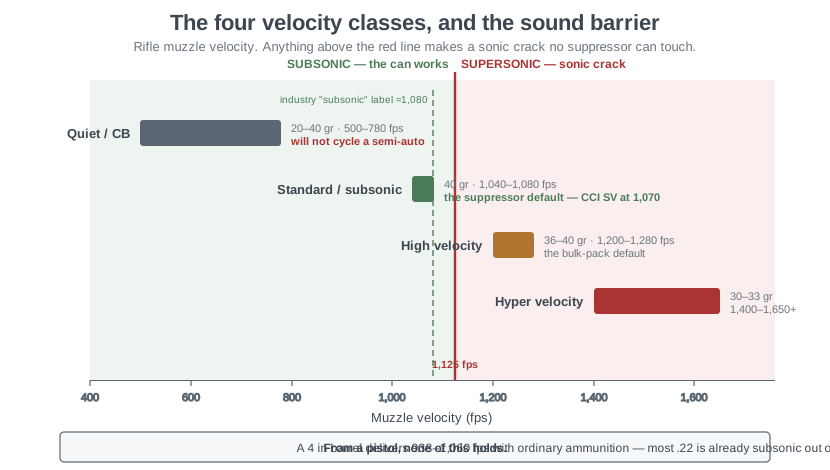
The .22 LR flies badly. That is not an insult — it is the design brief. A 40-grain lead cylinder with a rounded nose, launched at roughly the speed of sound, has a G1 ballistic coefficient of about 0.125 (CCI publishes 0.123 for its Standard Velocity 40 grain).1 For comparison, a mediocre centerfire match bullet is three to five times that. Everything about how a .22 behaves past 50 yards follows from that number.
5.1 The Four Velocity Classes
The market sorts itself into four bands. The boundaries are marketing conventions rather than standards, but they are consistent enough to reason with.
Table 1 — 5.1 The Four Velocity Classes
| Class | Typical load | Muzzle velocity | Notes |
|---|---|---|---|
| Quiet / CB | 20–40 gr | 500–780 fps | Will not cycle a semi-auto |
| Subsonic / standard velocity | 40 gr | 1,040–1,080 fps | Below the sound barrier by design |
| High velocity | 36–40 gr | 1,200–1,280 fps | The bulk-pack default |
| Hyper velocity | 30–33 gr | 1,400–1,650+ fps | Light bullet bought with velocity |
Representative published figures from an 18.5 in barrel: standard velocity 40-gr solid at 1,200 fps / 131 ft·lbf; high velocity 32-gr CPHP at 1,430 fps / 141 ft·lbf; hyper-velocity 30-gr CPHP at 1,640 fps / 191 ft·lbf.2 At the far end, CCI’s lead-free Copper-22 drives a 21-grain copper-polymer bullet at an advertised 1,850 fps — measured at 1,904 fps from a 20 in aftermarket barrel and 1,773 fps from a 16.25 in factory 10/22 barrel.3
The reference line that matters: the speed of sound is about 1,125 fps on a standard day, and the industry uses ~1,080 fps as the practical subsonic ceiling when labelling ammunition.4 Everything in the top two rows is supersonic from a rifle. Everything in the top two rows is marginal from a pistol (Volume 4 §4.2).
Note the energy column carefully. Going from standard velocity to hyper velocity buys you about 60 ft·lbf at the muzzle — a real increase — but it is bought by cutting bullet weight by a quarter, and light bullets shed velocity faster. Volume 6 works through what that trade does downrange.
5.2 Trajectory
With a 50-yard zero, published tables give:
Table 2 — With a 50-yard zero, published tables give
| High velocity 40 gr | Standard velocity 40 gr | |
|---|---|---|
| Muzzle | 1,235 fps / 135 ft·lbf | 1,070 fps / 102 ft·lbf |
| 50 yd (zero) | 1,095 fps / 107 ft·lbf | 980 fps / 85 ft·lbf |
| 100 yd | 1,000 fps / 89 ft·lbf, −5.5 in | 910 fps / 74 ft·lbf, −7.5 in |
A CCI Mini-Mag 36 gr at 1,260 fps (BC 0.126) drops −5.6 in at 100 yd and −44.1 in at 200 yd from the same 50-yard zero.5
Read the 200-yard row again. The bullet falls nearly four feet in the second hundred yards. That is the .22 LR’s defining external-ballistics property: the trajectory is not a curve so much as a cliff, and it arrives suddenly. Ranging error that would be irrelevant with a centerfire is a clean miss here.
Two consequences for how you zero:
- 50 yards is the right default zero for a general-purpose .22, which is why nearly every published table uses it. It puts the point of impact within about half an inch of the line of sight from the muzzle out to roughly 60 yards, which covers almost all small-game shooting.
- Do not extrapolate. Because drop accelerates so hard, a dope card built from a published table and your own 50-yard zero will be wrong at 150 yards. Shoot it.
5.3 Wind — the Real Limit
Past about 75 yards, wind beats drop as the thing that makes you miss.
Published 10 mph full-value crosswind deflection at 100 yards for .22 LR ranges across sources from about 3.5 in to 5.5 in, with one aggregate table giving 5.4 in at 100 yd, 18.9 in at 200 yd, and 39.2 in at 300 yd.6 The spread between those figures is not sloppiness; it reflects genuinely different assumed BCs and muzzle velocities, and different computation methods. Treat any single published number as an order-of-magnitude guide and build your own from observed hits.
For calibration on how bad that is: in the same aggregate comparison at 1,000 yards in a 10 mph wind, .22 LR deflects 396 inches — worse than everything except .17 HMR, and roughly four times a .308 Winchester’s 101 inches.6
5.3.1 The counter-intuitive part
One source pair gives Federal Gold Medal 711 subsonic at 1,080 fps deflecting 4.5 in at 100 yards in a 10 mph crosswind, and Federal Gold Medal 719 at 1,200 fps deflecting 5.5 in under the same conditions.7 The slower round drifted less.
That inverts the usual rule, and the popular explanation offered — that crosswinds “flow around subsonic bullets more easily” — is hand-waving. The defensible mechanism is the lag-time model: wind deflection is driven by lag time, the difference between actual time of flight and the time of flight the bullet would have in a vacuum, not by muzzle velocity as such. (The sibling Ballistics Overview dive develops this properly in its wind volume.) A .22 LR that starts supersonic runs straight into the transonic drag rise, sheds velocity hard, and gives most of its head start back — so the extra 120 fps at the muzzle buys much less lag-time reduction than the arithmetic suggests, and can be outweighed by the better-behaved subsonic drag curve.
Two honest caveats. This is a single reported data pair, not a systematic study; and the two loads differ in more than velocity. The direction of the effect is corroborated by shooters’ experience and by the drag physics; the magnitude is not established.
5.4 The Transonic Argument — Presented, Not Settled
Here is the claim you will read everywhere: high-velocity .22 LR leaves the muzzle supersonic, drops back through the sound barrier somewhere around 75 to 100 yards, becomes unstable in the transition, and that is why standard-velocity and match subsonic ammunition out-shoots it at 100 yards.
The observation is solid. The explanation is not.
Against the explanation: the transonic band is roughly 1,340 fps down to 890 fps. Most high-velocity .22 LR leaves the muzzle at 1,200–1,300 fps — inside that band already. It never transitions into the transonic regime, because it was never above it. And a 1990 study by Robert McCoy is cited for the finding that .22 LR in the transonic velocity range does not suffer the classic transonic instability.8
That McCoy attribution is reported second-hand in the sources consulted and was not read in the original, so this series treats it as medium confidence and does not build on it.
The confound: match subsonic ammunition is not merely slower than bulk high-velocity ammunition. It has tighter velocity SD, better-formed bullets, more uniform priming, and tighter dimensional control — every one of the six levers in Volume 3 pulled harder. Comparing Lapua Center-X to Remington Thunderbolt at 100 yards and attributing the difference to Mach number is comparing two things that differ in eight ways and crediting one of them.
What can be said without controversy:
- Good subsonic match ammunition does out-shoot bulk high-velocity ammunition at 50 and 100 yards, reliably and by a wide margin.
- Whether transonic instability is any part of the reason is unresolved, and this series does not assert it.
- If you want to test it yourself, the clean experiment is match subsonic against match high-velocity from the same maker and the same test protocol — which is a harder comparison to arrange than it sounds, because the match houses mostly do not make high-velocity ammunition. That absence is itself a data point about what the people who measure this for a living believe.
5.5 Range Limits, Honestly
Published figures put the .22 LR’s effective range at about 150 yards, with the explicit caveat that practical range is less, and its maximum range — the distance it will travel, which is a safety number and not a shooting number — at roughly 2,000 yards.4
The practical numbers most shooters converge on:
- Small game, clean kills: 50–75 yards with high-velocity hunting ammunition (Volume 6).
- Target work: 50 metres is the classic discipline distance, and it is where match ammunition is optimised. 100 yards is a real and increasingly popular game (NRL22 and rimfire benchrest), and it is where ammunition quality stops being optional.
- Past 150 yards it becomes a wind-reading exercise in which the cartridge’s own dispersion and a four-foot trajectory are both fighting you. People do it, and enjoy it, and it is a legitimate sport — but it is a sport, not a capability.
That 2,000-yard maximum range is worth carrying in your head for a different reason. A .22 LR is not a “safe” cartridge for backstop purposes. It carries well over a mile.
5.6 Bibliography
Footnotes
-
.22 LR 40 gr lead round nose G1 BC ≈ 0.125; CCI publishes 0.123 for Standard Velocity 40 gr. https://www.cci-ammunition.com/rimfire/cci/standard-velocity/6-32.html ; https://www.luckygunner.com/lounge/practical-ballistics-for-22lr/ (confidence: high). ↩
-
Representative published figures from an 18.5 in barrel: standard velocity 40 gr 1,200 fps / 131 ft·lbf; high velocity 32 gr CPHP 1,430 fps / 141 ft·lbf; hyper velocity 30 gr CPHP 1,640 fps / 191 ft·lbf. https://en.wikipedia.org/wiki/.22_Long_Rifle (confidence: high as representative figures; individual loads vary). ↩
-
CCI Copper-22, 21 gr lead-free, advertised 1,850 fps / 160 ft·lbf; measured 1,904 fps from a 20 in aftermarket barrel and 1,773 fps from a 16.25 in factory 10/22 barrel. https://www.thetruthaboutguns.com/ammo-review-cci-copper-22-fastest-22-lr-ever/ ; https://www.americanrifleman.org/content/tested-cci-copper-22-ammunition/ (confidence: high on the advertised figure; medium on the measured ones — a single review’s chronograph session). ↩
-
Subsonic threshold ~1,080 ft/s as used for ammunition labelling; effective range ~150 yd with the caveat that practical range is less; maximum range ~2,000 yd. https://en.wikipedia.org/wiki/.22_Long_Rifle (confidence: high). Speed of sound ~1,125 fps at sea level on a standard day is a standard atmospheric figure. ↩ ↩2
-
Trajectory tables, 50-yard zero: high velocity 40 gr 1,235 fps / 135 ft·lbf at the muzzle, 1,095 fps / 107 ft·lbf at 50 yd, 1,000 fps / 89 ft·lbf and −5.5 in at 100 yd; standard velocity 40 gr 1,070 fps / 102 ft·lbf, 980 fps / 85 ft·lbf, 910 fps / 74 ft·lbf and −7.5 in. CCI Mini-Mag 36 gr, BC 0.126, 1,260 fps: −5.6 in at 100 yd, −44.1 in at 200 yd. https://ammowisdom.com/22lr-ballistics-chart/ (confidence: medium — a computed table from stated inputs rather than measured data; the inputs are stated and the outputs are consistent with other published tables). ↩
-
10 mph crosswind deflection at 100 yd reported between ~3.5 in and ~5.5 in across sources; aggregate table gives 5.4 in at 100 yd, 18.9 in at 200 yd, 39.2 in at 300 yd, and 396 in at 1,000 yd versus 101 in for .308 Winchester and 470 in for .17 HMR. https://backfire.tv/wind-deflection/ ; https://www.rimfirecentral.com/threads/crosswind-effect-on-22lr.579030/ (confidence: medium — the aggregate table does not state its assumed BC or muzzle velocity, which is why the cross-source spread is presented as a range rather than a number). ↩ ↩2
-
Federal Gold Medal 711 subsonic at 1,080 fps: 4.5 in deflection at 100 yd in a 10 mph 90° crosswind. Federal Gold Medal 719 at 1,200 fps: 5.5 in under the same conditions. https://www.rimfirecentral.com/threads/crosswind-effect-on-22lr.579030/ (confidence: medium — a single reported data pair; the direction is corroborated by the drag physics and by shooters’ experience, the magnitude is not established. The “flow around subsonic bullets” explanation given in the source is not adopted here). ↩
-
Transonic band ~1,340–890 fps; McCoy (1990) cited for .22 LR not exhibiting classic transonic instability in that range; note that most high-velocity .22 LR starts inside the band rather than transitioning into it. https://www.canadiangunnutz.com/forum/threads/long-range-22lr-300-yards-transonic-zone-ammo-characteristics-and-quality.2224229/page-2 ; https://en.wikipedia.org/wiki/.22_Long_Rifle (confidence: medium — the McCoy attribution is second-hand and was not read in the original. The transonic explanation for high-velocity ammunition’s poorer 100-yard accuracy is deliberately not asserted). ↩
Comments (0)