The .22 Rimfire · Volume 4
Internal Ballistics — Pressure, Barrel Length, Twist, and Chambers
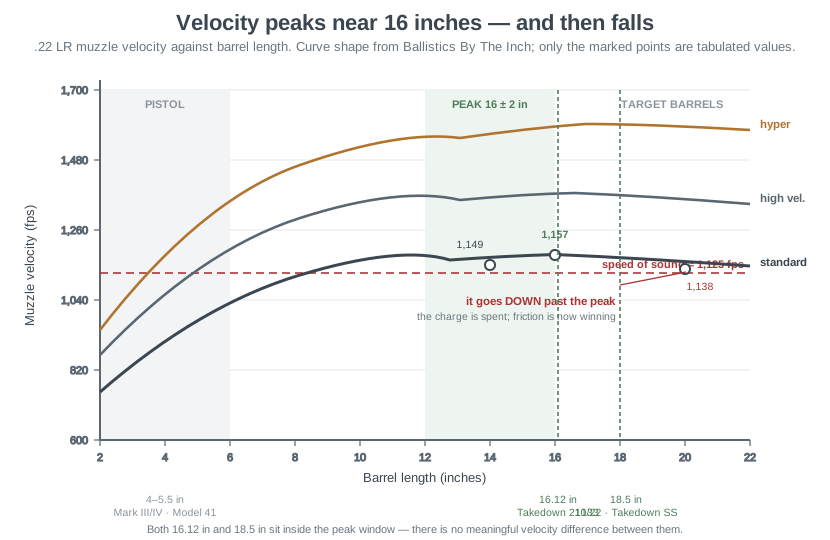
The .22 LR runs at a SAAMI maximum of 24,000 psi — respectable, and almost exactly the same ceiling as the .22 WMR — behind a very small, very fast charge.1 That combination produces the cartridge’s defining interior-ballistics behaviour, which is the single most counter-intuitive thing in this series.
4.1 The Barrel-Length Curve
Ballistics By The Inch tested .22 LR in one-inch increments from 2 in to 18 in across ten loads: CCI 27 gr CPHP, CCI 29 gr CPRN, CCI Stinger 32 gr, Remington Yellow Jacket 33 gr, Remington Viper 36 gr, Remington Golden Bullet 36 gr, CCI Mini-Mag 40 gr, Winchester Super X 40 gr, CCI Velocitor 40 gr, and Aguila Sniper SubSonic 60 gr. Velocities across the whole matrix ran from 663 fps (the Aguila subsonic from 2 in) to 1,510 fps (Stinger from 18 in).
The finding: peak velocity occurs at roughly 16 in ± 2 in, and gains past 16 in are negligible. In some loads they are negative. One worked example: a standard-velocity load measured 1,149 fps at 14 in, 1,157 fps at 16 in, and 1,138 fps at 20 in — up, then over, then down.2
4.1.1 Why
The mechanism is straightforward, even if the result is surprising. Two forces act on the bullet after ignition: gas pressure behind it, pushing forward, and friction against the bore, resisting. In a centerfire rifle with a slow powder and a large charge, gas pressure exceeds friction for the entire length of the barrel, so more barrel is always more velocity.
The .22 LR’s charge is tiny and fast, and is essentially fully burned in the first few inches of bore. From there, the gas column does nothing but expand and cool. Somewhere around the middle of a carbine barrel, the declining gas pressure drops below the friction of an outside-lubricated lead bullet dragging against the rifling — and past that point the barrel is decelerating the bullet.
This series states that as a mechanism rather than a measured number, because no source consulted pins the crossover point for a specific load; what is well established is the shape of the curve and the location of its peak.2
4.1.2 What follows from it
Three practical consequences, and they matter more than most .22 shooters realise.
- A 24-inch match barrel is not a velocity decision. It is a sight-radius, weight, harmonics and balance decision. Long target barrels are chosen for everything except muzzle velocity.
- The 16-inch class is the .22 LR’s efficiency sweet spot. A 10/22 Takedown with the 16.12 in threaded barrel is sitting essentially on the peak; a standard 18.5 in 10/22 is a hair past it. Neither is a mistake — but the shorter, handier, suppressor-ready barrel is giving up nothing measurable in velocity, which is a genuinely nice property for a packable rifle (Volume 11).
- Manufacturers’ advertised velocities generally come from longer test barrels than your gun has. Expect to measure less than the box says, and expect the shortfall to grow as the barrel gets shorter.3
4.2 What a Pistol Actually Delivers
The short end of that curve is where most people’s intuition fails hardest.
Chronographed from a 4-inch revolver, five brands of .22 LR ran 938 to 1,060 fps — Velociter HP at 1,060, Federal Auto Match at 1,036, Remington Yellow Jacket HP at 1,020.4 From a 4.6-inch pistol, a load advertised at 1,430 fps averaged 1,387 fps.3
Read that against the speed of sound — roughly 1,125 fps on a standard day, with the ammunition industry using ~1,080 fps as its practical subsonic label boundary.1 The implication is worth stating plainly:
Most ordinary .22 LR is already subsonic, or barely supersonic, out of a handgun. The “high velocity” on the box describes what the load does from a rifle.
That single fact drives several later chapters. It is why a suppressed .22 pistol is quiet on almost anything you feed it while a suppressed .22 rifle is fussy about ammunition (Volume 10). It is why hyper-velocity ammunition is largely wasted in a handgun — you are paying for velocity the barrel cannot deliver, while accepting the lighter bullet that was the price of it. And it is why a defensive .22 load like Federal’s Punch is engineered around 1,070 fps from a 2-inch barrel rather than around a rifle number (Volume 6).5
4.3 Twist and Stability
The universal .22 LR standard is 1:16 inches, six grooves — including on the 10/22, in both the 18.5 in and 16.12 in barrels.1 It is a good match for the 29–45 grain bullets that make up essentially the entire market.
It is not a match for one load. Aguila’s 22 Sniper Subsonic, a 60-grain bullet, needs 1:12 or faster by Aguila’s own recommendation, with 1:9 reported to stabilise it best. In a 1:16 barrel it frequently keyholes — one report of 50%+ keyholes from a 1:16, 24 in barrel; another of no keyholing at all out to 200 yards from a 1:16 Lilja. Those reports genuinely disagree, and this series reports the disagreement rather than resolving it.6
What does not depend on resolving it is the consequence. A yawing bullet leaving the muzzle at an angle is not merely inaccurate; through a suppressor it can strike the baffles. Confirm your twist before buying the 60-grain load, and never run keyholing ammunition through a can. That inference is this series’, from the geometry — but it is not a close call.
4.4 Chambers
Three chamber standards matter in .22 LR. Published dimensions, as length / mouth diameter / throat diameter:
Table 1 — Three chamber standards matter in .22 LR. Published dimensions, as length / mouth diameter / throat diameter
| Chamber | Length | Mouth | Throat |
|---|---|---|---|
| Sporting | 0.7751 in | 0.2307 in | 0.2270 in |
| Bentz | 0.6900 in | 0.2270 in | 0.2255 in |
| Match | 0.6876 in | 0.2267 in | 0.2248 in |
Sporting is what nearly every factory rifle has. It is generous, it will chamber anything including dirty or slightly oversize bulk ammunition, and it tolerates the fouling from a long session without complaint.
Match is the tight bolt-action target chamber. It is deliberately too tight to feed reliably in an autoloader.
Bentz is the semi-auto match chamber, and it exists precisely to split that difference — dimensionally between SAAMI Match and SAAMI Sporting, tight enough to reduce bullet jump and improve alignment, loose enough for a blowback action to feed and extract.7
Whether Bentz actually shoots better than sporting is contested in the same sources that document the dimensions: some report a meaningful gain, others report better reliability with no measurable accuracy improvement.7 What is not contested is the trade — Bentz and Match chambers are pickier about what you feed them, and match-grade ammunition stops being optional.
4.4.1 The Stinger asterisk
This is where the CCI Stinger’s odd construction bites. The Stinger’s case is 0.702 in, against the standard 0.613 in — the bullet is seated deeper so overall length still fits a .22 LR chamber, but the case itself is nearly nine hundredths longer.8 In a sporting chamber, no problem. In a Bentz or Match chamber, whose chamber length is 0.690 in and 0.6876 in respectively, the arithmetic is unforgiving, and reports of Stingers not working in match-chambered semi-autos and some factory rifles follow directly.
If your rifle has a match or Bentz chamber, this is a load to test deliberately rather than assume.
4.4.2 KIDD is not Bentz
Worth knowing if you have aftermarket 10/22 barrels, because the natural assumption is wrong: KIDD match barrels do not use the Bentz chamber that has become the default in aftermarket 10/22 barrels. KIDD uses a proprietary reamer, slightly tighter than Bentz, cut to feed smoothly. The barrels are 1:16 twist, available with 1/2×28 muzzle threads, and carry a manufacturer guarantee of half-inch groups at 50 yards; they also use a distinctive convex extractor slot to keep the extractor aligned with the case rim.9
The practical consequence is the same as for Bentz, only more so. A chamber tighter than Bentz is a chamber with less tolerance for the Stinger’s long case, for oversize bulk ammunition, and for fouling accumulated over a long session. A KIDD-barrelled 10/22 is a match-ammunition gun that will still digest ordinary ammunition — not a bulk gun that happens to shoot well.
4.5 Ignition, Barrel Time and the Fouling Shot
Two small effects worth knowing.
Ignition timing is set by the rim. The rim is the headspace datum and the thing the firing pin crushes, so rim-thickness variation is firing-pin-indent variation, which is ignition-timing variation, which is velocity variation. This is the physical reason rim thickness is a quality metric at all (Volume 3), and it has no analogue in centerfire, where the primer is a separately manufactured, separately inspected component.
Rimfire barrels need seasoning. Because the .22 LR bullet is outside-lubricated, the bore carries a wax film that is part of the system rather than contamination. A freshly and thoroughly cleaned rimfire barrel commonly needs a handful of fouling shots before it returns to its best grouping. Practically: do not clean a rimfire barrel to bare steel the night before a match, and do not judge a new lot on the first five rounds through a scrubbed bore.
4.6 Bibliography
Footnotes
-
.22 LR SAAMI maximum 24,000 psi; standard twist 1:16 in, six grooves; subsonic threshold used at ~1,080 ft/s. https://en.wikipedia.org/wiki/.22_Long_Rifle (confidence: high). .22 WMR maximum also 24,000 psi: https://en.wikipedia.org/wiki/.22_Winchester_Magnum_Rimfire (confidence: high). ↩ ↩2 ↩3
-
Ballistics By The Inch .22 LR matrix, 2–18 in in one-inch steps, ten loads listed; overall range 663–1,510 fps; peak at ~16 in ± 2 in with negligible gains beyond; worked standard-velocity example 1,149 fps at 14 in, 1,157 fps at 16 in, 1,138 fps at 20 in. https://www.firearmwiki.com/wiki/.22_LR_Velocity_By_Barrel_Length (reporting BBTI); https://en.wikipedia.org/wiki/Ballistics_by_the_Inch (confidence: high on the curve shape and peak; medium on any single tabulated value, which is load- and barrel-specific). The gas-pressure-versus-friction crossover is standard interior-ballistics reasoning, stated here as mechanism; no source consulted quantifies the crossover point for a named load. ↩ ↩2
-
Taurus TX22, 4.6 in barrel: hyper-velocity load advertised 1,430 fps averaged 1,387 fps; advertised velocities generally derived from longer test barrels than pistols have. https://www.targetbarn.com/broad-side/high-velocity-22lr-ammo/ (confidence: medium — single test session, but consistent with the BBTI short-barrel data). ↩ ↩2
-
Five .22 LR loads chronographed from a 4 in revolver: 938–1,060 fps; Velociter HP 1,060, Federal Auto Match 1,036, Remington Yellow Jacket HP 1,020. https://www.shootersforum.com/threads/22lr-velocities-4-barrel.54522/ (confidence: medium — single enthusiast chronograph session; consistent with BBTI). ↩
-
Federal Punch .22 LR, 1,070 fps from a 2 in barrel. https://gunmagwarehouse.com/blog/federal-punch-22lr-the-best-22-defense-load/ (confidence: high). ↩
-
Aguila 22 Sniper Subsonic, 60 gr: manufacturer recommends 1:12 or faster; 1:9 reported to stabilise best; conflicting field reports from 1:16 barrels (50%+ keyholes from a 24 in factory barrel vs no keyholing to 200 yd from a 1:16 Lilja). https://www.aguilaammo.com/products/22-sniper-subsonic-long-rifle-subsonic-lead-solid-point ; https://www.snipershide.com/shooting/threads/correct-twist-rate-for-the-aguila-60-grain-sss-round.6965386/ ; https://www.badgerandblade.com/forum/threads/evaluation-of-aguila-sss-60-gr-in-1-16-twist-match-barrel.522777/ (confidence: high on the manufacturer’s recommendation; medium on the field reports, which disagree. The baffle-strike consequence is this series’ inference from the geometry). ↩
-
Sporting / Bentz / Match chamber dimensions and the design rationale for Bentz as the semi-auto match chamber; contested accuracy benefit. https://www.rimfirecentral.com/forums/showthread.php?t=138533 ; https://www.rimfirecentral.com/threads/bentz-chamber.1166881/ (confidence: medium — consistent across multiple enthusiast sources and matching the known design intent, but not from a SAAMI print. The accuracy question is contested in the same sources and is not adjudicated here). ↩ ↩2
-
CCI Stinger case length 0.702 in vs. the standard 0.613 in, bullet seated deeper to preserve overall length; reported not to work in some match-chambered semi-autos and factory rifles. https://www.thefirearmblog.com/blog/the-rimfire-report-hot-n-light-cci-stinger-32gr-cphp-44819782 ; https://bulkmunitions.com/blog/cci-stinger-review/ (confidence: medium-high — two independent sources agree on both figures; not a SAAMI print). ↩
-
KIDD match barrels use a proprietary reamer slightly tighter than Bentz rather than the Bentz chamber itself; 1:16 twist, 1/2×28 threading available, convex extractor slot, and a stated guarantee of 1/2 in groups at 50 yards. https://www.rimfirecentral.com/threads/kidd-chamber.724297/ ; https://store.theshootingcentre.com/kidd-match-barrel-for-10-22-22-lr-18-1-2x28-threads-bead-blasted-stainless/ ; https://www.coolguyguns.com/productqa.asp?action=listallqa&catalogid=150 (confidence: medium-high — consistent across a KIDD-dealer Q&A and enthusiast sources; KIDD does not publish chamber dimensions, so no figures are given here. The inference about tolerance for long-cased and oversize ammunition follows from “tighter than Bentz” plus the Bentz dimensions above). ↩
Comments (0)