The .22 Rimfire · Volume 2
The Family — Every .22 Rimfire, and What Fits in What
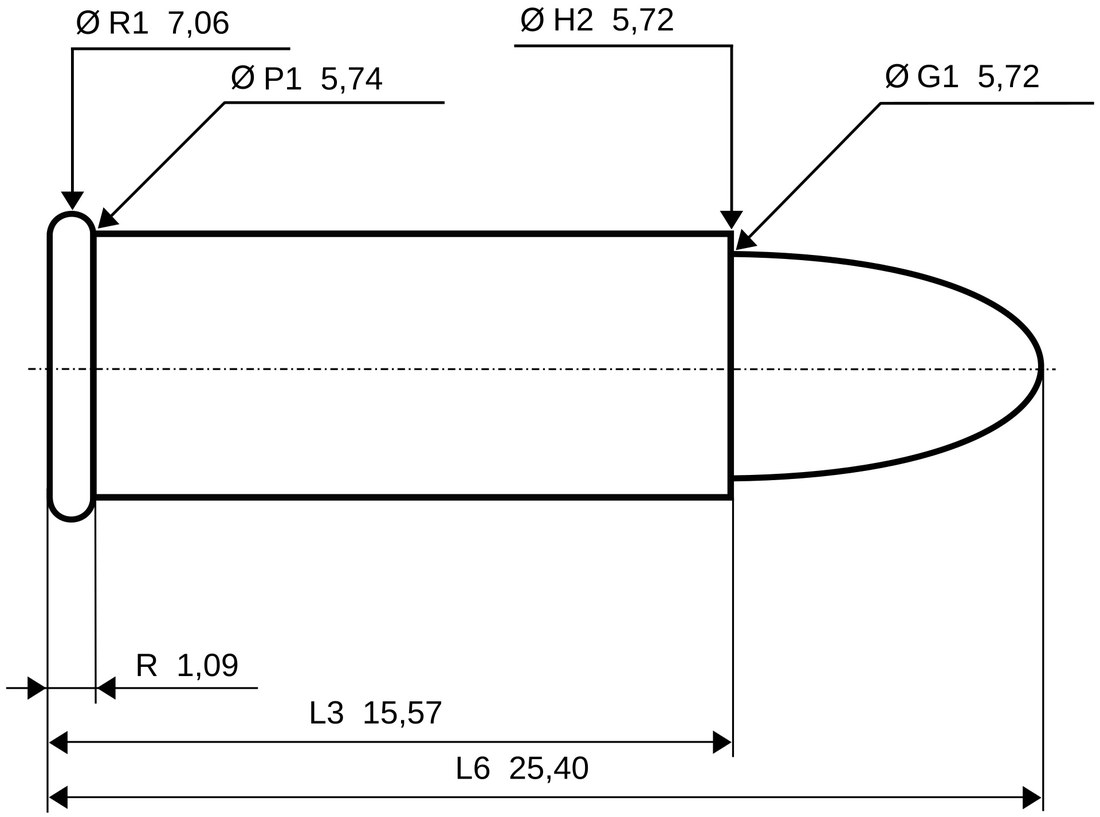
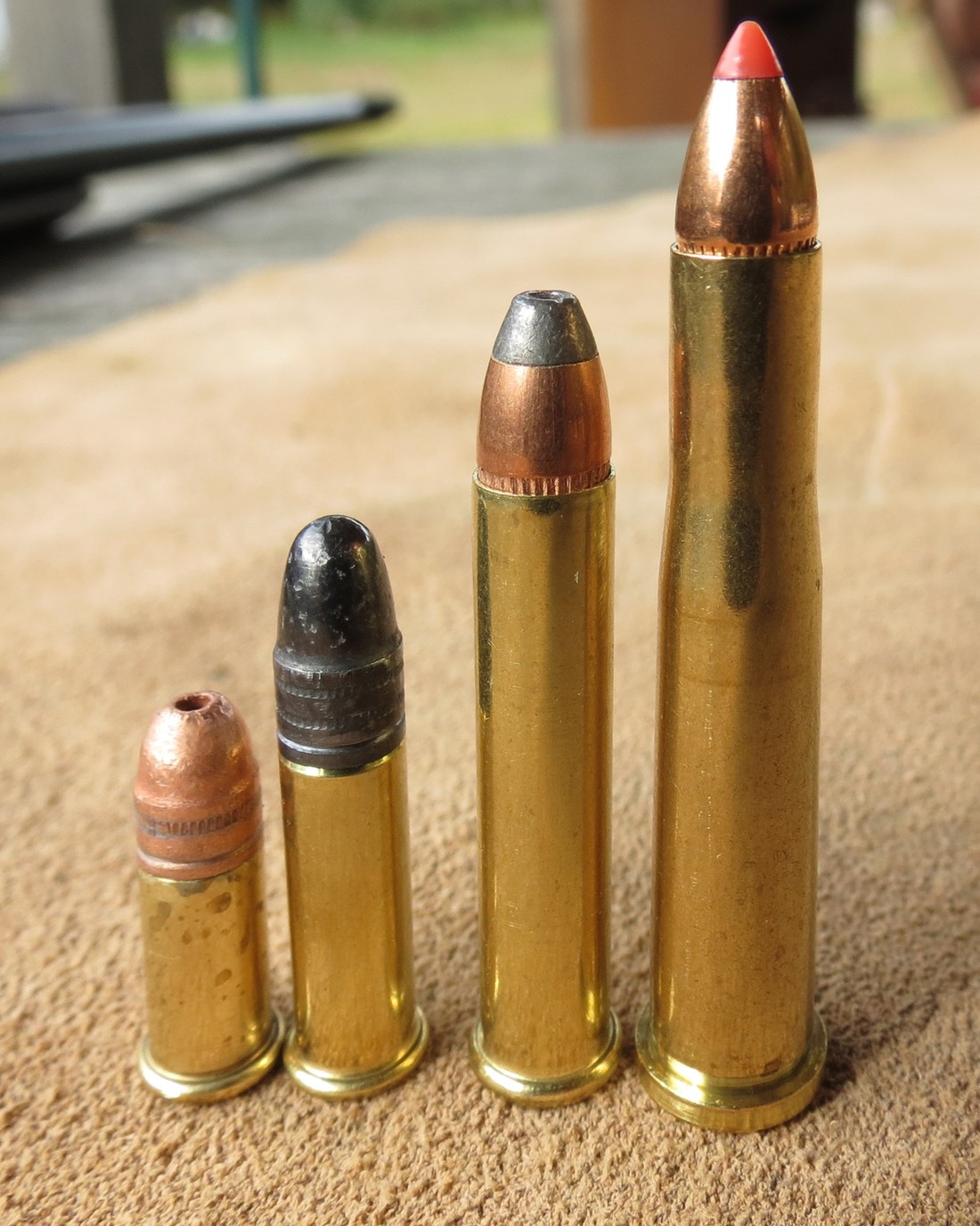
The word “twenty-two” covers at least nine distinct rimfire cartridges, three of which are not .22 caliber at all. Some of them interchange safely, some interchange unsafely, and one of them will chamber, fire, and leave the bullet sitting in your barrel. This volume is the map, and it exists mostly so the interchange rules at the end have somewhere to stand.
2.1 The Lineage
The rimfire family is the oldest continuously produced self-contained cartridge line in the world, and every member of it descends from one 1845 invention.
.22 BB Cap (1845). Louis-Nicolas Flobert’s “bulleted breech cap” — the first rimfire metallic cartridge ever made. A percussion cap with an 18-grain round ball pressed into the mouth and no separate powder charge at all; the priming compound alone drives it, at roughly 780 fps. Case length 0.284 in. It was designed for indoor parlour and gallery shooting, which tells you what 1845 thought a firearm was for.1
.22 CB Cap (1888). The BB Cap with a conical bullet instead of a ball — same 0.284 in case, same 18-grain projectile class, roughly 953 fps. American manufacturers dropped it in the 1940s. What is sold as “CB” today is a modern reconstruction: the same tiny charge loaded into a full-length Short or Long Rifle case so it will feed from a magazine and headspace in a modern chamber.1
.22 Short (1857). The cartridge for Smith & Wesson’s Model 1, and thus the round that opened the American metallic-cartridge era. 0.423 in case, 29-grain bullet, roughly 900 fps. It survived into the modern era as the Olympic rapid-fire pistol cartridge and as a gallery and pest round.2
.22 Long (1871). The Short’s case stretched to 0.613 in to hold 5 grains of black powder — 25% more than the Short — behind the same 29-grain bullet, for about 1,060 fps. It is the direct ancestor of everything that follows, because that 0.613 in case is still the .22 LR case today.2
.22 Extra Long (1880). A longer case with a 40-grain bullet. It was made obsolete almost immediately by the next entry, and is dead.3
.22 Long Rifle (1887). The J. Stevens Arms & Tool Company put the .22 Extra Long’s 40-grain bullet into the .22 Long’s 0.613 in case. That is the entire invention: an existing case, an existing bullet, combined. It killed the Extra Long, outlived every competitor, and 139 years later it is the best-selling cartridge on earth.3
.22 Winchester Rim Fire / WRF (1890). Winchester’s attempt to beat the .22 LR by going bigger: 0.2285 in bullet, 0.965 in case, 1.180 in overall, 19,000 psi, a 45-grain flat-nose at up to 1,450 fps. Critically, it abandoned the heeled bullet for a flat-based, inside-lubricated design — the modern arrangement. It is nearly extinct but not quite; CCI still loads a 45-grain JHP at 1,300 fps for the surviving Model 1890s.4
.22 Winchester Magnum Rimfire / WMR (1959). The one that stuck. 0.224 in jacketed bullet, 1.055 in case, 1.350 in overall, 24,000 psi, 1:16 twist. Published loads run 30 gr at 2,300 fps / 352 ft·lbf, 40 gr at 1,875 fps / 312 ft·lbf, 50 gr at 1,530 fps / 260 ft·lbf.5 Volume 6 covers what that extra energy buys.
.17 HMR (2002) and .17 HM2 (2004). Both are Hornady’s. The HMR is a .22 WMR case necked to .17; the HM2 is a .22 LR Stinger case necked to .17, firing a 17-grain V-MAX at 2,100 fps with roughly a 175-yard effective range. The HMR became a genuine commercial success. The HM2 did not — it had to compete with .22 LR on price and never could.6
2.2 The .22 LR in SAAMI Terms
Table 1 — 2.2 The .22 LR in SAAMI Terms
| Dimension | Figure |
|---|---|
| Case length | 0.613 in (15.6 mm) |
| Overall length | 1.000 in (25.4 mm) |
| Bullet diameter | 0.223–0.2255 in (5.7–5.73 mm) |
| Neck diameter | 0.226 in |
| Rim diameter | 0.278 in |
| Rim thickness | 0.043 in |
| Land diameter | 0.212 in |
| Max pressure | 24,000 psi (SAAMI) / 170.00 MPa ≈ 24,656 psi (C.I.P.) |
| Standard twist | 1:16 in, six grooves |
All figures SAAMI/C.I.P. as published.7
Two of those numbers are load-bearing for the rest of the series. Rim thickness, 0.043 in, is the cartridge’s headspace datum — the rim is what stops the round in the chamber, and variation in rim thickness is variation in firing-pin strike and ignition timing. That is why match-ammunition buyers talk about rim thickness at all (Volume 3). And bullet diameter equal to neck diameter is the signature of the heeled bullet: the bullet is the same outside diameter as the case, with a narrower heel seated inside it.7 The consequence is that the bearing surface rides outside the case where it must carry its own lubricant — which is why .22 LR bullets are waxy to the touch, why .22 LR fouls a suppressor so badly (Volume 10), and why the cartridge cannot be made with a conventional jacketed bullet without redesigning it into something else, which is exactly what the WRF and the WMR did.
2.3 The Interchange Rules
This is the part worth laminating.
2.3.1 Safe
.22 Short, .22 Long, .22 Long Rifle and modern CB loads all fire in a .22 LR chamber. They headspace on the same 0.278 in rim. Two caveats, neither of them a safety issue:
- Semi-autos will not cycle on them. A Short or a CB does not generate the bolt momentum a blowback action needs. Expect single-shot operation.
- The carbon ring is real, and it is a nuisance rather than a hazard. Firing shorter cases in a longer chamber deposits fouling at the short case mouth, forward of where a .22 LR case ends. Enough of it and full-length rounds start chambering tight. The historical warning about chamber erosion dates to black-powder priming and is obsolete; CCI’s own position is that you cannot shoot enough Shorts to damage a modern LR chamber. Clean the chamber when you switch back and the problem does not exist.8
.22 WRF fires safely in a .22 WMR chamber. This is the one genuinely useful substitution in the family, and it is how the surviving WRF rifles’ owners keep shooting. Expect feeding problems from a magazine cut for the longer WMR cartridge.4
2.3.2 Not safe
Never fire .22 LR in a .22 WMR chamber. The WMR chamber is dimensioned for a larger-diameter case, so it does not support an LR case at all. The documented failure modes are swollen or split cases, high-pressure gas escaping rearward out of the chamber, and the bullet entering the throat out of alignment.5 Rimfire cases are thin, unsupported brass; there is nothing forgiving about this one.
Never fire .22 LR in a .22 WRF chamber. Same mechanism. The LR case fits loosely, may or may not fire, will likely rupture if it does, and may not extract.9
Never fire .22 WMR in a .22 LR chamber. It will not chamber, and the effort required to try is the hazard.
2.3.3 The one that is safe in a pistol and not in a rifle
Aguila Colibri and Super Colibri. Roughly 20 grains at 500–590 fps, driven by priming compound alone with no powder charge. In a short barrel they work as intended. In a rifle-length barrel there are repeated, consistent reports of the bullet failing to exit — one account puts it about two and a half inches from the muzzle. Reports disagree about whether “Super” Colibri is any safer in a rifle, and some users report boxes being mismarked between the two.10
The rule this series gives is the conservative one, because the downside is a bore obstruction followed by a live round: no primer-only ammunition in a rifle, and never through a suppressor. A bullet that stalls in the bore is bad; a bullet that stalls in a baffle stack is a destroyed suppressor and possibly a destroyed barrel. If you want quiet, Volume 10 has loads that are quiet and leave the barrel.
2.4 What Is Actually Worth Owning
Of the nine cartridges above, three are live decisions in 2026.
.22 LR is the default and the subject of most of this series. .22 WMR is the answer when you need a hundred yards and a jacketed bullet — a different gun, roughly triple the ammunition cost, and 2.5× the muzzle energy (Volume 6). .17 HMR is the flat-shooting varmint answer, and it is where Hornady lives.
The rest are either historical, or niche tools: .22 Short for gallery guns and a handful of Olympic-legacy pistols, CB and Quiet-class loads for backyard pest work where the suppressor is the neighbours’ goodwill (Volume 9), and .22 WRF only if you own an 1890.
2.5 Bibliography
Footnotes
-
.22 BB Cap: Flobert, 1845, first rimfire metallic cartridge; 0.284 in case, 18 gr, ~780 fps, primer impulse only. .22 CB Cap: 1888, 0.284 in case, 18 gr, ~953 fps; dropped by US makers in the 1940s; modern CB loads use full-length Short/LR cases for magazine feeding. https://en.wikipedia.org/wiki/.22_BB ; https://en.wikipedia.org/wiki/.22_CB (confidence: high). ↩ ↩2
-
.22 Short: 0.423 in case, 29 gr, ~900 fps. .22 Long: 1871, 0.613 in case, 29 gr, ~1,060 fps, 5 gr black powder — 25% more than the Short. https://en.wikipedia.org/wiki/.22_long (confidence: high). ↩ ↩2
-
.22 LR introduced 1887 by the J. Stevens Arms & Tool Company, combining the .22 Long case of 1871 with a 40 gr bullet, rendering the .22 Extra Long obsolete. https://en.wikipedia.org/wiki/.22_Long_Rifle (confidence: high). ↩ ↩2
-
.22 WRF: 1890, Winchester M1890; bullet .2285 in, case .965 in, OAL 1.180 in, rim .300 in, 19,000 psi; 45 gr solid at 1,450 fps, 40 gr HP at 1,440 fps, 45 gr standard at 1,050 fps; flat-based inside-lubricated bullet rather than a heeled bullet; fires in any rifle chambered for .22 WMR, with possible magazine-feeding issues. https://en.wikipedia.org/wiki/.22_Winchester_Rimfire (confidence: high). Modern CCI load, 45 gr JHP at 1,300 fps / 169 ft·lbf: https://www.cci-ammunition.com/rimfire/cci/winchester-rimfire/6-69.html (confidence: high). ↩ ↩2
-
.22 WMR: 1959, Winchester; bullet .224 in, case 1.055 in, OAL 1.350 in, rim .300 in, 24,000 psi, 1:16 twist; 30 gr / 2,300 fps / 352 ft·lbf, 40 gr / 1,875 fps / 312 ft·lbf, 50 gr / 1,530 fps / 260 ft·lbf. Firing .22 LR in a .22 WMR chamber causes swollen or split cases, rearward high-pressure gas leakage, and misaligned bullet entry into the throat. https://en.wikipedia.org/wiki/.22_Winchester_Magnum_Rimfire (confidence: high). ↩ ↩2
-
.17 HMR: 2002, Hornady, .22 WMR case necked to .17. .17 HM2: 2004, Hornady, .22 LR Stinger case necked to .17, 17 gr V-MAX at 2,100 fps, ~175 yd effective range, commercially unsuccessful against .22 LR. https://en.wikipedia.org/wiki/.17_HM2 ; https://en.wikipedia.org/wiki/.17_HMR ; https://www.americanhunter.org/content/behind-the-bullet-17-mach-2/ (confidence: high). ↩
-
.22 LR SAAMI/C.I.P. dimensions, pressure, twist, and the heeled-bullet description. https://en.wikipedia.org/wiki/.22_Long_Rifle (confidence: high). ↩ ↩2
-
Carbon-ring formation from firing Shorts in an LR chamber, and the obsolescence of the black-powder-era erosion warning; CCI’s position that Shorts cannot be fired in sufficient quantity to damage a modern LR chamber. https://www.rimfirecentral.com/threads/is-shooting-22-shorts-bad-for-modern-22-rifles.1295943/ ; https://www.rimfirecentral.com/threads/22-short-in-long-rifle-chamber-damage.37379/ (confidence: medium on the CCI attribution, which is reported second-hand; high on the carbon-ring mechanism, which is consistently reported and physically straightforward). ↩
-
.22 LR in a .22 WRF chamber: fits loosely, may not fire, likely to rupture, may not extract. https://www.quora.com/Can-22-WRF-be-safely-fired-for-a-rifle-designated-for-22-LR ; https://www.thetruthaboutguns.com/ask-foghorn-can-you-fire-22lr-ammunition-through-a-22-wmr-chamber/ (confidence: medium on the source quality; high on the conclusion, which follows from the published case dimensions in notes 4 and 7). ↩
-
Aguila Colibri / Super Colibri: primer-only, ~20 gr, ~500–590 fps; repeated reports of bullets lodging in rifle barrels, one about 2.5 in from the muzzle; conflicting reports on Super Colibri and on box marking. https://www.rimfirecentral.com/threads/warning-avoid-aguila-super-colibri-in-long-barrels.569313/ ; https://www.marlinowners.com/threads/aquila-22lr-colibri-safe-for-a-rifle.160384/ (confidence: medium on individual reports; high that the hazard is real and repeatedly documented. The “never through a suppressor” rule is this series’ inference from the geometry, not a manufacturer statement). ↩
Comments (0)