The .22 Rimfire · Volume 11
The Suppressed Takedown as a Backpacking Rifle
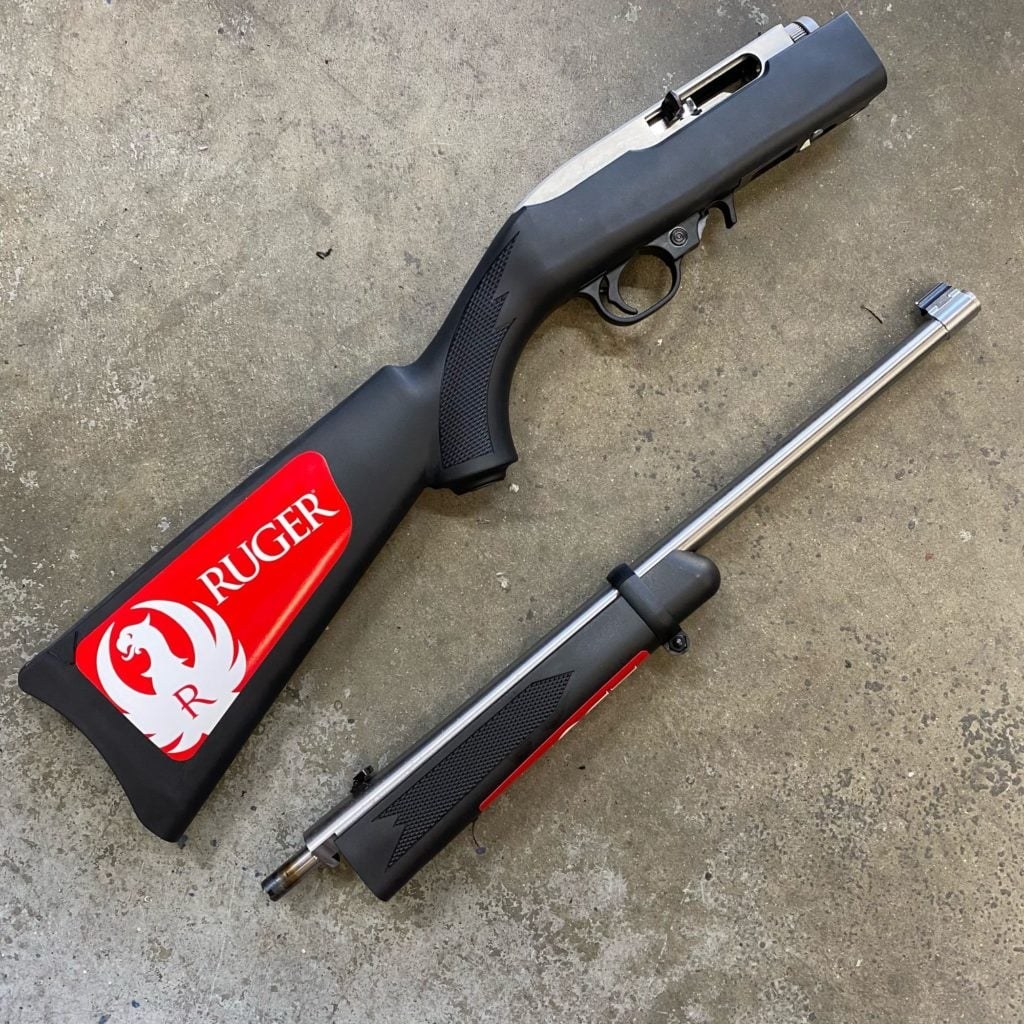
A suppressed .22 takedown carried into the backcountry is a genuinely different design problem from a bench gun, and almost none of the usual .22 advice is written for it. The constraints are weight, packed volume, a zero that survives being taken apart and put back together, ammunition that works in the cold and damp, and a suppressor that has to keep working a long way from a cleaning kit.
This volume works through one example rig — an 18.5-inch stainless Ruger 10/22 Takedown wearing a Mack Brothers Lima, a Magpul Hunter X-22 stock, a Nikon P-Rimfire 2-7×32 (BDC150) in TPS low rings, a Harris HBRMS 6–9 in bipod, and a KIDD drivetrain (single-stage trigger, bolt/firing pin/extractor, bolt buffer, bolt handle) with a Volquartsen automatic bolt release.
11.1 Why the Takedown Is the Right Platform
The 10/22 Takedown splits into a barrel/forend half and a receiver/stock half, which turns a 37-inch rifle into two roughly 20-inch pieces that lie flat against a pack frame or disappear into a pack.1 The suppressor stays threaded to the barrel half, so the can does not become a separate item to lose — it just makes the barrel half a few inches longer.
Ruger’s own suppressor-oriented takedown, the model 21133, uses a 16.12 in fluted .920 bull barrel with 1/2×28 threads and weighs 5.3 lb at 34.62 in overall.2 The stainless 18.5 in takedown is the lighter, slimmer alternative, and both threaded and unthreaded 18.5 in stainless configurations exist.1
Here is the pleasant surprise from Volume 4: the 18.5-inch barrel is giving up essentially nothing in velocity to the 16.12. Peak velocity for .22 LR lands around 16 in ± 2 in, and both barrels are inside that window.3 There is no ballistic penalty to either choice — it is purely a packed-length and balance decision.
11.2 The Zero Problem
This is the one thing that can make a takedown rifle useless, and it has a documented solution.
The takedown joint uses an adjustable locking ring that sets both headspace and barrel-to-receiver tension. The published procedure:
- Back the adjusting knob off.
- Join the two halves.
- Run the knob and spacer forward against the barrel’s shoulder.
- Separate the halves.
- Advance the knob two or three additional clicks, so the spacer sits slightly further forward.
- Reassemble. You should feel slight resistance and find no discernible play.
Once you have found the setting, leave it alone — it does not need re-finding on every assembly.4
Reviewers report that with the ring correctly adjusted and appropriate ammunition selected, point-of-impact shift on reassembly is controlled.4 No source consulted quantifies it, and this series is not going to invent an MOA figure. What it will tell you is how to find yours:
Set the ring per the procedure. Zero the rifle. Then take it apart and put it back together five times, shooting a three-shot group after each reassembly, all onto the same target with the groups marked. The spread of those five group centres is your reassembly shift. It is a forty-five-round test and it is the single most valuable thing you can do with this rifle before you carry it anywhere.
Do the same test again after adding or removing the suppressor, because the can changes barrel harmonics and shifts point of impact on its own (Volume 10 §10.6). Since this can moves between hosts and does not live on any one of them, the answer is not “never take it off” — it is to measure the can-on/can-off offset once, in clicks, and write it down. That is §11.3, step 4.
11.3 Making the BDC150 Actually Work — Suppressed and Unsuppressed
This is the interesting problem in this rig, and it has a better solution than “build a card and live with it.”
11.3.1 Separate the two variables first
Two different things are being blamed on each other here, and untangling them makes the whole problem tractable:
- The suppressor changes your zero. Hanging weight on the muzzle changes barrel harmonics and shifts point of impact. It does not change the shape of the trajectory. It is a constant offset.
- The ammunition changes the trajectory. A subsonic load drops differently from a high-velocity load, which is what makes the BDC circles land on the wrong ranges. This is a scale problem, not an offset.
Fix them separately. An offset is a turret setting you write down. A scale error is what the rest of this section is about.
11.3.2 The calibration mismatch
The BDC150 is calibrated for a 50-yard zero with a .22 LR at roughly 1,600 fps — hyper-velocity — with circles at 75, 100, 125 and 150 yards.5 Neither of your loads is close to that. Subsonic through the can runs about 1,070 fps; ordinary high-velocity ammunition unsuppressed runs about 1,255 fps. Both drop more than the reticle assumes, so at the reticle’s design magnification every circle corresponds to a shorter range than the number printed next to it.
Nikon’s Spot On tool — which the BDC reticle guide directs you to for exactly this situation — is gone. Nikon exited the riflescope business in December 2019 and the software was discontinued with it.5 So this has to be solved on paper and at the range.
11.3.3 The lever: it is a second-focal-plane scope
The P-Rimfire 2-7×32 is second focal plane.6 In an SFP scope the reticle’s apparent size stays fixed while the image magnification changes, so the angle each reticle mark covers on the target changes inversely with magnification. Turn the power down and every BDC circle subtends more MOA — that is, more holdover.
BDC reticles are calibrated at one magnification, normally maximum power, and are wrong at every other setting.6 That is usually described as a limitation. Here it is the fix: your loads need more drop compensation than the reticle was built for, and dialling the magnification down is precisely how you get more drop compensation out of the same circles.
11.3.4 Working out roughly where to look
Take the drops from the tables in Volume 5, all from a 50-yard zero: about 7.5 in at 100 yards for a 1,070 fps load, about 5.5 in for a 1,235 fps load, and less than either for the ~1,600 fps load the reticle assumes.
If the reticle’s circles are correct at 7×, then to make a circle cover roughly n times as much drop you want roughly 7 ÷ n magnification. Working that through gives a starting point in the neighbourhood of:
Table 1 — If the reticle's circles are correct at 7×, then to make a circle cover roughly n times as much drop you want roughly 7 ÷ n magnification. Working that through gives a starting point in the neighbourhood of
| Configuration | Load | Try around |
|---|---|---|
| Suppressed | subsonic ~1,070 fps | ≈3× |
| Unsuppressed | high velocity ~1,255 fps | ≈4× |
Those are estimates, not answers. They are computed from published trajectory tables rather than measured, and the arithmetic assumes the reticle is exactly right at exactly 7× for exactly 1,600 fps — none of which is guaranteed. What matters is that both numbers land inside a 2–7× range, which means this rifle can genuinely be made to shoot its own reticle correctly in both configurations. That is a much better outcome than a taped-on card.
11.3.5 The procedure
- Pick the magnification empirically. Zero at 50 yards. Set up steel or paper at 100 yards. Aim with the first BDC circle and shoot a group at 7×, then at 5×, 4×, 3× and 2×. One of those will put the group on. Refine between the two nearest settings.
- Confirm on a second circle. Move to 150 yards and check the third circle at the magnification you just found. If both circles agree, the whole reticle is calibrated for that load. If they disagree, split the difference and accept that the far circle is approximate — which it is anyway, because .22 LR drop accelerates.
- Mark the magnification ring. A paint pen witness mark, or a strip of tape, for each of your two settings. A power ring is not detented and “about 3” is not a repeatable setting.
- Record the can-on / can-off zero offset in clicks. The scope has ½ MOA adjustments.7 Shoot a group at 50 yards with the can on, then with it off, and count the clicks between the two group centres. Write it on the same tape as the magnification marks.
- Then it is a two-line card: can on — subsonic — 3× — zero as dialled. Can off — high velocity — 4× — up N clicks.
11.3.6 The shortcut worth considering
All of that gets simpler if you use one load in both configurations. If you shoot the same subsonic ammunition whether or not the can is fitted, the trajectory never changes — so there is one magnification setting and one set of circle values, and the only thing that changes when the can comes off is the zero offset in step 4.
You give up a little velocity when shooting unsuppressed, which for small game inside 75 yards costs you essentially nothing. In exchange you delete an entire axis from the problem. For a rifle whose configuration changes trip to trip, that is a good trade.
Do all of this separately for the blued DSP — it is a different barrel, a different mount and a different rifle, and there is no reason to expect the same numbers.
11.3.7 And on the other hosts
The Lima also fits the Mark III, the Mark IV and the Precision Rimfire — all 1/2×28. Two consequences:
- The pistols are the easy case. A 5-inch-class barrel cannot reach supersonic velocity with ordinary ammunition anyway (Volume 4 §4.2), so the Mark III and Mark IV are quiet on almost anything. The trade is more first-round pop, which is worse on short barrels because less powder has burned before the gas reaches the can (Volume 10 §10.5).
- The Precision Rimfire is the one worth zeroing carefully both ways, because it is the rifle in the battery most capable of showing the difference — and its Vortex Crossfire has no ammunition-specific reticle calibration to work around, so it only needs the zero offset, not the magnification exercise.
- One can across four or five hosts means the can accumulates rounds fast. Track its round count centrally rather than per gun, against the 300–500 round cleaning interval in §11.5.
11.4 Ammunition, Weight, and the Field Kit
11.4.1 What to carry
For a backcountry rifle whose jobs are small game and camp chores, the load-out is not one ammunition, it is two:
- Primary: CCI Standard Velocity, 40 gr at 1,070 fps. Subsonic, quiet through the can, cycles a 10/22 as delivered, cheap enough to practise with, and adequate on small game at the ranges you will actually shoot.
- Hunting: CCI Mini-Mag 36 gr CPHP for body shots on anything larger than a squirrel — accepting that it is supersonic and gives up most of the suppressor’s benefit. Or, to keep the quiet: CCI Suppressor 45 gr HP or Federal Hunter Match 40 gr subsonic HP, which are subsonic hollow points built for exactly this compromise.
- Consider CCI Clean-22 Sub-Sonic or Clean-22 Suppressor as the primary instead. The polymer coating is claimed to cut suppressor lead fouling by up to 60% (Volume 10 §10.4), which matters more on a trip than at home, and it matters more still for an out-of-production can. 🔴 But read the claim precisely: the coating changes what the fouling is made of, not how much fouling there is. Powder and priming residue still go into the can on every shot; what drops is the lead fraction — which is the part that cements a baffle stack. The can becomes easier to clean, not cleaner for longer, and the 300–500 round interval in §11.5 does not move.
11.4.2 What it weighs
A loaded .22 LR round runs roughly 3.5–3.8 grams — a 40-grain bullet is 2.59 g, plus a case, priming and a small charge. So:
Table 2 — A loaded .22 LR round runs roughly 3.5–3.8 grams — a 40-grain bullet is 2.59 g, plus a case, priming and a small charge. So
| Rounds | Approximate weight |
|---|---|
| 50 | ~6.5 oz (185 g) |
| 100 | ~13 oz (370 g) |
| 200 | ~1.6 lb (740 g) |
Those are computed estimates from the bullet weight plus a typical case, not a manufacturer figure — weigh a box on a reloading scale if the number matters to your pack list. The useful conclusion holds regardless: ammunition is not free weight on a long trip. A hundred rounds is most of a pound, and for a rifle you will realistically shoot a couple dozen times, fifty rounds plus a spare magazine is a more honest load-out than the brick instinct suggests.
11.4.3 Cold and damp
Two field considerations that do not come up at the range.
Cold slows propellant burn, which is why RWS builds a separate biathlon load — the R100 — loaded faster than its standard R50 specifically so that its cold velocity lands where the R50’s warm velocity does.8 You are not going to buy biathlon ammunition for a backpacking trip, but the mechanism is worth knowing: your zero and your subsonic margin both drift in the cold, and a load that chronographs at 1,070 fps in July has less bolt energy in November. If a rifle is marginal on cycling, it will be marginal sooner when it is cold.
Keep ammunition dry. Rimfire priming sits in a thin brass fold and the cartridges are wax-lubricated; a box that has been damp and dried is a box with an unknown misfire rate. A small screw-top container or a zip bag inside the pack costs nothing.
11.4.4 Heat — and why the truck case is a different problem
Everything above is written for a rifle in a pack for a few days. A rifle that lives in a vehicle is a different storage problem, and the difference is not degree — it is duration. A pack sees a week of whatever the weather is doing. A truck sees months of the same thermal cycle, every day, in a box nobody is looking at.
SAAMI’s line is sustained exposure above 150 °F, and the mechanism is propellant rather than lubricant: nitrocellulose degrades cumulatively and irreversibly, and nothing on the outside of the bullet touches it (Volume 9 §9.5). A measured parked vehicle gains roughly 40 °F over ambient in an hour — but that is a glazed cabin figure, driven by glass trapping re-radiated infrared, and it does not transfer to an unglazed enclosure such as a bed box or a truck-bed drawer.
⭐ Which produces a conclusion worth carrying: for ammunition in a vehicle, the location decision dominates the product decision. Polymer-coated ammunition in the cab is a worse plan than bulk paraffin-lubed ammunition in an unglazed bed box.
The vehicle case is worked out in full — container, desiccant, Michigan vehicle-transport law and the load-out — in the Overlanding project’s The Truck Rifle dive. It is deliberately not repeated here, because the backpacking constraints and the truck constraints genuinely do not overlap.
11.5 Suppressor Care in the Field
The .22 LR is the dirtiest suppressor host there is (Volume 10 §10.4), and the commonly cited cleaning interval is 300–500 rounds.9 On a backpacking rifle you will rarely approach that on a single trip — which is the good news — but two things still apply:
- Do not store it dirty between trips. The failure mode is fouling cementing the baffle stack, and it happens during storage, not during shooting.
- For an out-of-production can, buy the spares now. End caps, mounts, O-rings and the disassembly tool are the parts that get lost or cross-threaded, and they are what stand between a serviceable suppressor and a registered paperweight (Volume 10 §10.8).
Also worth confirming before a trip: that the can is still tight. A thread-mounted rimfire suppressor can loosen under cycling, and a partially unthreaded can is a baffle strike waiting to happen.
11.6 The Range Discipline Nobody Mentions
A .22 LR will travel up to about 2,000 yards.10 In the backcountry that is a mile and a bit of terrain you cannot see, often across a drainage, and the suppressor means nobody over there will hear the shot that goes past them.
The suppressed .22 is the least alarming-sounding firearm most people will ever carry, and it is worth deliberately not letting that quiet erode the habit of identifying a backstop. Upward shots at squirrels in trees are the specific case (Volume 6 §6.2): a miss on a steep upward angle has nothing behind it at all.
11.7 The Pre-Trip Checklist
- Locking ring set per §11.2 and left alone.
- Reassembly-shift test shot, and the result written down.
- Zeroed with the can on, at 50 yards, with the exact load you are carrying.
- BDC magnification setting found and witness-marked on the power ring for the load you are carrying, and the can-on/can-off offset recorded in clicks (§11.3).
- Can clean, threads clean, can tight, thread protector packed for the barrel half.
- Ammunition in a sealed container; count decided honestly (§11.4).
- Spare magazine. The rotary magazine is reliable but it is the one part whose loss ends the trip.
- Michigan digest checked if the trip is a hunting trip, and the season and 10–14 November restriction confirmed (Volume 6 §6.6).
11.8 Bibliography
Footnotes
-
Ruger 10/22 Takedown, stainless, 18.5 in barrel, 4.6 lb, 37 in overall, 1:16 RH twist, six grooves, 10-round rotary magazine; the standard 11100 barrel is not factory-threaded, while threaded 18.5 in stainless takedown configurations are also offered. https://ruger.com/products/1022Takedown/specSheets/11100.html ; https://blackstoneshooting.com/ruger-10-22-takedown-22-lr-18-50-threaded-barrel-25-rds-stainless-736676320288/ (confidence: high on the 11100 specification; medium on the current catalogue of threaded 18.5 in stainless variants, which changes — confirm against the specific rifle). ↩ ↩2
-
Ruger 10/22 Takedown model 21133: 16.12 in cold hammer-forged fluted .920 in barrel, 1/2×28 threads with protector, 5.3 lb, 34.62 in overall, 1:16 RH twist, Modular Stock System, listed as Silent-SR compatible. https://ruger.com/products/1022Takedown/specSheets/21133.html (confidence: high). ↩
-
.22 LR velocity peaks at roughly 16 in ± 2 in of barrel, with negligible gains beyond. https://www.firearmwiki.com/wiki/.22_LR_Velocity_By_Barrel_Length (reporting Ballistics By The Inch); https://en.wikipedia.org/wiki/Ballistics_by_the_Inch (confidence: high on the curve shape and peak). ↩
-
Ruger 10/22 Takedown adjustable locking ring procedure — back off the knob, join the halves, run the knob and spacer forward against the barrel shoulder, separate, advance two or three additional clicks, reassemble to slight resistance with no discernible play, then leave the setting alone; reviewers report POI shift is controlled with correct adjustment and suitable ammunition. https://www.americanrifleman.org/articles/2012/7/17/ruger-1022-takedown ; https://hub.gunbroker.com/article/ruger-10-22-takedown/ (confidence: high on the procedure; medium on the POI-shift characterisation. No source consulted quantifies the shift, and no figure is asserted here — the five-reassembly test in the text is this series’ recommended way to measure your own). ↩ ↩2
-
Nikon BDC 150 reticle calibrated for .22 LR at approximately 1,600 fps with a 50-yard zero and circles at 75/100/125/150 yards; Nikon exited the riflescope market in December 2019 and the Spot On ballistic tool is discontinued. https://cdn-1.nikon-cdn.com/pdf/sportoptics/riflescopes/Nikon%20BDC_Reticle%20Guide.pdf ; https://www.outdoorlife.com/story/gear/nikon-will-no-longer-make-riflescopes/ ; https://www.opticsplanet.com/nikon-spot-on-ballistic-software.html (confidence: high). ↩ ↩2
-
The Nikon P-Rimfire 2-7×32 is a second-focal-plane scope; SFP BDC holdover points are calibrated at a single magnification, normally maximum power, and every stadia mark represents a different range at any other setting; turning the power down is noted as a way to make BDC marks match a different load, at the cost of experimentation to find the setting. https://www.opticsplanet.com/nikon-p-rimfire-2-7x32-riflescope.html ; https://www.swampfoxoptics.com/faqs-second-focal-plane-scopes ; https://forum.accurateshooter.com/threads/suggestions-on-settings-for-a-bdc-reticle-scope.4123503/ ; https://www.ar15.com/forums/ar-15/Second-Focal-Plane-BDC-questions/18-744554/ (confidence: high that the scope is SFP and that SFP subtension scales inversely with magnification — this is optics, not opinion; medium that the BDC150 is calibrated specifically at 7×, which is the industry norm but was not confirmed in Nikon documentation. The ≈3× and ≈4× figures in the table are this series’ arithmetic from the Volume 5 trajectory tables, are explicitly labelled estimates, and must be verified on paper). ↩ ↩2
-
Nikon P-Rimfire 2-7×32: ½ MOA adjustments. https://www.midwayusa.com/product/100964708 (confidence: high). ↩
-
RWS R100 is the biathlon/cold-weather load, loaded slightly faster than the standard-conditions R50 to offset cold-induced velocity loss. https://www.rimfirecentral.com/threads/rws-r50-vs-r100.586676/ (confidence: medium — consistent community account matching the products’ stated purpose. The extension to bolt energy and cycling margin is this series’ inference from the same mechanism). ↩
-
Rimfire suppressor cleaning interval commonly cited at 300–500 rounds; fouling left too long can cement the baffle stack. https://www.silencershop.com/blog/cleaning-a-suppressor ; https://www.rifleconfigurator.com/guides/suppressor-cleaning-guide (confidence: medium on the specific round counts — widely repeated industry guidance rather than measured limits; high on the failure mechanism). ↩
-
.22 LR maximum range approximately 2,000 yards. https://en.wikipedia.org/wiki/.22_Long_Rifle (confidence: high). ↩
Comments (0)