Henry SPD HUSH · Volume 9
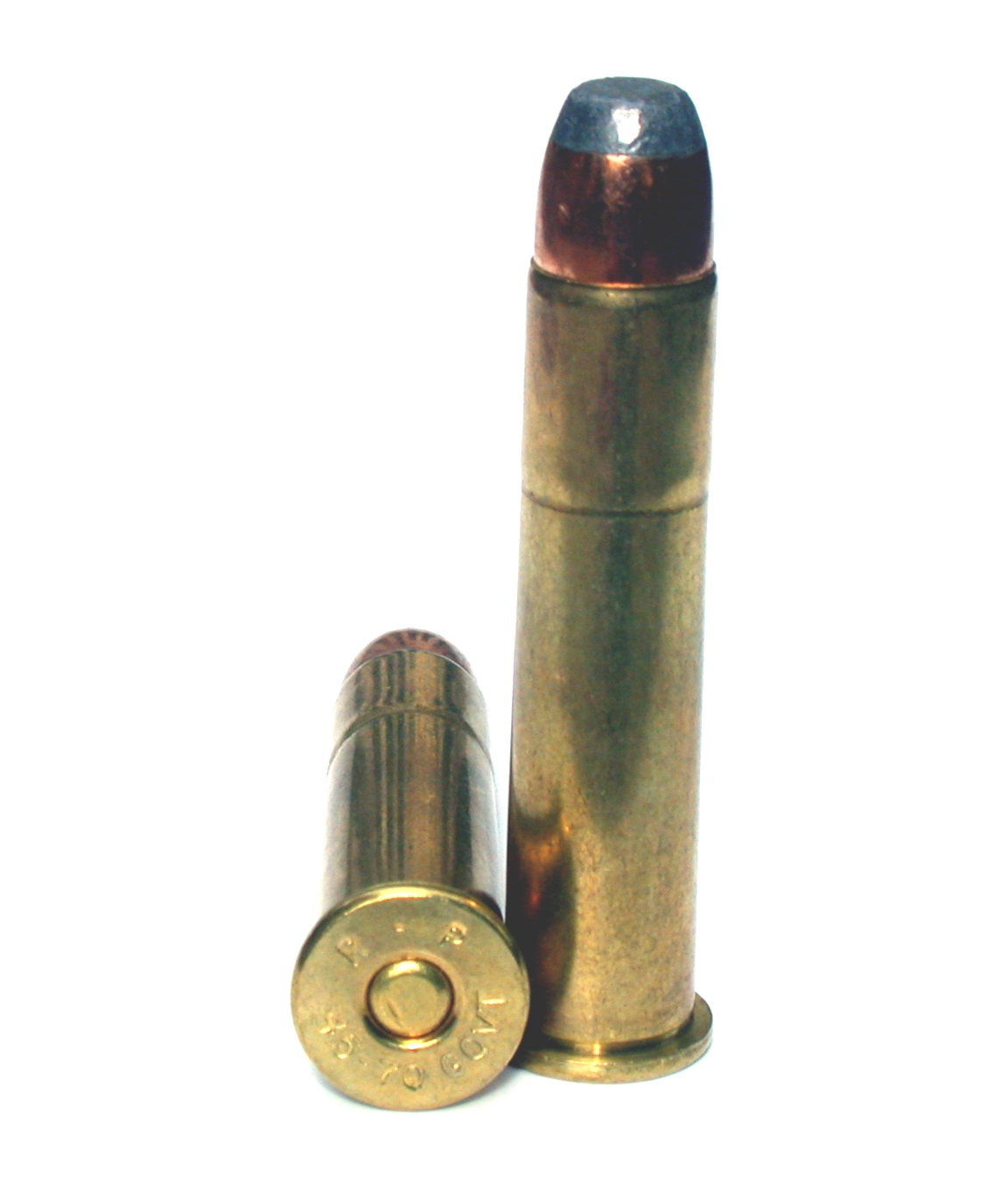
.45-70 Government — The Heavyweight, and the Twist Question
Model H010H · 1:22 twist · 4 + 1 · 6.7 lb · 35.25 in
An 1873 blackpowder military cartridge is the best suppressor host in a 2025 rifle designed around suppressors. That sounds like an accident and it is not one: .45-70 was designed to push a very heavy, very large-diameter bullet at modest velocity, which is precisely the specification a subsonic cartridge is written to. Everything the modern subsonic designer wants — mass, frontal area, a big case that works with tiny charges of fast powder — the cartridge already had.
This is the model to buy if you want the series to do what its name says. It also comes with the one genuine open question in the dive, and § 9.4 is careful about the difference between a caution and a finding.
9.1 Full-Power .45-70 Is Supersonic — and Suppressing It Is Still Worth Doing
Factory .45-70 spans roughly 1,300 to 1,800 fps, with the modern high-pressure loadings at the top of that. Supersonic across the board.
American Hunter’s test with a Banish 46 V2 found the rifle “hearing safe” on full-power ammunition and noted the can “definitely hid the fact I was shooting a .45-70.”1 On a cartridge with this much muzzle blast, taking the blast away is a large change even with the crack still present — arguably a larger change than on any other chambering here, because .45-70 has the most gas to deal with.
9.2 The Subsonic Support Is the Best in the Series
Unlike the .30-30’s two loads, .45-70 has a deep and varied subsonic catalogue:
Table 1 — Unlike the .30-30's two loads, .45-70 has a deep and varied subsonic catalogue
| Load | Bullet | Velocity | Note |
|---|---|---|---|
| Hornady Sub-X Subsonic | 410 gr | ~1,050 fps | Flex Tip; expands from 900 fps, holds together to 1,6002 |
| Federal subsonic target | 300 gr | 1,000 fps | Target soft point3 |
| Steinel | 405 gr RNFP | subsonic | Low-recoil load |
| Steinel | 730 gr, 777 gr WFN | subsonic | Hard cast hunting — see § 9.4 |
| Handload reference | 405 gr + 13 gr Trail Boss | 1,010 fps from a 16-inch barrel | Essentially this rifle4 |
That last row is worth pausing on: it is a published handload chronographed at almost exactly this rifle’s barrel length, landing at 1,010 fps. It has margin even at 0 °F, where Volume 4’s threshold falls to 1,051 fps. Nothing else in this dive has that much room.
The powders that work are the fast, bulky, low-charge ones — Trail Boss, Unique, Vihtavuori N32C. That is not incidental: a suppressor works better with less total gas volume and cleaner-burning powder, so slow rifle powders are doubly the wrong choice down here.
9.3 What You Get, and It Is Not Close
410 grains at 1,050 fps:
410 × 1,050² ÷ 450,240 = ≈ 1,004 ft-lb
Through 0.1647 in² — the largest frontal area in the series — with a sectional density of 0.279, the highest as well.
Set against the others on their own best quiet loads:
Table 2 — Set against the others on their own best quiet loads
| Model | Quiet bullet | Energy at ~1,050 fps | Frontal area | Sectional density |
|---|---|---|---|---|
| .45-70 | 410 gr | ~1,004 ft-lb | 0.1647 in² | 0.279 |
| .45 Colt | 250 gr | ~612 ft-lb | 0.1605 in² | 0.175 |
| .44 Special | 246 gr | ~602 ft-lb | 0.1446 in² | 0.191 |
| .30-30 | 175 gr | ~429 ft-lb | 0.0745 in² | 0.264 |
| .38 Special | 158 gr | ~387 ft-lb | 0.1004 in² | 0.177 |
Two-thirds more energy than the next best, the most frontal area, and the best penetration geometry — all at the same time, and all without making a supersonic crack. There is nothing to argue about here. If the question is “what does this series do that nothing else does,” the answer is this rifle with a box of Sub-X in it.
And it does that from a 6.7-pound, 35.25-inch rifle — lighter than the .30-30 model.
9.4 The Twist Question — A Caution, Not a Finding
⚠ This is the one place in the dive where the evidence genuinely runs out, and it calls for care about what is claimed.
The HUSH’s .45-70 barrel is 1:22, against the 1:20 used on most .45-70 rifles — a detail almost nobody notes.
⚠ But be careful how that is framed, because an earlier draft of this dive got it slightly wrong. 1:20 is SAAMI’s reference twist, used in the test barrel — and the standard marks it “OPTIONAL.” SAAMI mandates no twist for this cartridge at all. So 1:22 is not out of spec; it is a maker exercising a latitude the specification explicitly grants. The .45-70 Government dive reads that off the drawing.
That does not make the consequence go away — a slower twist still spins a given bullet more slowly, and at subsonic velocity there is not much spin to spare. But it is a design choice with consequences, not a deviation from a standard.
What the published experience says about 1:20:
- 405-grain bullets stabilise without trouble at 1:20; it is described as the common, unremarkable case.5
- A 500-grain cast bullet, by contrast, “hasn’t been able to stabilise in Marlins below about 1,200 fps.”5
Now apply Volume 4’s spin arithmetic — spin (rpm) = velocity × 720 ÷ twist:
Table 3 — Now apply Volume 4's spin arithmetic — spin (rpm) = velocity × 720 ÷ twist
| Configuration | Spin rate |
|---|---|
| 1:20 at 1,200 fps — the reported failure point for 500 gr | 43,200 rpm |
| 1:22 at 1,050 fps — the HUSH, subsonic | 34,400 rpm |
The HUSH at subsonic velocity spins the bullet about 20 % slower than the configuration where a 500-grain bullet was already reported failing.
🔴 What that justifies saying, and what it does not:
- Justified: 405–410 grains is the bullet weight the published evidence actually covers, it is what both major factory subsonic loads use, and it is the weight to buy.
- Justified: the two heaviest commercial subsonic .45-70 loads on the market — Steinel’s 730-grain and 777-grain — are outside the envelope that has any published support in a 1:22 barrel at subsonic velocity, and if you buy them, test them on paper for keyholing before you take them anywhere that matters.
- 🔴 NOT justified, and not claimed here: that those loads fail in this rifle. Nobody has published a 1:22 HUSH result with a 730-grain bullet. The arithmetic says the margin is thin; it does not say the answer. There is a real difference between “outside what anyone has demonstrated” and “does not work,” and collapsing the two is how a reference document ends up wrong.
If you own this model and you test heavy subsonic loads in it, that result is worth writing down — it is a number the internet does not currently contain.
9.5 Recoil, Honestly
A 6.7-pound rifle firing a cartridge designed around an eleven-pound one recoils, and it is the price of the carry weight.
Three things reduce it, and they compound:
- The suppressor itself — a pound and a half at the muzzle, plus gas captured rather than vented.
- Subsonic loads — a 410-grain bullet at 1,050 fps generates far less recoil than a 405-grain at 1,800.
- A brake, if you go that way — NRA Women measured a Ranger Point Precision brake cutting felt recoil “by at least 25 percent.”6
⚠ But a brake and a suppressor are alternatives on the same threads, not a stack. If you intend to run this suppressed, the brake is a range accessory you take off, or a muzzle device your can mounts over — not both at once by default. Decide which before you buy either.
Loaded subsonic and suppressed, the .45-70 HUSH is a mild rifle. Loaded with modern high-pressure hunting ammunition and unsuppressed, it is not, and the light weight is why.
9.6 The Verdict
Buy this one.
It is the model that justifies the series existing. It has the deepest factory subsonic support, the only load with real cold-weather margin, more than a thousand foot-pounds at subsonic velocity, the largest frontal area and the best sectional density in the lineup — and it weighs less than the .30-30 model does.
Its costs are honest and small: 4 + 1 rounds rather than 7 + 1, the most expensive ammunition in the series, real recoil on full-power loads, and a twist rate that puts a ceiling somewhere above 410 grains that nobody has located precisely.
None of that changes the conclusion. If you want a rifle that is genuinely quiet and genuinely lethal at the same time, this is the only one of the five that is both.
9.7 Bibliography
- Henry Repeating Arms, SPD HUSH Series specification table — H010H figures including the 1:22 twist; corroborated by Palmetto State Armory and Battlehawk Armory product listings.
- Steinel Ammunition .45-70 subsonic product pages — 405 gr RNFP, 730 gr WFN, 777 gr.
- Energy, frontal-area, sectional-density and spin-rate figures computed as set out in Volume 4.
Footnotes
-
American Hunter, “Hardware Review: Henry SPD HUSH” — .45-70 with Banish 46 V2; subsonic “extremely quiet,” full-power “hearing safe.” ↩
-
Hornady, “45-70 Government 410 gr Sub-X Subsonic” product page; Ultimate Reloader coverage — expansion from 900 fps impact, integrity to 1,600 fps. ↩
-
SSUSA, “New: Federal Subsonic Rifle Target Loads” — .45-70 Government 300 gr target soft point at 1,000 fps. ↩
-
Marlin Owners forum, “45-70 subsonic loads and molds”; xxlreloading .45-70 Govt CIP subsonic load data — 405 gr with 13 gr Trail Boss at 1,010 fps from a 16-inch barrel; powder selection guidance. ↩
-
Accurate Shooter and Marlin Owners subsonic .45-70 threads — 405 gr stabilising at 1:20; the 500 gr RCBS cast bullet reported not stabilising in Marlins below approximately 1,200 fps. ↩ ↩2
-
NRA Women, “Review: Henry’s SPD HUSH Lever-Action Rifle” — Ranger Point Precision brake, felt recoil reduction. ↩
Comments (0)