Henry SPD HUSH · Volume 1
Overview — A Lever Gun Designed Around the Can
Almost every rifle sold as “suppressor-ready” is an ordinary rifle with threads cut on the muzzle. Henry’s SPD HUSH series is the rarer thing: a rifle where the suppressor was the design brief and the rest of the gun was rearranged to suit it.
That claim gets made a lot, so it is worth saying what would have to be true for it to be honest. A rifle actually designed around a can would have to solve three problems that threading a muzzle does not touch: where the weight sits once you hang a pound and a half off the front, how you reload when the thing on the muzzle covers the magazine tube, and what ammunition makes the whole exercise worth doing. The HUSH has a specific answer to all three, and this dive is mostly about whether those answers hold up.
It is also the reason the dive spends more pages on ammunition than on the rifle. A suppressor fixes one of the two noises a gun makes. Only the ammunition fixes the other — and Henry chambers this rifle in five cartridges whose ability to make the second noise go away varies from excellent to essentially nil.
1.1 What the SPD Is
Henry stood up a Special Products Division as an R&D department, and the HUSH is its debut product — not a new barrel on an existing catalogue rifle, but the first thing the new group shipped. American Rifleman describes SPD as a “cutting-edge R&D department” making “its debut with the new-for-2025 SPD HUSH series of rifles.”1
The stated brief is unusually explicit for a lever gun: “the ultimate modern suppressor host,” built around “light weight, perfect balance and compact overall length.”1 Whatever you think of the marketing register, those three priorities are visible in the parts list, which is what Volume 2 goes through.
The trade agreed it was a real product rather than a repackage. The series was named Best New Rifle in the 2025 Caliber Awards, presented jointly by the National Association of Sporting Goods Wholesalers and the Professional Outdoor Media Association.
1.2 The Five Models
All five share the same architecture: a 16.5-inch carbon-fiber tension-wrapped 416R stainless barrel, threaded 5/8×24, on a side-gate Henry lever action, with an aluminium M-LOK fore-end and a carbon-fiber Picatinny rail. They differ only in frame size and chambering.
Table 1 — 1.2 The Five Models
| Model | Caliber | Twist | Capacity | Weight | Overall length |
|---|---|---|---|---|---|
| H012CH | .45 Colt | 1:16 | 7 + 1 | 6.4 lb | 34.29 in |
| H012MH | .357 Mag / .38 Spl | 1:16 | 7 + 1 | 6.4 lb | 34.29 in |
| H012H | .44 Mag / .44 Spl | 1:16 | 7 + 1 | 6.9 lb | 34.29 in |
| H009H | .30-30 Win | 1:12 | 4 + 1 | 7.0 lb | 35.25 in |
| H010H | .45-70 Gov’t | 1:22 | 4 + 1 | 6.7 lb | 35.25 in |
MSRP is $1,999 across the line — Henry’s own specification table rounds it to $2,000.
A note on the capacity figures, because they look like a contradiction and are not. Henry’s published table says 5 rounds for the .45-70 and 8 for the pistol calibers. Every reviewer who actually loaded one says 4 and 7, and retailers list “4+1.” Henry is counting the chamber. Seven in the tube plus one chambered is eight rounds in the rifle, and both numbers are correct.
The three pistol-caliber models sit on the Big Boy side-gate frame; the .30-30 and .45-70 sit on Henry’s large-frame side-gate action. That is why the two rifle-caliber models are an inch longer and hold fewer rounds.
1.3 Why a Lever Action Is a Good Suppressor Host
This surprises people, so it is worth establishing early. A manually-operated rifle has four structural advantages over a semi-automatic as a suppressor host, and the HUSH has all of them:
No gas system. Every self-loading rifle has to bleed propellant gas out of the bore to work the action, and a suppressor raises the pressure in that bore. The whole product category of low-backpressure and flow-through cans exists to manage the consequences — gas in the shooter’s face, accelerated wear, cycling that goes violent when a can goes on. A lever gun has none of this. You buy purely for suppression and never trade a decibel for a cycling problem. The Suppressors by Caliber dive treats that trade-off at length; here it simply does not arise.
No action noise while the bullet is leaving. A semi-auto unlocks, extracts and ejects on its own schedule, and that mechanical racket is part of what you hear. On a lever gun the action is dead still until you move it. American Rifleman’s coverage makes exactly this point about the HUSH: the manually-operated action “produces less bolt noise than suppressed semi-automatics.”2
No cylinder gap. This one matters specifically because three of the five chamberings are revolver cartridges. A revolver vents a substantial fraction of its propellant gas sideways out of the barrel-cylinder gap, ahead of anything you could screw onto the muzzle — which is why suppressing a revolver is mostly futile. Fire the same .45 Colt cartridge out of a sealed-breech carbine and every bit of that gas goes down the bore and into the can.
A closed breech that stays closed. The gas has exactly one way out and you have put a suppressor on it.
The counterpoint is honest and small: you give up rate of fire, and a tubular magazine constrains what bullet shapes you can feed it. Volume 8 deals with the second of those properly, because for the .30-30 it is a real limitation rather than a footnote.
1.4 The Question the Whole Dive Answers
Here is the framing that the rest of this dive hangs on, borrowed from the Suppressors by Caliber dive because it is the right one:
Are you buying quiet, or are you buying comfortable?
A suppressor removes muzzle blast — the explosion of propellant gas at the muzzle. It cannot do anything about the ballistic crack of a bullet travelling faster than sound, because that shock cone is generated along the bullet’s whole flight path, downrange of anything bolted to the gun.
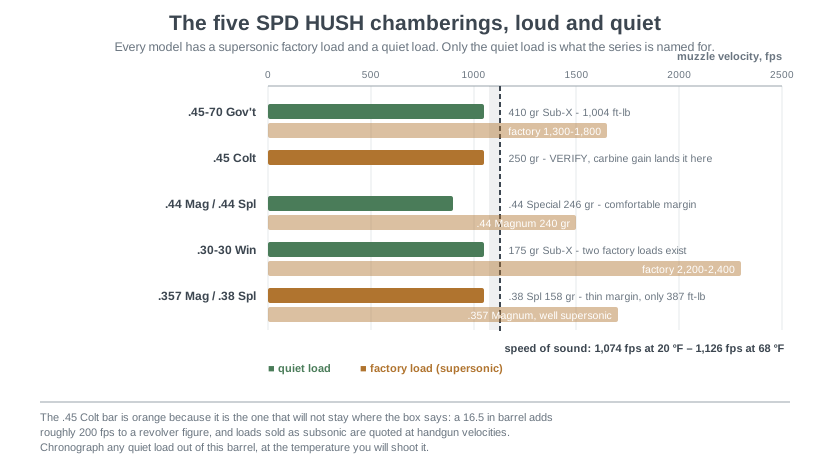
So the five HUSH models sort into two very different products depending on what you feed them:
Table 2 — So the five HUSH models sort into two very different products depending on what you feed them
| Model | On factory hunting ammunition | On the quiet load |
|---|---|---|
| .45-70 | Supersonic — comfortable | Genuinely quiet, and with over 1,000 ft-lb |
| .45 Colt | Depends entirely on the load — see Volume 5 | Quiet, if you verify it |
| .44 Mag / .44 Spl | Magnum is supersonic — comfortable | Quiet on .44 Special |
| .30-30 | Supersonic — comfortable | Quiet, on two specific boxes |
| .357 / .38 | Magnum is very supersonic — comfortable | Quiet, and the weakest of the five |
That table is the dive in miniature. Volumes 5 through 9 are one chapter per row, Volume 10 ranks them against each other, and Volume 4 explains the physics that makes the columns different.
1.5 What This Dive Is Not
This dive was not written from an owned example of the rifle. Every photograph here is a stand-in and the captions say so; the measured figures are other people’s, attributed, and treated as individual rifles under individual protocols. In particular — and this is a rule across the whole Suppressors category — no decibel figure in this dive is compared against a decibel figure from a different test. Sound measurement is protocol-dependent enough that cross-comparing published numbers produces confident nonsense.
Where the evidence genuinely runs out, the dive says so rather than filling the gap. There are two places it does, both in Volume 9, and both are flagged there.
1.6 Bibliography
- Henry Repeating Arms, SPD HUSH Series product specification table.
- Henry Repeating Arms press release, “Henry’s SPD HUSH Series Wins Best New Rifle Caliber Award.”
- American Hunter, “Hardware Review: Henry SPD HUSH”; NRA Women, “Review: Henry’s SPD HUSH Lever-Action Rifle”; Hook & Barrel, “Henry SPD HUSH Review.”
Comments (0)