Henry SPD HUSH · Volume 4
The Two Noises, and the One Number Everybody Gets Wrong
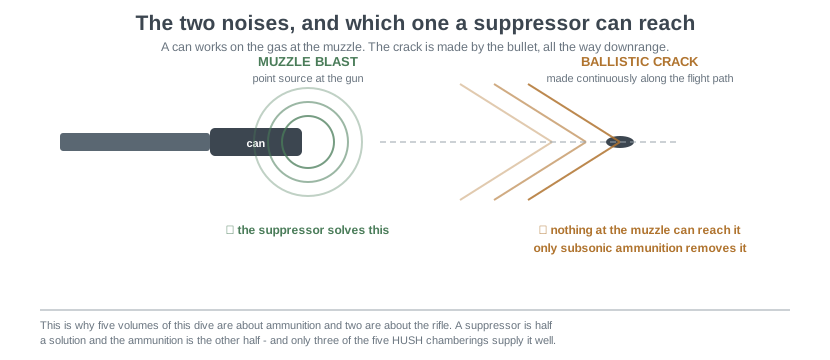
This is the volume the five caliber chapters depend on. It has two jobs: establish why ammunition, not the suppressor, decides whether this rifle is quiet — and then correct the single number that every subsonic discussion is built on and almost every one of them gets wrong.
4.1 The Two Noises
A rifle shot is two acoustic events, and they have nothing to do with each other.
Muzzle blast is the propellant gas leaving the barrel. It is a pressure wave from a point source at the muzzle, and it is what a suppressor addresses — the can gives that gas volume to expand into, baffles to slow it down, and time to cool before it reaches the atmosphere. This is the noise the How Suppressors Work dive is about, and it is genuinely solvable.
Ballistic crack is the shock cone dragged by a bullet moving faster than sound. It is generated continuously along the bullet’s flight path, downrange, and it arrives at anyone standing near that path regardless of what is bolted to the muzzle. There is no muzzle device — none, in principle, not just none on the market — that can do anything about it, because by the time the noise is being made the bullet has already left.
So:
A suppressor is half a solution. The ammunition is the other half, and only the ammunition can supply it.
American Hunter’s .45-70 test states the practical version of this cleanly: with subsonic loads the rifle was “extremely quiet,” with the “absence of the supersonic ‘crack’”; with full-power ammunition it was merely “hearing safe.”1 Same rifle, same suppressor, two entirely different products.
That distinction — quiet versus comfortable — is the axis the whole Suppressors by Caliber dive is organised on, and it is why Volumes 5 through 9 spend their time on ammunition rather than on the gun.
4.2 Comfortable Is Not a Consolation Prize
Before the dive spends five volumes chasing subsonic, it is worth defending the other half, because “it still cracks” gets used as if it means “it did not work.”
Suppressed supersonic shooting still buys you: the blast gone, the concussion gone, the muzzle flash gone, recoil down meaningfully, ears and neighbours enormously better off, and — for a hunter — the ability to hear what happens after the shot. On a .45-70 that is not a small change; it is the difference between a rifle you flinch on and one you shoot well.
What it does not buy is stealth, and buying it expecting stealth is the most common disappointment in the entire suppressor category.
4.3 The Number Everybody Gets Wrong
Every discussion of subsonic ammunition anchors on 1,125 feet per second. It appears on ammunition boxes, in load manuals, and in every forum thread on the subject.
It is a specific number under specific conditions, and the conditions are not the ones you hunt in.
The speed of sound in dry air depends only on temperature, and it does so through a clean formula:
c ≈ 49.02 × √T feet per second, where T is in degrees Rankine (°F + 459.67)
Run it:
Table 1 — Run it
| Air temperature | Speed of sound |
|---|---|
| −10 °F | 1,039 fps |
| 0 °F | 1,051 fps |
| 20 °F | 1,074 fps |
| 32 °F | 1,087 fps |
| 50 °F | 1,107 fps |
| 68 °F | 1,126 fps ← the number on the box |
| 90 °F | 1,149 fps |
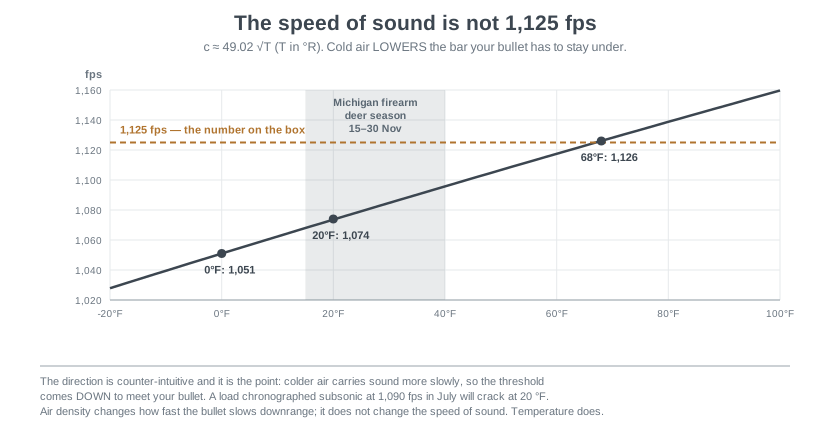
The spread from a cold November morning to a July afternoon is about 75 feet per second, and across the full range in that table it is 110.
🔴 And the direction is the opposite of what most people assume. Cold air makes it easier to go supersonic, not harder. Colder air carries sound more slowly, so the threshold your bullet has to stay under comes down to meet it. A load you chronographed at 1,090 fps on a pleasant range afternoon and pronounced subsonic will crack at 20 °F.
The opposite has been stated confidently more than once — the reasoning goes “cold air is denser, so the bullet slows faster, so it is safer” — and it is wrong twice over. Air density affects how fast the bullet decelerates downrange; it does not change the speed of sound, which depends on temperature alone. And the bullet is fastest at the muzzle, which is exactly where the threshold has dropped.
4.4 What That Means in Michigan
Michigan’s firearm deer season runs 15 to 30 November. Morning temperatures in the twenties are entirely ordinary, and the teens are not unusual.
So the number a load actually has to stay under, in the conditions it will be fired in, is roughly 1,075 to 1,085 fps — about 50 fps below the figure the ammunition industry designs to.
That has a direct consequence for four of the five chamberings in this series, and it is why the same sentence appears in every one of the caliber volumes:
Chronograph the load, out of this barrel, at the temperature you will hunt it.
Not out of a test barrel. Not from the box. Not in July. There is no substitute for the measurement, because the two variables that decide the answer — your barrel’s actual velocity and the air temperature on the day — are both yours and neither is printed anywhere.
4.5 The Second Tax: Subsonic Costs You Stability
There is a less obvious price for going subsonic, and it is the technical thread that runs through the .30-30 and .45-70 chapters.
A bullet is stabilised by spin, and spin comes from velocity:
spin (rpm) = velocity (fps) × 720 ÷ twist (inches per turn)
Halve the velocity in a given barrel and you halve the spin rate. The stability factor does not fall quite that fast — Miller’s rule carries a velocity correction of roughly (v ÷ 2800)^⅓ — but it falls meaningfully:
Table 2 — Halve the velocity in a given barrel and you halve the spin rate. The stability factor does not fall quite that fast — Miller's rule carries a velocity correction of roughly (v ÷ 2800)^⅓ — but it falls meaningfully
| Cartridge | Factory velocity | Subsonic | Stability retained |
|---|---|---|---|
| .30-30 Win | ~2,200 fps | 1,050 fps | ≈ 78 % — a 22 % loss |
| .45-70 Gov’t | ~1,800 fps | 1,050 fps | ≈ 84 % — a 17 % loss |
This is why a twist that is perfectly adequate for a factory hunting load can be marginal for a heavy subsonic in the same rifle. It is not that the rifle is badly made. It is that a barrel is cut for one velocity regime and you are asking it to work in another.
Two of the HUSH models are affected, and they are affected differently:
- The .30-30 is 1:12, and its factory subsonic loads are 170 and 175 grains. Volume 8 argues that pairing is not a coincidence.
- The .45-70 is 1:22 — slower than the 1:20 that is standard on most .45-70s — and Volume 9 works through what that does and does not rule out.
The three pistol-caliber models are all 1:16 firing short, stubby bullets that were designed at these velocities in the first place. They have no stability problem at all, which is a genuine advantage nobody mentions.
4.6 The Frame for the Next Five Volumes
Everything above reduces to three questions to ask of any cartridge in this rifle:
- Can it get under the line? — Is there a load, factory or hand, that stays subsonic out of 16.5 inches at the temperature you will shoot it?
- Does the bullet stay pointed forward when it does? — Will the twist stabilise the bullet weight that subsonic performance requires?
- Is there anything left when it arrives? — At 1,000-odd fps, energy comes only from mass and frontal area. Does the cartridge have either?
Volumes 5 through 9 ask those three questions of each chambering in turn. No cartridge in the series answers all three perfectly, and one of them fails all three — which is more interesting than it sounds, because it is not the one most people would guess.
4.7 Bibliography
- Speed-of-sound values computed from c = 49.02 √T (T in °R), the standard dry-air relation.
- Miller twist rule and its velocity correction term, as used throughout the subsonic handloading literature; see the Cast Bullet Association and Sniper’s Hide subsonic-twist discussions collected in this dive’s research notes.
- Michigan Department of Natural Resources, 2026 Deer Hunting Regulations Summary — firearm season dates.
- Henry Repeating Arms, SPD HUSH Series specification table — twist rates.
Footnotes
-
American Hunter, “Hardware Review: Henry SPD HUSH” — subsonic versus full-power observations, .45-70 with a Banish 46 V2. ↩
Comments (0)