Henry SPD HUSH · Volume 3
Balance — The Real Engineering Argument
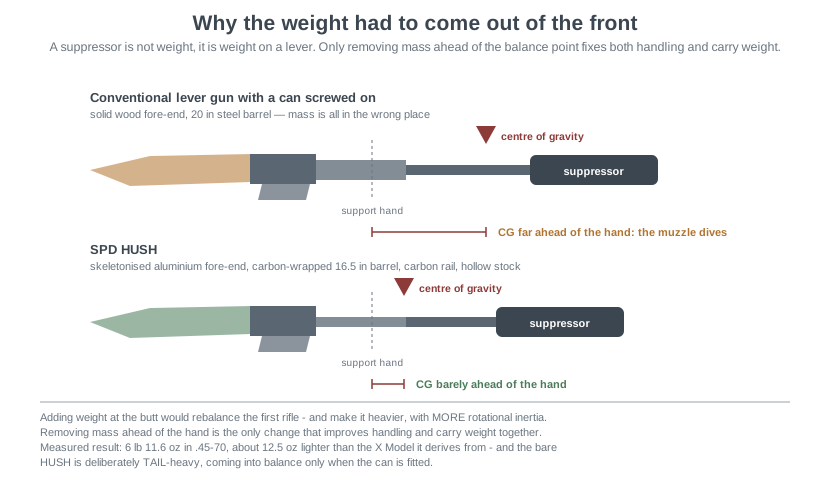
Of everything Henry claims about this series, balance is the claim that is actually engineering rather than description. It is also the one most likely to be dismissed as marketing, so this volume works through why the problem is real, why the obvious fix is the wrong one, and what the people who handled the rifle reported.
3.1 The Problem, Stated Properly
A suppressor is not just weight. It is weight at the end of a lever.
A big-bore rifle can runs on the order of 14 to 24 ounces and 7 to 9 inches long, and its own centre of mass sits several inches beyond the muzzle. Hang that on a 20-inch-barrelled lever gun and you have added roughly a pound and a half about two feet forward of where you hold the rifle.
What you feel is not the pound and a half. What you feel is the moment — mass multiplied by distance — and it shows up in three ways that all matter to a hunter:
- The muzzle dives. The rifle no longer wants to come up; it wants to fall.
- Offhand hold becomes work. Your support arm is now resisting a torque, not carrying a weight, and it fatigues far faster.
- The swing goes wrong. A muzzle-heavy rifle is slow to start and slow to stop, which is precisely backwards for the close, fast, often-moving shooting a 16.5-inch lever gun is for.
The last one is why this matters more on this rifle than on a bench gun. A precision rifle that is muzzle-heavy is often better — the mass damps wobble on a bipod. A brush and predator gun that is muzzle-heavy is worse at its actual job.
3.2 Why You Cannot Fix It at the Butt
The intuitive answer is to add weight at the back — a heavier stock, a weighted buttpad — to bring the balance point back.
That works, in the narrow sense that the rifle balances again. It is still the wrong answer, for a reason that is easy to state: you have fixed the balance and made the rifle heavier. You now carry a nine-pound rifle up a ridge in order to make a seven-pound rifle handle correctly, and the rotational inertia — how hard it is to start and stop a swing — has gone up, not down, because you added mass far from the pivot at both ends.
Balance and inertia are different quantities. Adding tail weight fixes one and worsens the other.
The only fix that improves both is removing mass from ahead of the balance point. That is exactly what Volume 2’s parts list does, and it explains why Henry attacked the barrel, the fore-end and the rail — the three heaviest things forward of the shooter’s hand — rather than doing the easy thing.
3.3 What Came Out, and From Where
Table 1 — 3.3 What Came Out, and From Where
| Change | Where the mass was | Effect on the moment |
|---|---|---|
| Carbon-wrapped barrel in place of steel | Along the whole lever arm | Large |
| Skeletonised aluminium fore-end in place of wood | Forward of the receiver | Large |
| Carbon fiber rail in place of aluminium or steel | Over the receiver | Small, but free |
| Hollowed laminate buttstock | Behind the pivot | Reduces total weight; slightly worsens balance |
| No iron sights | Front sight is at the muzzle | Small, at the far end of the lever |
Note the fourth row. Hollowing the stock takes weight off the back, which by itself moves the balance forward — the wrong direction. Henry did it anyway, because total carried weight matters too and the front-end savings were large enough to absorb it.
The net, measured: 6 lb 11.6 oz for the .45-70 HUSH, about 12.5 ounces lighter than the X Model it is derived from.1 Three-quarters of a pound, taken mostly from the end of the lever.
3.4 The Tell: It Is Deliberately Unbalanced Without the Can
Here is the most convincing evidence that the balance claim is real rather than a description written after the fact.
American Rifleman reports the bare rifle has “distinct tail-heaviness” unloaded, and that it comes into balance when the suppressor goes on.2
That is the design working exactly as specified, and it is a real trade. Henry did not build a rifle that balances nicely and also tolerates a can. They built a rifle whose designed configuration includes the suppressor, and accepted that it feels slightly wrong without one. You can only make that choice on purpose.
The NRA Women review, on the .45-70, records the intended end state directly: “the rifle’s natural center of gravity remains in place when a big-bore suppressor is attached to the muzzle.”1 Hook & Barrel, on the .357, independently found it “balanced well even with suppressor attached.”3
Three reviewers, three rifles, two chamberings, same conclusion. That is about as much corroboration as a handling claim ever gets.
3.5 The Consequence Nobody Mentions
If the rifle is designed around being suppressed, then the unsuppressed rifle is the compromised configuration — and that has a practical consequence for anyone buying one before the stamp clears.
The federal transfer tax went to $0 on 1 January 2026, but as the Suppressor Law dive sets out at length, the registration, the Form 4, the fingerprints, the photograph, the background check and the wait all survived intact. The tax changed; the process did not. So there is a real possibility of owning this rifle for months before you own the thing it was designed around.
That is not a reason to avoid it. It is a reason to not judge the handling until the can is on, and to be unsurprised when the bare rifle feels back-heavy on the range. It is supposed to.
3.6 Where the Argument Stops
Two honest limits on all of this.
Balance is not free of the suppressor you choose. Henry balanced the rifle around “a big-bore suppressor,” which is a range, not a number. A 24-ounce, 9-inch .45-70 can and a 14-ounce, 7-inch one are different rifles once mounted. If you care about this, the can is part of the handling decision, not an accessory to it — see Volume 11.
Balance says nothing about recoil. The .45-70 HUSH is a 6.7-pound rifle firing a cartridge that was designed for an eleven-pound one. A suppressor helps — it is mass at the muzzle and it captures gas — and the NRA Women review found a muzzle brake cut felt recoil “by at least 25 percent.”1 But a light big-bore rifle recoils, and the lightness that makes it carry well is the same lightness that makes it kick. That is a fair trade, not a flaw, and it is worth knowing before you buy the .45-70 rather than after.
3.7 Bibliography
- American Rifleman, “New For 2025: Henry SPD HUSH Series” — the stated design priorities of light weight, balance and compact overall length.
- Henry Repeating Arms, SPD HUSH Series product specification table.
Footnotes
-
NRA Women, “Review: Henry’s SPD HUSH Lever-Action Rifle” — 6 lb 11.6 oz; 12.5 oz lighter than the X Model; centre of gravity with suppressor; muzzle brake recoil observation. ↩ ↩2 ↩3
-
American Rifleman, “Review: Henry SPD Hush Rifle” — tail-heaviness unloaded, improving with the suppressor mounted. ↩
-
Hook & Barrel, “Henry SPD HUSH Review.” ↩
Comments (0)