Henry SPD HUSH · Volume 2
The Rifle Itself — What Henry Actually Changed
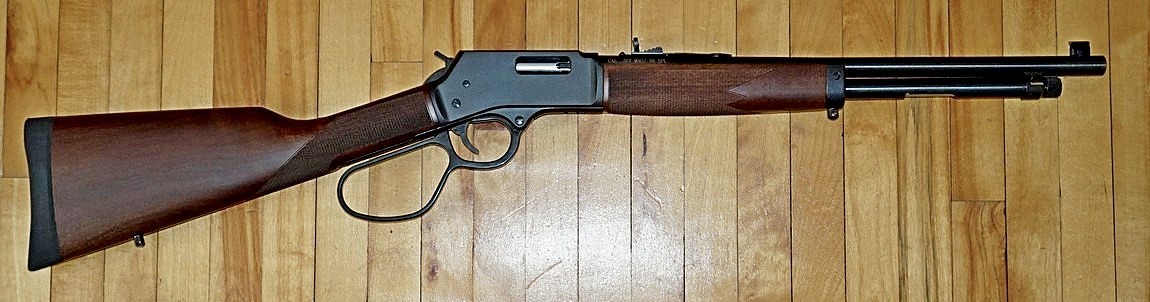
If you strip the marketing off, the HUSH is a side-gate Henry lever action with four components replaced and one deleted. That is not a criticism — the replacements are all in the same direction and they add up to a coherent argument. This volume goes through them one at a time and says what each one is actually for.
2.1 The Barrel
16.5 inches, 416R stainless steel, carbon-fiber tension-wrapped, threaded 5/8×24, made by BSF Barrels in Wisconsin.
Three separate decisions are packed in there.
The 16.5-inch length is doing two jobs. It keeps the rifle legal without paperwork — the federal minimum rifle barrel is 16 inches and the minimum overall length is 26, and at 34.29–35.25 inches overall the HUSH clears both by a wide margin. There is no short-barrelled-rifle question to answer here, which matters because you are already going to file a Form 4 for the suppressor and nobody wants two. And it budgets length for the can: a 7-to-9-inch big-bore suppressor on a 16.5-inch barrel gives you a rifle around 41–43 inches overall, which is roughly the length of an ordinary 24-inch-barrelled bolt-action deer rifle. Volume 12 does that arithmetic properly.
The carbon wrap is a weight decision first and a stiffness decision second. BSF’s architecture puts an air gap between the stainless liner and the carbon fiber — American Rifleman notes this specifically — rather than laying the wrap directly onto the steel.1 The marketing case is heat dissipation. The stiffness case is more defensible and matters more here: a stiffer barrel deflects less under the cantilevered weight of a suppressor.
⚠ The heat story is contested, and there is no pretending otherwise. Carbon-fiber-wrapped barrels are sold on heat dissipation, but independent shooter testing reported across the long-range forums finds some wrapped barrels hold heat longer than a steel barrel of the same contour, and reports a consistent point-of-impact shift as they warm. Both positions are in circulation and neither is settled.
For this rifle it is close to moot. A 4-to-8-round hunting and predator lever gun is not a volume-fire platform, nobody is selling it as one, and the review that measured the tightest group with it — 0.78 inch at 100 yards in .45-70 — was firing three-shot strings.2 Take the stiffness and the weight saving, which are real, and file the thermal argument under “unresolved and mostly irrelevant at this round count.”
The 5/8×24 thread is the standard rifle thread from .223 through .375. It is the obvious choice and it is also the source of the most dangerous mistake you can make with this rifle, which is why Volume 11 exists.
2.2 The Fore-End
A skeletonised aluminium handguard by TAPCO, with M-LOK slots at 3, 6 and 9 o’clock and ventilation cuts through the lower portion.
This is the least traditional thing on the rifle and it is entirely about mass and where it sits. A wood fore-end on a lever gun is a solid block of walnut hung off the barrel forward of the receiver — exactly the wrong place to carry weight on a rifle that is about to grow a suppressor. Replacing it with skeletonised aluminium removes weight from the worst possible location.
The M-LOK slots are the practical half. This rifle has no iron sights and is aimed squarely at night predator and hog work, where a light and a thermal or IR illuminator are not accessories but the point. Getting those onto a traditional lever gun has always meant clamps and compromise.
2.3 The Rail
A forged carbon fiber Picatinny rail by ARRIS Technology, mounted to the receiver. The receiver is also drilled and tapped for a conventional Weaver 63B or Henry’s BB-RSM mount if you want steel instead.
The NRA Women review makes the point that matters: the carbon rail is lighter than aluminium and held zero under .45-70 recoil.3 That is the test that counts for a composite optic mount, and it passed.
⚠ The recorded criticism is real and worth repeating. American Rifleman wanted “a longer, metal” rail, noting the carbon one limits what magnified optics you can mount.4 If you intend to hang a big variable scope with a long tube on this rifle rather than a red dot or a compact thermal, check ring spacing against the rail before you buy.
2.4 The Stock
Hollowed American hardwood laminate, pistol grip, checkered, 14-inch length of pull, ventilated rubber recoil pad, water-resistant grey finish.
Laminate rather than walnut for weather stability, hollowed for weight. Reviewers liked it and consistently made the same suggestion: a polymer option would fit the rest of the rifle better.3 That is a fair note. Everything else on this gun is a modern-materials answer to a weight problem, and the stock is the one place Henry stayed traditional.
Between the hollow stock, the skeletonised fore-end and the carbon barrel, the NRA Women review measured the .45-70 HUSH at 6 lb 11.6 oz — about 12.5 ounces lighter than the X Model it derives from.3 Three-quarters of a pound out of a rifle that was not heavy to begin with.
2.5 What Was Deleted: The Sights
There are none. No front bead, no rear notch, no folding backup. The rail is the sighting system.
That is worth stating flatly because it is easy to skim past in a spec table. If your optic fails in the field, this rifle has no aiming reference at all. On a hunting rifle in Michigan in November that is a genuine consideration, not a theoretical one.
It is a defensible decision — iron sights on a suppressed rifle are half-blocked by the can anyway, and a front sight is weight in the worst place — but it is a decision, and Henry made it for you. Plan a backup accordingly, or accept that you have a single-point-of-failure sighting system.
2.6 The Side Gate, and Why It Is Not a Convenience Feature
The HUSH is built on Henry’s side-gate receivers: the Big Boy frame for the three pistol calibers, the large frame for .30-30 and .45-70. You can load through the gate in the right side of the receiver, or traditionally through the magazine tube at the front.
🔴 With a suppressor mounted, you cannot use the tube. The can covers it. Both hands-on reviews that fired this rifle suppressed hit that independently — American Hunter and Hook & Barrel both note that the suppressor blocks the magazine tube and you load through the gate.56 Henry’s own coverage frames it as the design intent: the side gate “eliminates the need to remove the magazine tube.”7
This is the single most load-bearing design observation about the whole series. It is also the cleanest evidence that the suppressor genuinely was the brief rather than an afterthought — because a Henry without a side gate would be a rifle you had to unscrew a suppressor from in order to reload, and that rifle would be useless.
If you are cross-shopping older or non-side-gate lever guns as suppressor hosts, this is the question to ask first. It is not a preference.
2.7 The Parts List, Read as an Argument
Put together, the changes all point the same way:
Table 1 — Put together, the changes all point the same way
| Component | Standard lever gun | HUSH | What it buys |
|---|---|---|---|
| Barrel | 20 in blued steel | 16.5 in carbon-wrapped stainless, threaded | Weight and length off the muzzle |
| Fore-end | Solid wood | Skeletonised aluminium, M-LOK | Weight off the front; lights and thermals |
| Optic mount | Drilled and tapped | Forged carbon rail | Weight off the top; a sighting system at all |
| Stock | Solid walnut | Hollow laminate | Weight, and weather |
| Sights | Bead and notch | None | Weight, at a cost |
| Loading | Tube, or gate | Gate, necessarily | Reloading with a can fitted |
Five of the six rows are weight, and four of those five are weight forward of or around the balance point. That is not a coincidence, and it is the subject of Volume 3.
2.8 Bibliography
- Henry Repeating Arms, SPD HUSH Series product specification table.
- Long Range Hunting and Accurate Shooter forum threads on carbon-fiber barrel heat retention and point-of-impact shift.
Footnotes
-
American Rifleman, “Review: Henry SPD Hush Rifle.” ↩
-
NRA Women, “Review: Henry’s SPD HUSH Lever-Action Rifle” — 0.78 in three-shot group at 100 yd, DoubleTap Hunter. ↩
-
NRA Women, “Review: Henry’s SPD HUSH Lever-Action Rifle.” ↩ ↩2 ↩3
-
American Rifleman, “Review: Henry SPD Hush Rifle” — rail criticism. ↩
-
American Hunter, “Hardware Review: Henry SPD HUSH.” ↩
-
Hook & Barrel, “Henry SPD HUSH Review.” ↩
-
American Rifleman, “Gun Of The Week: Henry SPD HUSH.” ↩
Comments (0)