Henry SPD HUSH · Volume 10
Ranking the Five — Mass, Frontal Area, and What Subsonic Costs
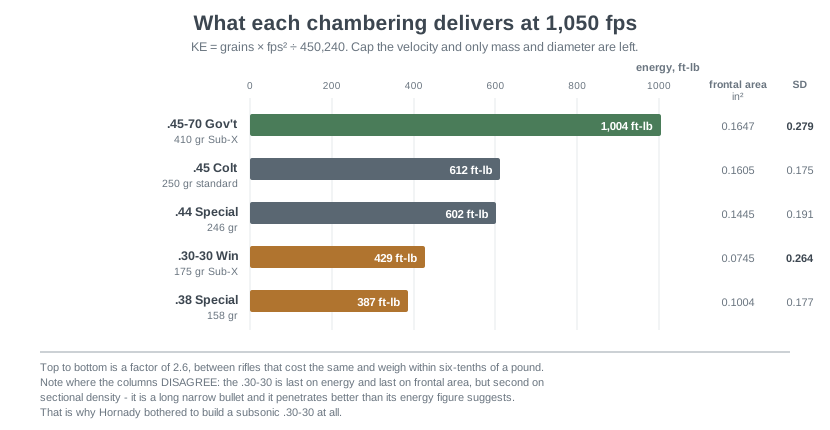
Five volumes of individual chapters, collected and set against each other. This volume does three things: state the physics that makes the ranking come out the way it does, give the ranking, and then argue that the ranking is the wrong tool for about half the people reading it.
10.1 The Physics, in One Paragraph
Kinetic energy is ½mv², so velocity is worth more than mass — twice as much, in the exponent. Which means the moment you agree to cap velocity at about a thousand feet per second, you have thrown away the variable that normally does the work, and you are left competing on the two that remain: how much the bullet weighs, and how big a hole it makes going in.
That is why the subsonic ranking looks nothing like the supersonic one. Supersonic, the .30-30 beats the .45 Colt comfortably at any sensible range. Subsonic, it is not close, and the .30-30 loses to a cartridge from 1873 by a factor of two and a half.
Subsonic shooting is a big-bore, heavy-bullet game. It has been ever since the .45 ACP, and none of the modern engineering changes it.
10.2 The Table
Every model on its best factory-available quiet load, at a common 1,050 fps:
Table 1 — Every model on its best factory-available quiet load, at a common 1,050 fps
| Rank | Model | Quiet load | Bullet | Energy | Frontal area | SD | Subsonic margin |
|---|---|---|---|---|---|---|---|
| 1 | .45-70 Gov’t | Hornady 410 gr Sub-X | 410 gr / .458 | ~1,004 ft-lb | 0.1647 in² | 0.279 | Excellent — 1,010 fps handload documented from 16 in |
| 2 | .45 Colt | Standard 250–300 gr | 250 gr / .452 | ~612 ft-lb | 0.1605 in² | 0.175 | ⚠ Verify — carbine gain puts it near the line |
| 3 | .44 Mag / .44 Spl | .44 Special 246 gr | 246 gr / .429 | ~602 ft-lb | 0.1446 in² | 0.191 | Comfortable |
| 4 | .30-30 Win | Hornady 175 gr Sub-X | 175 gr / .308 | ~429 ft-lb | 0.0745 in² | 0.264 | Good — but only two loads exist |
| 5 | .357 / .38 Spl | .38 Special 158 gr | 158 gr / .357 | ~387 ft-lb | 0.1004 in² | 0.177 | ⚠ Thin — verify carefully |
Top to bottom is 1,004 against 387 — a factor of 2.6. That is not a difference in degree between rifles that cost the same money and weigh within six-tenths of a pound of each other; it is a difference in what job the rifle can do.
10.3 Reading the Columns Against Each Other
The columns disagree in ways worth understanding, because each of them is answering a different question.
Energy is the headline and the crudest measure. It tells you how much work the bullet can do in total, and nothing about how it does it.
Frontal area is the one that matters most at these velocities. A subsonic expanding bullet may or may not open — Volume 8 explains how hard the engineering is — so the diameter you start with is the diameter you are guaranteed. This is where .45-70 and .45 Colt separate themselves from everything else, and where .30-30 is worst by a wide margin at 0.0745 in², 45 % of the .45-70’s.
Sectional density governs penetration, and it produces the table’s one genuine surprise: the .30-30, dead last on frontal area, is second on sectional density at 0.264 — ahead of the .44 Special, the .45 Colt and the .38 Special. It is a long, narrow bullet, and long narrow bullets drive deep. That is a real capability and it is why Hornady bothered to build Sub-X: at 60 yards on a deer, penetration plus reliable expansion beats raw energy.
Subsonic margin is the column people skip and should not. A cartridge that theoretically wins and is actually supersonic in your barrel on the day has lost. The two ⚠ rows are ⚠ for the reason Volume 5 sets out at length: carbine barrels make pistol cartridges faster than the box says.
10.4 The Ranking Is the Wrong Tool for Half of You
Here is the argument against the table just built.
It ranks the rifles on one axis — quiet terminal effect — and that is not why most people buy a lever gun.
If the rifle’s job is a suppressed evening of steel plates and informal practice, then energy at the target is worth nothing at all and the ranking inverts almost exactly:
Table 2 — If the rifle's job is a suppressed evening of steel plates and informal practice, then energy at the target is worth nothing at all and the ranking inverts almost exactly
| For volume shooting | Why |
|---|---|
| 1. .357 / .38 Spl | Cheapest centerfire ammunition made; least recoil; 7 + 1 |
| 2. .45 Colt | Lightest and shortest rifle; mild; 7 + 1 |
| 3. .44 Mag / .44 Spl | Slightly more expensive, more capable |
| 4. .30-30 | Rifle ammunition prices; 4 + 1 |
| 5. .45-70 | Most expensive per round; most recoil; 4 + 1 |
That is a completely defensible ranking of the same five rifles, and for a lot of buyers it is the correct one. The .357 model finishing last on physics and first on practice is not a contradiction — it is two different questions.
The reason the dive leads with the terminal ranking is that the series is called HUSH and Henry’s stated brief was the suppressed rifle. Judged against its own brief, the ranking in § 10.2 is the right one. Judged against how a lever gun usually gets used, § 10.4’s is.
10.5 The Recommendations, by Job
Cutting through both tables:
For the thing this series exists to do → .45-70 (H010H). A thousand foot-pounds with no crack, from a 6.7-pound rifle. Nothing else here is in the category. Accept 4 + 1, expensive ammunition, and real recoil on full loads.
For one rifle that does two genuinely different jobs → .44 Magnum / .44 Special (H012H). The dual chambering where both halves are worth having: 1,200 ft-lb supersonic, 600 quiet, both factory. The most complete rifle in the series and the one most people should buy.
For the handiest, most pleasant one → .45 Colt (H012CH). Lightest, shortest, 7 + 1, no twist question, and second on terminal performance. Just chronograph the ammunition.
For a hunter who already uses a .30-30 and wants it suppressed → .30-30 (H009H). Good at that, cheap to feed, and it gains a narrow but real quiet capability on two boxes.
For shooting it a lot, when cost matters → .357 / .38 Special (H012MH). By a mile. Just do not expect it to be the quiet-and-lethal rifle; it is the quiet-and-cheap one.
10.6 The Two-Rifle Answer
If you are going to end up with more than one, the pairing that covers the most ground with the least redundancy is .45-70 and .357/.38 — the extremes rather than the middle.
They share nothing and overlap nowhere: the heaviest quiet load in the series and the cheapest, the most capable rifle and the most shootable. Buy the .44 in the middle and you own two rifles that do similar things.
And they can share one suppressor — a large-bore rifle can rated for .45-70 will mount and safely fire both, at an over-bore decibel cost on the .357. Whether that is the right call is Volume 11’s subject, and the answer turns out to be “usually, but not obviously.”
10.7 Bibliography
- All energy figures computed as KE = grains × fps² ÷ 450,240 at a common 1,050 fps; frontal area from nominal bullet diameter; sectional density as (grains ÷ 7,000) ÷ diameter².
- Load and velocity sources are given in the individual caliber volumes: Volume 5 (.45 Colt), Volume 6 (.357/.38), Volume 7 (.44), Volume 8 (.30-30), Volume 9 (.45-70).
- Henry Repeating Arms, SPD HUSH Series specification table — weights, capacities, twist rates and lengths.
- Subsonic threshold values as computed in Volume 4.
Comments (0)