Henry SPD HUSH · Volume 6
.357 Magnum / .38 Special — The Quietest to Shoot, the Least to Show
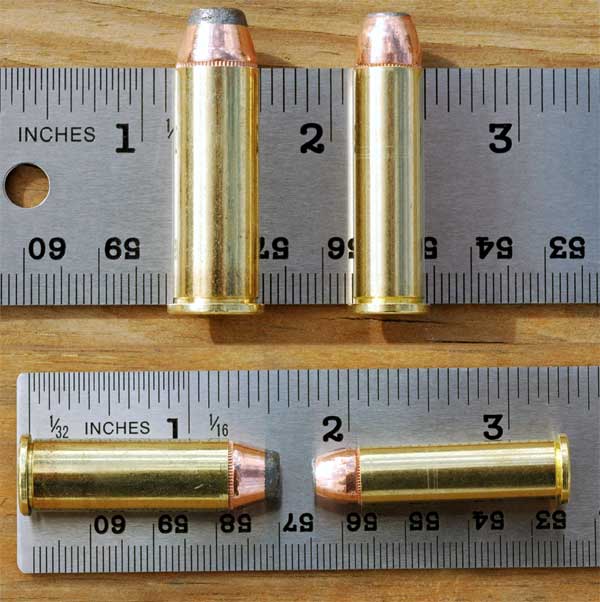
Model H012MH · 1:16 twist · 7 + 1 · 6.4 lb · 34.29 in
This is the model that will sell best and the model that makes the least sense for what the series is for. Both of those things are true at once, and it is worth being precise about why rather than dismissing it.
6.1 The Magnum Half Is Not in the Conversation
.357 Magnum from a 16.5-inch barrel is emphatically supersonic and there is nothing to be done about it.
The cartridge gains more from a carbine barrel than almost anything else in the pistol-cartridge family — it was designed with slow powder and a long pressure curve that a 4-inch revolver simply wastes. Revolver velocities in the 1,270 fps range from 2.5 inches become carbine velocities well over 1,600, and the light-bullet loads go higher still.
A specific carbine figure is deliberately not printed here. The one number the research surfaced — 150-grain loads “around 2,280 fps” from a 16-inch .357 — is far outside the published range for the cartridge and could not be corroborated, so it does not belong in a reference document. The defensible statement is that .357 Magnum from this barrel is comfortably supersonic across every factory bullet weight, by a margin that no load selection closes.
So on .357 Magnum, the HUSH is a comfortable rifle, not a quiet one. Which is fine — see Volume 4 on why comfortable is a real product — but it means the magnum chambering contributes nothing to the thing the rifle was designed for.
6.2 The .38 Special Half Is the Quiet Load, and It Is Close to the Line
.38 Special is where the quiet lives, and it is closer to the edge than people expect for exactly the reason Volume 5 laid out.
Revolver figures: .38 Special around 836 fps and +P around 960 fps from a 2.5-inch barrel.1 Add the carbine gain — smaller than the magnum’s, because .38 Special uses faster powder, but real — and standard-pressure .38 Special out of 16.5 inches lands somewhere in the 1,000 to 1,150 fps band depending on the load.
Which means: some .38 Special is subsonic out of this rifle and some is not, and +P probably is not, and at 20 °F the threshold drops to 1,074 fps and takes another slice of the margin with it.
Same instruction as everywhere else in this dive: chronograph it, out of this barrel, in the cold. Standard pressure, heavy for calibre, and verify.
6.3 The Structural Problem: There Is No Bullet
Suppose you do all that and land a genuinely subsonic .38 Special load. Here is what you have.
At subsonic velocity there is no velocity left to trade, so terminal effect comes down to mass and frontal area. And .357 is the smallest bore in the series:
Table 1 — At subsonic velocity there is no velocity left to trade, so terminal effect comes down to mass and frontal area. And .357 is the smallest bore in the series
| Bore | Diameter | Frontal area | Relative to .357 |
|---|---|---|---|
| .30-30 | .308 in | 0.0745 in² | 0.74× |
| .357 / .38 | .357 in | 0.1004 in² | 1.00× |
| .44 | .429 in | 0.1446 in² | 1.44× |
| .45 Colt | .452 in | 0.1605 in² | 1.60× |
| .45-70 | .458 in | 0.1647 in² | 1.64× |
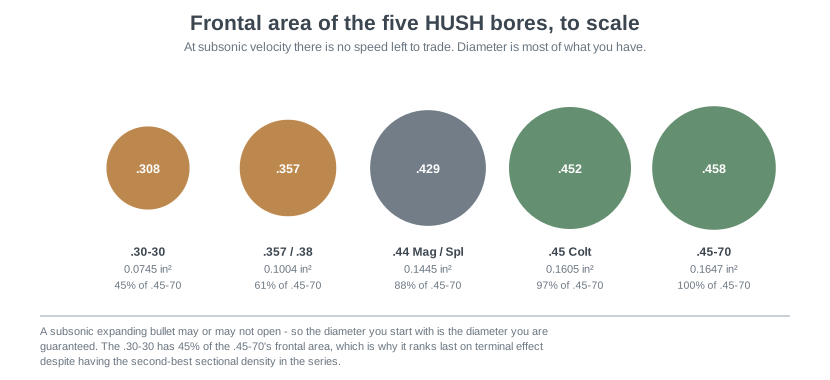
And the bullets are light. A heavy .38 Special bullet is 158 grains. At 1,050 fps that is:
158 × 1,050² ÷ 450,240 = ≈ 387 ft-lb
That is the lowest number in the series — below even the .30-30, which has less than three-quarters of the frontal area but carries 175 grains. Against the .45-70’s thousand-plus it is not in the same category of tool.
Sectional density, which governs penetration, is no better: 0.177 for a 158-grain .357, against 0.279 for a 410-grain .45-70.
6.4 So Why Would Anyone Buy It
Because the numbers above are the wrong test for what most people want this rifle for, and they should not talk anyone out of a good decision.
It is the cheapest to shoot by a wide margin. .38 Special is among the least expensive centerfire ammunition made. If the rifle’s job is a suppressed evening of steel and cans in the back forty, the .357 model costs a fraction of what the .45-70 does per trigger pull, and the .45-70 model gives you exactly nothing extra for that money at 50 yards on a steel plate.
It recoils least. In a 6.4-pound rifle firing subsonic .38 Special, recoil is negligible. This is the model to hand to a new or small-framed shooter, and it is the model you can shoot for two hours without developing a flinch.
It is the most versatile as a rifle rather than as a quiet rifle. .357 Magnum from a carbine is a legitimate 100-yard deer cartridge in the states that allow it, and .38 Special makes the same rifle a plinker. That range of capability from one gun is real.
It has no stability question. 1:16 with short, stubby pistol bullets designed at these velocities — nothing in Volume 4’s twist discussion applies. It just works.
And it is genuinely, subjectively quiet. Hook & Barrel, testing the .357 model, wrote that from five yards away it “sounded like a high-powered air rifle, not a centerfire.”2 That is a subjective observation and it is labelled as one, but it is the experience people are buying.
6.5 A Note on That Test, Because It Illustrates Volume 11
The suppressor Hook & Barrel used on the .357 was a Banish 46-V2 — a .458-bore can on a .357 bore.2 That works safely, and it is a common thing to do when you own one big can, but it is heavily over-bore: every thousandth of clearance between the bullet and the end cap is gas escaping forward instead of being trapped.
American Rifleman, testing the same chambering with a Banish 9 — a properly-sized can — measured about 151 dB unsuppressed dropping to 137 dB suppressed.3
🔴 Do not read those two results against each other. They are different cans, different rifles, different protocols and, in one case, a subjective impression rather than a measurement. Cross-comparing published sound numbers is how confident nonsense gets made, and it is a rule across this whole Suppressors category. The point of putting them side by side is only that bore size is a decibel decision, which Volume 11 takes up properly.
6.6 The Verdict
The .357 HUSH is the best rifle in the series and the worst HUSH.
If the question is “which of these is the most fun, the cheapest to feed, the easiest to shoot, and the most versatile as a general-purpose carbine,” it wins outright. If the question is “which of these best fulfils the design brief of a suppressed rifle that puts something meaningful on target quietly,” it comes last, and it comes last on physics that no amount of load development fixes.
It is not a bad rifle. It is a rifle whose magnum chambering is irrelevant to the purpose the series exists for, and whose quiet load is the weakest of the five. Buy it knowing which of those two questions you are answering.
6.7 Bibliography
- Henry Repeating Arms, SPD HUSH Series specification table — H012MH figures.
- Frontal-area and kinetic-energy figures computed from nominal bullet diameters and KE = grains × fps² ÷ 450,240.
- Marlin Owners forum, “.38 Special velocity from a .357 carbine or rifle” — community chronograph reports.
Footnotes
-
Shooting Illustrated, “Snubbie Ballistics: .38 Special vs. .357 Magnum” — 836 fps .38 Special and 960 fps +P from a 2.5-inch S&W revolver; 1,276 fps .357 Magnum from the same. ↩
-
Hook & Barrel, “Henry SPD HUSH Review” — .357 model, Silencer Central Banish 46-V2, subjective sound observation, 0.60 in group at 50 yd. ↩ ↩2
-
American Rifleman, “Review: Henry SPD Hush Rifle” — .357 model with a Banish 9; ~151 dB unsuppressed to 137 dB suppressed; ~1 % suppressed velocity increase. ↩
Comments (0)