Henry SPD HUSH · Volume 12
Living With It — Loading, Zeroing, Hunting, and the Honest Verdict
The last volume is the practical one: what actually changes about owning and using this rifle once the suppressor is on it, and a verdict that tries to be fair to a rifle that was not fired for this dive.
12.1 The Side Gate Is the Loading System
🔴 With a suppressor mounted, you cannot load through the magazine tube. The can covers it.
Two independent hands-on reviews found this separately — American Hunter and Hook & Barrel both report it as a practical constraint rather than a design note.12 Henry’s own coverage frames it from the other side: the side gate “eliminates the need to remove the magazine tube.”3
This single fact is the best evidence that the suppressor genuinely was the design brief, because a lever gun without a side gate would be a rifle you had to unscrew a suppressor from to reload — which is to say, not a suppressed rifle at all.
What it means in practice:
- Learn to load through the gate before you need to. It is a different motion from tube loading, it is done one round at a time, and it is worth being fluent at it in daylight on a bench before doing it cold and in a hurry.
- You still get the tube for cleaning and unloading. The .45-70 model has a removable magazine liner. That is a bench operation, not a field one, and not something you do with a can fitted.
- Top-up loading is a genuine advantage. Side-gate loading lets you keep the rifle full without cycling the action, which the tube never did well.
- If you are cross-shopping other lever guns as suppressor hosts, ask about the side gate first. It is not a preference; it is whether the rifle works suppressed at all.
12.2 Zero, Twice
Record a can-on and a can-off zero for this rifle and keep both.
American Rifleman measured the point of impact moving about 8 inches high at 50 yards on the .357 model with the suppressor fitted.4 That is a very large shift. It is not a defect — a can changes the barrel’s harmonics and adds a substantial cantilevered mass, and some shift is expected on any rifle — but the magnitude is a reminder that this is a measurement, not an estimate.
Practical protocol, the same one this collection uses for the .22 battery where one can serves six hosts:
- Zero suppressed, since that is the configuration the rifle is designed for and the one you will hunt in.
- Fire a group unsuppressed at the same distance and write down the offset.
- Re-check after any remount if you are running quick-detach, and after the first few outings if direct-thread — threads settle.
- Confirm the zero in cold weather, because you are going to be at the range in the cold anyway to chronograph the ammunition (§ 12.3).
12.3 The Measurement This Whole Dive Asks You to Take
If you do one thing with this rifle before hunting it, do this:
Chronograph your chosen quiet load, out of this 16.5-inch barrel, at the temperature you will actually shoot it.
Volume 4 established why: the speed of sound is 1,126 fps at 68 °F but only 1,074 fps at 20 °F, so a Michigan November morning lowers the bar your bullet has to stay under by about 50 fps. And Volume 5 established the other half: a carbine barrel adds a couple of hundred feet per second to a pistol cartridge, which is enough to push a load sold as subsonic over the line.
Both effects push the same way, and neither is printed anywhere on the box.
Nobody publishes this number for this rifle. It depends on your barrel, your load, your lot, and the air on the day. It is a twenty-minute job with a chronograph and it is the difference between a rifle that is quiet and a rifle that you believed was quiet.
12.4 Cleaning and Care
- The carbon wrap wants to be left alone. Standard bore care through the stainless liner is unchanged; keep aggressive solvents and heat off the wrap itself. Do not attempt to clean a carbon-wrapped barrel the way you would strip a steel one.
- Lead fouling accumulates in the can. Cast bullets are cheap and pleasant in .45 Colt, .44 Special and .38 Special, and they foul a suppressor considerably faster than jacketed or polymer-coated projectiles. If you shoot volume through a can, coated or jacketed is worth the money.
- Subsonic loads burn dirtier at the muzzle, because the powders that work down here are fast and the charges are small relative to the case. Expect more residue than a supersonic load leaves.
- Let it cool between strings. Volume 2 noted the carbon-barrel heat argument is contested; a suppressor traps heat at the muzzle regardless of which side of that argument is right, and this is a rifle designed to be shot slowly.
12.5 Hunting It
In Michigan, suppressors are legal to own and legal to hunt with — all game, all seasons, no state permit or endorsement beyond the federal process. Michigan tracks federal law here and adds nothing of its own. The Suppressor Law dive has the federal process and the state-by-state picture.
Things worth thinking about before opening morning:
- There are no iron sights and no backup. If the optic fails, the rifle is out of the hunt. That is a deliberate weight decision (Volume 2) and it deserves a plan, not a shrug.
- The M-LOK fore-end is there for a reason. Suppressed lever guns are being bought heavily for night predator and hog work, and a light or a thermal is the point of those slots.
- Know your loaded configuration. A mixed magazine tube — .44 Special over .44 Magnum, or a subsonic behind a full-power load — is a way to be surprised by recoil, by point of impact, and by a crack you were not expecting. Fill the tube with one load.
- Range discipline changes. Subsonic .45-70 at 1,050 fps drops fast. It is a genuinely quiet, genuinely lethal cartridge inside about 100 yards and it is not a 200-yard proposition. Know your drops before you need them.
- You can hear again. The thing nobody puts in a spec table: shooting suppressed means you can hear what happens after the shot, hear the woods, and talk to whoever is with you. On a hunting rifle that is worth more than most of the numbers in this dive.
12.6 What Is Not Known
None of these rifles was fired for this dive, and everything measured in this dive is somebody else’s measurement, attributed where it appears. Three specific gaps are worth naming rather than papering over:
- No chronograph data from a 16.5-inch HUSH. The .45 Colt argument in Volume 5 rests on a chronograph report from a different 16-inch rifle plus the general behaviour of pistol cartridges in carbines. The direction and rough magnitude can be stated with confidence; a specific number for this rifle does not exist publicly.
- No 1:22 stability result above 410 grains. Volume 9 sets out exactly why the heavy Steinel subsonic loads are outside the envelope that has published support, and equally why that is not the same as saying they fail.
- No sound measurement that can be compared to another. The 151 → 137 dB figures are one can, one rifle, one protocol. The rule across this whole Suppressors category is that dB figures are not compared across protocols, and this dive obeys it.
12.7 The Verdict
The claim is true. This is a lever action that was actually designed around a suppressor rather than threaded for one.
The evidence is not the marketing; it is the parts list and one detail. Every material change — carbon barrel, skeletonised fore-end, carbon rail, hollowed stock, deleted sights — removes weight from ahead of the balance point, which is the only fix that improves handling and carry weight at once. The rifle is deliberately tail-heavy without the can and comes right with it fitted, which is a choice you can only make on purpose. And the side gate is load-bearing, because a suppressor covers the magazine tube and a lever gun that cannot be reloaded suppressed is not a suppressor host.
Where it falls down is not the rifle. It is that two of the five chamberings do not deserve it. The .357 model’s quiet load is the weakest in the series by physics that no load development fixes, and the .30-30’s is confined to two boxes of ammunition by a twist rate that closes the door on handloading heavier. Both are good rifles. Neither is what the name promises.
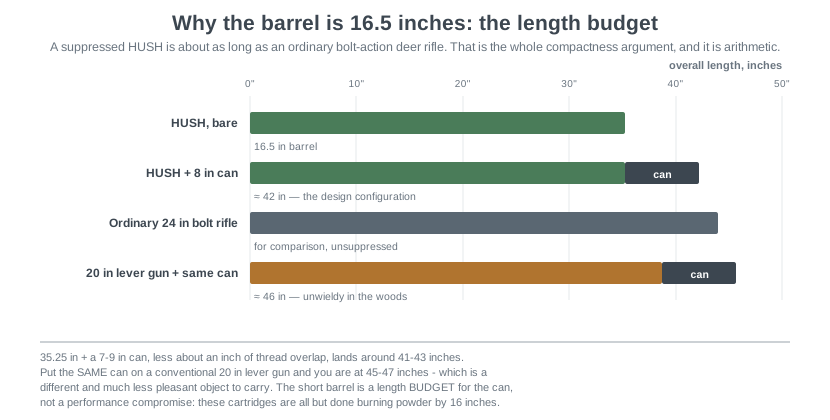
And where it succeeds it succeeds completely. The .45-70 model puts over a thousand foot-pounds through the largest frontal area in the series with no supersonic crack at all, from a 6.7-pound, 35.25-inch rifle that measures about 42 inches with a can on it. No other production rifle is known to do that.
Buy the .45-70 if you want what the series is for. Buy the .44 if you want one rifle that does two jobs well. Buy the .357 with your eyes open about what it is — the cheapest, mildest, most-shootable one, and the last one you would pick if the target has to fall over.
And whichever you buy: chronograph the ammunition, in that barrel, in the cold. Everything else in this dive is somebody’s specification. That part is yours.
12.8 Bibliography
- Silencer Shop Michigan state pages; Michigan Department of Natural Resources 2026 Deer Hunting Regulations Summary — suppressor legality for hunting, all game and seasons.
- Henry Repeating Arms, SPD HUSH Series specification table.
- Speed-of-sound, energy and stability figures as computed in Volume 4 and applied in Volumes 5 through 10.
Footnotes
-
American Hunter, “Hardware Review: Henry SPD HUSH” — suppressor blocking the magazine tube; removable magazine liner. ↩
-
Hook & Barrel, “Henry SPD HUSH Review” — suppressor blocking the magazine tube, loading through the receiver port. ↩
-
American Rifleman, “Gun Of The Week: Henry SPD HUSH” — side gate eliminating the need to remove the magazine tube. ↩
-
American Rifleman, “Review: Henry SPD Hush Rifle” — approximately 8 inches of high point-of-impact shift at 50 yards with the suppressor mounted. ↩
Comments (0)