Henry SPD HUSH · Volume 11
Choosing the Can — Thread Pitch Is Not Bore Diameter
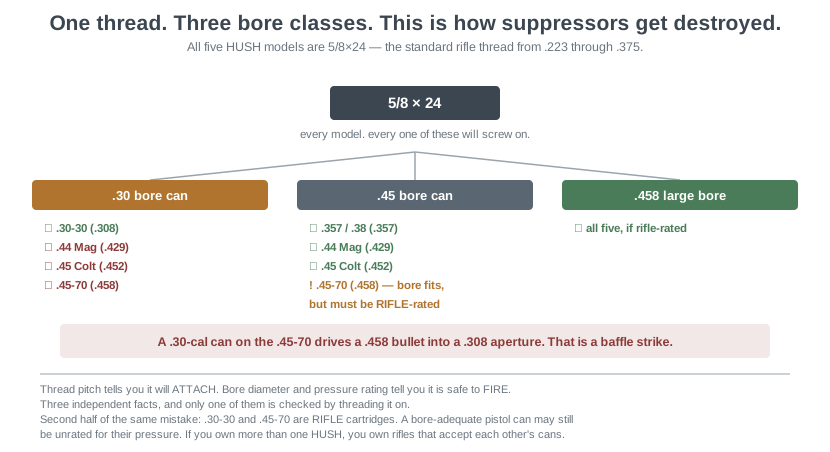
The rifle is half the system. This volume is about the other half, and it opens with the mistake that can destroy both.
11.1 The Trap: One Thread, Three Bore Classes
🔴 All five HUSH models are threaded 5/8×24. That is the industry-standard thread for rifle cartridges from .223 through .375 — by a wide margin the most common rifle muzzle thread in existence.
Which means: essentially every rifle suppressor on the market will screw onto a .45-70 HUSH. Including a .30-calibre can with a bore around .308.
A .45-70 bullet is .458 inch.
Put a .30-cal can on the .45-70 model and the first round fired drives a .458 bullet into a .308 aperture. That is a baffle strike — a destroyed suppressor, a possibly destroyed rifle, and shrapnel leaving the muzzle in whatever direction the geometry dictates.
Thread pitch tells you the suppressor will attach. Bore diameter and pressure rating tell you it is safe to fire. These are three independent facts and only one of them is checked by threading it on.
This is not an exotic failure mode. It is the single most common way people damage suppressors, and the HUSH series is unusually exposed to it because five rifles spanning .308 to .458 all wear the same thread. If you own more than one HUSH, you own rifles that will happily accept each other’s suppressors and must not.
11.2 What Each Model Actually Requires
Table 1 — 11.2 What Each Model Actually Requires
| Model | Bullet dia. | Minimum can bore | Pressure class required |
|---|---|---|---|
| .357 / .38 Spl | .357 | 9mm / .35 bore or larger | Magnum-pistol rated is adequate |
| .44 Mag / .44 Spl | .429 | .45 bore | Magnum-pistol rated |
| .45 Colt | .452 | .45 bore | Magnum-pistol rated |
| .30-30 Win | .308 | .30 bore or larger | 🔴 Rifle rated |
| .45-70 Gov’t | .458 | 🔴 .458 / large bore | 🔴 Rifle rated |
⚠ The second half of the same mistake is pressure, and it catches people who got the bore right. .30-30 and .45-70 are rifle cartridges. A .45-bore pistol can will pass a .458 bullet without touching it and may still be entirely unrated for .45-70 chamber pressures and gas volume. Bore adequacy and pressure rating are separate checks; do both.
The three pistol-caliber models are the forgiving ones here — a magnum-pistol-rated .45 can covers .45 Colt and .44 Magnum, and a 9mm can covers .357 Magnum. That is a well-populated, inexpensive part of the market.
11.3 What the Reviewers Actually Ran
Useful as a reality check on the size classes:
Table 2 — Useful as a reality check on the size classes
| Rifle | Can used | Note |
|---|---|---|
| .357 Mag | Banish 9 | Correctly sized — American Rifleman1 |
| .357 Mag | Banish 46-V2 | ⚠ .458 bore on a .357 bore — very over-bore, Hook & Barrel2 |
| .45-70 | Banish 46 V2 | Correctly sized — American Hunter3 |
Large-bore cans commonly listed as rated for .45-70 / .458 SOCOM include the SilencerCo Hybrid 46 and 46M — titanium, Inconel and stainless, around 14.1 oz, the 46M rated up to .460 Weatherby Magnum — and the Dead Air Primal, a fully-welded .46-bore can rated to .338 Lapua Magnum.4
These are model names in a fast-moving market and they will date. The category — a large-bore, rifle-rated, .458-capable can — will not. Treat the names as examples of the class, not as recommendations with a shelf life.
11.4 Over-Bore Costs Decibels, and That Is the Whole One-Can Trade
The Hook & Barrel configuration above — a .458-bore can on a .357 barrel — is safe, common, and loud for its size.
Every thousandth of clearance between the bullet and the end-cap aperture is gas escaping forward past the bullet instead of being trapped and slowed. A can two bore classes too large leaks a great deal of it. This is a real, consistent and unfixable penalty, and the Suppressors by Caliber dive documents it at length for the .30-calibre case.
The one cheap fix, where the design allows it: interchangeable end caps. A large-bore modular can with a tighter cap fitted for the smaller host recovers most of the loss for very little money, and it is the best decibels-per-dollar available anywhere in the category.
11.5 The One-Can Question for This Series
Yes, one large-bore rifle can rated to .45-70 will cover all five HUSH models. It will mount and safely fire every one of them — .458, .452, .429, .357 and .308 all pass through a .46 bore without complaint, and a .45-70-rated can is comfortably over-rated for everything else in the series.
What it costs you:
- Decibels on the small bores. Most on the .30-30 and .357, least on the .45 Colt and .44.
- Weight and length everywhere. A .45-70-rated can is a large object, and Volume 3’s balance argument was written around “a big-bore suppressor,” so this is at least the right class — but it is more can than the .357 model needs or wants.
- One point of failure and one zero to track per host. Every time it moves rifles, the point of impact moves with it. See § 11.7.
When it is clearly right: you own the .45-70 model, or you own two or three HUSH rifles and want one stamp.
When it is clearly wrong: the .357 model is your only HUSH and you bought it to shoot cheaply and quietly. Buy the 9mm-class can. It is smaller, lighter, less expensive, and quieter on that rifle than the big one is.
11.6 Sizing the Can to the Rifle
Volume 3 established that the HUSH is designed to balance with a suppressor, and that the bare rifle is deliberately the compromised configuration. That has a consequence for buying:
The can is part of the handling decision, not an accessory to it. A 24-ounce, 9-inch .45-70 can and a 14-ounce, 7-inch one produce two meaningfully different rifles once mounted, and Henry balanced around a range rather than a number.
Overall length arithmetic, which is simple and worth doing before you buy:
35.25 in rifle + 7 to 9 in can − about 1 in of thread overlap ≈ 41 to 43 inches
That is about the overall length of an ordinary 24-inch-barrelled bolt-action deer rifle — which is the whole reason the barrel is 16.5 inches. The compactness claim survives contact with the arithmetic. Put the same can on a 20-inch lever gun and you are at 45 to 47 inches, which is a different and considerably less pleasant object in the woods.
11.7 Mounting, Zero and the Thing to Measure
Direct-thread or quick-detach is the usual question. On a rifle you shoot slowly, in modest volume, and largely leave suppressed, direct thread is fine and saves weight, length and money. QD earns its keep when the can moves between hosts often — which, if you take the one-can route in § 11.5, it will.
🔴 Whatever you choose, record the can-on and can-off zero offset, per rifle. American Rifleman measured the point of impact shifting about 8 inches high at 50 yards on the .357 model with the can mounted.1 That is a very large shift, it is not a defect, and it is exactly why the measurement matters: a rifle zeroed suppressed is not zeroed unsuppressed, and finding that out on an animal is not acceptable.
The same practice is standard on the .22 battery in this collection, where one suppressor moves between six hosts — one recorded offset per rifle, checked after any remount.
11.8 The Federal Side, Briefly
The transfer tax on a suppressor went to $0 on 1 January 2026. Everything else survived intact — the registration, the Form 4, the fingerprints, the photograph, the background check, and the approval-before-possession requirement. The tax changed; the regulatory scheme did not, and the number of people who believe otherwise is remarkable.
The Suppressor Law dive covers the process, the litigation and the state-by-state position properly. What matters here is only the timing consequence Volume 3 flagged: you will very likely own this rifle for some months before you own the thing it was designed around.
In Michigan: suppressors are legal to own and legal to hunt with, for all game and all seasons, with no state permit or endorsement beyond the federal process. Michigan tracks federal law here and adds nothing.
11.9 Bibliography
- Silencer Central, Rugged Suppressors, Primary Arms and JK Armament thread-pitch guides — 5/8×24 as the standard rifle thread for .223 through .375, and the thread-versus-bore distinction.
- Silencer Shop Michigan state pages; Michigan Department of Natural Resources 2026 Deer Hunting Regulations Summary.
- Henry Repeating Arms, SPD HUSH Series specification table — thread pitch and overall lengths.
Footnotes
-
American Rifleman, “Review: Henry SPD Hush Rifle” — Banish 9 on the .357 model; approximately 8 inches of high point-of-impact shift at 50 yards. ↩ ↩2
-
Hook & Barrel, “Henry SPD HUSH Review” — Banish 46-V2 on the .357 model. ↩
-
American Hunter, “Hardware Review: Henry SPD HUSH” — Banish 46 V2 on the .45-70 model. ↩
-
SilencerCo product material on the Hybrid 46 and Hybrid 46M; Silencer Central and Silencer Shop large-bore / .458 SOCOM category pages; Dead Air Primal specifications. ↩
Comments (0)