Experimental Sensing · Volume 1
Ideas at the Edge — What Counts as Evidence, and How Each Idea Is Judged
The sensing ideas the other Sensing and Aiming dives handed on, plus the ones research turned up: what each could buy a Pico gun with a PixArt PAJ7025R3 camera, what has actually been published or sold, and the yardstick every later volume uses
1.1 What This Dive Is For
Every light gun built since the CRT went away aims in one of two ways. Either a camera in the gun finds infrared points at the screen (IR Point Tracking), or it finds a bright border drawn round the picture (Border Tracking). Both work, both are sold, and the reference gun in this category uses the first: decision BT-1 in the category’s decision log re-checked infrared against border and kept infrared.
While those dives were written, each of them ran into ideas it could not settle from the evidence in hand and passed them on:
- IR Point Tracking found that the PixArt PAJ7025 sensor has a frame-subtraction feature and an LED-sync pin that no light-gun firmware uses, and asked whether a bar synchronised to the camera, the home equivalent of the arcade “frequency jumper”, or passive retroreflectors lit from the gun could use them (Volume 1, §1.9; Volume 2, §2.9).
- CRT Timing generalised the Zapper’s flash-frame trick into coded frames, Gray-code patterns that tell a photodiode where it is pointing on any display, and handed the question on because no published light gun uses them (Volume 7, §7.6).
- Border Tracking showed that a border tracker running inside the gun on a microcontroller-class camera is plausible on paper and unpublished, and that a hybrid of infrared and border might help where a bar cannot be mounted (Volume 2, §2.9; Volume 8).
- Reference Electronics set aside general-purpose and global-shutter cameras as the kit camera because no light-gun firmware for them was found (Volume 3).
This dive takes those ideas, adds the ones that a search of papers, patents, repositories and product pages turned up, and gives each an engineering assessment, a bench experiment that can be run with the lab’s own instruments, and a verdict. It is a reference for ideas, not a build guide: nothing in it has been built or measured yet, and where a bench result will go the text says so.
1.2 What This Dive Owns, and What It Links To
This dive owns:
- PixArt frame subtraction and synchronised or modulated bars (Volume 2).
- Retroreflective targets lit from the gun (Volume 3).
- Coded frames on modern displays, and display-embedded markers that a camera could read (Volumes 4 and 7).
- General-purpose cameras on a microcontroller in the gun, for infrared blobs and for a border (Volume 5).
- Hybrids and multiple cameras: infrared with border, and two PixArt sensors of different field of view (Volume 6).
- Event cameras, time of flight and the phone as a gun (Volume 7).
- The ranking and a bench programme (Volume 8).
It links to, and does not repeat:
- IR Point Tracking — the sensor’s internals, the emitters and their link budget, point geometry, the playing envelope and failure modes. The radiometry in Volumes 2 and 3 here starts from its numbers.
- Border Tracking — how border tracking works, the open host-side pipelines, latency and displays.
- CRT Timing — the flash-frame method and what it needs from a lagging display.
- Aiming Maths and Calibration — the homography, parallax, smoothing and the latency budget.
- Positional and Inertial — angle sensors, gyroscopes and accelerometers, magnetometers, ultrasonic, magnetic and ultra-wideband positioning, optical flow, and any hybrid of an inertial sensor with an optical fix. Those are not covered here.
- Reference Electronics and Open-Source Firmware — the camera choice, the bar circuit, the board and the firmware as built.
1.3 The Gun Every Idea Is Judged Against
An idea is only worth a bench afternoon if it could improve the gun actually being built. The decisions that define it, from the category’s decision log:
Table 1 — An idea is only worth a bench afternoon if it could improve the gun actually being built. The decisions that define it, from the category's decision log
| Decision | What it says | What it means for an idea |
|---|---|---|
| D2 | Raspberry Pi Pico (RP2040) to start | No camera interface; 264 KB of SRAM; SPI and PIO only |
| D18, P-RE16 | Kit camera: PixArt PAJ7025R3 over SPI on an 850 nm bar; the R2 as the bench comparison | Any idea must work with, or beat, a 98 × 98 blob-tracking sensor with a 113° lens |
| D25, D30 | Trial the OpenFIRE ESP32-S3 port and its wireless dongle as a separate track | An ESP32-S3 with a camera interface and a radio is on the bench anyway |
| BT-1 | Infrared, re-checked against border, unchanged | A border idea must say what it adds to an infrared gun |
So the question for each idea is concrete: what would it add to a Pico with a PAJ7025R3 and an 850 nm bar, or to the ESP32-S3 trial, and at what cost? Two weaknesses of the chosen design come up again and again, because IR Point Tracking measured them by arithmetic:
- The R3 collects about a thirty-ninth of the light the R2 collects from the same emitter, because its wide lens has a far smaller entrance pupil, so its range on a given bar is about a sixth of the R2’s (IR Point Tracking, Volume 2, §2.8).
- A steady bar shares the camera’s exposure with everything else in the room. Sunlight on a wall, a lamp and a reflection all integrate over the same 300 µs (IR Point Tracking, Volume 5).
Ideas that attack either weakness score well here. Ideas that solve problems the gun does not have score badly however clever they are.
1.4 The Evidence Ladder
Every idea in this dive carries one of three labels, and the label is set by the best evidence found, not by how promising the idea sounds.
Table 2 — 1.4 The Evidence Ladder
| Label | Meaning | Examples of acceptable evidence |
|---|---|---|
| Idea | Nobody was found to have built it for this purpose | A datasheet feature unused by any published project; an arithmetic argument |
| Prototype exists | Someone has built and described it, for a light gun or for a closely related pointing task | A paper with measurements; a public repository with working code and its author’s numbers; a published demonstration |
| Product exists | Something with the capability is on sale | A maker’s product page or datasheet with a part number |
Three rules keep the labels honest:
- A product that has the capability is not a light gun that uses it. A Prophesee event sensor is a product; an event-camera light gun is an idea. Both facts are stated.
- A prototype for a related task is labelled as such. Johnny Chung Lee’s retroreflector finger tracking with a Wii Remote is a prototype of the optical arrangement, not of a light gun (Volume 3).
- Search summaries, forum claims and press coverage are leads, not evidence. Where only a summary was found, the claim is marked as unconfirmed and kept out of the verdict.
1.5 Four Questions for Every Idea
Each idea is put through the same four questions, and each volume ends with a section titled “Why try this, and why not the others”.
- What would it buy this build? In numbers where possible: range on the kit bar, rejection of room light, minimum distance, latency, cost per kit, or a capability the gun does not have (no bar at all, for example).
- What does it cost? Parts, with a dated price from a maker’s or seller’s page, and firmware effort.
- What is the risk? What is unknown, what could make it fail, and whether failure leaves anything useful behind.
- What bench test answers it? Using the lab as it exists: the Digilent Analog Discovery Pro ADP3450 (oscilloscope, pattern generator, logic analyser, protocol decoder), the Analog Discovery 2, the programmable supplies, the reflow and rework stations, and the machine shop for fixtures. Each test is written as a
FIGURE SLOTin the volume, naming what to capture and with which instrument.
1.6 The Ideas at a Glance
Table 3 — 1.6 The Ideas at a Glance
| Idea | Label | Best evidence | What it could buy | Verdict | Volume |
|---|---|---|---|---|---|
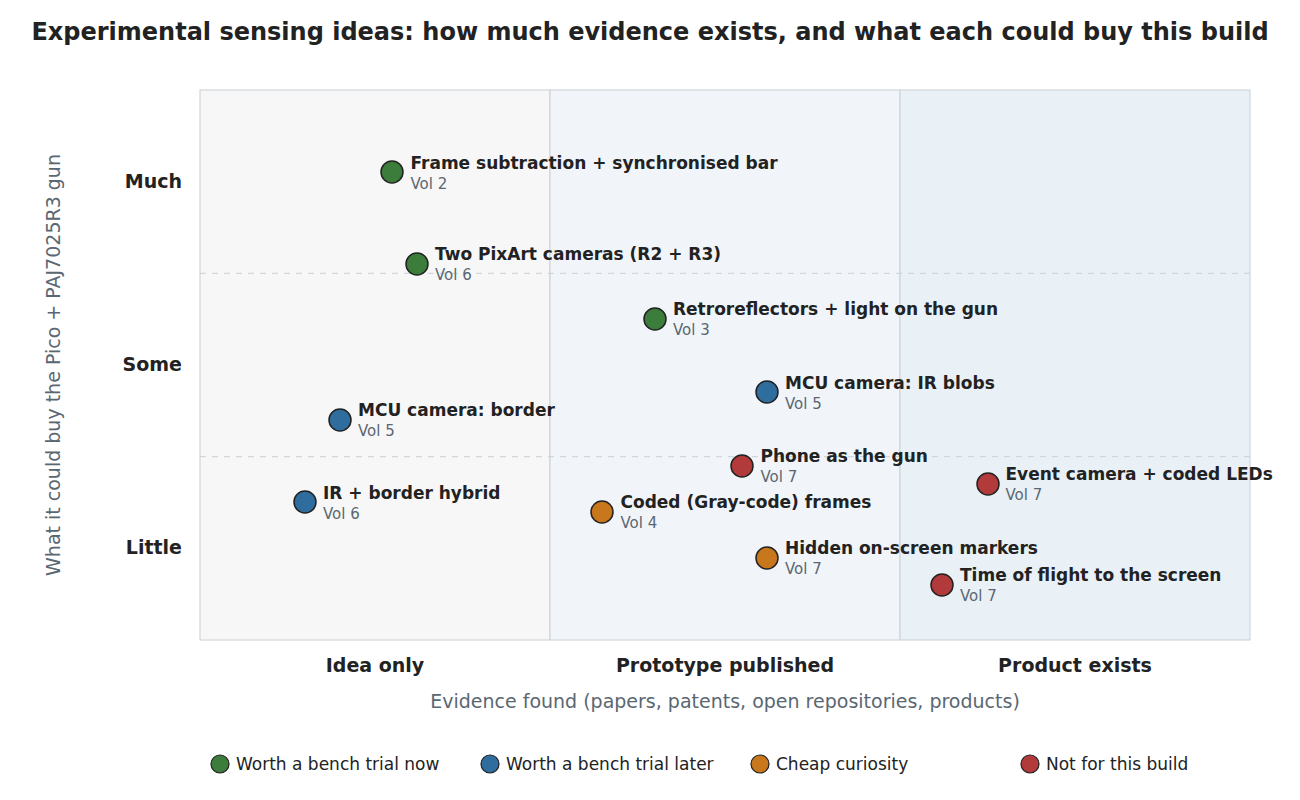
| PAJ7025 frame subtraction with a synchronised or pulsed bar | Idea (the sensor feature is a product; no light gun uses it) | PixArt PAJ7025R2 general datasheet: register Cmd_FrameSubtraction_On; LED pins rated 130 to 170 mA | Ambient rejection; several times the bar’s peak current; back some of the R3’s lost range | Bench trial now | 2 |
| Free-running modulated bar the gun locks to | Idea | Arcade frequency jumper (Sega, Namco manuals); the sensor’s frame-period register | The same, with no link to the bar and any number of guns | Bench trial now | 2 |
| Retroreflectors at the screen, light at the gun | Prototype exists (related task) | Lee’s Wii Remote finger tracking, 2007; PixArt’s “passive IR reflector” application | No power or cable at the screen | Bench trial now | 3 |
| Coded (Gray-code) frames with a photodiode | Prototype exists (related task) | Lee and others, projector calibration with embedded sensors, UIST 2004; 12 Hz tracking in 2005 | The cheapest possible gun hardware | Cheap curiosity | 4 |
| An in-gun IR blob tracker on a general camera | Prototype exists | ESP32-IR repository: 136 fps on an ESP32-S3 with an OV2640, author’s measurement; an OpenFIRE overlay | A second source of camera if PixArt supply fails | Bench trial later | 5 |
| An in-gun border tracker on a microcontroller | Idea | Arithmetic in Border Tracking Volume 2; nothing published | A border gun that is a plain USB device | Bench trial later | 5 |
| Infrared and border in one gun | Idea | Nothing published | A fallback where no bar can be mounted | Bench trial later, if at all | 6 |
| Two PixArt cameras of different field of view | Idea | The datasheets; IR Point Tracking’s envelope and light-grasp arithmetic | The R3’s close range and the R2’s reach | Bench trial now (the parts are in the sample kits) | 6 |
| Event camera with frequency-coded LEDs | Prototype exists (robotics); product exists (sensor) | Censi and others, IROS 2013; Prophesee GenX320 | Lower latency and motion blur immunity | Not this build | 7 |
| Time of flight to the screen | Product exists (sensor) | ST VL53L1X datasheet | A distance the homography already gives | Not this build | 7 |
| Imperceptible on-screen markers | Prototype exists; patent | Sampaio and others, 2015; Interphase patent US 8,982,050 | Aiming with no bar and no visible border | Cheap curiosity (host-side) | 7 |
| A phone as the gun | Prototype exists | AndroidLightGun (MIT, v1.0.0) | Nothing for this build | Not this build | 7 |
The map at the top of this volume plots the same table: evidence across, value to this build up.
1.7 What Was Looked For and Not Found
A gap is a finding, provided it was searched for in more than one way. Searches on 19 October 2026, of GitHub, the papers and patents named in each volume, and maker pages, found no published example of:
- a light gun, or any open firmware, that enables the PAJ7025’s frame subtraction or drives its LED pins (the OpenFIRE ESP32 port’s PixArt driver never writes the register; Volume 2);
- a light gun using coded or Gray-code frames on any display (CRT Timing found none either);
- a border tracker running on a microcontroller inside the gun;
- a gun combining infrared points and a border;
- a light gun with two tracking cameras of different field of view;
- a light gun built on an event camera.
Each is therefore labelled an idea, and each volume says what the bench test would establish that nobody has published.
1.8 The Volumes
Table 4 — 1.8 The Volumes
| Vol | Title | What it settles |
|---|---|---|
| 1 | Ideas at the Edge | The yardstick (this volume) |
| 2 | Frame Subtraction and the Synchronised Bar | What the PAJ7025’s own LED and subtraction features offer, three ways to synchronise a bar, and the arithmetic of pulsing |
| 3 | Retroreflectors and a Light on the Gun | Whether passive targets return enough light, and the glint from a glossy screen |
| 4 | Coded Frames on a Modern Display | How far a photodiode and Gray codes can go, and why a lens sets the limit |
| 5 | A General Camera in the Gun | Infrared blobs and a border on an ESP32-S3 or RP2040 camera |
| 6 | Hybrids and Two Cameras | Infrared with border; the R2 and R3 together |
| 7 | Further Out | Event cameras, time of flight, hidden screen markers, the phone |
| 8 | Verdicts and a Bench Programme | The ranking, the costs, the order of experiments, and proposed decision rows |
1.9 What Could Not Be Verified
- That no light gun anywhere uses the ideas listed in 1.7. The searches were broad but cannot be exhaustive; closed products (Sinden, GUN4IR, arcade cabinets) do not publish their sensing in enough detail to rule anything out.
- Every verdict rests on arithmetic and published figures until the bench tests in each volume are run.
Sources
- Light Guns decision log (
Light-Guns/DECISIONS.md): D2, D18, D25, D30, P-RE16, BT-1, read 2026-10-19. - The sibling dives as linked above: IR Point Tracking Vols 1, 2 and 5; CRT Timing Vol 7; Border Tracking Vols 2 and 8; Reference Electronics Vol 3; Aiming Maths and Calibration; Positional and Inertial (in preparation).
- Sources for each idea are listed in the volume that treats it.
Comments (0)