Experimental Sensing · Volume 8
Verdicts and a Bench Programme — What to Try, in What Order, and Why
Every experimental idea ranked against the gun being built, with its cost, its risk and the bench test that settles it; eight experiments in order on the ADP3450; and the decision rows proposed for the category's log
8.1 The Ranking
Table 1 — 8.1 The Ranking
| Rank | Idea | Label | What it buys the Pico + R3 gun | Cost | Main risk | Volume |
|---|---|---|---|---|---|---|
| 1 | Synchronised or free-running pulsed bar, with frame subtraction | Idea (sensor feature exists) | Several times the bar’s peak current: about twice the R3’s range, or the same range in a brighter room; steady room light rejected; no cross-talk with a second system | A timer, crystal and MOSFET in the bar; a firmware loop | The sensor’s subtraction may not follow an external bar; the LED pins are “reserved” | 2 |
| 2 | Retroreflectors at the screen, pulsed light at the gun | Prototype exists (related task) | No powered bar in the kit; built-in synchronisation; guns that do not see each other | An LED ring and driver in the gun; prismatic sheeting | Return at 850 nm unmeasured; large targets; the screen’s glint | 3 |
| 3 | Two PixArt cameras (R2 and R3) | Idea | Close range and reach together | A second module, a GPIO, a calibration | Handover jump; complexity | 6 |
| 4 | General camera blob tracker on an ESP32-S3 | Prototype exists | A second source of camera | A US$19.99 board and a filter | Rolling-shutter shear; unfinished aiming | 5 |
| 5 | Border tracker in the gun | Idea | A border gun that is a plain USB device | Firmware effort | Needs VGA; border still needs host software | 5 |
| 6 | Coded frames with a photodiode | Prototype exists (related task) | The cheapest gun hardware, per shot only | A lens and a tube | None to the build; low ceiling | 4 |
| 7 | Hidden on-screen markers for a camera | Prototype; patent | No bar, no visible border | Host software, fast display | Weak under motion | 7 |
| 8 | Infrared and border hybrid | Idea | A fallback with no bar | A second sensing path | Imports border tracking’s costs | 6 |
| — | Event camera, time of flight, phone, laser at the screen | Products or prototypes | Nothing this gun needs | — | — | 7 |
8.2 Why This Order
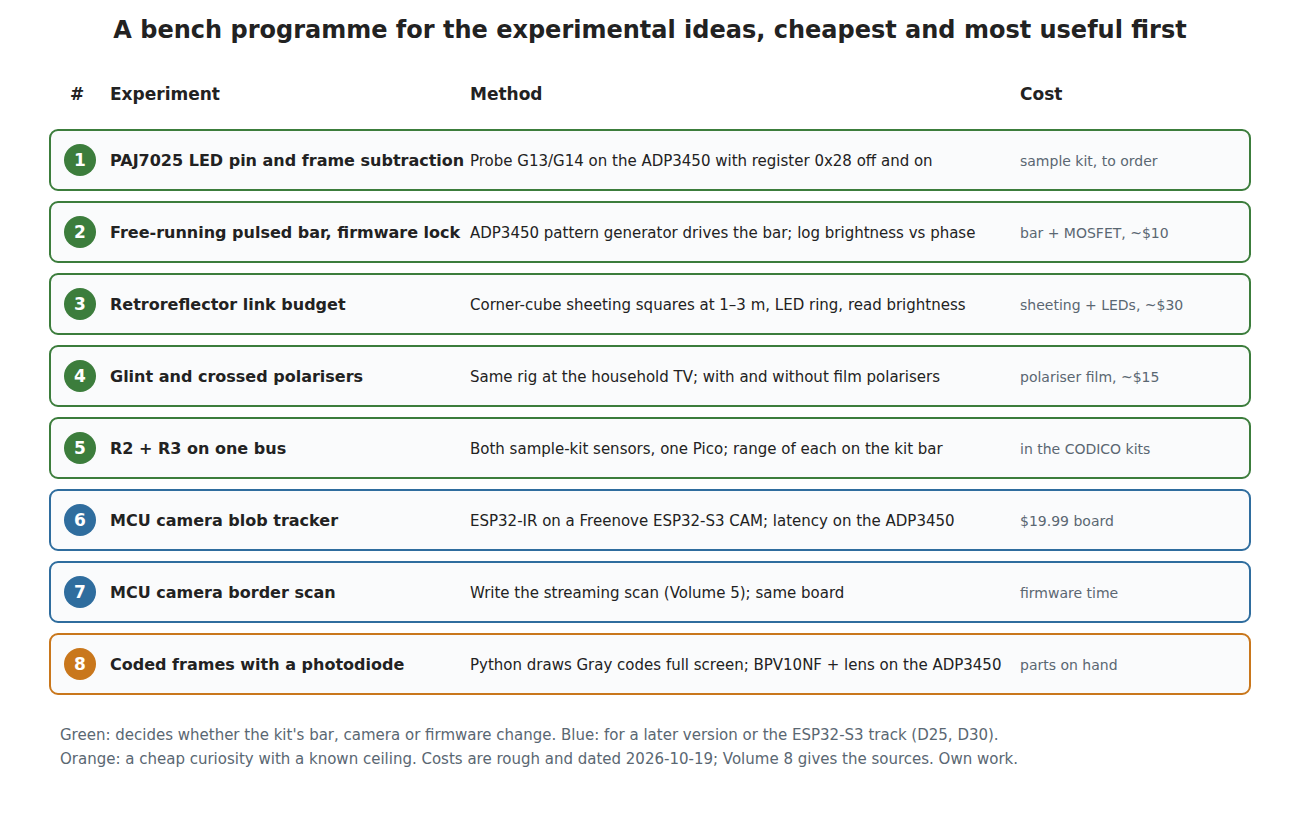
The experiments are ordered so each one’s answer decides whether the next is worth doing.
- The LED pins and frame subtraction come first because they cost nothing once the CODICO sample kits arrive, and because their answer shapes two ideas at once. If the pin pulses in step with the exposure and the sensor subtracts LED-off frames, retroreflectors get synchronisation for free and a wired bar can be driven from the gun; if not, everything falls back on the frame-period register and firmware subtraction (Volume 2, Test 1).
- The free-running pulsed bar next, because it needs no answer from step 1 and is the only idea that improves the camera already chosen in the room it will be used in (Volume 2, Tests 2 and 3).
- The retroreflector link budget and 4. the glint together, on the same rig. They decide whether a kit can ship without a powered bar (Volume 3).
- Both PixArt cameras on one bus, run as the P-RE16 comparison it already is. If step 2 has doubled the R3’s range, the two-camera gun is probably unnecessary, which is itself the answer (Volume 6).
- The general-camera blob tracker when the ESP32-S3 boards for the D25 trial are on the bench, as insurance on PixArt supply (Volume 5).
- A border scan in the gun only if the host-side border trial (BT-2) shows a border mode is wanted.
- Coded frames whenever someone wants a satisfying evening; it closes CRT Timing’s open question with a measurement (Volume 4).
8.3 What to Buy
Prices from the makers’ or sellers’ own pages on 19 October 2026.
Table 2 — 8.3 What to Buy
| Part | For | Where | Price |
|---|---|---|---|
| PixArt PAJ7025R3 and PAJ7025R2 sample kits | Steps 1 to 5 | CODICO, as in decision D32 (Reference Electronics, Volume 3) | €70 for five, per the decision log |
| White prismatic retroreflective sheeting, a small sheet | Steps 3 and 4 | Any sign-supply or industrial seller; 3M Diamond Grade DG³ 4090 is the grade whose figures Volume 3 uses | not captured |
| Linear polariser film, two pieces | Step 4 | Any optics or hobby seller | not captured |
| Vishay TSHG6400, a dozen | Steps 2 and 3 (bar point and LED ring) | Vishay distributors (Reference Electronics, Volume 6) | not captured |
| Freenove ESP32-S3 CAM board, FNK0085 | Step 5 | store.freenove.com | US$19.99 (8 MB flash) |
| OV2640 module without infrared-cut filter (“NV”), 850 nm long-pass filter | Step 5 | Module sellers; the ESP32-IR repository’s shopping list | not captured |
| Arducam HM0360 for Pico, B0319 (optional) | Step 5, a Pico-side alternative | arducam.com | US$19.99 |
Items marked “not captured” are commodity parts whose price was not looked up on a seller’s page for this volume; check before ordering. The bench instruments, the ADP3450 and the programmable supplies, are on hand.
8.4 Proposed Decision Rows
For the category’s decision log, as Proposed, in its existing format:
Table 3 — For the category's decision log, as Proposed, in its existing format
| ID | Item | Options | Proposal | Status | Why / why not | Where |
|---|---|---|---|---|---|---|
| ES-1 | PAJ7025 LED pins and frame subtraction | ignore; characterise on the bench | Characterise first (scope G13/G14 with 0x28 off and on) | Proposed | Free once the sample kits arrive; decides ES-2 and ES-3 | Vol 2 §2.9 |
| ES-2 | Bar drive | steady 100 mA; pulsed, wired from the LED pin; pulsed via the D25 radio; free-running pulsed with firmware lock | Free-running pulsed bar with firmware lock, to bench | Proposed | No link, works on the Pico, any number of guns; wired needs a conductor and one bar per gun; radio jitter unknown and needs the same loop anyway | Vol 2 §2.6 |
| ES-3 | Passive targets | none; corner-cube sheeting with an LED ring at the gun | Bench the link budget and the glint | Proposed | Could remove the powered bar from the kit; return at 850 nm and the glint are unmeasured | Vol 3 |
| ES-4 | Second camera | R3 only; R2 + R3 | Decide after ES-2 and the P-RE16 range test | Proposed | If pulsing doubles the R3’s range the R2 is likely unnecessary | Vol 6 |
| ES-5 | General-camera insurance | none; ESP32-IR on the D25 ESP32-S3 | One-evening test on the D25 bench | Proposed | Supply insurance (D32); rolling shutter and unfinished aiming keep it out of the kit | Vol 5 |
| ES-6 | Not pursued | event camera; time of flight; phone; laser at the screen; IR + border hybrid; hidden markers | Record and close | Proposed | None addresses the build’s measured weaknesses; see each volume | Vols 6, 7 |
8.5 What Would Change the Answers
- PixArt documents the LED pins (the full datasheets’ §7.7.1 and §6.4.6). Then step 1 becomes a confirmation, and the wired or retroreflective designs could be committed with less bench work.
- The R3 holds four clean points across the whole room on a steady bar. Then the range argument for pulsing and for a second camera weakens, and only the room-light argument remains.
- PixArt supply fails or production pricing is prohibitive. Then the general-camera route (Volume 5) moves from insurance to plan, and rolling-shutter shear becomes a problem to engineer rather than a footnote.
- A light gun using any of these ideas is published. Each volume’s label would move up the ladder, and its evidence should be read before the bench time is spent.
8.6 Questions for the Builders
- Should the experimental bench (steps 1 to 4) run alongside the R2-against-R3 comparison when the CODICO kits arrive?
- Is a kit with no powered bar attractive enough to spend effort on retroreflectors, given that the targets may need to be 50 to 100 mm squares on the bezel?
- Is a wired gun the target for the first kit? It decides whether a wire from the sensor’s LED pin to the bar (Volume 2, architecture A) is even possible.
- Does the household television have a glossy or matt screen? It decides how bad the retroreflector glint will be.
Sources
- Volumes 1 to 7 of this dive and their sources.
- Light Guns decision log rows D2, D18, D25, D30, D32, P-RE16, BT-1, BT-2, read 2026-10-19.
- Freenove, FNK0085 product data, store.freenove.com, and Arducam, B0319 product page, read 2026-10-19.
Comments (0)