Experimental Sensing · Volume 6
Hybrids and Two Cameras — The Wide Lens and the Bright One, Infrared and Border
The PAJ7025R3 sees the whole bar from 0.64 m but collects a thirty-ninth of the R2's light; the R2 needs 2.81 m. A gun with both, what the handover costs, and the harder case of a gun that tracks infrared points and a drawn border
6.1 Why Two Cameras
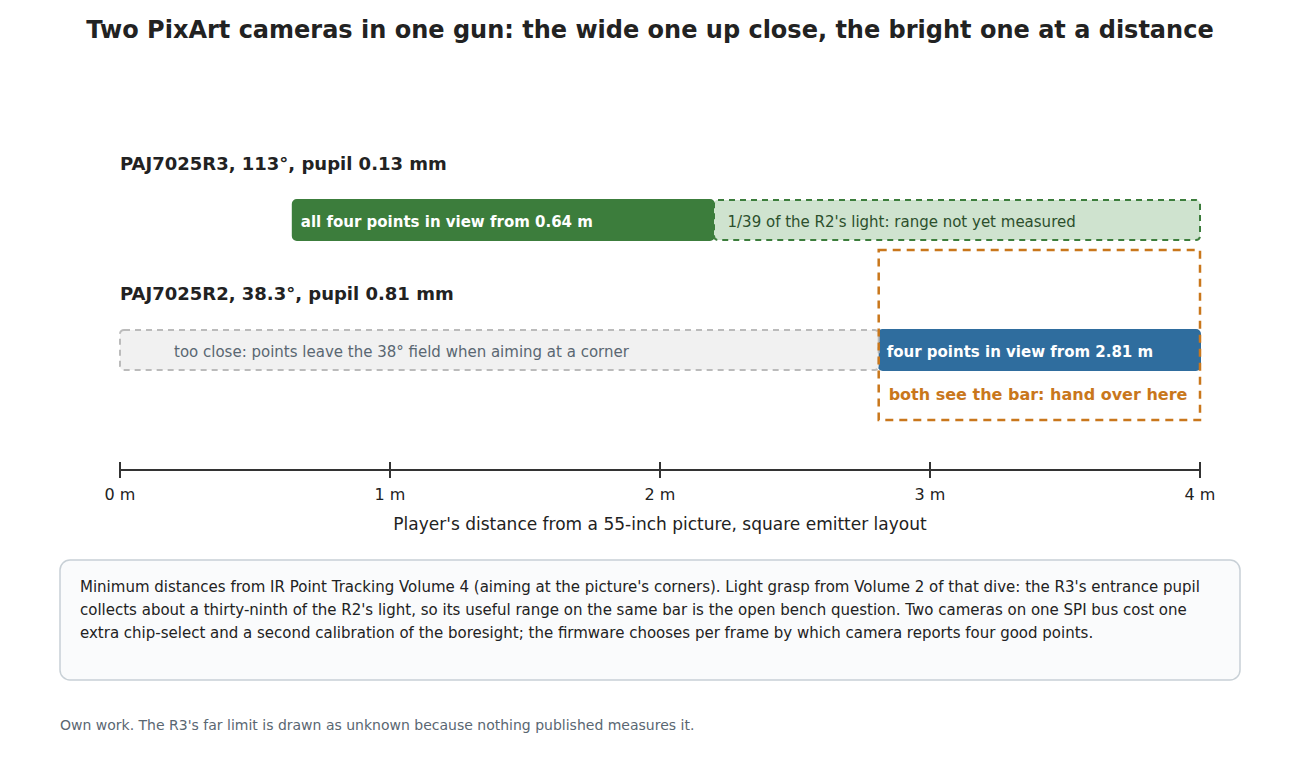
The kit camera’s two key numbers pull in opposite directions. IR Point Tracking, Volume 4 computed the closest distance at which each camera keeps all four points of the square layout in view while aiming at the picture’s corners; for a 55-inch set, the R3 manages it from 0.64 m and the R2 only from 2.81 m. Volume 2 of the same dive computed light grasp from the datasheets’ focal lengths and f-numbers: the R3’s entrance pupil, 0.13 mm across, collects about 1/39 of the R2’s 0.81 mm, so on the same bar its range is about a sixth. And one R3 pixel spans 1.15°, nearly three times the R2’s 0.39°, so at 2 m an R3 pixel is 40 mm of screen against the R2’s 13.6 mm.
So the R3 is right for a small room and a player who stands close, and weak at the back of a large one; the R2 is the reverse. Decision P-RE16 already plans to bench the two against each other. The experimental idea is not to choose: put both in the gun. Nothing published was found that does this in a light gun; it is an idea, built from two products.
6.2 How It Would Work
Both modules speak the same SPI protocol (4-wire, up to 14 MHz in both datasheets; mode 3, least significant bit first, in the ESP32 port’s driver) and report the same object records, so on the bus they differ only by chip-select. Reference Electronics, Volume 3 owns the camera wiring; a second camera costs one more GPIO for its select line, and read time: two reports per frame period instead of one.
Each frame, the firmware reads both and uses whichever reports four good points, by the same tests it already applies to one camera (count, brightness, the quadrilateral’s shape). Close to the screen only the R3 sees all four; far away only the R2 does, or only the R2 sees them brightly enough; in the band where both do, the firmware prefers the R2 for its finer pixels and stronger signal. The two can also check each other: in the overlap band, a fifth object that one camera reports and the other does not is suspect.
The two modules sit side by side in the muzzle. The MP7 shell’s space for them is a question for the build dives (MP7 Donor Build).
6.3 What the Handover Costs
The difficulty is not electrical. It is that two cameras are two sets of calibration.
- Two boresights. Each camera’s image point that corresponds to the aim is found by calibration (Aiming Maths and Calibration, Volume 4). Both can be computed from the same calibration shots, since both see the bar at the calibration distance only if that distance is in the overlap band. Otherwise each needs its own calibration at its own distance.
- Two parallaxes. Two modules side by side cannot both sit on the sight line. Aiming Maths and Calibration, Volume 5 shows that a camera a distance d from the aiming line makes an error of d (1 − D/D_cal) away from the calibration distance, and recommends keeping d within about 8 mm. With two modules, at least one is further off, and the two errors differ, so at the handover the cursor jumps by the difference. Mounting both within a few millimetres of the line, one above the other on it, or the dynamic correction that volume describes, keeps the jump small.
- Two lenses. The R3’s −30 % distortion needs the correction that Aiming Maths Volume 1 proposes; the R2’s 2.8 % hardly does. The handover joins a corrected and an uncorrected map, and any residual shows as a jump.
A hysteresis band, switching to the R2 only when it has seen four good points for several frames and back only when it loses them, stops the cursor dithering between the two at the boundary.
6.4 Infrared and Border in One Gun
Border Tracking, Volume 8 asked whether a hybrid, infrared primary with a border fallback, could help where a bar cannot be mounted. A search found no gun that does both. Three arrangements are possible, and the comparison is short:
Table 1 — [Border Tracking, Volume 8](/light-guns/sensing-and-aiming/border-tracking/vol-8/) asked whether a hybrid, infrared primary with a border fallback, could help where a bar cannot be mounted. A search found no gun that does both. Three arrangements are possible, and the comparison is short
| Arrangement | How | What is lost |
|---|---|---|
| Two cameras | PixArt for the bar, a general camera without an infrared-pass filter for the border | The second camera’s cost, space and processing (Volume 5) |
| One general camera with a switchable filter | A day/night infrared-cut filter switch of the kind security cameras use, in front of an OV2640-class sensor | A mechanism in the gun; a rolling shutter for both modes (Volume 5, §5.4) |
| One general camera, no infrared-pass filter | The bar’s 850 nm points show as bright spots on a sensor with no infrared-cut filter, and the white border shows as well | Infrared’s whole advantage: the filter that keeps the room’s visible light out (IR Point Tracking, Volume 2) |
Whichever is chosen, the border mode brings border tracking’s costs with it: a border drawn by host software on every platform, in every video path, at the price of some picture (Border Tracking, Volume 6). The hybrid buys a fallback for screens where no bar can be mounted, a projector screen or a wall-mounted set with no bezel, say, and pays for it with every one of border tracking’s costs plus a second sensing path in the firmware. Decision BT-1 kept infrared for reasons the hybrid does not remove.
6.5 What This Dive Leaves to Positional and Inertial
The other obvious fusion, a gyroscope with the optical fix, as the Wii MotionPlus and PlayStation Move did, belongs to Positional and Inertial, which covers inertial sensors, fusion filters, and what an inertial sensor could add to this gun. It is not treated here.
6.6 The Bench Tests
Test 1: each camera’s real range. With an R2 and an R3 from the CODICO sample kits on one carrier and one Pico bus, clamped side by side, step back from the kit’s 850 nm bar at the household television from 0.5 m to the far wall. Log the distance at which each first holds four points when aiming at each corner, and the distance at which each loses them, and the weakest point’s brightness margin over threshold at each step. This is the P-RE16 comparison done at once for both.
Test 2: the handover jump. Calibrate both cameras, then walk slowly through the overlap band aiming at a fixed target and log both cameras’ cursor positions every frame. The difference between them at the same instant is the jump the player would see at a switch.
6.7 Why Try This, and Why Not the Others
What it buys the build. The R3’s close range and the R2’s reach and finer pixels in one gun, and a cross-check that rejects spurious points.
What it costs. A second module (the sample kit holds five of each; at production quantity both are by quotation, and the R2’s datasheet states a minimum order of 900); a GPIO; read time; muzzle space; a calibration per camera; firmware for the handover.
The risk. A visible jump at the handover if the two parallaxes are not tamed, and a design whose complexity grows twice over (two calibrations, two lens models) for a benefit that some rooms never need.
Why try this, and why not the others. Test 1 is worth running at once, because P-RE16 requires it anyway and the parts arrive together. Building a two-camera gun should wait for Volume 2’s pulsed bar: if pulsing doubles the R3’s range, the R2 may never be needed. The infrared-and-border hybrid is last of everything in this dive that is still worth considering, because it imports border tracking’s costs to cover a case the household may not have.
6.8 What Could Not Be Verified
- Either camera’s real range on the kit bar, which is Test 1.
- Any published gun or pointer using two tracking cameras of different field of view, or infrared and border together.
- Whether both modules fit in the planned shell.
Sources
- IR Point Tracking, Volumes 2 and 4: light grasp, minimum distances, pixel sizes, from the PAJ7025R2 and R3 datasheets.
- Aiming Maths and Calibration, Volumes 1, 4 and 5: lens correction, calibration, parallax.
- Border Tracking, Volumes 6 and 8; decision log rows P-RE16, BT-1.
- PixArt Imaging, PAJ7025R2 and R3 datasheets, SPI interface (see Volume 2, sources 1 and 2).
Comments (0)