Border Tracking · Volume 8
Open Alternatives, and Border Against Infrared for This Build
What exists in the open, how an open border gun would have to be built, and why the reference design uses infrared emitters, with the reasons each way and a cheap bench trial that would test them
8.1 What is open today
A search of GitHub on 19 October 2026 (“lightgun border”, “lightgun opencv”, “lightgun webcam”, “sinden”) found the projects described in Volume 2: cygun (GPL-3.0, Python on Windows with a USB webcam, “an early alpha”, last pushed in January 2025), AndroidLightGun with its LightGunHost helper (MIT, a phone as the gun, version 1.0.0 in August 2026), CameraGun (Android, no licence file visible), LightGun-CV (Qt and OpenCV, no licence file), and WebCamLightGunAI (MIT, a neural-network detector of the monitor at about three updates a second).1 Around Sinden’s own gun there is a larger open ecosystem of helpers: border drawers (a Unity package, a GNOME extension, Mega Bezel presets), configuration packs, a C# library for the gun’s serial port, emulator forks and the SindenPS console adapter. None of those replaces Sinden’s closed driver, which remains the only thing that turns a Sinden gun’s camera into an aim point.
Michael’s starting brief recorded the position before this research: border tracking was “Not chosen” because “no open-source hardware or software found.”2 That was nearly right. Open software does exist; it is young, small, and in no case runs in the gun.
8.2 Three ways to build an open border gun
Table 1 — 8.2 Three ways to build an open border gun
| Architecture | Gun contains | Host does | Strengths | Weaknesses |
|---|---|---|---|---|
| A. Sinden pattern | A UVC camera module plus a microcontroller for buttons and recoil | Everything visual (cygun-style pipeline) | Cheapest gun; any webcam module; the host’s processor is fast | A driver on every platform; host CPU per gun; no plain-HID operation; console and FPGA use need host software |
| B. Microcontroller in the gun | A parallel-interface camera, an ESP32-S3 (or RP2350), buttons and recoil | Nothing: the gun is a USB HID pointer | Same host behaviour as an infrared gun; no driver | Unproven: no published firmware; the streaming threshold-and-scan design of Volume 2 must be written from scratch; camera frame rates on the ESP32-S3 not published |
| C. Single-board computer in the gun | A Raspberry Pi-class board and camera | Nothing | Sinden-class software is known to run on a Pi | Power, heat, boot time and cost inside a shell that already holds a solenoid; still a full Linux system to maintain |
Architecture B is the only one that would make a border gun a drop-in replacement for the infrared gun, and it is a research project, not a parts list. It belongs in Experimental Sensing, with the feasibility arithmetic from Volume 2 as its starting point.
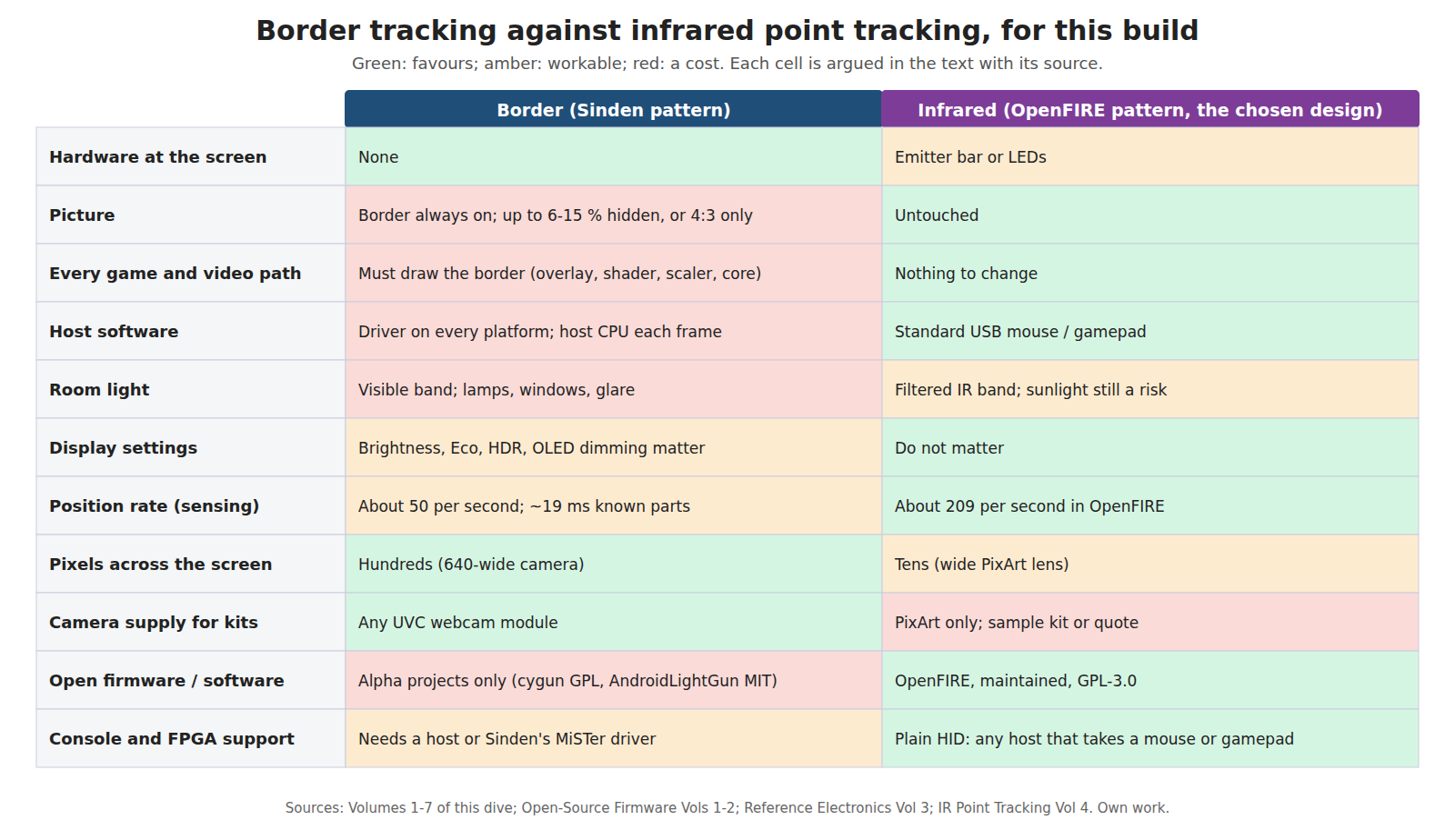
8.3 Border against infrared, criterion by criterion
Table 2 — 8.3 Border against infrared, criterion by criterion
| Criterion | Border tracking | Infrared point tracking | Where argued |
|---|---|---|---|
| Hardware at the screen | None | An emitter bar or LEDs, wired and powered | Vol 1; Reference Electronics, Volume 6 |
| The picture | A border always on; 6.2 % hidden at 2 %, 15.1 % with the outer band, unless the game is 4:3 or shrunk | Untouched | Vol 5 |
| Every game and video path | Must draw the border: overlay, shader, artwork, scaler or core | Nothing to change | Vol 6 |
| Host | Driver on every platform; a quarter of a core per gun at 50 fps in the wiki’s screenshots | Standard USB mouse or gamepad, computed in the gun | Vols 1, 4 |
| Room light | Visible band, unfiltered; lamps, windows, glare | Filtered infrared band; sunlight and lamps can still intrude | Vol 7; IR Point Tracking |
| Display settings | Brightness, Eco, ambient sensor, HDR, OLED dimming all matter | Irrelevant | Vol 5 |
| Position rate | About 50 per second; about 19 ms of known sensing delay | About 209 per second in OpenFIRE | Vol 4; Open-Source Firmware, Volume 2 |
| Pixels across the screen | Hundreds | Tens with the wide PixArt lens, interpolated | Vol 3; IR Point Tracking, Volume 4 |
| Camera supply for kits | Any UVC webcam module or parallel camera | One maker’s sensor; sample kits from one distributor, production by quotation | Reference Electronics, Volume 3 |
| Open software | Alpha-stage projects on a PC or phone | OpenFIRE: maintained, GPL-3.0, runs on the Pico | Vol 2; Open-Source Firmware, Volume 1 |
| Consoles and FPGA | Needs host software, or Sinden’s own MiSTer driver | Any host that accepts a mouse or gamepad | Vols 1, 6 |
8.4 Why infrared, and why not border tracking
The reference design uses an infrared camera and emitter bar, chosen in Reference Electronics and resting on the choice of OpenFIRE as the firmware (Open-Source Firmware, Volume 1). This volume does not reopen that choice; it sets out why it holds up against the evidence in this dive.
Why infrared.
- The gun is self-contained. It computes its own position and is a plain USB device. That is what lets one gun work on a Windows PC, a Linux box, a Raspberry Pi and anything else that takes a mouse, with no software to install, which matters doubly if kits are sold.
- The picture is left alone. No border, no lost edge, no per-game border setup, no exclusive-full-screen problem, no display settings to police.
- There is a mature open stack. OpenFIRE is maintained, documented and licensed in a way a kit seller can comply with. On the border side, nothing comparable exists.
- It is faster at sensing. About four times as many position updates per second, and on average 10 to 15 ms sooner (Volume 4).
Why not border tracking, for this build.
- Its best implementation is closed. Sinden’s driver cannot be studied, modified or redistributed (“You have no rights to decompile this software”; “You have no rights to use any part of this software in another application”), so a kit could not build on it.3
- The open implementations are alphas on a PC or a phone. None runs in a gun, none has been maintained for long, and two have no licence file at all.
- It moves the gun’s difficulty into the household. Lighting, the television’s settings and every emulator’s border become part of the product’s support burden. Sinden’s own wiki is, in large part, a record of that burden.
What border tracking does better, stated plainly. Nothing to mount at the screen; a camera that is cheap and easy to source, against an infrared camera whose supply is the project’s hardest open problem (Reference Electronics, Volume 3); and many more pixels across the screen. Those are real advantages, and the second one is why the method is worth a bench trial rather than a dismissal.
8.5 What would change the answer
- The PixArt camera becomes unobtainable in kit quantities and no substitute appears. A border gun’s camera has no such single point of supply.
- An in-gun border tracker (architecture B) is shown to work at 50 frames per second or better on an ESP32-S3 or RP2350, so a border gun can be a plain HID device.
- The household’s own screen and room turn out to suit it unusually well, and the per-game border work is acceptable for the games actually played.
- A hybrid proves useful: the infrared design remains primary, and a border mode (or a fusion of both) is added for screens where mounting a bar is impossible. Any such idea belongs to Experimental Sensing.
8.6 A cheap bench trial
Two trials would settle most of what this dive leaves open, and neither needs a part designed.
- The open method on the household screen. Run cygun (GPL-3.0) on a Windows PC with a USB webcam that meets its stated requirement of “at least 60 FPS at 1280x720”, held or mounted at the playing position. Record the raw and debug views by day and by night, measure the steadiness of the cursor with the camera clamped, and run the border-step latency test from Volume 4 on the Analog Discovery Pro ADP3450.4
- Sinden as the reference. If the comparison is wanted with the commercial product, a Sinden gun would answer the questions no document does: the lens’s field of view, the real frame rate of a current module, and an end-to-end latency figure. Prices on Sinden’s own shop, as recorded on 18 October 2026, are in Open-Source Firmware, Volume 1; the shop is at https://www.sindenshop.com.
8.7 What could not be verified
- Whether any open border tracker has run inside a gun on a microcontroller. None was found.
- The current maintenance state of the Android projects beyond their last push dates.
- Whether CameraGun and LightGun-CV have licences outside their repositories.
A patent to know about (added 2026-10-20). Sinden Technology holds US 11,314,339, “Control device for detection”, active and expected to run to about 2039. Its first claim is a method of applying a border that completely surrounds the display content to aid detecting the display, so any border-tracking gun sold in the US, open or not, is measured against it; an IR-emitter gun like this build’s is outside it (Licensing, IP and Kits, Volume 3).
Sources
Footnotes
-
GitHub repository search API, queries “lightgun border”, “light gun border camera”, “lightgun opencv”, “lightgun webcam” and “sinden”, run 2026-10-19; repositories as cited in Volume 2. ↩
-
Michael’s starting brief for the category (a project-memory note, October 2026; not published). ↩
-
Sinden Lightgun software V2.08b,
License.txt; https://www.sindenlightgun.com/software/SindenLightgunSoftwareReleaseV2.08b.zip, downloaded 2026-10-19. ↩ -
Cynobs-repo, “cygun”, README, https://github.com/Cynobs-repo/cygun (GPL-3.0; read 2026-10-19). ↩
Comments (0)