Solenoid Recoil · Volume 8
Choosing the Solenoid — Candidates, Kinetic Energy, and the Voltage Question
Real parts with their published figures, the energy each can put into a plunger at its rated voltage and at the light-gun habit of twice that, why a higher-voltage coil is not a stronger coil, and the shortlist to buy and rank on the bench
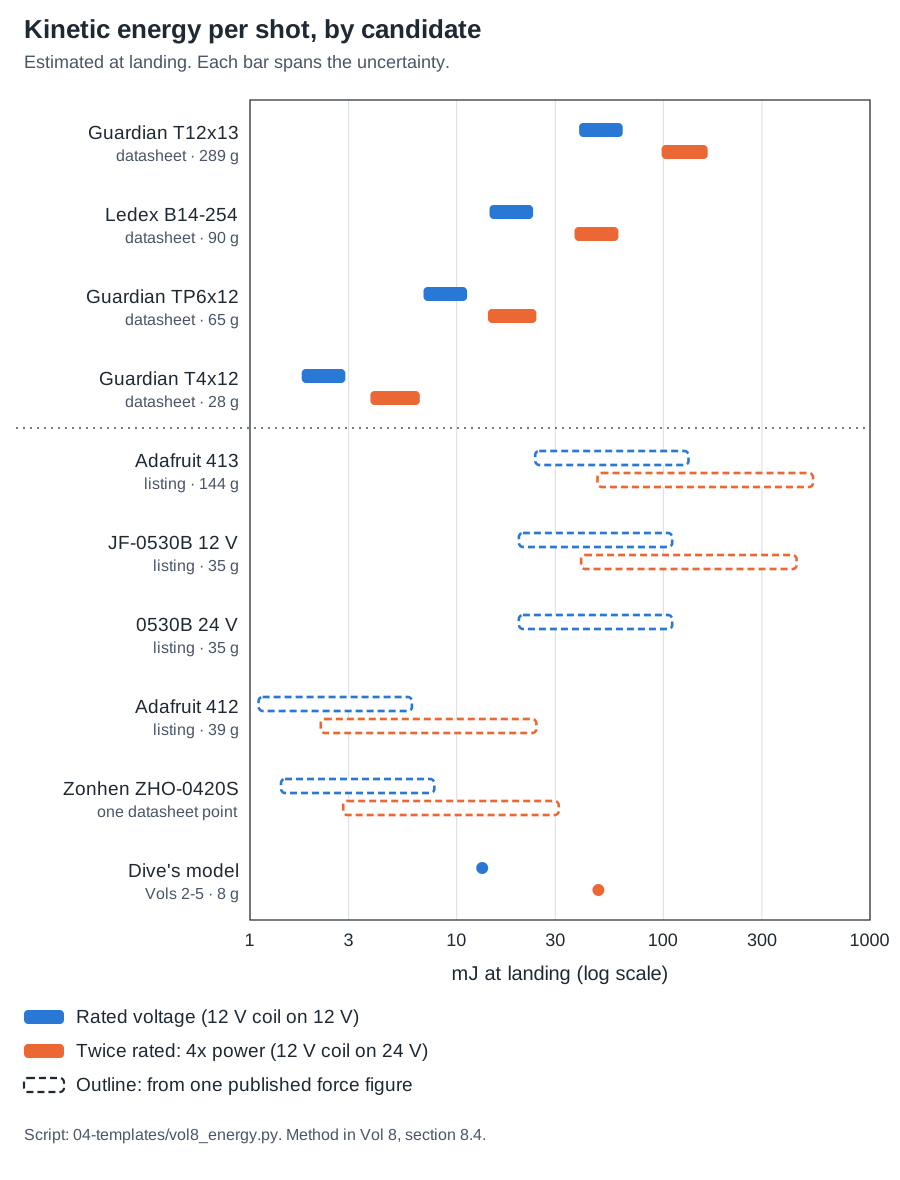
8.1 Where this volume sits
No solenoid has been bought for this project yet. The decision is to survey the candidates, estimate the energy each can deliver per shot, buy a shortlist and decide on the bench, and to settle the old light-gun argument about running “higher voltage, lower current” or “lower voltage, higher current” from first principles before any money is spent on a supply.
This volume is numbered 8 so that links to the earlier volumes stay stable, but it reads best before Volume 7: this one picks the candidates and the rail, and Volume 7 covers buying, failure modes and upkeep for whatever is picked. It leans on Volume 2 for the force-stroke curve and the voltage rating as a duty-cycle rating, on Volume 4 for pulse width and regulated current, on Volume 5 for moving mass, and on Volume 6 for the rig the shortlist will be tested on. The driver circuit belongs to the Reference Electronics dive and the supply to Power Supplies.
8.2 The candidates and their published figures
The field divides three ways: catalogued industrial parts with a maker’s datasheet, hobby parts sold by retailers with a listing, and the parts inside the complete light guns and kits. The table gives what each source states, marked D for a maker’s datasheet, L for a retailer’s or maker’s listing, and C for a figure calculated here from the others. Prices are as shown on the named seller’s page on 18 October 2026, single quantity, before shipping.
Catalogued parts. Each publishes a force-stroke table at several power levels, a coil table, masses and a life figure.
Table 1 — The candidates and their published figures
| Part | Type | Rated V and duty | Coil R | Current at rated V | Stroke used here | Force at stated stroke | Plunger / total mass | Size | Price, 2026-10-18 |
|---|---|---|---|---|---|---|---|---|---|
| Ledex B14-254-B-11 | Box frame, pull | 12 V at 100 %, 17 V at 50 %, 24 V at 25 %, 38 V at 10 % (D) | 28.6 Ω (D) | 0.42 A (C) | 10.2 mm | 0.12 lb (0.53 N) at 0.4 in, 12 V; 2.6 lb (11.6 N) at 0.02 in (D, read off chart) | 12 g / 90 g (D) | about 44 mm long box frame (D) | Not captured; element14 China lists other B14 parts at CNY 374–6492 |
| Ledex B14-255-B-11 | As above, 871 turns | 6 V at 100 %, 12 V at 25 % (D) | 6.9 Ω (D) | 0.87 A at 6 V (C) | 10.2 mm | Same table as above at the same watts (D) | 12 g / 90 g (D) | As above | Not captured |
| Guardian T4x12-C-12D, A420-066011-003 | Tubular, pull | 12 V continuous; 25 %, 10 %, 1 % rows (D) | 49.8 Ω ±5 % (D) | 241 mA (D) | 6.35 mm | 0.3 N at 0.25 in, 1.1 N at 0.05 in, 12 V (D) | 8.5 g / 28 g (D) | 38 × 12.7 mm dia. (D) | Not captured |
| Guardian TP6x12-C-12, A420-066091-004 | Tubular, push | 12 V continuous (D) | 31.7 Ω (D) | 379 mA (D) | 9.5 mm | 0.6 N at 0.375 in, 3.6 N at 0.05 in, 12 V (D) | 11 g / 65 g (D) | 39 × 19 mm dia. (D) | Not captured; TP6X12-C-24D CNY 334.71 ex GST at element14 China5 |
| Guardian TP6x12-I-12, A420-066092-004 | As above, intermittent coil | 12 V at 25 % (D) | 12.1 Ω (D) | 992 mA (D) | 9.5 mm | Same rows as above at the same watts (D) | 11 g / 65 g (D) | As above | Not captured |
| Guardian T12x13-C-12D, A420-066051-006 | Tubular, pull | 12 V continuous (D) | 22.8 Ω (D) | 526 mA (D) | 9.5 mm | 2.8 N at 0.375 in, 22.2 N at 0.05 in, 12 V (D) | 48 g / 289 g (D) | 41 × 38 mm dia. (D) | Not captured; T6X12-I-12D (pull, 12 V) CNY 429.59 ex GST7 |
Hobby parts with a readable listing.
Table 2 — Hobby parts with a readable listing.
| Part | Type | Rated V | Coil R | Current | Stroke | Force | Mass | Size | Price, 2026-10-18 |
|---|---|---|---|---|---|---|---|---|---|
| Zonhen ZHO-0420S-05A4.5, sold as Adafruit 2776 and SparkFun ROB-1101589 | Open frame | 5 V, 1 s on / 3 s off (D) | 4.5 Ω ±5 % (D) | 1.1 A (D) | 4.5 mm (measured by SparkFun; datasheet 6 mm) (L) | 80 gf (0.78 N) minimum at 3 mm (D) | Not stated | 20 mm body (L) | $4.95 Adafruit; $6.50 SparkFun |
| Adafruit 412, Small Push-Pull9 | Open frame, 30 mm; sold elsewhere as “JF-0530B”10 | 12 V (L) | 40 Ω (L) | ~300 mA (L) | 5.5 mm (L) | 0.5 N starting, 5.0 N retentive (L) | 39 g (L) | 30 mm (L) | $7.50 |
| JF-0530B, 12 V, Sigmanortec listing11 | Open frame | 12 V, 1 s on / 1 s off (L) | 8 Ω (C, from 1.5 A) | 1.5 A (L) | 10 mm (L) | 5 N initial (L) | 35 g (L) | 13 × 15 × 30 mm (L) | Listing read; price not used here |
| ”0530B 24V”, Probots PRO81212 | Open frame | 24 V (L) | 25 Ω (L) | 0.96 A (C) | 10 mm (L) | 5 N starting; “Keeping Force (10mm Travel): 700g” (L) | 35 g (L) | 13 × 15 × 30 mm (L) | ₹669.00 incl. GST |
| Adafruit 413, Large Push-Pull (label TAU1040T-07)9 | Open frame, 40 mm | 12 V (L) | ~12 Ω (L) | ~1 A (C) | 10 mm (L) | 6 N starting at 12 V / 50 % duty (L) | 144 g (L) | 40 mm (L) | $14.95 |
| ”0826B 12V”, Probots PRO85013 | Open frame | 12 V (L) | 25 Ω (L) | “2A” and “about 100mA” on one page (L); 0.48 A (C) | 10 mm (L) | “Torque: 20N @ 12VDC” (L) | 40 g (L) | 26 × 25 × 22 mm (L) | ₹999.00 incl. GST |
| SparkFun ROB-10391, “Solenoid - 36V”14 | Open frame | 36 V (L) | ~19 Ω (C) | 650 mA at 12 V, 1.85 A at 36 V (L) | 10 mm measured; datasheet 25 mm (L) | None published | Not stated | Not stated | $34.95 |
The parts inside complete guns and kits. None of them is identified by part number on its maker’s page.
Table 3 — The candidates and their published figures
| Gun or kit | What its maker says about the solenoid | Source |
|---|---|---|
| Blamcon Ace of Spades | ”JF-0826B Solenoid”, run from 12 V, driving a hammer | 15 |
| GUN4IR mod kits and pre-modified guns | Kit includes a “Solenoid”, unnamed; “Solenoid feedback (requires an extra 12v power supply …)”; “Temperature sensor mounted on the solenoid” | 16 |
| GUN4IR rumble-and-solenoid board shared on OSH Park by a community member | ”running on 18-35V Solenoid Power” | 17 |
| RetroShooter RS3 Reaper | ”powered by a 24V solenoid”, unnamed | 18 |
| Ultimarc AimTrak with recoil | Supply of 24–36 V required; solenoid unnamed | 19 |
| OpenFIRE build guide in this project’s brief | ”12V for a basic kick; 24V for full slide action”, $5–10 (an unverified forum price) | 20 |
So the community parts reduce to the JF-0530B and JF-0826B classes that the hobby table already covers, plus unnamed units in the commercial guns. Several other catalogue makers were considered and left out because no light-gun-sized part with a public force-stroke table could be read on the day: Takaha (no datasheet reachable), TE Connectivity’s Pontiac line, Kuhnke and Magnet-Schultz. Ledex parts were catalogued under Saia-Burgess and are now sold by Johnson Electric. A JF-1253B, a larger open frame some builders use, appeared only in a search summary and is kept out of the table.
8.3 What the figures say before any arithmetic
Three things stand out before any energy is computed.
The catalogued parts describe one coil several ways, and the hobby parts describe several coils one way. Ledex lists the B14 at 12, 17, 24 and 38 V for the same 28.6 Ω coil, and lists a 6.9 Ω and a 110 Ω coil that share every force figure at the same wattage. Guardian lists a “C” (continuous) and an “I” (intermittent) coil for each voltage, and one force table per power level. The hobby listings give one voltage, sometimes a resistance, and one force at one stroke, and the same “0530B” name covers a 40 Ω, a 25 Ω and an 8 Ω coil.
One listed force at full stroke is a strong claim, and some of them are too strong. The Sigmanortec JF-0530B listing gives 5 N “initial” force over a 10 mm stroke at 18 W, from a 35 g part. Ledex’s 90 g B14, at a similar 20.8 W, gives about 0.62 lb (2.8 N) at 10 mm. Guardian’s 65 g TP6x12 gives 3.3 N at 9.5 mm only at 37 W. A 35 g body making nearly twice the force of a 90 g catalogued part at the same power and stroke is not impossible in principle, since magnetic design varies, but it is not what the catalogued parts show, and the listing gives no test condition. The likelier reading is that “initial force” was measured at a smaller gap than the full 10 mm. Probots’s “0826B” listing is further out: 20 N at 12 V from a 40 g part drawing 0.48 A by its own resistance. Twenty newtons is the order of a holding force, not a starting force (Volume 2).
Force near closure says little about kick. Every part makes its largest force in the last millimetre, and that is the figure listings prefer. The kick depends on the integral of force over the whole stroke, which is dominated by the long-gap end where the force is smallest (Section 8.4). Adafruit’s 412 states both ends honestly, 0.5 N starting and 5.0 N retentive, and the ratio of ten is the curve in two numbers.
8.4 What is computed, and what is assumed
Three quantities, kept separate because they answer different questions.
- Static work, W. The integral of the published force-stroke curve over the working stroke, W = ∫F dx, with the coil at its steady current for the stated voltage. It is the most mechanical work the magnetic field can do on the plunger over that stroke at that current, and an upper bound on everything that follows.
- Kinetic energy at landing, KE. What the plunger actually carries into the stop. It is less than W because the return spring and friction take their share, because the current is still rising during the early stroke (the coil’s L/R time constant), and because the moving plunger’s back-EMF pulls the current down (the cusp of Volume 4). The dive’s lumped model (
04-templates/solenoid_model.py) gives the ratio: across moving masses of 8 to 40 g at 12 V and 24 V, it delivers 40 to 65 % of W as KE at landing, lighter masses and lower voltages at the low end. That range, η = 0.40–0.65, is applied to every part as an assumption, and its spread is part of each error bar. - Impulse to the gun, J. The momentum the plunger hands to the stop, J = m·v·(1 + e), where e is the coefficient of restitution at the stop. For a damped stop e is near zero, and J ≈ m·v = √(2·KE·m). This is the quantity the hand feels most directly (Volume 2, Section 2.9), and Volume 6 measures it by integrating acceleration across the impact.
The working stroke is each part’s own, capped near 10 mm: 10.2 mm (0.4 in) for the Ledex B14, 9.5 mm (0.375 in) for the TP6x12 and T12x13, and 6.35 mm (0.25 in) for the T4x12, whose continuous rows stop there. The integral runs by trapezoids between tabulated points and then, from the smallest tabulated gap to closure, at the force of that last point: a floor, since the true force rises further.
Rated and overdriven. “Rated” is the continuous 12 V rating for the catalogued parts and the listed voltage for the hobby parts. “Overdriven” is twice that voltage, four times the power: the habit of running a 12 V coil on 24 V for a short pulse. For the catalogued parts, the power at a voltage is V²/R, and the force at that power is read from the maker’s rows. Between rows it is interpolated two ways, linear in power (the unsaturated law, F ∝ I², so F ∝ P) and linear in the square root of power (F ∝ I, a saturated limit); the two bracket the answer. Guardian marks its 10 % and 1 % rows “Calculated force values to be verified in application”, so the overdriven Guardian figures carry that caveat as well.
The hobby parts give at most one force at one stroke. The floor is that force times the stroke, a flat curve, since a real curve only rises toward closure. The ceiling multiplies by 3.4, the ratio of the area under Ledex’s B14 25 % curve to its force at full stroke times the stroke: the shape of a catalogued curve of the same class. Overdriving multiplies the floor by two (force near saturation, roughly proportional to current) and the ceiling by four (force at long gap, proportional to current squared). Those ranges are wide because one number fixes so little, and the chart shows them as outlines to say so. The SparkFun 36 V part and the Probots “0826B” are left out of the chart: the first publishes no force, and the second publishes one that cannot be a starting force.
The script that does all of this is 04-templates/vol8_energy.py; it prints the table below and writes the results to vol8_results.json for the figures.
8.5 Energy per shot, by candidate
Table 4 — Energy per shot, by candidate
| Part | At rated voltage | At twice rated | ||||
|---|---|---|---|---|---|---|
| Coil power | Static work W | KE at landing | Coil power | Static work W | KE at landing | |
| Ledex B14-254 | 5.0 W at 12 V | 36 mJ | 14–23 mJ | 20 W at 24 V | 93 mJ | 37–61 mJ |
| Guardian T4x12-C-12D | 2.9 W | 4.4 mJ | 1.8–2.9 mJ | 11.6 W | 9.6–10.2 mJ | 3.8–6.6 mJ |
| Guardian TP6x12-C-12 | 4.5 W | 17 mJ | 6.9–11 mJ | 18 W | 35–37 mJ | 14–24 mJ |
| Guardian T12x13-C-12D | 6.3 W | 98 mJ | 39–64 mJ | 25 W | 245–252 mJ | 98–164 mJ |
| Zonhen ZHO-0420S (5 V) | 5.6 W at 5 V | 3.5–12 mJ | 1.4–7.8 mJ | 22 W at 10 V | 7–48 mJ | 2.8–31 mJ |
| Adafruit 412 | 3.6 W | 2.8–9.3 mJ | 1.1–6.1 mJ | 14 W | 5.5–37 mJ | 2.2–24 mJ |
| JF-0530B 12 V (listing) | 18 W | 50–170 mJ | 20–110 mJ | 72 W | 100–680 mJ | 40–440 mJ |
| 0530B 24 V (listing) | 23 W at 24 V | 50–170 mJ | 20–110 mJ | — | — | — |
| Adafruit 413 | 12 W | 60–204 mJ | 24–132 mJ | 48 W | 120–815 mJ | 48–530 mJ |
| Dive’s lumped model, 8 Ω, 8 g | 17 W at 12 V | 32 mJ | 13 mJ | 69 W at 24 V | 92 mJ | 49 mJ |
Read the table with the method in mind, and four results come out of it.
- Doubling the voltage roughly doubles to triples the energy, not quadruples it. The Ledex B14 goes from 36 to 93 mJ of static work for four times the power, a factor of 2.6; the TP6x12 by about 2.1. At long gap, force goes as current squared and energy would quadruple; near closure the iron saturates and the gain falls to about two (Volume 2, Section 2.4). The integral sits between.
- Mass buys energy, and there is no free lunch in a small body. The catalogued parts line up by weight: 28 g gives a few millijoules, 65 g some tens, 90 g some tens to sixty, 289 g over a hundred. The model’s 8 Ω part, sized like a 30 mm hobby open frame, lands at 13 and 49 mJ, in the same family as the Ledex and the TP6x12 at similar power.
- The listing-derived bars for the JF-0530B and the Adafruit 413 sit above every catalogued part of similar mass, and above the catalogued parts at similar power. Either the hobby parts are remarkably good, or the single published force is not a full-stroke figure. The bench will say which; until then the solid bars are the ones to plan on.
- A “24 V” listing of the 0530B body is the 12 V body’s wattage. At 25 Ω on 24 V it dissipates 23 W, the same class as the 8 Ω “12 V” listing on 12 V at 18 W. It is not a stronger part, only a different winding (Section 8.8).
For a sense of scale, 49 mJ is the energy of a 20 g striker moving at about 2.2 m/s. Heat per shot is a separate question. In the model, the supply delivers 365 mJ to land a 12 V shot with 13 mJ in the plunger, about 4 %, and 594 mJ to land a 24 V shot with 49 mJ, about 8 %. A solenoid is a poor engine and a good heater; that is why pulse width (next) matters so much.
8.6 Energy against pulse width
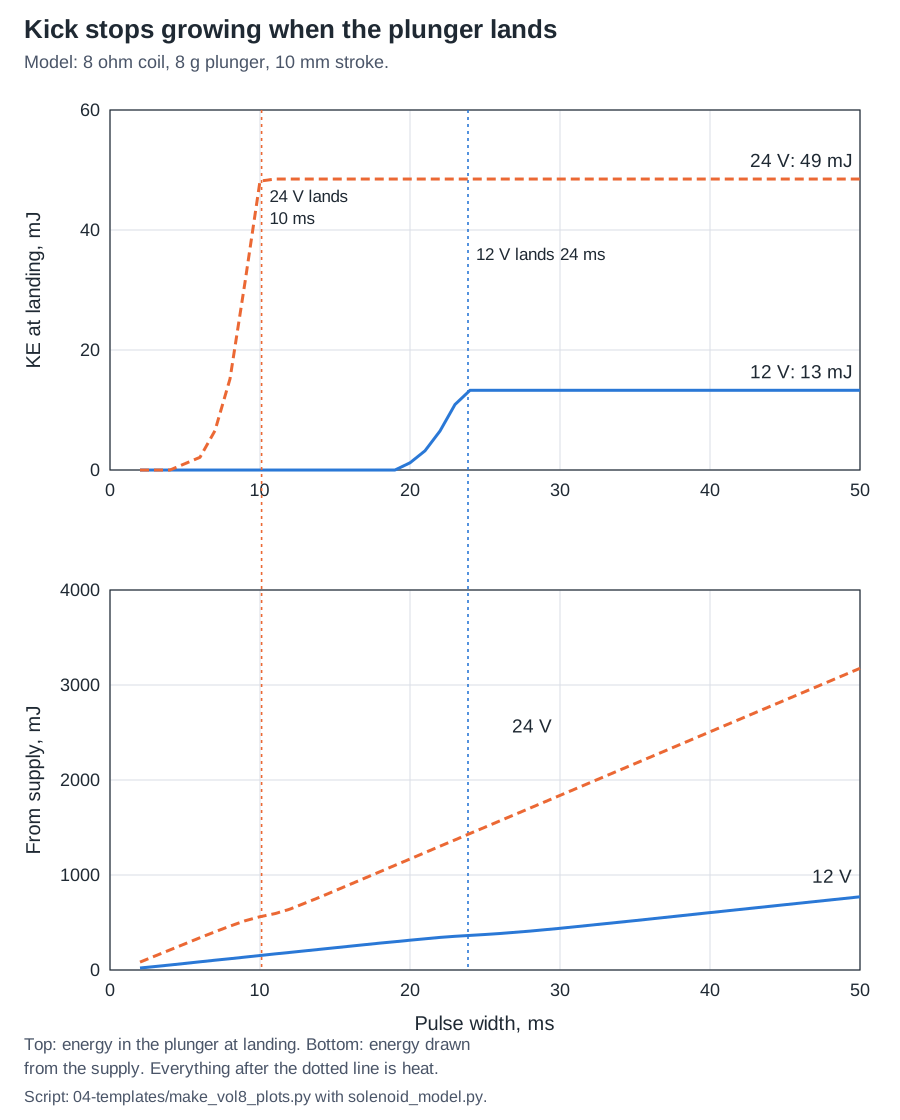
Below a threshold the plunger does not land at all: the spring wins once the current falls. At 24 V the model’s plunger lands for pulses from about 6 ms; by 10 ms it has its full 49 mJ. At 12 V nothing lands below about 20 ms, and the full 13 mJ needs 24 ms. Beyond landing, every millisecond adds heat and no kick, linearly: at 24 V, 50 ms draws 3.2 J for the same 49 mJ that 11 ms delivers for 0.59 J. Volume 4 makes the same point from the current trace; this is the energy view of it. The practical consequence for choosing a part is that arrival time is a specification: it sets the pulse, and the pulse sets the heat. Two candidates with the same energy at landing are not equal if one lands in 10 ms and the other in 25.
8.7 Impulse against moving mass
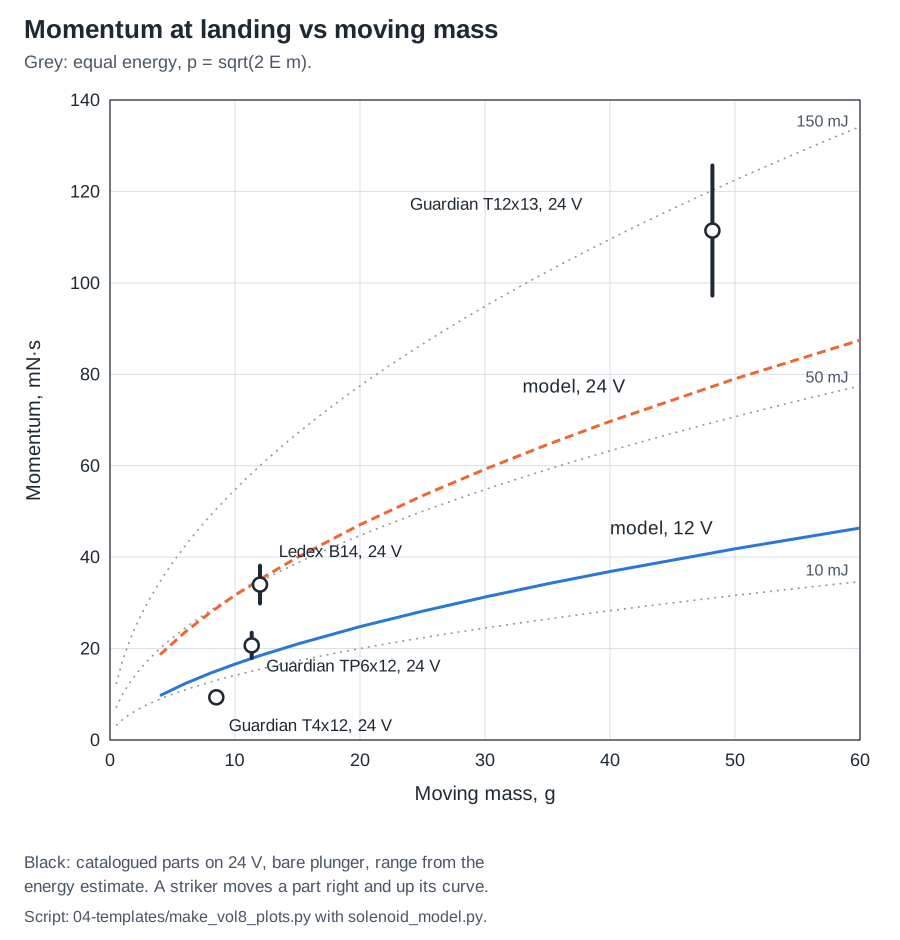
For a given energy, momentum grows as the square root of the moving mass: p = √(2·E·m). Quadrupling the mass at constant energy doubles the impulse. In practice the energy also rises a little with mass, because a heavier plunger moves more slowly, the current has longer to build, and less of it is lost to back-EMF; the model’s curves are slightly steeper than the equal-energy lines for that reason. Volume 5 tabulates the 24 V case. Two consequences for choosing:
- Compare candidates at the moving mass the gun will use, not at their bare plungers. The Ledex B14’s 12 g plunger on 24 V carries about 30–38 mN·s; with a 20 g brass striker added, the same energy would give about 50–60 mN·s, but it will also arrive later and need a longer pulse.
- The big parts are big because of their plungers. Guardian’s T12x13 carries 97–126 mN·s on 24 V, but 48 g of that is plunger and 289 g is the whole part. In a carbine whose striker is a separate mass, a mid-size part plus a brass striker reaches the same point on the chart for a third of the weight. That is the case for the 60–90 g class in an MP7-sized shell.
8.8 The voltage question: rewinding the same coil
The light-gun argument usually runs: a 24 V solenoid is stronger than a 12 V one, or a 12 V solenoid at higher current is stronger than a 24 V one. Both framings mix up two different changes. Rewinding a coil for a different voltage is one; raising the voltage on a given coil is the other.
Rewinding. Take one bobbin, one magnetic circuit, one copper volume, and wind it with N turns of whatever wire fills the window. The wire’s cross-section is the window area divided by N, and its length is N times the mean turn. So:
Table 5 — Rewinding. Take one bobbin, one magnetic circuit, one copper volume, and wind it with N turns of whatever wire fills the window. The wire's cross-section is the window area divided by N, and its length is N times the mean turn. So
| Quantity | Scales as | Why |
|---|---|---|
| Resistance R | N² | N times the length, 1/N times the cross-section |
| Voltage for a given power, V = √(P·R) | N | |
| Current for that power, I = V/R | 1/N | |
| Ampere-turns N·I | constant | N × 1/N |
| Force at every gap | constant | Force depends on N·I and the gap (Volume 2) |
| Inductance L | N² | Same reluctance, N² turns |
| Time constant L/R | constant | N²/N² |
| Rise of ampere-turns at switch-on, d(NI)/dt = N·V/L | constant | N × N / N² |
| Copper loss at that force, I²R | constant | (1/N)² × N² |
Every row that matters to the kick is constant. A coil rewound for a higher voltage, run at the same power, makes the same force, at the same speed, for the same heat. The voltage is a choice about the wire, not about the solenoid.
Ledex’s own B14 coil table is the experiment already done. Its three standard coils have 871, 1,791 and 3,450 turns and 6.9, 28.6 and 110 Ω. The turns ratios squared are 1 : 4.2 : 15.7; the resistance ratios are 1 : 4.1 : 15.9. At their continuous ratings of 6, 12 and 24 V, the currents are 0.87, 0.42 and 0.22 A, and the ampere-turns 757, 751 and 753, against the datasheet’s single figure of 750 for all three. Ledex prints one force curve for all three coils for that reason.1 Guardian does the same, one force table per power level for every coil of a body.4
The dive’s model agrees when asked the same question. Volume 4 regulated six coils of 6, 8 and 10 Ω, cold and hot, to 2.0 A from a 36 V supply and found impact energies of 43–48 mJ, a spread of 1.12 to 1. Rewinding the model’s coil with two-thirds of the turns (4/9 of the resistance, 2.7–4.4 Ω) and regulating it to 3.0 A from 24 V gives 43–48 mJ and 1.12 to 1 again, identical to the millijoule once the wiring resistance is scaled with the coil, and 1.13 to 1 with the original 0.3 Ω of wiring left in place.
Raising the voltage on one coil is a different thing entirely. Doubling the voltage on a given coil doubles its current and ampere-turns, quadruples its power and heat, and doubles the initial rate at which current builds, because di/dt = V/L at switch-on. This is what “running a 12 V solenoid on 24 V” does, and it is why it kicks harder: it is four times the power, accepted as a duty-cycle trade (Volume 2, Section 2.5). It is not a property of 24 V. A coil wound for 24 V and run on 48 V would gain exactly the same.
So the question “higher voltage and lower current, or lower voltage and higher current?” has a clean answer for the solenoid: for the same power in the same body, it makes no difference to the force, the speed or the heat. The kick is set by the body, the power and the pulse. The choice of voltage is a choice about everything else in the system.
8.9 What the voltage does decide
Once the solenoid is taken out of the argument, the voltage is decided by the parts around it. At a fixed pulse power, every one of them prefers the higher voltage until the safety and availability limits arrive.
Cable and connector losses. The gun hangs on a cable, often three metres of it, carrying the pulse out and back. At a fixed coil power, current goes as 1/V, so the I²R lost in the cable and every contact goes as 1/V².
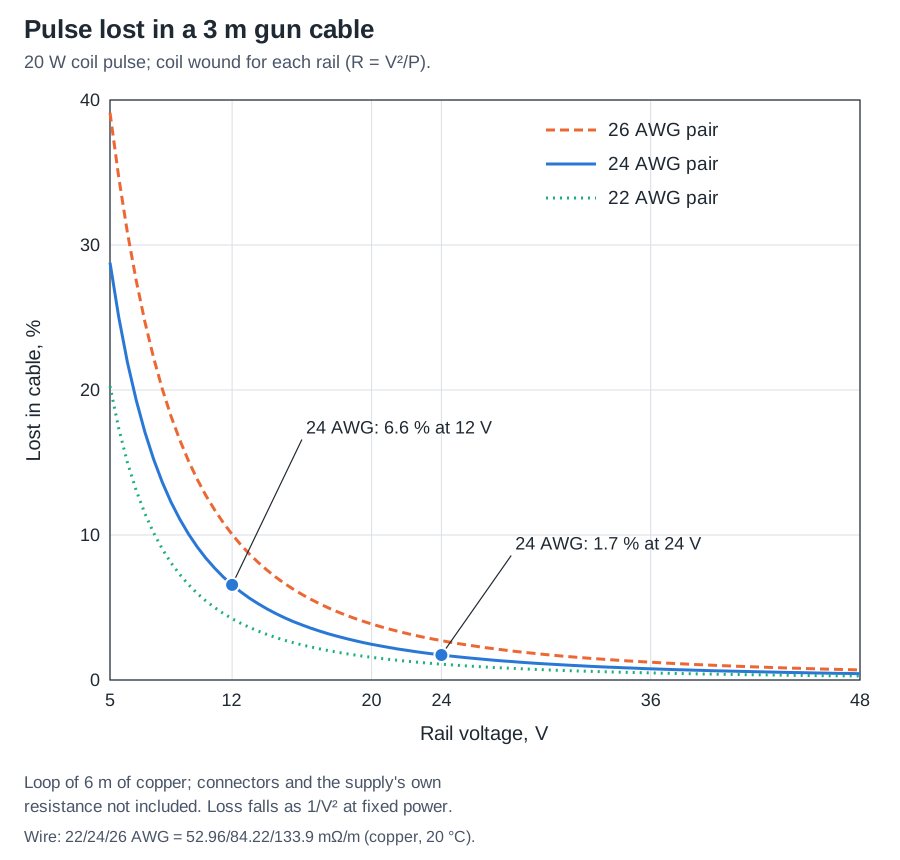
For a 20 W pulse over a 3 m pair of 24 AWG (a 6 m loop of about 0.5 Ω), the cable takes 6.6 % at 12 V and 1.7 % at 24 V, and 29 % at 5 V. The loss also shows up as droop at the coil during the pulse, about 0.8 V at 12 V in that example, and the droop is the same mechanism Volume 3 lists among the reasons two guns kick differently. OpenFIRE’s README asks for 24 AWG at the thinnest for the solenoid run.21 Halving the current also quarters the heating at the barrel jack and at any crimped or board-mounted connector inside the gun.
The switch. A MOSFET’s conduction loss is I²·R_DS(on): at half the current, a quarter of the heat for the same part, or a smaller part for the same heat. Against that, the drain sees the rail plus the clamp at turn-off (Volume 4, Section 4.10), so a higher rail needs a higher-voltage switch, and higher-voltage MOSFETs have higher on-resistance for the same die. The sibling dive’s reference board uses a 60 V MOSFET with a 33 V TVS from drain to ground, a design for 12 V and 24 V rails, and feeds its gate driver from a 12 V Zener on 24 V because the driver’s own limit is 18 V.22 A 36 V rail would need a TVS above 36 V, a switch of 80–100 V, and a new gate-driver supply.
Rise time. For a given coil, the current at switch-on rises at V/L. More voltage means a faster rise, a shorter arrival time and a more punchy shot, which is the honest part of the “24 V is better” lore. But it is a statement about the ratio of supply voltage to the coil’s own I·R, not about volts as such: the rewound coil of the previous section needs proportionally more voltage for the same rise. The quantity that matters is the forcing ratio, k = V_supply / (I_target · R_hot). With k = 1 the current approaches its target only exponentially and never quite arrives; with k = 2 it reaches the target in about 0.7 L/R; with k = 3 in about 0.4 L/R. Section 8.10 returns to it.
USB-C Power Delivery. A standard-power-range USB PD source offers fixed 5, 9, 15 and 20 V at up to 3 A, and 20 V at 5 A with a 5 A cable; the extended power range adds 28, 36 and 48 V at 5 A, but only after both ends enter EPR mode and over an EPR-rated cable.23 So 20 V is the highest voltage a gun can expect from an ordinary PD charger. A recoil rail designed around 24 V nominal that still works at 20 V can be fed by a common PD charger as well as by a 24 V brick. The PD details belong to the USB-C Power Delivery dive.
Batteries. A wireless gun’s recoil rail comes from a pack. A lithium-polymer cell runs from about 4.2 V full to about 3.0–3.5 V near empty, so a 3S pack gives roughly 9–12.6 V, 4S 12–16.8 V and 6S 18–25.2 V. A 6S pack sits inside a 24 V-class rail’s window; a 3S pack is a 12 V system that sags by a quarter over its discharge. The pack choice belongs to the LiPo Batteries dive.
Safety. IEC 62368-1 treats DC sources up to 60 V as ES1, the class that needs no safeguard against touch, and SELV conventions in installation standards use the same 60 V DC figure for dry locations.24 A 24 V rail sits far inside that; a 48 V rail leaves little margin for ripple, regulation and the turn-off spikes that appear inside the gun. Under about 30 V the parts are also the cheap, common ones: 30–60 V MOSFETs, 35–50 V capacitors, Schottky diodes of 40 V.
Measurement. The lab’s ADP3450 reads ±25 V on its direct range (Volume 6). A 24 V rail can be watched on a channel directly; a 36 V rail cannot without a ×10 probe.
Availability. 12 V and 24 V wall bricks are everywhere, and 24 V is the arcade industry’s solenoid rail: Namco’s Time Crisis 4 wiring labels the gun’s supply “+24V … SOLENOID” (Volume 1), and RetroShooter and Ultimarc ask for 24 V and 24–36 V.
Table 6 — What the voltage does decide
| Rail | Cable loss, 20 W over 3 m of 24 AWG | Fits USB PD | Fits a LiPo pack | Switch and clamp | Safety margin to 60 V |
|---|---|---|---|---|---|
| 5 V | 29 % | Yes (any USB) | 1S + boost | Trivial; very high current | Large |
| 12 V | 6.6 % | No fixed 12 V in PD (9 or 15 V) | 3S, sags 25 % | 30–60 V parts | Large |
| 20 V | 2.5 % | Yes, the highest SPR level | 5S | 60 V parts | Large |
| 24 V | 1.7 % | 20 V PD at reduced headroom | 6S | 60 V parts; the reference board’s design point | Large |
| 36 V | 0.8 % | EPR only | 9S–10S (uncommon) | 80–100 V switch, new TVS, gate-driver rail | Comfortable |
| 48 V | 0.4 % | EPR only | 12S+ | 100 V parts | Thin |
8.10 How current regulation changes the answer
With fixed-voltage drive, which is what the open firmwares and most DIY boards do, the rail voltage is the kick setting. A 12 V coil on 12 V is gentle, on 24 V is four times the power, and the only other knob is the pulse width, which mostly adds heat after landing. Every supply, cable and coil temperature changes the kick (Volume 3), and the community ends up with one supply per gun.
With regulated current (Volume 4, Section 4.9), the driver sets the current, and therefore the ampere-turns and the force, directly. The rail voltage stops being the kick setting and becomes only the headroom: how fast the current reaches its target, and whether it can reach it at all with a hot coil and a sagging supply. The kick is then set by one number in the firmware, the same on a 20 V PD charger, a 24 V brick or a 6S pack, as long as the forcing ratio stays above about 1.5 on the worst of them.
That changes how the coil is chosen. Under regulation the right coil for a rail is the one whose hot resistance times its target current is about half the rail, so that the forcing ratio is near two. On a 24 V rail, that is a coil of roughly 5–12 Ω run at 1–2.5 A, which is exactly the class the community calls “12 V solenoids”. The Ledex B14 shows the consequence. Its 28.6 Ω coil, sold as the 12 V part, needs 0.84 A for its 25 % rating (1,500 ampere-turns at 1,791 turns); hot, at about 34 Ω, that needs 29 V, which a 24 V rail cannot supply. Its 6.9 Ω coil, the “6 V” part, needs 1.72 A for the same 1,500 ampere-turns, which is 14 V hot: a forcing ratio of 1.7 on 24 V. On a regulated 24 V rail, the coil to buy is the one sold for 6 to 12 V, not the one sold for 24 V. The same reasoning picks the Guardian TP6x12-I-12 (12.1 Ω) over the TP6x12-C-24 (121 Ω).
The model shows what happens when the coil is not matched to the rail. Volume 4’s six coils of 6–10 Ω, regulated to 2.0 A, give a spread of 1.12 to 1 from 36 V; from 24 V the hot 10 Ω coil needs all 24 V and the spread opens to 1.57 to 1. Regulated to 1.4 A from 24 V, the forcing ratio is restored and the spread closes to 1.15 to 1, but each shot carries about 21–25 mJ instead of 43–48. A lower-resistance winding of the same body, at 1.5 times the current, recovers the full energy (Section 8.8).
The regulation also sets the limit on how far down the voltage can go. A 12 V rail regulating a 6.9 Ω coil to 1.72 A has a forcing ratio of 12 / 14 hot, under one: it cannot reach the current. So regulation does not rescue a 12 V rail; it makes a 24 V-class rail tolerant of whatever feeds it.
8.11 The rail: decided
Decided by the owner on 18 October 2026 (decisions D13 and D14): design the recoil rail for 24 V nominal, working from about 18 to 28 V, with the coil chosen from the “6–12 V” class (roughly 5–12 Ω), the current regulated, and the pulse ended at landing.
- It keeps cable and connector losses under 2 % on a 3 m lead of ordinary 24 AWG.
- It accepts the three supplies the project is likely to use: a 24 V brick (the arcade standard), a 20 V USB PD contract at somewhat reduced forcing (at worst just under the window’s 18 V floor at the gun, USB-C Power Delivery, Volume 2), and a 6S pack for the wireless builds.
- It matches the sibling dive’s reference board (60 V switch, 33 V drain TVS, Zener-fed gate driver) without redesign.22
- It stays far inside the 60 V ES1 limit, inside the ADP3450’s direct input range, and on cheap 60 V parts.
- Under regulation, the kick becomes a firmware number that does not change with the supply, which removes the reason for the drawer of supplies.
Regulated current is required from the first driver board (D13), so the Reference Electronics carrier needs a regulated stage rather than a plain low-side switch. Fixed-voltage drive with a per-gun pulse width, what the community does today with “12 V” parts on 24 V, survives only as a bench condition: the Section 8.14 sweeps run in constant-voltage mode until that board exists. The rail is 24 V class, 18–28 V working (D14). If the bench in Section 8.14 contradicts the reasoning above, the decision log gets a new dated row; the old one is not erased.
8.12 Why this, and why not the others
The rail.
Table 7 — The rail.
| Option | Verdict | Why |
|---|---|---|
| 24 V nominal, 18–28 V working, regulated current | Decided (D13, D14) | Low cable loss; fits brick, 20 V PD and 6S; matches the reference board; cheap parts; well inside ES1; kick independent of supply under regulation |
| 5 V from USB, directly or via a capacitor bank | Rejected as the main rail | 29 % lost in a 3 m 24 AWG pair at 20 W; amperes of current through USB-grade contacts; needs a boost or capacitor bank (Power Supplies dive). Kept for a USB-only build, as Sinden does |
| 12 V | Rejected | Four times the cable loss of 24 V; no fixed 12 V level in USB PD; a 3S pack sags a quarter; too little headroom to regulate a coil strong enough for a carbine. Fine for a pistol tap such as Blamcon’s hammer |
| 20 V only (USB PD) | Supported as an input, not the design centre | The highest ordinary PD level, so worth accepting; but 24 V bricks and 6S packs are the more common recoil sources, and the arcade guns are 24 V |
| 36 V (the top of Ultimarc’s range) | Rejected for now | Faster rise, lower loss, but EPR-only on USB, uncommon pack sizes, an 80–100 V switch, a new TVS and gate-driver supply, and outside the ADP3450’s direct range; the 24 V gain under regulation is enough |
| 48 V | Rejected | Little safety margin to 60 V once spikes are counted; EPR-only; 100 V parts; nothing in the light-gun world uses it |
The class of solenoid. No single part is picked yet; that is the bench’s job. The classes are ranked for the carbine builds:
Table 8 — The class of solenoid. No single part is picked yet; that is the bench's job. The classes are ranked for the carbine builds
| Class | Verdict | Why |
|---|---|---|
| Catalogued box frame, 60–90 g, 6–12 Ω coil (Ledex B14-255 class) | Testing | A force-stroke curve, coil table, duty ratings and life figure come with it; energy in the right range on 24 V; pull action suits a striker on a pushrod |
| Catalogued push tubular, about 65 g, 12 Ω coil (Guardian TP6x12-I-12 class) | Testing | Push action and a round body suit a bore-axis striker; datasheet force tables; 1 million cycle life figure, “dependent on load conditions” |
| Large hobby open frame (Adafruit 413) | Testing | Widely available at a known price from a retailer that labels the part; listing figures promising but unverified |
| Community open frame (JF-0530B, JF-0826B) | Testing | What most DIY guns use; cheap; but listings contradict themselves and each other, so buy a batch and characterise every unit |
| Small catalogued tubular (Guardian T4x12) | Rejected | 2–7 mJ even overdriven: too little for a carbine |
| Large catalogued tubular (Guardian T12x13) | Rejected for the gun, kept as a reference | 289 g and 38 mm diameter will not fit an MP7-sized shell; a mid-size part with a brass striker reaches the same momentum for a third of the weight |
| 5 V mini parts (Zonhen ZHO-0420S, Adafruit 2776) | Rejected | Too little energy; 4.5 mm stroke |
| SparkFun 36 V part | Rejected | No force published and a measured stroke of 10 mm against a datasheet’s 25; nothing to plan on |
| Small 30 mm hobby part (Adafruit 412) | Rejected | Single-figure millijoules on 12 V; a 40 Ω coil cannot draw useful current on 24 V |
8.13 The bench shortlist
Decided (D15, 18 October 2026): the shortlist below is being bought as listed — 2× Ledex B14-255, 2× Guardian TP6x12, 2× Adafruit 413, 5× JF-0530B 12 V and 5× JF-0826B 12 V — and ranked on the ADP3450 bench. US-dollar prices for the Ledex and Guardian parts are read from the distributor at order time.
Four kinds of part, chosen to span the field: two catalogued parts with published curves to anchor the measurements, one labelled hobby part from a retailer, and the marketplace parts the DIY guns actually use.
Table 9 — The bench shortlist
| # | Part | Why it is on the list | Quantity | Price, 2026-10-18 | Where |
|---|---|---|---|---|---|
| 1 | Ledex B14-255-B-1 (6.9 Ω) | Catalogued box frame; its datasheet curve is the reference every other part is compared with; the right coil for a regulated 24 V rail (Section 8.10) | 2 | Not captured | Ledex/Johnson Electric distributors; datasheet1 |
| 2 | Guardian TP6x12-I-12, A420-066092-00 (12.1 Ω) | Catalogued push tubular; the shape a bore-axis striker wants | 2 | Not captured for this exact part; nearest variants CNY 334.71 (TP6X12-C-24D) and CNY 429.59 (T6X12-I-12D) ex GST at element14 China | Guardian distributors (element14, Newark)57 |
| 3 | Adafruit 413, Large Push-Pull | A labelled hobby part at a known price; listing promises the most energy per dollar | 2 | $14.95 each, $29.90 | https://www.adafruit.com/product/413 |
| 4 | JF-0530B 12 V and JF-0826B 12 V | The community parts (Blamcon uses the 0826B) | 5 of each | Not captured (AliExpress and Amazon unreadable on the day, Volume 7) | Marketplace; search by name and voltage |
Cost. The only price captured in US dollars is the Adafruit pair, $29.90. The two catalogued pairs will dominate the total: element14 China shows the nearest Guardian variants at CNY 335–430 each, and Ledex B14-family parts at CNY 374–649. The marketplace parts are the cheapest by far but could not be priced. The shortlist should be priced from the distributors’ pages on the day of ordering, and the prices written into this table.
Two of each catalogued part, not one, because unit-to-unit spread is itself a result (Volume 3); five of each marketplace part because their spread is the larger question.
8.14 The test plan that ranks them
The rig is Volume 6’s: a 1–2 kg test mass on a bifilar suspension, a shunt in the driver, an ADXL1002 on the mass, and a firmware sync pin. The instruments are the lab’s Digilent Analog Discovery Pro ADP3450 and its programmable bench supplies.
The ADP3450. Digilent’s specification gives it four single-ended analogue inputs, 14 bits, at least 55 MHz of bandwidth and up to 125 MS/s per channel, a buffer of up to 32 MS per channel (32,768 samples in Linux mode), ±25 V input range with ±50 V protection, 16 digital I/O and two waveform generators.25 It has no current input: coil current is captured as the voltage across a shunt. With single-ended inputs, the clean way is a low-side shunt between the MOSFET source and ground, ground-referenced, on one channel: 0.1 Ω gives 0.1 V per ampere. A high-side shunt would need two channels and a difference, and at 24 V of common mode on a ±25 V range the 14-bit resolution leaves steps of about 3 mV, too coarse for a 10 mΩ shunt. A clamp-on current probe with a BNC output is the alternative where the circuit cannot be broken. Channel use:
Table 10 — The ADP3450. Digilent's specification gives it four single-ended analogue inputs, 14 bits, at least 55 MHz of bandwidth and up to 125 MS/s per channel, a buffer of up to 32 MS per channel (32,768 samples in Linux mode), ±25 V input range with ±50 V protection, 16 digital I/O and two waveform generators.[^adp] It has no current input: coil current is captured as the voltage across a shunt. With single-ended inputs, the clean way is a low-side shunt between the MOSFET source and ground, ground-referenced, on one channel: 0.1 Ω gives 0.1 V per ampere. A high-side shunt would need two channels and a difference, and at 24 V of common mode on a ±25 V range the 14-bit resolution leaves steps of about 3 mV, too coarse for a 10 mΩ shunt. A clamp-on current probe with a BNC output is the alternative where the circuit cannot be broken. Channel use
| Channel | Signal | Note |
|---|---|---|
| 1 | Low-side shunt, 0.1 Ω | Coil current; the cusp gives arrival time |
| 2 | Rail at the driver input | Supply droop; with channel 1 gives energy per shot by a math channel |
| 3 | ADXL1002 analogue output | Impact acceleration; integrate across the impact for the impulse |
| 4 | Drain, through a ×10 probe | Clamp voltage and release time; above ±25 V at turn-off with a Zener or TVS |
| DIO 0 | Firmware sync pin | Trigger, with a few ms of pre-trigger |
The supplies. One USB-controlled programmable supply provides the recoil rail, stepped by script: 12, 18, 20, 24 and 28 V, with its current limit set just above the expected peak, which also protects the coil if the driver sticks on (Volume 7). The Bluetooth-controlled supply, or a second USB one, powers the logic and the accelerometer separately so that the rail can be swept without disturbing them. A programmable supply’s own constant-current loop is too slow to regulate a 10 ms pulse; regulated-current tests wait for the driver from the Reference Electronics dive, and until then the supply runs in constant-voltage mode.
Per part, in order:
- Identify and characterise (Volume 3, steps 1–4): label photographed; cold resistance by four-wire measurement; inductance open and seated from the step response on channel 1; static force at 0.5, 1, 2, 4, 6, 8 and 10 mm at two currents in the force fixture. Integrate the measured curve: this is the measured W, to set beside the datasheet’s.
- Mount on the test mass with the stroke set to the gun’s and no striker. Record the moving mass.
- Rail sweep, long pulse. At 12, 18, 20, 24 and 28 V, ten shots each with a 50 ms pulse. Read arrival time and its spread from channel 1.
- Trimmed pulse. At each voltage, set the pulse to arrival plus 2 ms and fire ten shots. Integrate channel 3 across the impact for the impulse, J = M·Δv of the test mass; with the moving mass m, the plunger’s landing energy is J²/(2m). Integrate channel 1 × channel 2 for the energy drawn per shot.
- Add the striker (20 g brass, Volume 5) and repeat step 4 at 24 V.
- Heat. At 24 V, trimmed pulse, fire a 30 s burst at eight shots a second; log the steady current of each shot and infer winding temperature from resistance (copper, 0.39 %/K).
- Spread. Repeat steps 3–4 at 24 V on every unit of the part, and report the spread of landing energy.
Ranking. Each part gets one row:
Table 11 — Ranking. Each part gets one row
| Part | Measured W at 24 V | KE at landing, bare | Impulse with striker | Arrival time at 24 V | Supply energy per shot | Unit spread | Temperature rise, 30 s burst | Mass and fit in the shell | Price |
|---|
The figure of merit for a carbine is impulse with the striker, per joule drawn per shot, subject to fitting the shell and staying under the coil’s temperature limit through a burst; arrival time breaks ties, because it sets the rate of fire. The winner goes into the decision log as Decided, with the measured row, and the losers with their measured reasons.
8.15 What could not be verified
- US-dollar distributor prices for the Ledex and Guardian parts. DigiKey’s search returned nothing for the part numbers; Newark, Mouser and RS returned 403 or timed out; the browser extension was not connected. Only element14 China’s CNY prices for neighbouring variants were read.
- The hobby parts’ force figures. Each is a single number with no stated test condition; the JF-0530B’s 5 N at 10 mm in particular is out of line with catalogued parts of greater mass.
- The 10 % and 1 % rows of the Guardian tables, which Guardian itself marks as calculated. Guardian’s duty-cycle footnotes also misprint “90% On Time” for the 10 % rating (its own 10 s on, 90 s off says 10 %).
- The dynamic fraction η = 0.40–0.65 comes from the dive’s model, not from any of these parts; the bench replaces it.
- The parts inside the GUN4IR kits, RetroShooter and AimTrak guns; none is named by its maker.
- The OSH Park board’s 18–35 V figure is a community member’s design note, not GUN4IR’s specification.
Sources
Footnotes
-
Ledex (Johnson Electric), Ledex® Box Frame Size B14 datasheet, copy at https://media.e-sonic.com/productfiles/mf-jon/openframe_b14.pdf, read 2026-10-18. Coil table, duty-cycle table and force-stroke chart; force values read off the chart by eye. ↩ ↩2 ↩3 ↩4
-
element14 China, search “ledex B14”: B14-L-258-B-4, CNY 374.05; B14HD-253-B-4, CNY 649.35, https://www.element14.cn/en-CN/search?st=ledex%20B14, read 2026-10-18. ↩
-
Guardian Electric, DC Tubular Solenoid Model T4x12 datasheet, copy at https://www.farnell.com/datasheets/2722934.pdf, read 2026-10-18. ↩
-
Guardian Electric, DC Push Tubular Solenoid Model TP6x12 datasheet, copy at https://www.farnell.com/datasheets/2722935.pdf, read 2026-10-18. ↩ ↩2 ↩3
-
element14 China, Guardian Electric TP6X12-C-24D, order code 1190222, https://www.element14.cn/en-CN/guardian-electric/tp6x12-c-24d/solenoid-cylindrical-push-continuous/dp/1190222, read 2026-10-18. ↩ ↩2
-
Guardian Electric, DC Tubular Solenoid Model T12x13 datasheet, copy at https://www.farnell.com/datasheets/2722933.pdf, read 2026-10-18. ↩
-
element14 China, Guardian Electric T6X12-I-12D, order code 1386411, https://www.element14.cn/en-CN/guardian-electric/t6x12-i-12d/20m0275/dp/1386411, read 2026-10-18. ↩ ↩2
-
Shenzhen Zonhen Electric Appliances, Specification ZHO-0420S-05A4.5, rev. B, https://cdn.sparkfun.com/datasheets/Robotics/ZHO-0420S-05A4.5%20SPECIFICATION.pdf, read 2026-10-18; and SparkFun, “Solenoid - 5V (Small)”, ROB-11015, https://www.sparkfun.com/solenoid-5v-small.html. ↩
-
Adafruit product pages 412, 413 and 2776, https://www.adafruit.com/product/412, /413, /2776, read 2026-10-18 (Volume 3). ↩ ↩2 ↩3
-
circuit.rocks, “Adafruit Solenoid JF-0530B Mini Push-Pull - 412”, https://circuit.rocks/small-push-pull-solenoid.html, read 2026-10-18. ↩
-
Sigmanortec, “Electromagnetic piston JF-0530B with solenoid 12V push-pull”, https://sigmanortec.ro/en/electromagnetic-piston-jf-0530b-with-solenoid-12v-push-pull, read 2026-10-18 (Volume 3). ↩
-
Probots, “0530B 24V Solenoid 0.7kg Push Pull Linear Actuator Motor Electromagnet”, SKU PRO812, https://probots.co.in/24v-solenoid-0-7kg-push-pull-linear-actuator-motor-electromagne.html, read 2026-10-18. ↩
-
Probots, “0826B 12V Solenoid 2kg”, SKU PRO850, https://probots.co.in/0826b-12v-solenoid-2kg-push-pull-linear-actuator-motor-electromagnet.html, read 2026-10-18 (Volume 3). ↩
-
SparkFun, “Solenoid - 36V”, ROB-10391, https://www.sparkfun.com/solenoid-36v.html, read 2026-10-18. The datasheet link on the page (ZHO-1364S-36A13.pdf) returned 404. ↩
-
Blamcon, “Blamcon Ace of Spades” build guide, https://blamcon.com/lightgun-lineup/blamcon-ace-of-spades/, read 2026-10-18. ↩
-
GUN4IR / JB Game Lab online store product data, https://www.gun4ir.com/products.json, read 2026-10-18. ↩
-
drbogger, “GUN4IR Rumble & Solenoid”, OSH Park shared project, 7 August 2022, https://oshpark.com/shared_projects/yC6D11ud, read 2026-10-18. ↩
-
RetroShooter, “RS3 Reaper 2 Pink & Blue”, https://retroshooter.com/?p=22789, read 2026-10-18. ↩
-
Ultimarc, “AimTrak Light Gun With Recoil”, https://www.ultimarc.com/light-guns/aimtrak-light-gun/aimtrak-light-gun-with-recoil/, read 2026-10-18. ↩
-
“Build a DIY OpenFIRE lightgun with recoil”, build guide written for this project, held in the Open-Source Firmware dive’s inputs; parts table. ↩
-
TeamOpenFIRE, OpenFIRE-Firmware README, https://github.com/TeamOpenFIRE/OpenFIRE-Firmware, read 2026-10-18 (Volume 4). ↩
-
The Reference Electronics dive, solenoid driver volume (MOSFET rating, drain TVS, gate-driver supply), as drafted 2026-10-18. ↩ ↩2
-
Texas Instruments, “USB Type-C® and USB Power Delivery: Designing for both Extended Power Range and battery-powered systems”, technical article SSZTD49A, 2024, https://www.ti.com/lit/SSZTD49, read 2026-10-18; Table 1. ↩
-
David Law (IEEE 802.3 PDCC ad hoc), “ES1, LPS and SELV voltage and source requirements summary”, August 2021, https://www.ieee802.org/3/ad_hoc/PDCC/public/2021/ES1_LPS_SELV_1_0821.pdf, read 2026-10-18. A summary of IEC 62368-1 subclause 5.2.1.1 and related standards, not the standards themselves. ↩
-
Digilent, Analog Discovery Pro (ADP3450/ADP3250) Specifications, revision 0924, copy at https://assets.testequity.com/te1/Documents/pdf/Digilent_Analog-Discovery-Pro-ADP3450-ADP3250_Specifications_0924.pdf, read 2026-10-18 (Digilent’s own web pages refused automated access). ↩
Comments (0)