Solenoid Recoil · Volume 7
Selection, Purchase and Upkeep — Choosing a Recoil Solenoid, Where to Buy It, and Keeping It Working
A decision table for the gun being built, the parts whose sellers' pages could be read on 18 October 2026 with their prices, and the failure modes, diagnoses and protections that keep a kicking gun alive
The earlier volumes give the reasons; this one gives the choices. It starts from the gun being built, narrows to a part, lists the parts whose sellers’ pages could be read on 18 October 2026 with their prices on that day, and ends with what goes wrong with a recoil mechanism and how to keep it working. Volume 8, added later and numbered after this one so that links stay stable, reads best before it: it surveys the candidate parts with their energy per shot, settles the choice of supply voltage, and sets out the shortlist to buy and rank on the bench.
7.1 Choosing: start from the gun, not the part
Five questions decide the choice, in this order.
- What should move, and how far? A hammer that flicks through 30° (the Blamcon revolver), a striker that runs along the bore (a carbine), or a visible slide (an arcade pistol). The stroke the mechanism needs is the stroke the solenoid must deliver at useful force, and Volume 2 showed that force falls steeply with stroke.
- How much moving mass? Two to five times the bare plunger is the useful range for a small open-frame part (Volume 5). More mass needs a bigger solenoid or a slower shot.
- What supply is available? USB alone means a capacitor bank and a boost converter (the Power Supplies dive). A 12 V or 24 V brick means overvoltage drive of a “12 V” part at short pulses (Volume 4). A wireless gun on a battery means the energy per shot is a battery-life question (the LiPo Batteries dive).
- How will it be driven? Fixed voltage and fixed pulse width, as the open firmwares do, makes every part a calibration problem; a regulated-current driver makes parts interchangeable (Volume 4).
- How will it be cooled and replaced? A coil that will see automatic fire needs a temperature sensor, metal or high-temperature mounting, and a way out of the gun in a few minutes.
7.2 A decision table
Table 1 — A decision table
| The gun | Moving part | Solenoid class | Drive | Notes |
|---|---|---|---|---|
| Pistol, hammer tap | Hammer on a pivot | ”0530B” or “0826B” open frame | 12 V, short pulse | Blamcon’s Ace of Spades uses a JF-0826B on 12 V1 |
| Pistol, visible slide | Slide on guides | Large open frame or tubular | 24 V, short pulse or regulated current | The arcade pattern (Volume 1) |
| Carbine, striker on the bore axis | Brass striker, 20–40 g | Large open frame (Adafruit 413 class), a catalogued box frame (Ledex B14 class) or a catalogued push tubular (Guardian TP6x12 class) | 24 V-class rail, regulated current, pulse ended at landing (Volume 8) | The project’s MP7 builds; the bench decides between the classes |
| Carbine with moving ejection port | Port cover, plus striker | Second, smaller solenoid or a linkage | Peak and hold if the port must stay open | See the Moving Ejection Port dive |
| USB-only gun | Light striker | Mid-size open frame | Capacitor bank, short pulse | Sinden’s approach; limited sustained rate (Volume 1) |
For the carbine, the starting choice is a large open-frame unit or a catalogued industrial box frame, overdriven to about 24 V with the pulse ended at landing, a striker of a few tens of grams, and current regulation as soon as the driver board supports it. A catalogued part such as the Ledex B14 costs more than a marketplace part but comes with a force-stroke chart, a coil table, duty-cycle ratings and a life figure, which removes most of Volume 3’s work.2 Pick the coil for the rail, not the label: on a current-regulated 24 V rail the right B14 is the 6.9 Ω B14-255-B-1, sold as a 6 V continuous part, because the 28.6 Ω “12 V” coil cannot reach its working current when hot (Volume 8, Section 8.10).
7.3 Where to buy, with dated prices
Prices below are as shown on each seller’s own page on 18 October 2026, for single quantities, before shipping and tax. Every part should be characterised on arrival (Volume 3), whoever sold it.
Table 2 — Where to buy, with dated prices
| Part | Seller | Price, 2026-10-18 | Key listed figures | Link |
|---|---|---|---|---|
| Large Push-Pull Solenoid (product 413) | Adafruit | $14.95 | 12 V; ~12 Ω; 10 mm throw; 6 N starting force; 144 g | https://www.adafruit.com/product/413 |
| Medium Push-Pull Solenoid, 5–6 V (3992) | Adafruit | $7.50 | 1 A at 6 V; 10 mm throw | https://www.adafruit.com/product/3992 |
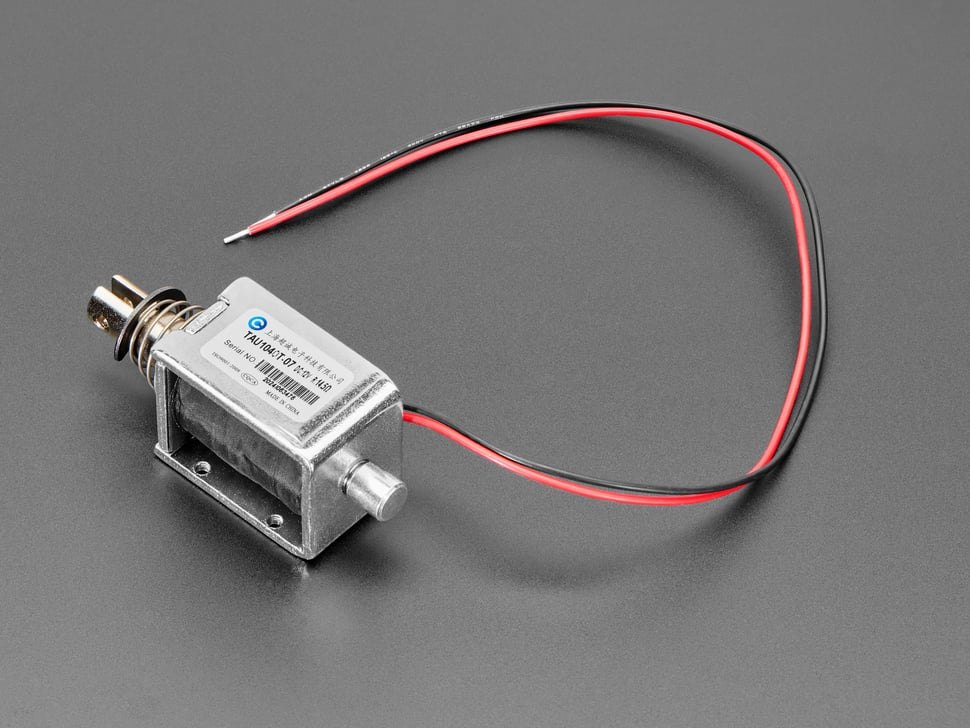
| Small Push-Pull Solenoid, 12 V (412) | Adafruit | $7.50 | 40 Ω; ~300 mA; 5.5 mm throw; 0.5 N starting, 5 N retentive | https://www.adafruit.com/product/412 |
| Mini Push-Pull Solenoid, 5 V (2776) | Adafruit | $4.95 | 4.5 Ω ±5 %; 1.1 A | https://www.adafruit.com/product/2776 |
| Solenoid - 36V (ROB-10391) | SparkFun | $34.95 | 650 mA at 12 V, 1.85 A at 36 V; 10 mm throw measured | https://www.sparkfun.com/solenoid-36v.html |
| Solenoid - 5V Small (ROB-11015) | SparkFun | $6.50 | Zonhen ZHO-0420S; ~4.5 mm throw measured | https://www.sparkfun.com/solenoid-5v-small.html |
| 0826B 12V Solenoid (PRO850) | Probots (India) | ₹999.00 incl. GST | Listing self-contradictory on current (Volume 3) | https://probots.co.in/0826b-12v-solenoid-2kg-push-pull-linear-actuator-motor-electromagnet.html |
| Ledex B14 box frame: B14-255-B-1 for a regulated 24 V rail, B14-254-B-1 for fixed 12 V or 24 V drive | Ledex distributors | not captured | 6.9 Ω or 28.6 Ω; one force table for both at equal watts; 15.6 N holding | Datasheet2 |
| Guardian TP6x12-I-12 push tubular (A420-066092-00) | Guardian distributors | not captured; nearest variants CNY 335–430 at element14 China | 12.1 Ω; 12 V at 25 %; 11 g plunger, 65 g total | Volume 8 |
| ADXL375 ±200 g breakout (5374), for measurement | Adafruit | $24.95 | ±200 g, to 3200 Hz output rate | https://www.adafruit.com/product/5374 |
Prices for the Ledex parts and for Analog Devices’ EVAL-ADXL1002Z accelerometer board could not be read from a distributor’s page on the day.
7.4 Buying the marketplace parts
The “JF-0530B” and “JF-0826B” families are sold in large numbers on AliExpress and Amazon, which is where most light-gun builders buy them. Neither site’s pages could be read for this dive on 18 October 2026, so no price or specification from them is given here. When buying there:
- Search by size class and voltage, for example “JF-0530B 12V push pull solenoid” or “0826B 24V solenoid”, and expect several different bodies under one name.
- Prefer listings that state coil resistance and a duty cycle, and check the resistance against the stated current (Volume 3). A listing whose numbers fail Ohm’s law describes no particular part.
- Buy more than needed. Buy five, characterise all five, keep the closest matched pair for a two-gun set and the rest as spares. Solenoids are consumables (Volume 3).
- Read the label on arrival and record it; it is the only traceable identity the part has.
7.5 Complete guns and kits as benchmarks
A complete commercial gun is worth having on the bench as a reference for how a kick should feel and sound. The makers’ pages on 18 October 2026:
Table 3 — A complete commercial gun is worth having on the bench as a reference for how a kick should feel and sound. The makers' pages on 18 October 2026
| Gun or kit | Price | Recoil supply required | Source |
|---|---|---|---|
| Ultimarc AimTrak with recoil | $120.00 (maker); $129.00 (Arcade Renovations) | 24–36 V; no more than 4 A at 24 V or 3 A at 36 V; one supply per gun | 34 |
| RetroShooter RS3 Reaper, pair | $229.97 | 24 V adapter and RetroShooter’s 24 V hub | 5 |
| GUN4IR GunCon 2 pre-modified set, UK/EU | €279.00 | 12 V, 2 A or more, “non switching if possible” | 6 |
| GUN4IR GunCon 2 mod kit (includes a solenoid) | €155.00 | as above | 6 |

7.6 How recoil mechanisms fail
The arcade manuals and the repair thread in Volume 1, and the physics of Volumes 2 to 5, give a short list of failures.
Table 4 — How recoil mechanisms fail
| Failure | Cause | Evidence or reasoning |
|---|---|---|
| Coil open circuit | Overheating; a thermal fuse doing its job; a broken lead at the solder tag | Namco’s coil carried a thermal fuse under its tape, and a blown one reads open7 |
| Weak kick that worsens through a session | Coil heating raising resistance; supply sagging | Copper’s 0.39 %/K (Volume 4) |
| Weak kick that stays weak | Shorted turns (resistance low but force down), worn plunger or bobbin, spring set, loose stop | Resistance against the record sheet distinguishes them |
| No kick, solenoid good | Driver transistor failed open; missing common ground; connector | Namco’s SLA4060 failures;7 the build guide: a missing common ground “is the most common reason recoil does nothing”8 |
| Solenoid stuck on, overheating | Driver failed short; gate floating high; firmware holding the pin | Volume 4; the open firmware’s thermal check does not gate the first shot of a pull9 |
| Driver killed at turn-off | Flyback diode missing, open or reversed | Unclamped coil voltages of hundreds of volts10 |
| Gun drops off USB when firing | Ground bounce or coupling from the solenoid loop | Volume 4, Section 4.12 |
| Rattle, double tap | Spring weak or broken; no forward-stop damper; striker loose | Volume 5 |
| Cracked mount or shell | Stop screwed into thin plastic; PLA near a hot coil | Volume 5 |
7.7 Diagnosis at the bench
- Measure the coil’s resistance cold and compare it with the record sheet. Open: the coil or its fuse has failed. Well below the recorded value: shorted turns. Within a few percent: the coil is good.
- Fire it on the bench supply directly, briefly, with a diode across it. If it kicks there but not in the gun, the fault is in the driver, wiring or ground.
- Capture one shot’s current (Volume 6). No current: driver or wiring. Current but no cusp: the plunger is not moving, so look for binding, a broken spring, or a stop that has moved into the stroke. A cusp much later than recorded: friction, a weaker supply, or a hot coil.
- Check the flyback clamp with a diode test, and the switch’s drain-source path with the gate held low. A shorted switch is the dangerous failure.
- Inspect the mechanism: plunger and bobbin for wear marks, spring free length against new, dampers for compression set, every screw for tightness.
7.8 Protection against the driver that sticks on
The most dangerous failure in a recoil gun is a driver that sticks on with a 12 V coil on 24 V: four times the coil’s continuous rating, indefinitely (Volume 4). Several independent protections are available, and a gun that will be handed to other people should have more than one:
- A supply whose current limit protects the coil. This is the defensible reading of Ultimarc’s rule that the AimTrak’s recoil supply must not be able to deliver more than 4 A.3 A supply that can deliver only a little more than the pulse current will droop and fold back when the coil is held on, limiting the damage. A supply rated at many amps will happily cook the coil. The retailer’s version, that a bigger supply “will overload the recoil solenoid”, has the mechanism wrong but the advice right for an unprotected driver.4
- A fuse or resettable fuse in the solenoid supply, sized to carry the pulses at their duty cycle but to open on a continuous fault.
- A thermal fuse on the coil, as Namco fitted.7
- A temperature sensor read by the firmware, as OpenFIRE and GUN4IR provide; it cannot help if the switch itself has failed short.96
- A hardware limit on on-time, such as a monostable or an AC-coupled gate drive that cannot hold the switch on beyond a few tens of milliseconds whatever the microcontroller does. This is a design requirement handed to the Reference Electronics dive, along with the gate pull-down that stops the switch floating on at power-up.
7.9 Routine upkeep
Table 5 — Routine upkeep
| When | Check |
|---|---|
| Before each session | The kick is present and sounds right; no rattle at rest |
| Every few sessions | Every screw in the mechanism is tight (Namco’s own daily check was “the screws on the gun are secure”11) |
| Every few thousand shots | Coil resistance cold, against the record sheet; spring free length; damper condition |
| When the kick changes | A one-shot current capture, compared with the first one on record |
| Every hundred thousand shots, roughly | Plan to replace the solenoid; that is the order of life the makers quote (Volume 3) |
Lubrication needs a note. Solenoid plungers are generally run dry or as supplied; oil and grease collect debris in the bobbin and add drag. Namco’s manuals do specify a grease for a plunger, but it is the plunger of the cabinet’s pedal assembly, not the gun’s solenoid, and that procedure should not be read across to the recoil mechanism.11 Striker guides and slide rails are another matter, and follow the guidance for whatever bearing material is used.
7.10 Why this, and why not the others
The choice of solenoid class and supply voltage, with every rejected option and its reason, is in Volume 8, Section 8.12. The protections in this volume are chosen together rather than one instead of another:
Table 6 — The choice of solenoid class and supply voltage, with every rejected option and its reason, is in [Volume 8](/light-guns/recoil-and-force-feedback/solenoid-recoil/vol-8/), Section 8.12. The protections in this volume are chosen together rather than one instead of another
| Protection | Picked | Why, and why not alone |
|---|---|---|
| Supply current limit just above the pulse | Yes | Limits a stuck-on fault cheaply; alone, it still lets the coil cook slowly |
| Fuse or resettable fuse in the recoil supply | Yes | Opens on a continuous fault; alone, sizing it to pass pulses lets a slow fault through |
| Temperature sensor read by firmware | Yes | Catches overuse; useless when the switch itself fails short |
| Hardware on-time limit on the gate | Yes, required of the driver design | The only protection that works whatever the firmware and the switch do |
| Thermal fuse on the coil | Optional | Namco’s answer; one-shot, so a nuisance trip ends the session |
7.11 Open questions for the build
These were open when the volume was written and have since been answered by the owner’s decisions of 18 October 2026, or moved:
- Hobby or catalogued part? Decided not by argument but on the bench: the Volume 8 shortlist spanning both is being bought (D15) and will be ranked there (Sections 8.13–8.14).
- 24 V or 36 V? Decided (D14): a 24 V-class rail, 18–28 V working. Volume 8 gives the reasons 36 V lost.
- Regulated current from the first board revision? Decided (D13): yes, from the first driver board, so the same kick comes regardless of coil, temperature, wiring and supply. Fixed-voltage drive remains only a bench condition until that board exists. The circuit is the Reference Electronics dive’s.
- Shared solenoid or a separate actuator for the moving ejection port? Both will be tried and the choice made on feel and reliability; see the Moving Ejection Port and MP7 Donor Build dives.
7.12 What could not be verified
- AliExpress and Amazon listings and prices for JF-0530B, JF-0826B and similar parts; neither site could be read on 2026-10-18.
- Distributor prices for Ledex B14 parts and for EVAL-ADXL1002Z.
- Lubrication guidance from any solenoid maker for recoil-type duty; none was found.
Sources
Footnotes
-
Blamcon, “Blamcon Ace of Spades” build guide, https://blamcon.com/lightgun-lineup/blamcon-ace-of-spades/, read 2026-10-18. ↩
-
Ledex (Johnson Electric), Ledex® Box Frame Size B14 datasheet, copy at https://media.e-sonic.com/productfiles/mf-jon/openframe_b14.pdf, read 2026-10-18. ↩ ↩2
-
Ultimarc, “AimTrak Light Gun With Recoil”, https://www.ultimarc.com/light-guns/aimtrak-light-gun/aimtrak-light-gun-with-recoil/, read 2026-10-18. ↩ ↩2
-
Arcade Renovations, “Ultimarc AimTrak Arcade Light Gun With Recoil - Red”, https://www.arcaderenovations.com/aimtrak-recoil-light-gun-red.html, read 2026-10-18. ↩ ↩2
-
RetroShooter, “RS3 Reaper 2 Pink & Blue”, https://retroshooter.com/?p=22789, read 2026-10-18. ↩
-
GUN4IR / JB Game Lab online store product data, https://www.gun4ir.com/products.json (currency EUR), read 2026-10-18. ↩ ↩2 ↩3
-
KLOV / Arcade Museum forum, “Replacing solednoid in Time Crisis Namco Gun?”, 17 January 2019, https://forums.arcade-museum.com/threads/replacing-solednoid-in-time-crisis-namco-gun.443665/, read 2026-10-18. ↩ ↩2 ↩3
-
“Build a DIY OpenFIRE lightgun with recoil”, build guide written for this project, held in the Open-Source Firmware dive’s inputs; troubleshooting section. ↩
-
TeamOpenFIRE, OpenFIRE-Firmware,
OpenFIREmain/OpenFIREFeedback.cpp, branchOpenFIRE-dev, read 2026-10-18; and the Open-Source Firmware dive, Volume 5. ↩ ↩2 -
TE Connectivity, relay coil suppression application note 13C3264_AppNote, September 2020, https://www.te.com/en/products/relays-and-contactors/relays/intersection/coil-suppression-relay-life.html, read 2026-10-18. ↩
-
Namco, Time Crisis SD Operation Manual, §6.7.1 and §7.1.3–7.1.4. Internet Archive item
arcademanual_Time_Crisis_SD_Manual, read 2026-10-18. ↩ ↩2
Comments (0)