Solenoid Recoil · Volume 5
Mechanical Design — Moving Mass, Stops, Springs, Dampers, Noise, and Making It Feel Like a Long Gun
Why the hand feels the stop and not the coil, how a heavier striker buys momentum, what a damper does at each end of the stroke, and where to put the whole mechanism in a carbine-sized shell
Volume 4 got the plunger moving as fast as the coil and its heat allow. This volume is about what happens next: what the moving part is, what it hits, how it comes back, how loud it is, and where in the gun all of that should happen. The project’s flagship build is an MP7-pattern gun, a compact carbine fired from the shoulder, so the last part of the volume deals with a long gun rather than a pistol. The placement inside a particular shell belongs to the MP7 Donor Build and later build dives; this volume gives the principles they apply.
5.1 What the hand feels
A solenoid recoil mechanism cannot give the gun net momentum. Every newton the coil puts on the plunger, it puts back on the gun in the opposite direction, and when the moving part has gone out and come back, the momenta sum to zero. What varies is how that exchange is distributed in time. The coil’s push is long and weak: several milliseconds of a few newtons. The stop is short and strong: the moving part’s whole momentum returned in well under a millisecond. The hand reads the short, strong event as the kick.
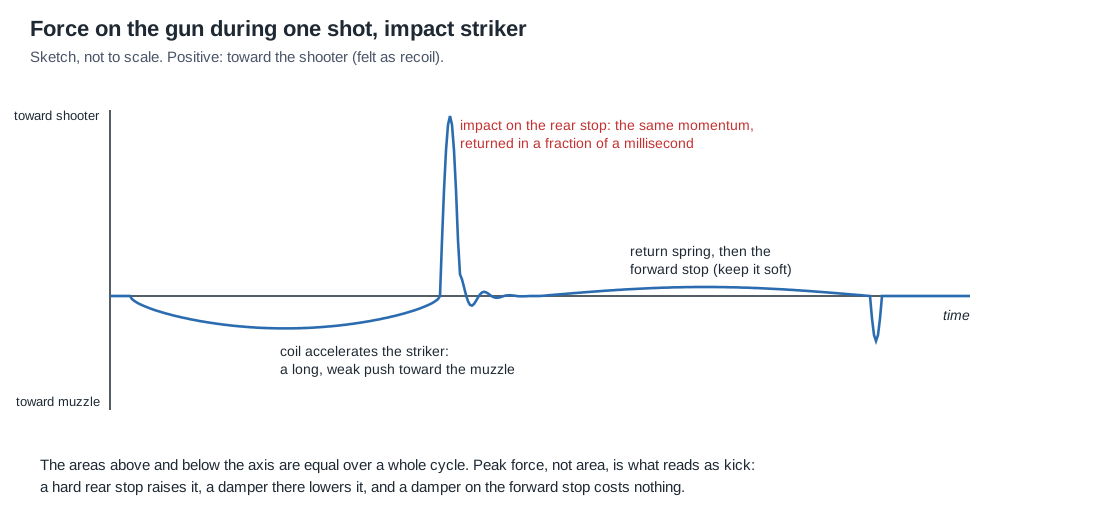
Three properties of that event matter:
- Momentum delivered at the stop, p = m·v, which sets how far the gun is moved;
- Duration of the impact, which, for a given momentum, sets the peak force: for a contact that behaves like a spring, the peak force of a half-sine impulse is about π·p / (2·t), so halving the contact time doubles the peak;
- Direction, which decides whether the gun is pushed back into the shoulder, or lifted, or twisted.
Two numbers for orientation, as estimates rather than measurements. A 20 g striker arriving at 2.4 m/s carries about 0.047 kg·m/s. Stopped by a rubber pad in about 1.5 ms, it gives a peak force of the order of 50 N; stopped by steel on steel in about 0.1 ms, the order of 700 N. The same momentum, an order of magnitude apart in peak force: that difference is the difference between a thud and a crack.
5.2 Moving mass: buying momentum
For a given amount of energy E delivered to the moving part, its momentum is √(2·m·E). A heavier moving part carries more momentum for the same energy. The coil also delivers slightly more energy to a heavier part, because a slower plunger spends longer on the steep end of the force-stroke curve. The lumped model shows both effects for one coil at 24 V:
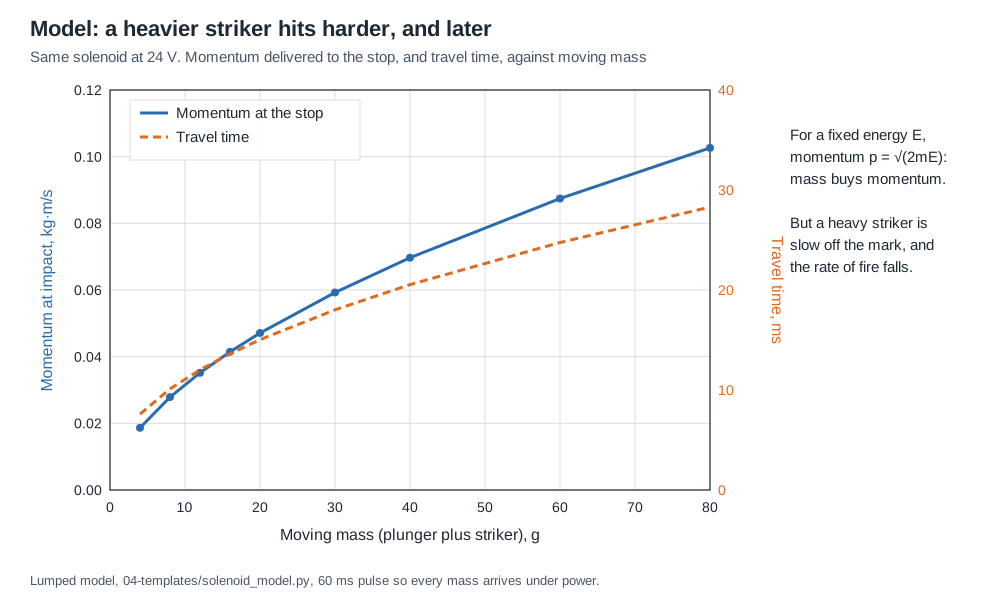
Table 1 — Moving mass: buying momentum
| Moving mass | Travel time | Impact speed | Momentum | Kinetic energy |
|---|---|---|---|---|
| 8 g (bare plunger) | 10.1 ms | 3.48 m/s | 0.028 kg·m/s | 48 mJ |
| 20 g | 15.0 ms | 2.35 m/s | 0.047 kg·m/s | 55 mJ |
| 40 g | 20.5 ms | 1.74 m/s | 0.070 kg·m/s | 61 mJ |
| 80 g | 28.3 ms | 1.28 m/s | 0.103 kg·m/s | 66 mJ |
This is why the arcade guns throw a slide. The Time Crisis gun’s plunger drives a whole upper slide on guides (Volume 1); the slide’s mass multiplies the momentum of the hit. The costs are the ones the table shows: travel time grows, so the pulse must be longer, which brings heat; the cycle lengthens, which caps the rate of fire; and a heavier part needs a stronger return spring to come home in time, which takes force from the start of the next stroke. A moving mass of a few times the plunger’s own is the useful range for a small open-frame part. Beyond that the coil is too weak at full stroke to get the mass moving briskly, and the shot starts to feel late after the trigger.
Latency deserves a sentence of its own. A shot that lands 30 ms after the trigger is pulled is perceptibly later than one that lands at 10 ms. The game’s own display latency adds to it. Overvoltage drive and a modest moving mass keep the kick close to the trigger.
5.3 Strikers, slides and what to make them from
A striker is mass added to the plunger outside the coil. Three practical rules:
- Keep added mass out of the magnetic circuit. A steel extension close to the frame or pole piece can carry flux it should not and alter the force curve. Brass, bronze and the austenitic stainless steels are effectively non-magnetic and dense; brass at about 8.5 g/cm³ is easy to machine on the lathe. Tungsten alloy is twice as dense where space is tight.
- Fix it positively. A striker that loosens on its thread becomes a hammer against itself. The plungers of the hobby parts usually have a cross-hole or slot at the push end (Volume 3’s photographs show both); a cross-pin or a threaded collar with threadlocker suits them.
- Hit with a hard face. The striker’s own impact face sets the contact stiffness at the rear stop along with the stop itself. A hardened steel or brass face on a hardened steel stop gives the sharpest contact.
A slide, as in the arcade guns, does the same job and also moves something the player can see. It needs guides, which bring friction and alignment into the design (Section 5.7).
5.4 The rear stop and the sharpness of the hit
The stop the striker hits when travelling toward the shooter is where the kick is made. Its stiffness decides the contact time and therefore the peak force. Its connection to the rest of the gun decides where that force goes.
- Make it stiff, and tie it to the structure. A steel or aluminium block fixed to the receiver’s main structure, with as short and stiff a path as possible to whatever the shooter holds and shoulders. A stop screwed into thin printed plastic flexes, lengthens the contact and soaks up the peak; the shell then also flexes on every shot, which is how printed mounts crack.
- Damp it only as much as noise and wear require. A thin hard elastomer or a polyurethane washer of high durometer lowers the peak force a little and the noise and wear a lot. A soft rubber pad turns the crack into a thud. Namco’s “silencer rubber” in the Time Crisis SD gun and the rubber spacer in the Time Crisis 4 gun show the arcade designers making this compromise, though the manuals do not say at which end of the stroke each acts.12
- Let the plunger seat, or not, deliberately. If the striker hits the stop before the plunger seats in the pole piece, the stop takes the impact and the solenoid’s own pole faces are spared; the residual gap costs some force at the end of the stroke. If the plunger seats first, its pole faces are the stop, they take the impact, and the hit is as sharp as the steel allows but the solenoid wears. For a recoil mechanism the first is usually better: the stop is the replaceable part, not the solenoid.
5.5 The forward stop and the damper that costs nothing
When the pulse ends, the return spring drives the striker back toward the muzzle until it hits a forward stop. That impact pushes the gun forward, the wrong way. It is small, because the spring has given the striker less energy than the coil did, but it is sharp if the stop is hard, and it can be felt as a second, wrong-way tap after the kick. Damping the forward stop softly removes that tap without touching the kick, because the kick happened at the other end of the stroke. It also quietens the gun. There is no reason not to.
5.6 The return spring
The spring has four jobs: return the striker in time for the next shot, hold it against the forward stop between shots so the gun does not rattle, overcome friction and any residual magnetism, and do all that without taking too much force from the start of the coil’s stroke, where the coil is weakest (Volume 2).
- Preload has to exceed the friction and the residual force with margin, and hold the striker against the forward stop when the gun is tilted or shaken. More preload than that takes force directly from the start of the stroke.
- Rate sets the return time. A spring-and-mass return from rest takes roughly a quarter to a half of the period 2π·√(m/k), plus the delay while the field decays (Volume 4). A heavier striker needs a stiffer spring for the same return time.
- Fatigue and coil bind. A recoil spring is cycled hundreds of thousands of times. It should never close solid at full stroke, and its stress should be kept well within the wire’s fatigue range; a spring that has taken a set is a common cause of a gun whose kick weakens and whose striker rattles.
In the lumped model, doubling the spring’s preload and rate cost only about 3 % of impact speed at 24 V (Volume 3’s variance figure), because the 24 V force at the start of the stroke is several times the spring force. At 12 V, where the margin is smaller, the same change costs more.
5.7 Guides, alignment and side load
A solenoid plunger is guided by its bobbin, which is a plastic tube, not a bearing. Any side load on the plunger, from a misaligned striker, a slide that binds on its guides or a mount that twists under load, presses the plunger against the bobbin, adds friction at the moment the coil is weakest, and wears the bobbin. The arcade guns run the slide on separate slide guides and connect it to the plunger so the plunger is only ever pulled along its own axis.1 The same principle applies to a striker: guide the striker independently, in a bushing or between rails, and connect it to the plunger so that misalignment cannot bind either.
5.8 Noise
A solenoid gun is loud. The Time Extension review of the Sinden recoil found its default setting “quite loud” and “so strong it often drowns out the game audio”.3 Most of the noise is the impact at the stops, radiated by whatever the stops are bolted to. A thin printed shell is an excellent loudspeaker.
The useful measures, in order of effect:
- Damp the forward stop (Section 5.5): it costs no kick.
- Use the minimum pulse (Volume 4). An over-long pulse adds nothing to the kick, and a plunger re-energised before it is home chatters against its stops.
- Mount the mechanism on a stiff metal sub-chassis, so that the impact excites a heavy, stiff part rather than the shell, and connect the sub-chassis to the shell at a few points.
- Line the shell’s large flat panels with a constrained-layer damping material or felt, away from the mechanism’s load path.
- Damp the rear stop lightly, accepting the loss of crack that brings.
The tension is real: the stiff path that carries the kick to the shoulder also carries noise to the shell. Keeping the kick path short and direct, from the stop to the stock and grip, and everything else soft, gets most of both.
5.9 Placing the kick in a long gun
In a long gun the shooter holds the gun at two or three points: the shoulder through the stock, the firing hand on the grip, and usually the support hand forward. Real recoil acts along the bore and is taken mostly by the shoulder. A solenoid kick will read as recoil if it does the same.
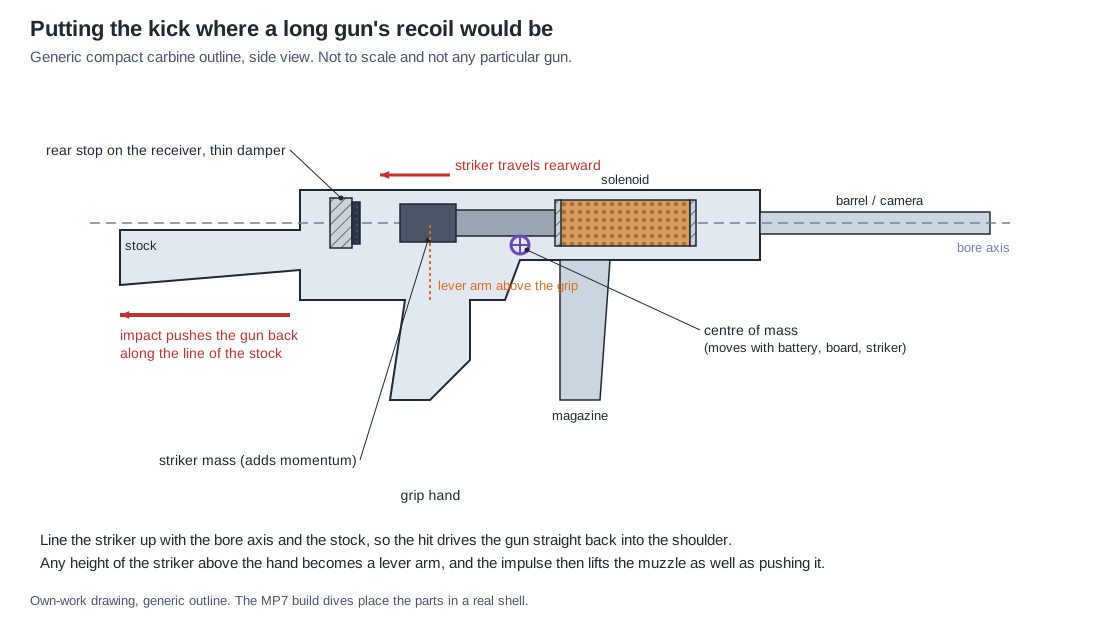
- Strike toward the shooter. The striker should travel rearward and stop hard at the rear, so that the sharp half of the momentum exchange pushes the gun back into the shoulder. A mechanism that strikes forward pushes the gun out of the shoulder, which feels wrong however strong it is.
- On the bore axis, or as close as the shell allows. A kick along a line above the shooter’s hand and shoulder has a lever arm about them and lifts the muzzle; a kick below the line pushes it down. A real carbine’s muzzle rise comes from its bore sitting above its support points, so a little height is authentic; a lot is merely odd.
- In line with the stock. The stop should push into structure that runs straight back to the stock, so that the shoulder, not the grip hand, takes the hit, as it would in the real gun.
- Mind the centre of mass. Battery, board, camera and the striker itself all move the centre of mass. A mechanism far from the centre of mass and off the axis through the hands also twists the gun. Placing heavy fixed parts low and central, and the striker on the axis, keeps the motion a push.
- Visible motion is a bonus. An MP7-pattern gun has no reciprocating slide on top, but the moving ejection port the project plans can be driven by, or synchronised with, the recoil mechanism. The Moving Ejection Port dive covers it. The real gun’s dimensions and handling are the subject of the HK MP7 dive.
5.10 Mounting that survives
A recoil mechanism is a vibration test that runs every time the trigger is pulled. The arcade operators’ daily checklist for Time Crisis included “Check that the screws on the gun are secure” and “Check the reaction of the gun”.1
- Threaded inserts, not screws into plastic, at every mechanism mount in a printed shell; heat-set brass inserts are the usual choice.
- Threadlocker on screws into metal, and on any thread on the striker.
- Load paths in metal between stop and structure where possible; printed parts in compression rather than in bending or shear.
- Heat. The coil warms its mount (Volume 4). A PLA mount softens around 60 °C; PETG, ASA or a nylon is a better choice next to the coil, and an aluminium cradle better still.
- A replaceable solenoid. The solenoid has a life of the order of 10⁵ operations (Volume 3). It should come out with a few screws and a connector, as it does in every arcade gun manual.
5.11 A design checklist
Table 2 — A design checklist
| Item | Aim |
|---|---|
| Moving mass | Two to five times the bare plunger; non-magnetic added mass |
| Stroke direction | Toward the shooter; hard stop at the rear |
| Rear stop | Stiff, tied straight to the stock structure; thin hard damper at most |
| Forward stop | Soft damper |
| Plunger seating | Striker hits the stop before the plunger seats |
| Return spring | Preload enough to hold and overcome friction; rate for the required cycle; never solid |
| Guidance | Striker or slide guided independently; plunger pulled only along its axis |
| Axis | On or close to the bore axis, in line with the stock |
| Mounting | Metal sub-chassis or inserts; threadlocker; heat-tolerant material near the coil |
| Service | Solenoid replaceable with a few screws and a connector |
5.12 Why this, and why not the others
Table 3 — Why this, and why not the others
| Choice | Picked | Alternatives and why they lost |
|---|---|---|
| Striker material | Brass (about 8.5 g/cm³, non-magnetic, easy on the lathe) | Steel: magnetic, so near the frame it carries flux and changes the force curve. Austenitic stainless: non-magnetic and dense, but harder to machine. Tungsten alloy: twice as dense, for where space is short; costs more. Aluminium or printed plastic: too light to add useful momentum in the space available |
| Moving mass | Two to five times the bare plunger | Bare plunger: fast but little momentum (Section 5.2). Much heavier: more momentum but slower arrival, a longer pulse and more heat; the solenoid must be sized up (Volume 8, Section 8.7) |
| Rear stop | Steel or aluminium block tied to the main structure, striker landing before the plunger seats | A stop in printed plastic: flexes, softens the hit and cracks the mount. Plunger seating on its own pole face: sharpest hit, but wears the solenoid instead of a replaceable stop |
| Rear-stop damper | Thin, hard polyurethane or elastomer washer | No damper: loudest and hardest on the parts. Soft rubber: turns the hit into a thud |
| Coil mount near the heat | PETG, ASA or nylon, or aluminium | PLA: softens around 60 °C, within reach of a working coil |
5.13 What could not be verified
- Impact durations and peak forces are estimates from simple contact models; they are orders of magnitude, to be replaced by Volume 6’s measurements.
- Which end of the stroke Namco’s silencer rubber acts at. The parts list names it; the drawing found does not show it.
- How the real MP7’s recoil and handling feel, which belongs to the HK MP7 dive and is not described here.
Sources
Footnotes
-
Namco, Time Crisis SD Operation Manual, §6.7.1 (inspection items before operation), §7.3.4(4) (replacing the solenoid), §8.5 (gun assembly parts list). Internet Archive item
arcademanual_Time_Crisis_SD_Manual, read 2026-10-18. ↩ ↩2 ↩3 -
Namco, Time Crisis 4 DX Manual, issue 2, §7-18. Internet Archive item
time_crisis_4_dx_manual_issue2_ptm, read 2026-10-18. ↩ -
Damien McFerran, “Sinden Light Gun review”, Time Extension, 24 December 2023, https://www.timeextension.com/reviews/sinden-light-gun-old-school-arcade-blasting-on-your-modern-day-tv, read 2026-10-18. ↩
Comments (0)