The History of Light Guns · Volume 6
The Flat-Panel Crisis — Why Every CRT Light Gun Died With the CRT
Scan-line timing at engineer depth: what the photodiode actually measured, the three things a flat panel takes away, why no firmware patch could bring them back, and what the industry did instead
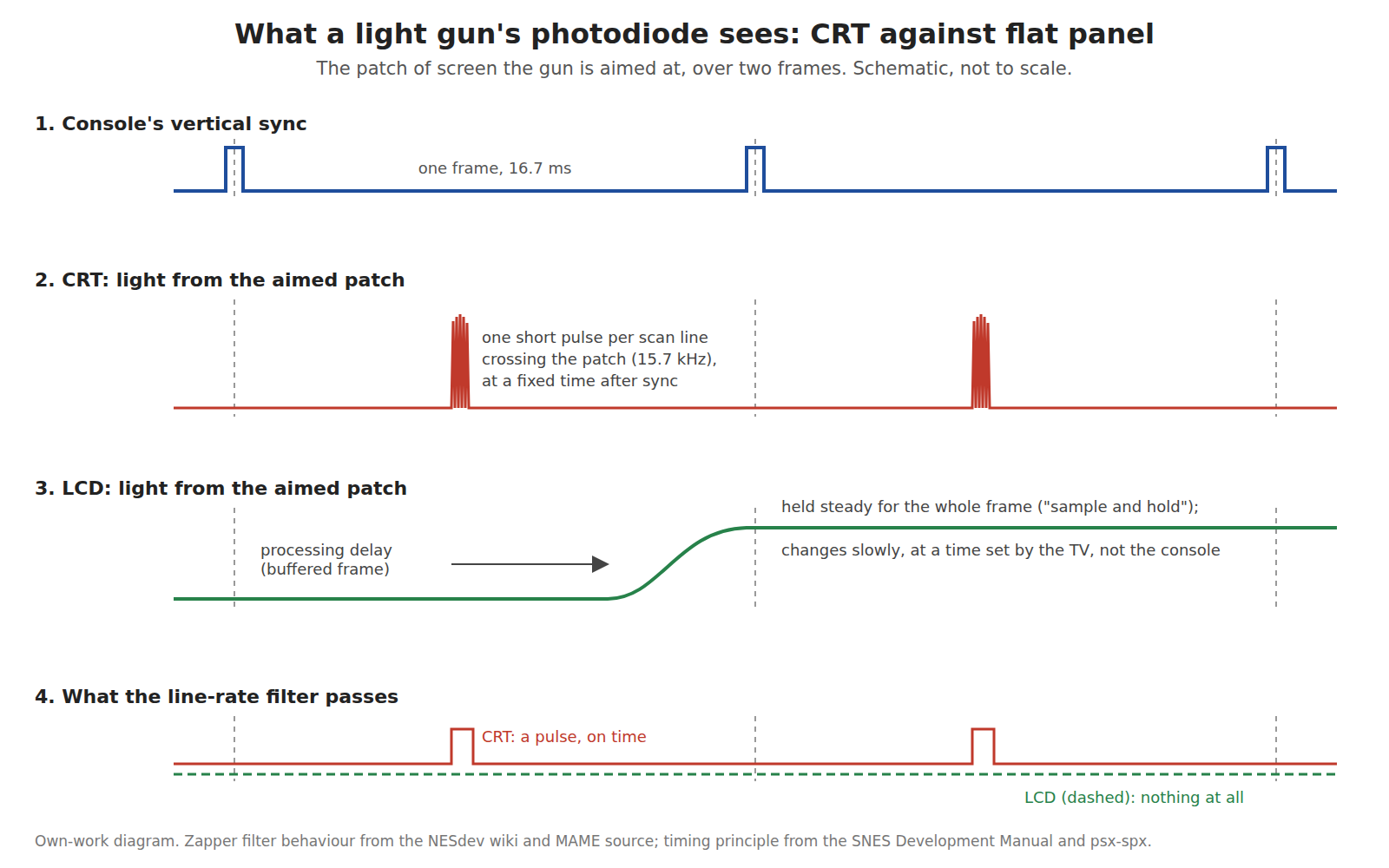
6.1 The crossover
For thirty-five years every television light gun relied on the cathode-ray tube, and in the space of about five years the cathode-ray tube left the living room. The market research firm DisplaySearch reported that in the fourth quarter of 2007 “LCD TVs accounted for 47 per cent of all sets sold”, against 46 per cent for CRT, the first quarter in which flat panels outsold tubes worldwide.1 The PlayStation 2 and its GunCon 2 spent most of their lives connected to CRTs. Its successor, the PlayStation 3, launched in 2006 into homes that were buying flat panels.
Every gun in Volumes 3 to 5 stopped working on the new sets: the Zapper, the Light Phaser, the Super Scope, the Menacer, the Justifier and the GunCons 1 and 2. Not “worked badly” — stopped. This volume explains why, at the level of the signals, because the explanation is also the specification for what replaced them. The classic guns’ sensing chain is drawn at block level in CRT Timing; this is the history of why that technology ended.
6.2 What a CRT light gun actually measures
A CRT draws the picture with one electron beam, swept left to right along each line and top to bottom down the screen, and the phosphor at each point lights for a short time after the beam passes and then fades. The point that matters for a light gun is that each point on the screen is lit at a known moment: a fixed time after the start of its frame (vertical sync) and a fixed time after the start of its line (horizontal sync), and at no other time.
A light gun is a lens and a photodiode that see a small disc of the screen. As the beam paints the frame, the photodiode sees nothing until the beam reaches the first line that crosses the disc; then a short pulse on that line, another on the next, and so on, a burst of pulses at the line rate, and then nothing again until the next frame.
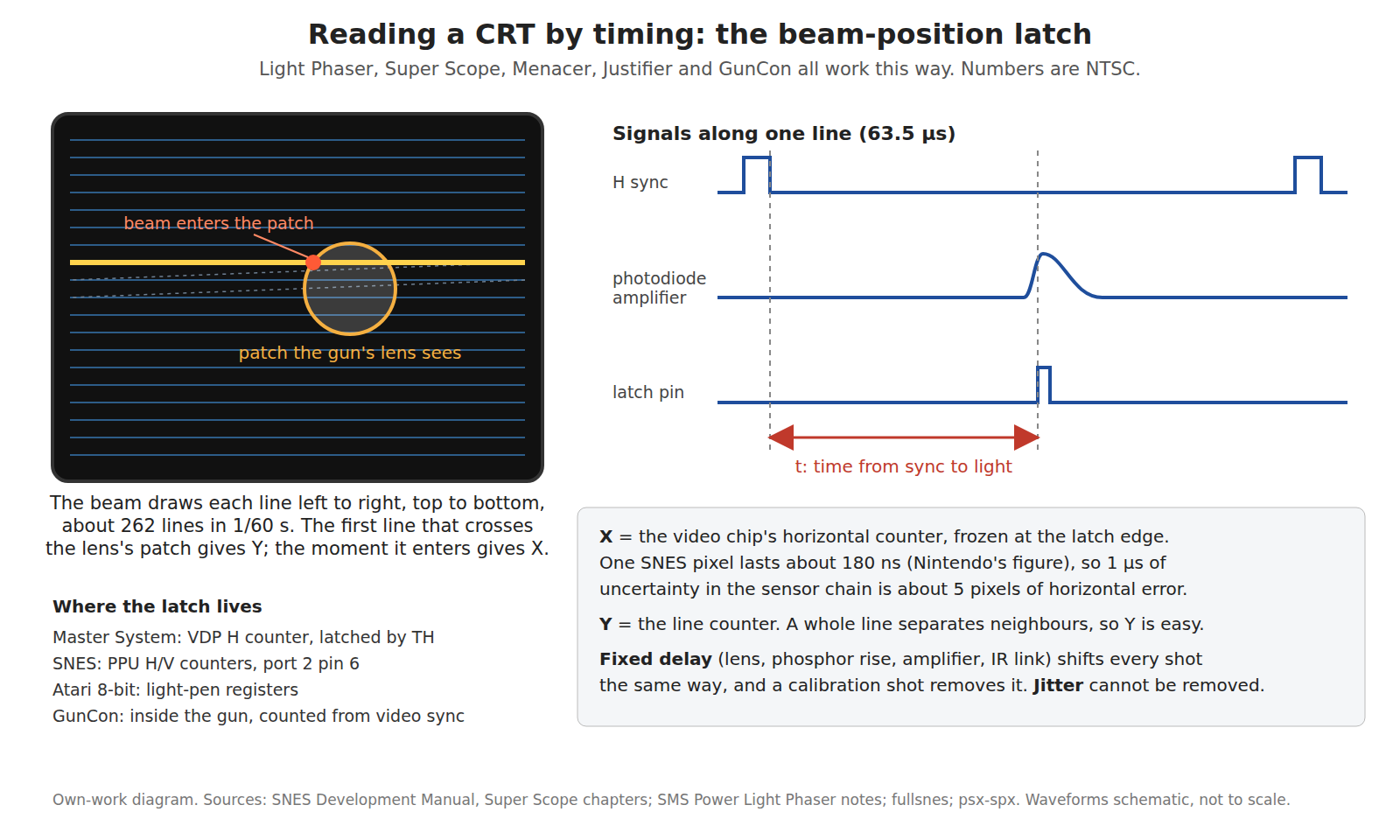
Every light gun since 1980 extracts one of two things from that burst:
- That it happened, during a particular frame. The Zapper: the game draws a test frame and asks whether the gun saw a burst during it (Volume 3).
- When it happened, to the microsecond. Everyone else: the first pulse’s time after sync, counted in the video chip (Light Phaser, Super Scope, Menacer, Justifier) or in the gun (GunCon), gives the line number and the position along the line (Volumes 4 and 5).
Both also use the burst’s character — short pulses at about 15.7 kHz (NTSC) or 15.6 kHz (PAL) — to reject everything else in the room. The Zapper’s Sharp IR3T07A is a filter “tuned approximately to the CRT scanline frequency (~15 kHz)” that “filters out slow light sources like bulbs”.2 The GunCon flags any light seen during vertical sync, when a real CRT is dark, as a lamp or sunlight.3 The Super Scope’s receiver reports noise and null conditions.4 In every case the gun’s idea of “this is the screen” is light that pulses at the line rate, at the right time.
6.3 The timing budget
It is worth putting numbers on how tight this was, because it shows that the CRT gun was not a loose approximation that a flat panel merely made a bit worse.
Table 1 — 6.3 The timing budget
| Quantity | Value | Source or derivation |
|---|---|---|
| NTSC line period | 63.5 µs | Nintendo’s figure in the Super Scope manual4 |
| Active (visible) part of the line | about 48–52 µs | GunCon X range 04Dh–1CDh = 384 counts at 8 MHz = 48 µs3 |
| One SNES pixel | about 180 ns | ”an amazing 180 nsec”, Nintendo4 |
| Super Scope resolution | about 8 pixels | Nintendo’s specification4 |
| Implied total jitter allowed | about 1.4 µs | 8 × 180 ns |
| Baer’s precision rifle, 1979 | ”a couple of microseconds”, 3–4 % of the line | Baer5 |
So the working CRT guns held the variation in the delay between the beam hitting the phosphor and the latch pin firing to around a microsecond. The fixed part of that delay — phosphor rise, photodiode and amplifier, infrared link, cables — could be much larger, because a calibration shot subtracts it. Nintendo made a calibration screen mandatory in every Super Scope game for exactly that reason.4 The design rule of the whole technology is: any delay is acceptable if it is constant; any variation larger than a microsecond or so is error.
6.4 What a flat panel takes away
A liquid-crystal panel differs from a CRT in three ways, and any one of them is enough to kill a timing gun.
1. It does not flash; it holds. An LCD pixel is a light valve in front of a backlight. When the panel writes a new value to a pixel, the liquid crystal turns over a period of milliseconds and then holds that transmission until the next write, a frame later. The patch of screen the gun sees is therefore lit continuously for the whole frame, at a level that changes slowly when the picture changes. There is no burst of line-rate pulses. To a line-rate filter like the Zapper’s, a steadily lit LCD is indistinguishable from a desk lamp, which is to say invisible. The NESdev wiki puts it in one sentence: the Zapper’s filter “will strongly attenuate the light signal from many modern televisions (e.g. LCD based)”.2 The backlight may itself be pulsed for dimming, but at a frequency, phase and duty set by the television’s own driver, unrelated to the console’s lines.
2. It does not draw at the console’s time. A CRT’s beam is driven directly by the console’s sync; the picture appears at the instant the signal arrives. A flat-panel television digitises the signal, scales it to the panel’s native resolution, often deinterlaces, converts frame rate, processes the image, and only then writes it to the glass — commonly a frame or more after it arrived, and at a time set by the television’s own clock. The NESdev wiki notes that “modern TVs also have display lag, which games don’t expect”.2 For a timing gun, that delay lands directly in the measurement. If it were a constant few microseconds, a calibration shot could remove it; it is not microseconds, it is milliseconds, and it varies between sets, between picture modes, and with the input format.
3. It does not write in the console’s order. Even a panel that writes rows top to bottom — many do — writes them on its own row clock, at its own rate, with the image scaled so that one console line maps to a non-integer number of panel rows. The relationship between “the console’s line 120, 30 µs after horizontal sync” and “the moment this patch of glass changes” no longer exists. The console’s horizontal counter is counting a raster that is not on the screen.
Plasma panels, the other flat technology of the period, do emit light in pulses — they build each frame’s grey levels out of several sub-fields of light — but those pulses are timed by the plasma’s own drive electronics after the same kind of frame buffering, so they carry no information about the console’s raster either.
6.5 Why the guns fail in different ways
The two schools of Volume 3 fail differently, which explains a good deal of contradictory folklore about which old guns “sort of work” on which sets.
Table 2 — 6.5 Why the guns fail in different ways
| Gun type | On a flat panel |
|---|---|
| Zapper (filtered light bit, test frames) | The line-rate filter sees no line-rate light, so the light bit never asserts: every shot misses. A clone with a weaker filter can see the test box — but a frame or more late, after the game has stopped looking. |
| Latch guns (Light Phaser, Super Scope, Menacer, Justifier) | With no line-rate pulses the sensor chain may not trigger the latch at all (the Super Scope’s “null”). If it does trigger, on backlight flicker or a slow transition, the counters freeze at a time unrelated to where the gun points. |
| GunCon 1 and 2 (sync counted in the gun) | The gun still has clean sync from its video cable, but the light it sees arrives at the wrong time, or never pulses; it reports no-light or a meaningless coordinate. |
Nothing in that table is a calibration problem. The quantity each gun was built to measure — when the beam passed — has no physical counterpart on the new screen.
6.6 Why it could not be patched
Owners asked, at the time and since, why the console makers did not issue an adapter or a firmware fix. The signals answer it.
- A different filter would not help. Without line-rate pulses there is nothing for a better filter to find, and a filter wide enough to pass slow changes also passes the room’s lamps, undoing the protection that made the guns work.
- A lag offset would not help a timing gun. A latch gun needs the delay constant to within about a microsecond (§6.3). A television’s processing delay varies by far more than that from set to set and mode to mode, and the panel’s row timing has no fixed relation to the console’s line timing at all.
- The guns could not be given new information. Every one of them reports a time. There is no time on a flat panel worth reporting.
What can be patched is the narrowest case: a game that only asks “did the gun see a bright box during this frame?” (the Zapper school) can be told to wait longer for the answer, and a gun with a broad enough sensor can see a slow-changing bright box. The NESdev wiki records exactly that: “clone hardware with a weaker filter” together with “a software lag compensation patch” may help.2 It only ever helps the yes-or-no school, it needs a modified game, and it gives up the lamp rejection that was the point of the filter.
6.7 Partial rescues
Three kinds of workaround kept the old guns alive in particular settings, and they are all still in use:
- Keep a CRT. Collectors and arcades kept tubes, and still do, precisely for light guns. A CRT fed by an original console works exactly as it always did.
- Make the modern system pretend to be a CRT. An FPGA console or emulator driving a real CRT can produce a true raster, with the original timing, from modern hardware; how far that works with which guns is the subject of MiSTer FPGA and Original Consoles.
- Replace the gun’s insides. Gut a GunCon or a Zapper and put a camera in it — the do-it-yourself route of Volume 8 and Modding Classic Light Guns.
6.8 The way out: stop timing, start looking
The only real solution was to change what the gun measures. A CRT gun asked “when is the patch I am aimed at lit?” A flat-panel gun has to ask “where in my view is the screen?”, which is a geometry question, not a timing one, and needs a sensor that sees an image rather than a single photodiode that sees a patch.
Two answers emerged, and between them they are the rest of this history:
- Put markers beside the screen and track them with a camera in the gun. Two or four infrared points at known positions around the display; a small camera in the controller reports where those points appear in its view; the aim point follows from their geometry. Nintendo’s Wii Remote made this a mass-market product in 2006, and Namco’s GunCon 3 adopted it for the PlayStation 3 (Volume 7). It is what OpenFIRE does today (IR Point Tracking).
- Track the screen itself. Draw a border round the picture and let a camera in the gun find it — Sinden’s method (Volume 8, and Border Tracking).
Both throw away the beautiful property of the CRT gun — the screen told the gun where it was pointing, with microsecond precision, for free — and replace it with an image sensor, an image-processing step, and a calibration that maps camera coordinates to screen coordinates. Both also add delay that a CRT gun never had: a camera frame, processing, and the television’s own lag, which now matters because the player sees the result of the shot that much later. That latency budget is taken up in Aiming Maths and Calibration.
6.9 What could not be verified
- Typical input-lag figures for flat-panel televisions of 2005–2010; no primary measurement source was read for this dive, so no number is given.
- Whether any console maker publicly explained the end of its CRT guns. None was found.
- The PAL line frequency used above (15.625 kHz) and NTSC (15.734 kHz) are the broadcast standards’ figures, stated from the standards rather than from a document read for this dive.
Sources
Footnotes
-
“Global LCD TV sales overtake CRT”, The Register, 22 February 2008, reporting DisplaySearch figures for Q4 2007, https://www.theregister.com/2008/02/22/displaysearch_crt_lcd_global_q4/, read 2026-10-19. ↩
-
NESdev Wiki, “Zapper”, https://www.nesdev.org/wiki/Zapper, read 2026-10-19. ↩ ↩2 ↩3 ↩4
-
Martin Korth (nocash), PlayStation Specifications (psx-spx), “Controllers and Memory Cards — Lightguns”, https://psx-spx.consoledev.net/controllersandmemorycards/, read 2026-10-19. ↩ ↩2
-
Nintendo of America, Super NES Development Manual, Book II, Section 4, “Super NES Super Scope”, and Book I, Software Submission Requirements item 12. Internet Archive item
SNESDevManual, read 2026-10-19. ↩ ↩2 ↩3 ↩4 ↩5 -
Ralph H. Baer, Videogames: In the Beginning (Rolenta Press, 2005), “The Precision Rifle Story”. Internet Archive item
VideogamesInTheBeginningRalphH.Baer, read 2026-10-19. ↩
Comments (0)