The History of Light Guns · Volume 5
The GunCon Era and Arcade Recoil, 1992 to 2006
Polygon arcades, the action pedal and the blowback slide; the offscreen reload that turned a sensor's blind spot into a button; and Namco's GunCon, which stopped trusting the console and timed the video signal itself
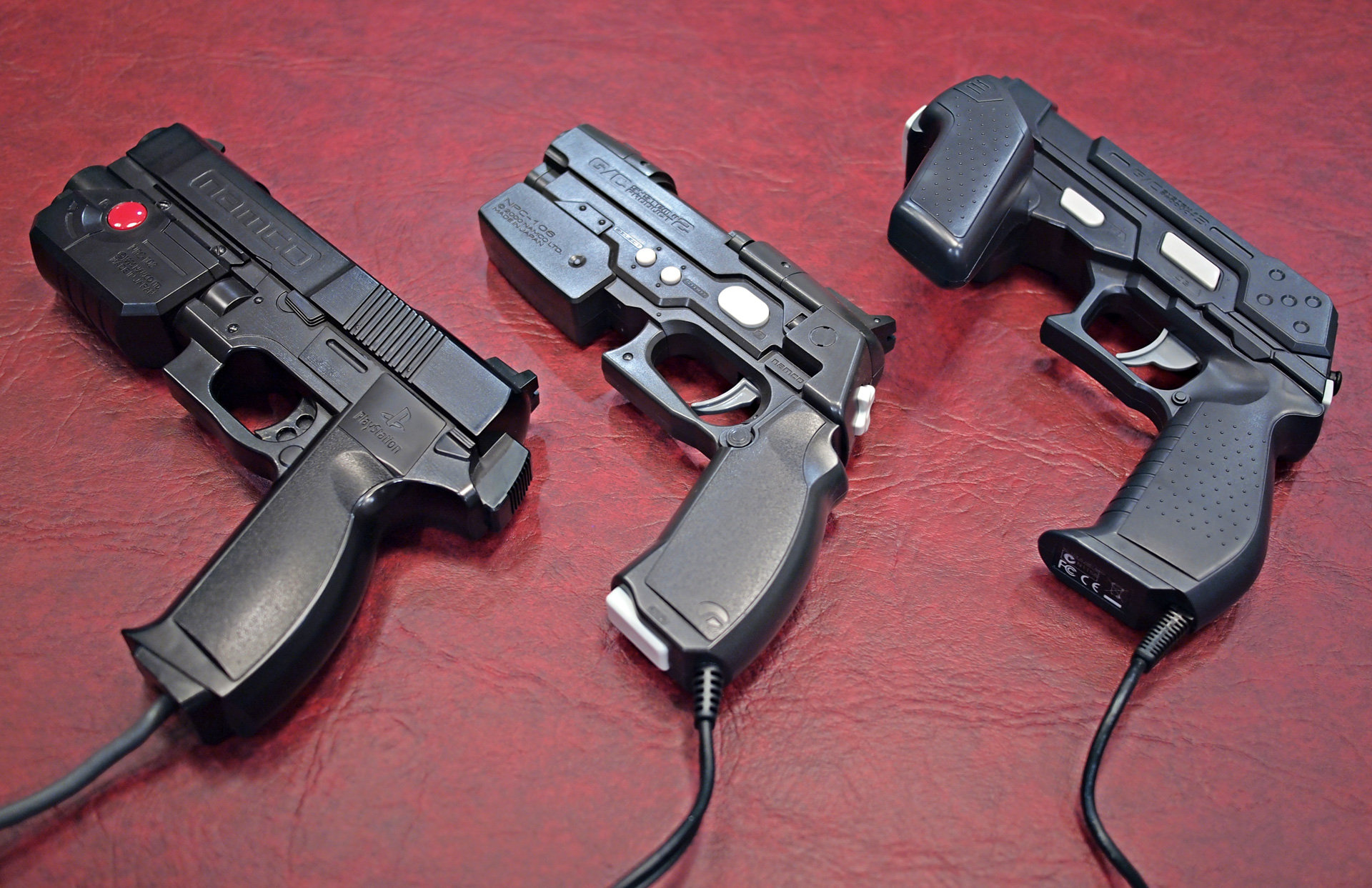
5.1 The arcade takes the lead
From the early 1990s to the mid-2000s the light gun’s best hardware was in the arcade, and the home guns followed it. The reasons were economic as much as technical. An arcade cabinet could afford a big, bright, fast CRT that the gun was designed for and nothing else; a mounted or tethered gun that never left the cabinet; a pedal; a solenoid with its own power supply; and a gun built to survive thousands of players a week. The home gun had to work with whatever television the buyer owned, run on batteries or a thin controller cable, and cost a fraction of the game.
The genre that resulted — the “rail shooter”, in which the game moves the player through a scene and the player only aims and fires — was carried by a handful of franchises. Konami’s Lethal Enforcers (1992), with digitised photographic graphics and a revolver-shaped gun, came first and gave the home market the Justifier (Volume 4). Sega’s Virtua Cop (1994), Namco’s Point Blank (1994) and Time Crisis (1995), and Sega’s The House of the Dead (1996) followed. The cabinets themselves — guns, sensing, wiring and service manuals — are catalogued in Arcade Light Guns. This volume follows the three ideas from that decade that a modern gun still inherits.
5.2 Virtua Cop and the polygon shooter
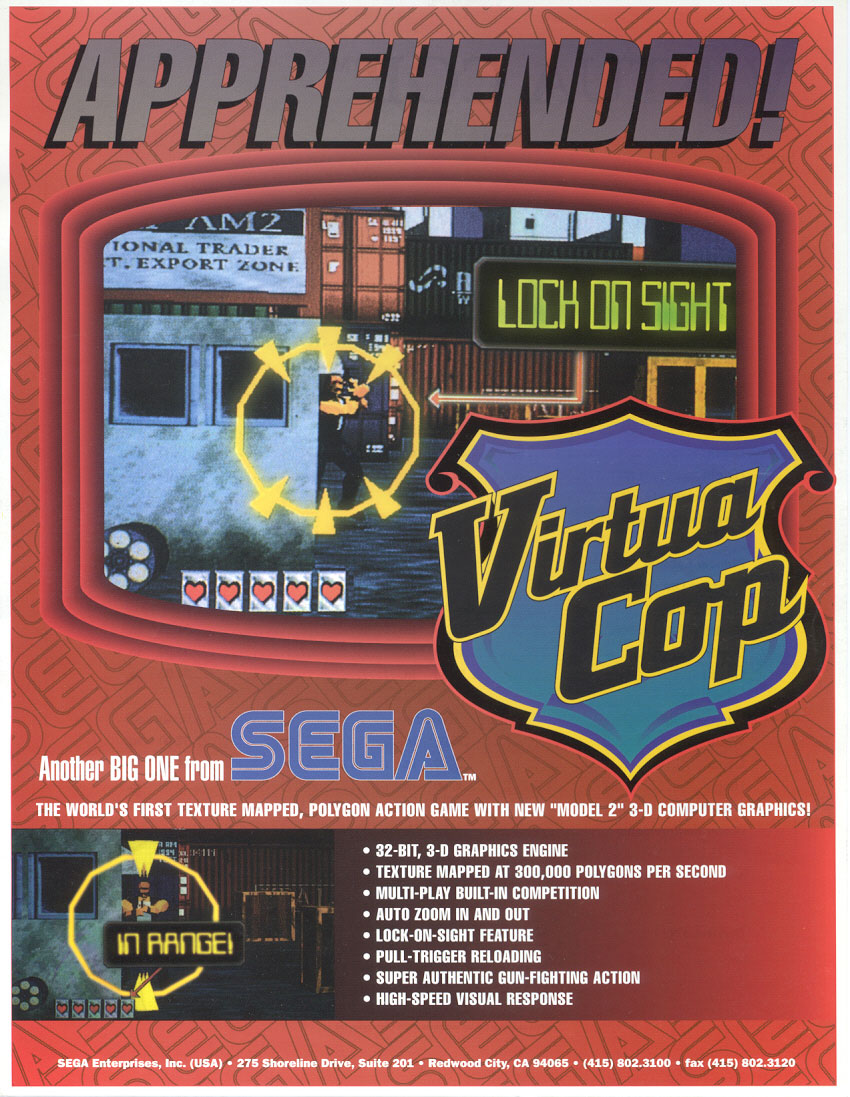
Sega’s flyer for Virtua Cop sold the cabinet on its graphics: “the world’s first texture mapped, polygon action game with new ‘Model 2’ 3-D computer graphics”, a “32-bit, 3-D graphics engine”, “texture mapped at 300,000 polygons per second”.1 What that meant for the gun was that targets were no longer sprites at fixed sizes but polygon figures at any distance and angle, and the game had to decide a hit by projecting the gun’s screen coordinate into a 3-D scene. That only works with a gun that reports a position — the silicon school of Volume 3 — and from here on every arcade and console gun does.
The same flyer lists the interface ideas that made the game play well: a “lock-on-sight feature” that draws a shrinking ring round the enemy about to fire, so the player knows whom to shoot first, and “pull-trigger reloading”.1
5.3 Time Crisis: the pedal and the blowback slide
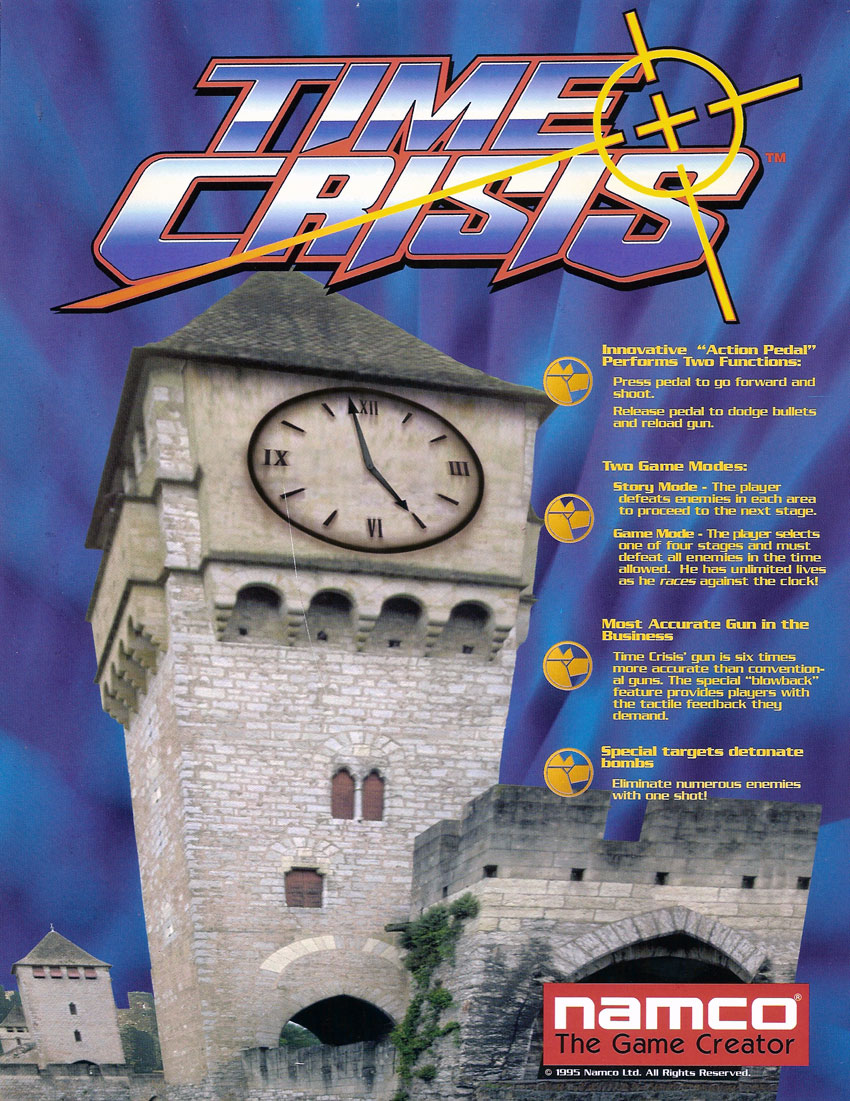
Namco’s Time Crisis, on System 22 hardware in 1995, added two physical inputs to the gun. The Action Pedal “performs two functions”: “Press pedal to go forward and shoot. Release pedal to dodge bullets and reload gun.”2 Taking cover became a foot movement, and reloading became something that happened while hidden, which made the timing of exposure and fire the skill the game tested.
The second was in the gun itself. Under the heading “Most Accurate Gun in the Business”, the flyer claims that “Time Crisis’ gun is six times more accurate than conventional guns” and that “the special ‘blowback’ feature provides players with the tactile feedback they demand”.2 The accuracy figure is Namco’s and the baseline it is measured against is not stated, so it is a marketing claim; but it shows what arcade makers were competing on. “Blowback” means a slide that runs back and forward on each shot, like the slide of a self-loading pistol — a moving mass inside the gun, not only a buzz.
5.4 Recoil becomes part of the gun
Recoil in the arcade was not new in 1995; Taito’s Operation Wolf cabinet (1987) already kicked its mounted Uzi (Volume 3). What the 1990s did was make it expected. A solenoid throwing a slide or a weight, fed from the cabinet’s own supply, is cheap, robust and loud, and it changed what players thought a light gun should feel like. When the home guns of the period dropped it — the original GunCon had no recoil, and contemporary reporting attributes that to cost — the absence became one of the defining complaints about home light guns, and recoil became the feature the do-it-yourself guns of the 2020s set out to restore (Volume 8).
How a recoil solenoid works, how hard it kicks, how hot it gets and how it should be driven are the subject of Solenoid Recoil; the supplies that feed it are in Power Supplies. Neither is repeated here.
5.5 The offscreen reload
The reload in these games was done by pointing the gun away from the screen and pulling the trigger — what Sega’s flyer calls “pull-trigger reloading”, and what Namco moved to the pedal. It is one of the neatest pieces of interface design in the history of the light gun, because it turns the sensor’s failure into an input.
A CRT gun aimed off the screen sees no raster. The Super Scope reports that condition with its null bit — “a valid raster signal could not be found” — and the GunCon with a fixed error code (§5.6).34 A game that treats “trigger pulled, no raster seen” as reload gives the player a physical gesture — swing the gun out, pull, swing back — with no extra button, and one that takes the gun off target for a moment, which is exactly the cost a reload should have.
The gesture outlived the technology that created it. A camera gun has to manufacture the offscreen condition from its picture of the screen edges or markers, and every modern firmware does, because players expect it. How OpenFIRE does it is in Open-Source Firmware.
5.6 The GunCon: a gun that times the video itself
Namco’s home gun for the PlayStation, the GunCon (sold in Europe as the G-Con 45), shipped with the PlayStation version of Time Crisis in 1997. Its engineering choice is the most important one of the decade for this dive’s story.
Every earlier timing gun relied on the console’s video chip to latch the beam position (Volume 4). The PlayStation did not have a usable one: its light-gun input raises an interrupt, and software has to read timers when it arrives, which the hardware documentation calls “reportedly less accurate”.4 Namco’s answer was to take the timing out of the console. The GunCon has a second cable that taps the composite video signal (a “cinch” connector, the European name for RCA), extracts horizontal and vertical sync itself, and counts. What it hands the console is finished coordinates:4
Table 1 — 5.6 The GunCon: a gun that times the video itself
| Report | Meaning |
|---|---|
ID 5A63h | ”Namco Lightgun; GunCon/Cinch Type” |
| X | ”8MHz clks since HSYNC” — valid range 04Dh to 1CDh |
| Y | ”Scanlines since VSYNC” — NTSC 19h to F8h, PAL 20h to 127h |
X = 0001h, Y = 0005h | light sensed during vertical sync: a bulb or sunlight |
X = 0001h, Y = 000Ah | no light sensed: off screen, screen too dark, or read while busy |
Because the gun counts its own 8 MHz clock from the sync pulses it has extracted, the result is, in the documentation’s words, “completely independed of software timings”.4 The range 04Dh to 1CDh is 384 counts across the visible line, about 48 µs at 8 MHz, which matches the active part of a 63.5 µs NTSC line. And the error codes encode the two failure modes of the whole technology: light where there should be none (the vertical-sync interval is dark on a real CRT, so light then is a lamp), and no light where there should be some.
The GunCon is, in effect, Baer’s 1980 precision rifle again (Volume 2, §2.8): sync counted inside the gun’s own logic, a photodiode edge latching the count. It is also the reason GunCons became the favourite donor shells and electronics of the CRT-gun community: a gun that needs only composite video and a controller port can be made to work with anything that produces composite video, which is a modification story for Modding Classic Light Guns. The GunCon 2 for the PlayStation 2 kept the approach for that console’s generation, with Time Crisis II and Time Crisis 3. Model numbers and versions are in Console Light Guns.
5.7 The last CRT guns
By the end of the 1990s the CRT light gun had reached its technical peak. The arcade guns were accurate to a few pixels and kicked in the hand; the GunCon had freed the gun from the console’s video chip; Sega’s Saturn and Dreamcast had their own guns for the home versions of Virtua Cop and The House of the Dead. And the method was about to lose the one thing it could not do without.
The first warnings came from inside the CRT world. Televisions that processed the picture before showing it — 100 Hz sets in Europe that stored each field and drew it twice, line-doubling and progressive-scan sets — still had an electron beam, but the beam no longer passed a given point at the time the console’s sync said it would. A timing gun measures the time from sync to light; any delay the television adds lands in that measurement. Fixed processing delay can in principle be calibrated out; a television that draws each field twice, or reorders lines, cannot be calibrated at all. Contemporary owners report that such sets broke light guns, but no manufacturer’s statement on the point was found for this dive.
Then the beam itself went. Volume 6 explains why that was fatal to every gun in this and the previous three volumes at once.
5.8 What the era left behind
Table 2 — 5.8 What the era left behind
| Idea | Where it came from | Where it lives now |
|---|---|---|
| A gun that reports position, for polygon scenes | Virtua Cop’s generation | Every camera gun; Aiming Maths and Calibration |
| Recoil as standard | Arcade solenoids and blowback slides | Solenoid Recoil, the DIY guns of Volume 8 |
| Cover and reload on a pedal | Time Crisis | Sinden and other makers’ pedals; a button input in Controls and Inputs |
| Offscreen reload | The sensor’s no-raster state | Emulated by every camera-gun firmware |
| The gun does its own measurement | GunCon | The camera gun, which measures everything itself |
The last row is the bridge to the present. The GunCon put the measurement inside the gun and asked the console for nothing but a trigger port and a video signal. A camera gun asks for even less: not the video signal, only a picture of the screen or of markers beside it. Getting there took the collapse described next.
5.9 What could not be verified
- How much more accurate Time Crisis’ gun was than “conventional guns”, and against what baseline. The “six times” figure is Namco’s advertising.
- The release dates of the GunCon by region; given here only as the year of the Time Crisis PlayStation release. Console Light Guns owns them.
- Whether the original GunCon’s lack of recoil was a cost decision. Widely reported, not found in a Namco source.
- Which 100 Hz and line-doubling televisions broke which guns. Owner reports only.
- The sensing methods of the Saturn and Dreamcast guns (assumed here to be raster timing, like their contemporaries).
Sources
Footnotes
-
Sega Enterprises, Inc. (USA), Virtua Cop sales flyer, 1994, front. The Arcade Flyer Archive, https://flyers.arcade-museum.com/videogames/show/2063, read 2026-10-19. ↩ ↩2
-
Namco Ltd., Time Crisis sales flyer (USA), © 1995, front. The Arcade Flyer Archive, https://flyers.arcade-museum.com/videogames/show/5248, read 2026-10-19. ↩ ↩2
-
Nintendo of America, Super NES Development Manual, Book II, Section 4, “Super NES Super Scope”, Table 4-1-1 (signal bit definitions). Internet Archive item
SNESDevManual, read 2026-10-19. ↩ -
Martin Korth (nocash), PlayStation Specifications (psx-spx), “Controllers and Memory Cards — Lightguns” (Namco GunCon and Konami Justifier/Hyperblaster), https://psx-spx.consoledev.net/controllersandmemorycards/, read 2026-10-19. ↩ ↩2 ↩3 ↩4
Comments (0)