The History of Light Guns · Volume 4
The 16-Bit Guns — Super Scope, Menacer and Justifier, 1992 to 1994
Nintendo's own development manual explains the Super Scope: a pin photodiode, a 4-bit CPU, raster pulses relayed by infrared to the console's counter latch, 180 ns a pixel, and a calibration screen that every game had to carry
4.1 The second generation: position, not targets
The 8-bit years left two schools of light gun (Volume 3): Nintendo’s, which flashes test frames and asks the gun yes or no, and the light-pen school of Sega and Atari, which freezes the video chip’s beam counters when the gun sees light. The 16-bit generation chose the second school without exception. Nintendo said why in the first lines of its own documentation: “The Super NES Super Scope detects where the device is aimed, unlike the existing Nintendo Entertainment System device (Zapper), which detects targets.”1
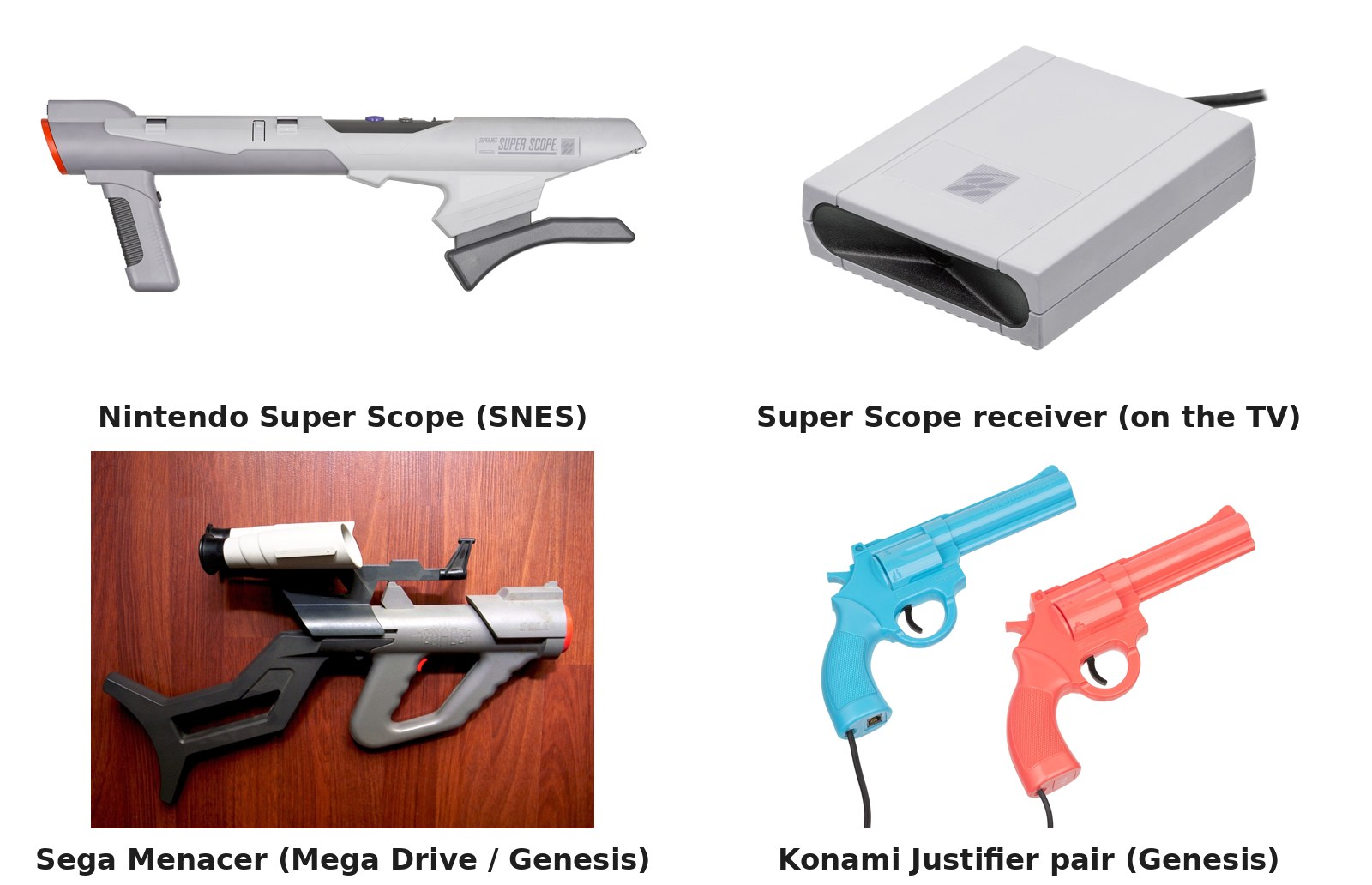
Position makes a different kind of game. A gun that reports X and Y can drive a cursor, aim a crosshair that follows the barrel, and let the program decide hits however it likes, against targets of any size, without darkening the screen for each one. All three of the era’s guns — Nintendo’s Super Scope, Sega’s Menacer and Konami’s Justifier — were built around it.
4.2 The Super Scope, from Nintendo’s development manual
The best source on any light gun of the period is Nintendo’s Super NES Development Manual, whose Section 4 is four chapters on the Super Scope written for game programmers.1 It describes “two units; the Super NES Super Scope (light sensitive device) and a receiver/transmitter (Super NES Super Scope-RX)”, and gives a specification:
Table 1 — The best source on any light gun of the period is Nintendo's Super NES Development Manual, whose Section 4 is four chapters on the Super Scope written for game programmers.[^snesdm] It describes "two units; the Super NES Super Scope (light sensitive device) and a receiver/transmitter (Super NES Super Scope-RX)", and gives a specification
| Item | Nintendo’s figure |
|---|---|
| Range | 3.28 to 16.4 ft “with fully charged batteries” |
| Resolution | ”About 1 character (8 dots, in x and y orientation)“ |
| Lens | f = 150 mm, 30 mm diameter |
| Batteries | Six size AA |
| Controls | Power and single/multiple-shot (one three-position switch), pause, cursor, trigger |
Inside the gun are three blocks. A light receiver/amplifier — “a pin photo-diode H-amp, and an M-amp for signal amplification and pulse conversion” — turns the screen’s light into pulses. A one-chip CPU, the SM595, reads the switches, generates the codes and controls a “raster gate”. A light output stage, “an infra-red LED and its driver”, sends everything to the receiver.1 The switches are debounced in the CPU: a key “is recognized as ‘on’ after it is on for 1 msec or more, and ‘off’ after 20 msec or more”, and only trigger and cursor can be pressed together.1
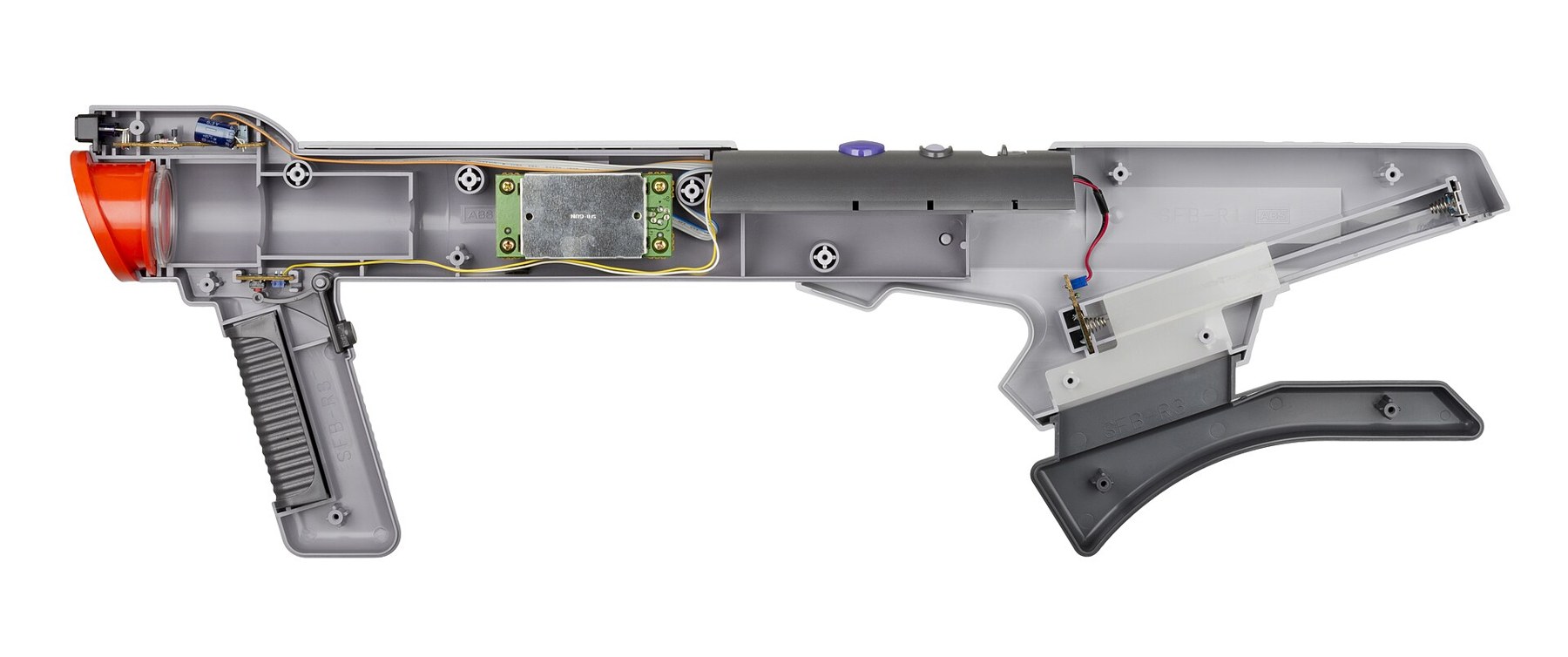
A 150 mm lens of 30 mm aperture is a long, slow, narrow-field optic. At the 3 m range the manual recommends, it images a small patch of the screen onto the photodiode, which is why the gun’s barrel is so long and so empty: it is the focal length.
4.3 Raster pulses by infrared
The clever part of the Super Scope is that the gun does not measure anything. Nintendo is explicit: “The Super NES Super Scope does not process the raster signal.”1
The manual’s principle chapter explains why it could not. Each pulse from the photodiode amplifier “represents a raster in the Braun tube” — one scan line crossing the lens’s patch. “Pulse selection determines the vertical location on the screen by the raster count … The horizontal position is determined by the timing of pulses with respect to the Super NES Control Deck’s horizontal synchronization signal.” And then the number that settles the architecture: “The time corresponding to one dot on the screen is an amazing 180 nsec. This processing speed cannot be achieved by most micro-computers, and in the Super NES Super Scope system, the raster pulse is not processed directly by the CPU.”1
So the gun relays the raw pulses. When the trigger is pulled, the infrared signal has two segments. First a code segment: five one-byte blocks of eight pulses each, with pulse spacings the manual gives in microseconds, carrying trigger (single or multiple), cursor or pause. Then a raster segment, in which the CPU “opens the raster gate and connects the light receiver/amplifier and light output” — the photodiode’s pulses go straight through to the infrared LED, at the speed of the analogue chain, for “a few frames”. In the receiver on top of the television, a second CPU recognises the code and “opens the gate for an appropriate duration to provide the Super NES with the timing pulses”, which arrive at the console’s external latch pin and freeze the picture processor’s horizontal and vertical counters.1
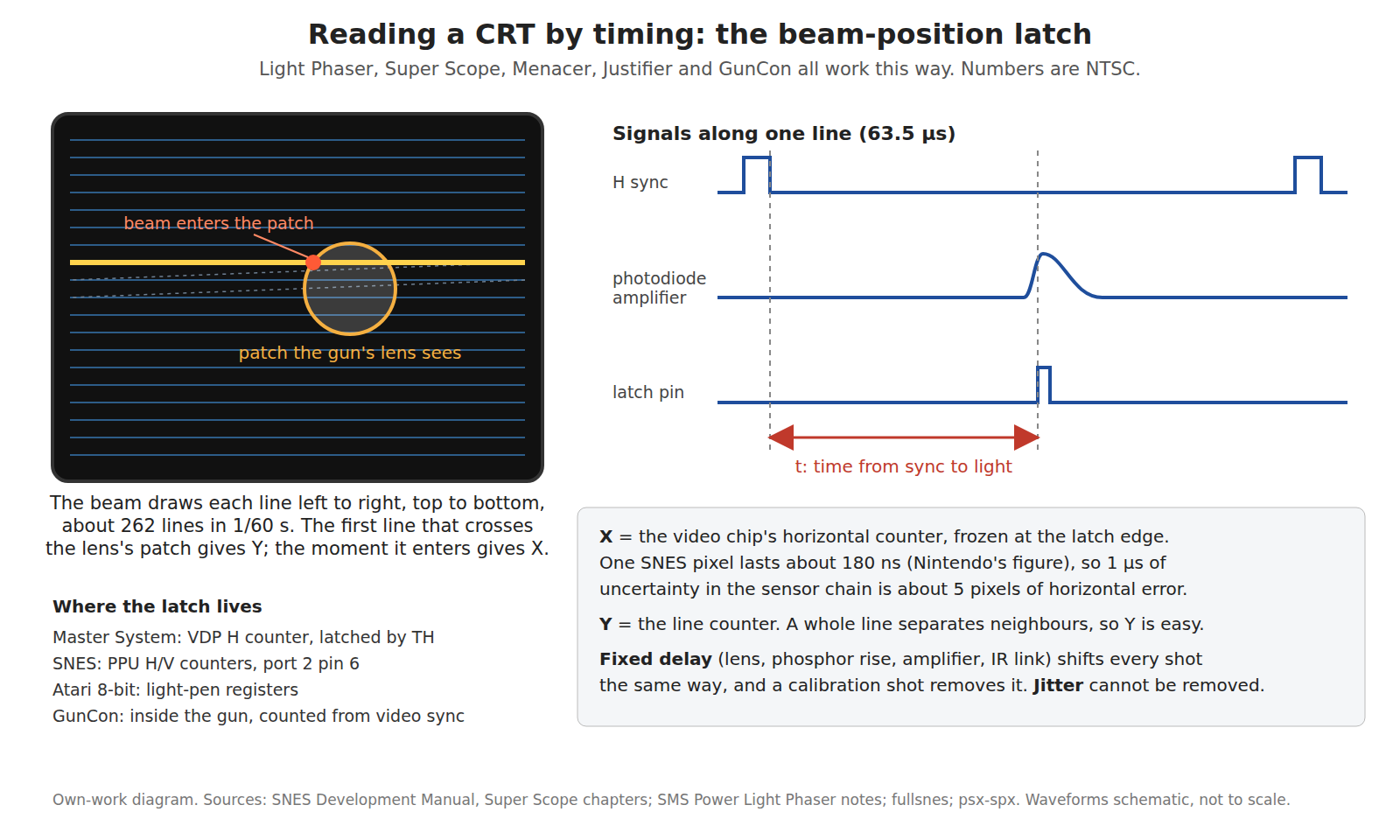
This is Baer’s 1980 precision-rifle architecture almost exactly — photodiode, amplifier, infrared LED to a receiver, position from counting lines and timing against sync (Volume 2, §2.8) — built as a consumer toy twelve years later. What makes it work is that every delay in the chain (lens, phosphor, photodiode, amplifiers, infrared LED, receiver, cable) is fixed. A fixed delay moves every shot the same distance to the right, which software can subtract. Only the jitter in that delay becomes error. At 180 ns a pixel, a microsecond of jitter is five or six pixels; Nintendo’s stated resolution of about eight pixels says the real chain held its jitter to roughly a microsecond and a half.
4.4 Aim, parallax and the calibration screen
A sighted gun has two axes: the line of the sights, and the optical axis of the lens. The Super Scope manual describes the consequence plainly. “The most precise alignment … occurs when the end of its barrel is 3 meters (about 10 feet) away from the television screen … As demonstrated above, an offset occurs as this range is moved away from 3 meters, in either direction.”1
The cure was software. Every game carried an ADJUST AIM / TEST AIM routine that “adjust[s] the optical axis for proper sight alignment through software at the beginning of the game. This adjustment takes into account all electrical delay times.” Nintendo made it mandatory: item 12 of its software submission requirements reads “All games for use with the Super NES Super Scope are required to include a calibration mode.”1 The manual also records the cost. Moving the coordinate frame to match the sights leaves “an insensitive area … at the edge of the screen. The greater the offset adjustment, the larger this insensitive area becomes” — a gun calibrated far off-axis cannot reach the screen edges.1
The same three facts govern every camera gun built since, including the one this project is building: the sight line and the sensor axis converge at one distance only; a calibration shot removes the fixed part of the error; and calibration that shifts the coordinate frame costs usable screen at the edges. The modern treatment is in Aiming Maths and Calibration.
4.5 What the console sees
To the program, the Super Scope is a controller on port 2 whose report carries trigger, cursor, multiple-shot and pause bits, plus two status bits: noise, which “indicates that noise disturbance is impairing operations”, and null, which “indicates that a valid raster signal could not be found”. The position comes from the picture processor’s latch registers at $213C and $213D, with a latch flag in bit 6 of $213F that “only can be reset by read”.1 Independent documentation of the hardware notes that the same latch fires on a high-to-low transition of pin 6 of the second controller connector, but only when a control bit is set, and gives the Super Scope mapping as X = OPHCT − 40, Y = OPVCT − 1 before calibration.2 Nintendo warns programmers that the gun is asynchronous: “Super NES Super Scope operations are not synchronized with the Super NES”, and the latch flag is not tied to the program’s flow and cannot raise an interrupt.1
The null bit is the Super Scope telling the console that there was no raster to see. On a flat panel, it is all the gun would ever say.
4.6 Sega’s Menacer: six months and four ways to play
Sega’s answer came from Sega of America, not Japan, and on a deadline. In a 2023 account, the project’s producer Mac Senour recalled being given six months by product-development head Clyde Grossman to deliver the hardware and six pack-in games for the 1992 holiday season. The internals were designed by Western Technologies, Jay Smith’s company, which had designed the Microvision and the Vectrex; when Sega Japan sent a revised internal design late in development, Senour and Smith kept their own to make the date.3 The shell was modular — a pistol with a detachable shoulder stock and a sight unit — which Sega sold as four ways to play. Senour wanted lenses in the sight; cost ruled them out: “So it’s just two cans.”3
Sega’s own promotional copy shows how the technology was explained to buyers. “Aim at the screen, and fire. The infrared receiver reads the laser beam from your fire and feeds the message into your Genesis machine.”4 There was no laser. Like the Super Scope, the Menacer is a light receiver that reports to a box on the television by infrared; the copywriter had the direction of the light backwards, as much light-gun marketing since has.
4.7 Konami’s Justifier: the arcade revolver comes home
Konami’s Justifier took the other approach to the cable: it kept it. The guns were modelled on the revolvers of Konami’s 1992 arcade game Lethal Enforcers, and they shipped with the home versions of that game for the Mega Drive / Genesis and the Super NES. A wired gun needs no batteries and no infrared link and has a constant, short delay; the second player’s gun plugged into the first rather than into the console. On the PlayStation, Konami’s gun (the Justifier, or Hyperblaster) carried the same idea to a console with no video-chip latch at all: the gun’s signal raises an interrupt, and software reads the system timers when it arrives, which the PlayStation programming documentation calls “reportedly less accurate”.5 Identification of each Justifier version is in Console Light Guns.
4.8 Why wireless guns still had to see a CRT
The wireless guns of 1992 are sometimes remembered as a step toward the infrared guns of the 2000s. They were not. The infrared in a Super Scope or a Menacer is a data link, a cable without the copper; the sensing is the same scan-line timing as a 1987 Light Phaser. Every pulse the console latches is a pulse of phosphor light, and the gun’s whole design — lens, pin photodiode, fast amplifier, raster gate — exists to carry that pulse to the console’s counter within a microsecond or two of when it happened.
That is also why the 16-bit guns could not be adapted when televisions changed. The infrared link would have carried any signal; there was simply no raster pulse left to carry. The engineering of that failure is in Volume 6. Before it came, the CRT light gun had one more decade, and its best one: Volume 5.
4.9 What could not be verified
- The Super Scope’s launch dates by region, and the Menacer’s and Justifier’s. Console Light Guns owns the dated identification tables.
- The Menacer’s battery type (six AAA is commonly stated) and its internal sensor and processor. No Sega technical document was found.
- The Super Scope receiver’s processor part number (the manual names only the gun’s SM595).
- Whether the Justifier’s daisy-chain carries the second gun’s sensor on a separate line or multiplexes it; Konami’s documentation was not found.
Sources
Footnotes
-
Nintendo of America, Super NES Development Manual, Book II, Section 4, “Super NES Super Scope”, chapters 1–4 (System; Principles; Functional Operation; Receiver Functions), and Book I, “Super NES Software Submission Requirements”, item 12. Internet Archive item
SNESDevManual, filesbook1_djvu.txtandbook2_djvu.txt, read 2026-10-19. ↩ ↩2 ↩3 ↩4 ↩5 ↩6 ↩7 ↩8 ↩9 ↩10 ↩11 ↩12 -
Martin Korth (nocash), fullsnes — SNES hardware specifications, sections on the PPU H/V counter latch (
$2137,$213C,$213D,$213F,$4201) and controllers, https://problemkaputt.de/fullsnes.htm, read 2026-10-19. ↩ -
Time Extension, “The Making Of The Menacer: How Sega Rustled Up A Super Scope Rival In Just Six Months, 31 December 2023, https://www.timeextension.com/features/the-making-of-the-menacer-how-sega-rustled-up-a-super-scope-rival-in-just-six-months, read 2026-10-19. ↩ ↩2
-
EGM’s Video Game Accessory Guide (1992), Sega Menacer interview and promotional copy. Internet Archive item
egms-video-game-accessory-guide-1992, read 2026-10-19. ↩ -
Martin Korth (nocash), PlayStation Specifications (psx-spx), “Controllers and Memory Cards — Lightguns”, https://psx-spx.consoledev.net/controllersandmemorycards/, read 2026-10-19. ↩
Comments (0)