The History of Light Guns · Volume 1
Before Video — Bulbs, Photocells and the Rifle Ranges of 1934 to 1974
Charles Griffith's two Tulsa patents, the Rayolite company and its Seeburg licence, the coin-machine boom they started, and Nintendo's solar-cell guns: forty years of shooting light at a target before anyone shot at a television
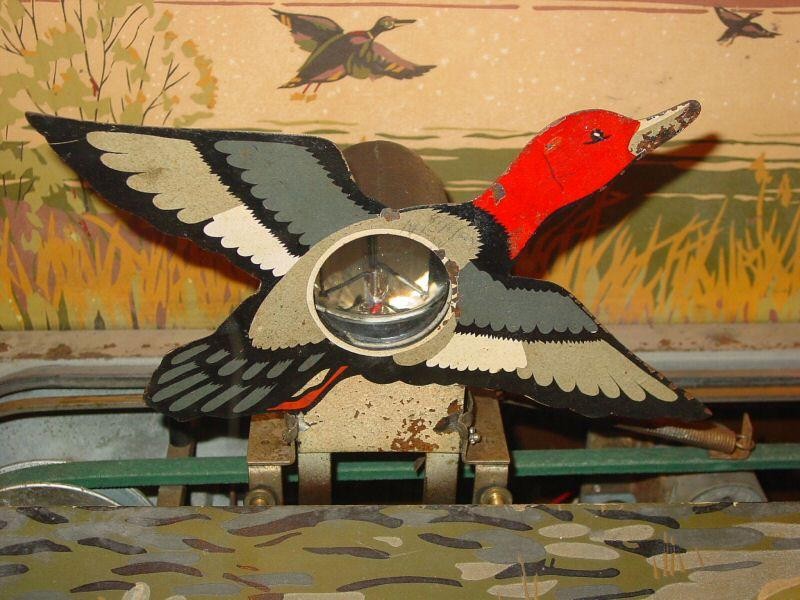
1.1 What this dive is, and how the catalogues hang off it
This is the narrative history of the light gun, told once. Its neighbours in History and Hardware are catalogues: Console Light Guns carries the identification table for every console gun (maker, year, connector, model numbers), Home-Computer Light Guns does the same for the home computers and their light pens, and Arcade Light Guns for the cabinets. Those dives say what each gun is. This one says why each generation looked the way it did, which is almost always a story about what the screen could and could not tell the gun.
There are three generations of sensing, and the volumes follow them:
- A photocell that sees a flash — the coin-operated rifle ranges from 1935 (this volume), and the first television games (Volume 2).
- A photodiode timed against a raster — the 8-bit and 16-bit consoles and the arcade’s golden period (Volumes 3 to 5), and how the end of the cathode-ray tube killed every one of them (Volume 6).
- A camera in the barrel looking at markers or the screen — infrared and motion controllers (Volume 7) and the do-it-yourself revival that this project belongs to (Volume 8).
The common thread, which runs from a 1934 patent to a 2026 firmware release, is that a light gun is never really aimed at a target. It is aimed at a signal, and every generation is defined by what signal the screen offered.
1.2 Two ways to shoot light
There are only two arrangements, and the first light guns used the one that later consoles abandoned.
- The gun emits, the target senses. A lamp in the gun throws a flash; a photocell in the target decides whether the flash landed. The target knows it was hit; the gun knows nothing. This is how every coin-operated “light-ray” rifle range of the 1930s worked, and how Nintendo’s toy guns of 1970 worked.
- The target emits, the gun senses. The screen (or a marker beside it) is the light source; a photocell in the gun decides whether it is looking at the right patch of light at the right moment. The gun knows it was aimed; the target is just a picture. Every television light gun from 1968 onwards works this way, because a television cannot carry a photocell on each duck.
The first arrangement needs a sensor per target. The second needs one sensor, in the gun, and pushes all the cleverness into knowing when to look. That shift is the whole of Volume 2.
1.3 Charles Griffith’s two patents, 1934
The light gun has a documented inventor. Charles W. Griffith, of Tulsa, Oklahoma, filed two US patent applications in 1934, and both were granted on the same day, 2 July 1935, assigned “by mesne assignments” to the Rayolite Rifle Range Company, an Oklahoma corporation also of Tulsa.12
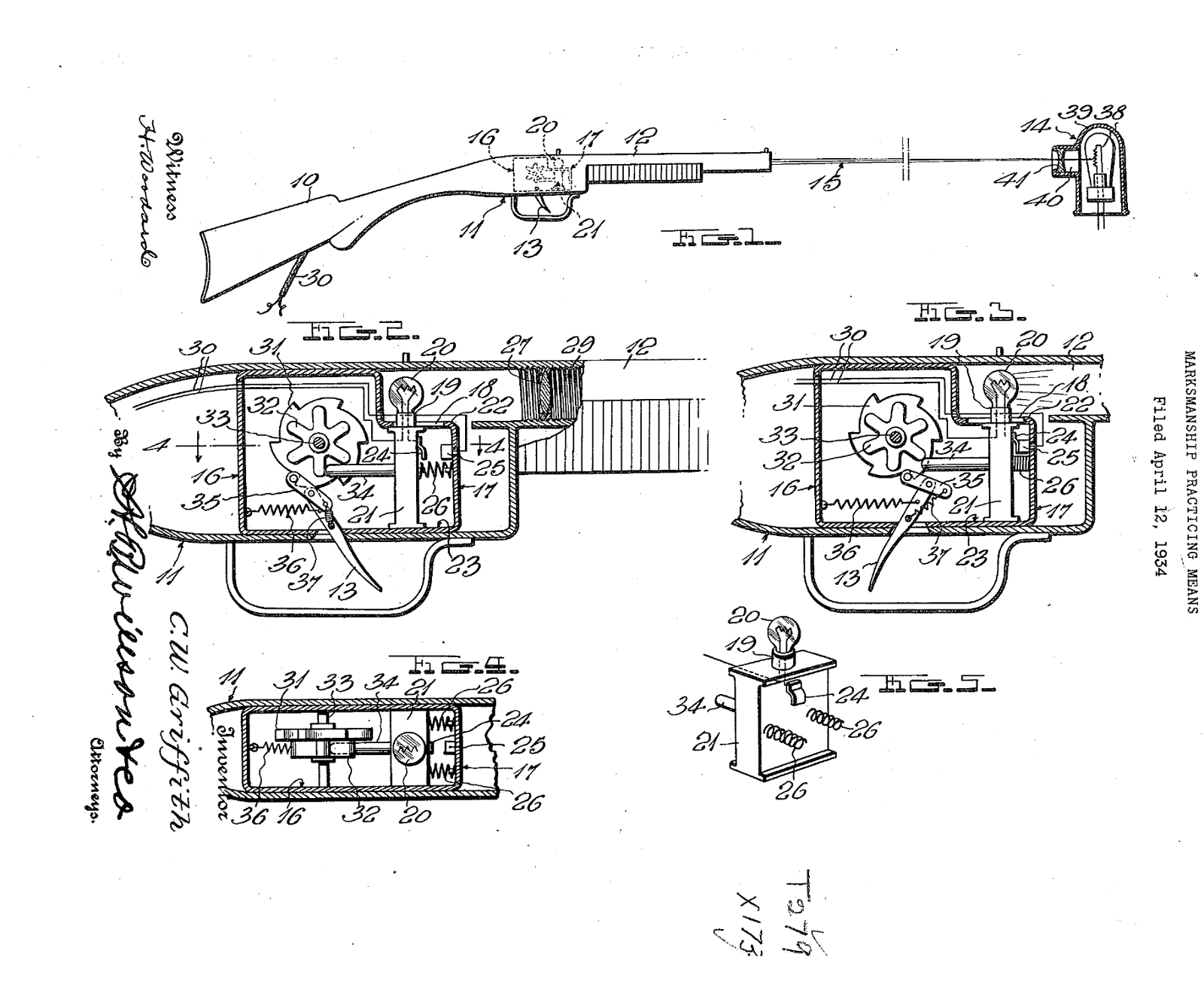
US 2,007,082, “Marksmanship Practicing Means” (filed 12 April 1934) is the gun. Its first sentence states the whole idea: “the practice gun is provided with means for projecting a flash of light against a light-sensitive target,” the target “preferably including a photo-electric cell”. The construction is a toy rifle with a sheet-metal box in the breech. A lamp sits in a socket on a sliding insulated carrier; the light leaves through “an appropriate lens … suitably mounted in the barrel … preferably adjustable with respect to the bulb”, and the wiring “may receive current from either a storage battery or an electric light socket or line”.1
The interesting part is the trigger. Griffith did not simply wire the trigger to the lamp. The trigger carries a pawl that advances a ratchet wheel one tooth per pull; the ratchet turns a star wheel; one arm of the star wheel pushes the lamp carrier forward until its contacts close, then slips past and lets a spring snap the contacts open again. The patent spells out why: “upon each pull of the trigger the switch is operated to close the circuit, but … the switch is no longer under control of the trigger, being automatically released therefrom … so that the light source is instantaneously energized and deenergized once upon each trigger pull whereby a flash of light is projected forwardly along the line of sight”.1
That is the first light-gun anti-cheat. A player who could hold the lamp on could sweep the beam across the range until something fell over. The star wheel makes every shot a single short flash, so the only way to hit is to be aimed when the trigger breaks. Every later generation had to solve the same problem in its own terms; Volume 3 shows Nintendo solving it with a black frame.
The patent also deals with sights and parallax, in two sentences any modern builder of a camera gun will recognise. The sights “define a line of sight which is substantially coextensive with the axial line of the barrel”, and the light leaving the lens is “not, of course, parallel”: the spot grows with distance, so although the sight line and the beam are not exactly coaxial, the sight line “passes through the disk at a point adjacent the center thereof”. The gun is accurate because the beam is wide. The target’s photocell sat under “an appropriate hood … having a small light entrance opening” behind “a light dispersing lens”, which narrows what the cell can see to the target face and keeps the room lights out.1
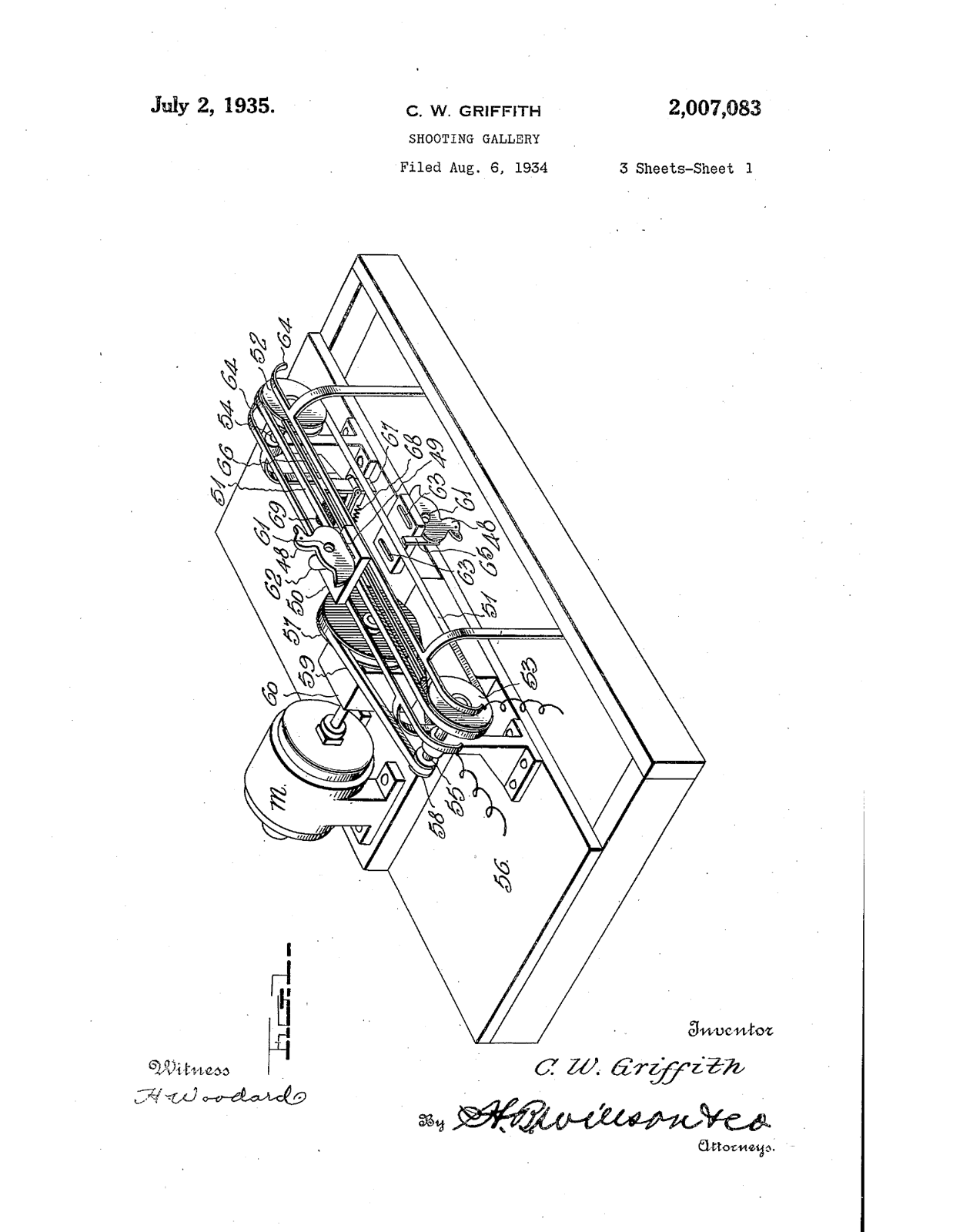
US 2,007,083, “Shooting Gallery” (filed 6 August 1934) is the machine around the gun. Gun 45 “having an electric light bulb 46 and a lens 47 for projecting a beam of light toward a target”; a target “of the traveling type” with portions “which may simulate ducks” pivoted on bases “secured to an endless belt” driven by an electric motor; a photo-electric cell and amplifier to “operate a signal if the aim be accurate”; and the commercial logic in the claims — the target drive and lamp are “initially conditioned for operation by means of a coin switch”, and the person shooting “is permitted to ‘fire’ a predetermined number of shots for the coin he inserts”.2 Coin in, ducks move, a fixed number of flashes, the gallery stops. That is the format of every light-ray rifle range that followed, and of Duck Hunt fifty years later.
1.4 Rayolite, Phoebus and Seeburg
The usual story — that a man named Charles Griffith invented a light system in 1935 and Seeburg “snapped up the rights” — is close but compressed. The best surviving record is a federal court transcript, which says how the business actually worked in 1936.
In Phoebus Corporation and Rayolite Rifle Range Company v. Ford Amusement Devices, Inc., H. E. Schayer and Nathan E. Squire, heard in the US District Court for the Northern District of Illinois in May and June 1936 (In Equity No. 15,014), the parties stipulated that title to the patents lay with the Rayolite Rifle Range Company and that Phoebus Corporation was the exclusive licensee.3 Plaintiffs’ counsel opened by describing the business:
“Plaintiffs had manufactured target rifle range falling within the terms of this patent in the early part of 1935. They have had such machines in use ever since and are having them manufactured for them and are operating them in this area. Their manufacturing source and licensee, the J. P. Seeburg Corporation, is selling machines. They are entitled to sell throughout all the United States except the States of Illinois, Indiana, Michigan and Wisconsin. These are States which the plaintiff has reserved as States in which they will operate machines themselves. There are now out some fifty or sixty of these machines and they are being turned out at the rate of four a day …”3
So the sequence is: Griffith’s applications in 1934; the patentees’ own rifle ranges operating from early 1935; Seeburg as manufacturing licensee by the 1936 show, with the patent owners keeping four Midwestern states for their own route operation. Counsel added that the machines “in use are exceedingly successful”, that the coin box “averages better than five dollars a day”, and that “the machines manufactured by Seeburg are superior to the original machines”.3
The same opening is the earliest plain-language description of the device on record: “a rifle or gun which looks like an ordinary rifle, is used to shoot a bullet of light … The target which is provided is a moving target in which the moving target structure supports one or more photoelectric cells”, the cell being, “for example, … a selenium cell”.3 The plaintiffs dropped the gun patent (2,007,082) from the suit because the defendants’ gun did not infringe it and pressed four claims of the gallery patent (2,007,083). The transcript also records that Griffith himself had left the plaintiffs’ employment and become an incorporator of a competing firm, which was the subject of a separate case. How the case ended is not in the transcript that survives on the Internet Archive.
The J. P. Seeburg Corporation of Chicago was a jukebox and coin-piano maker, which explains both the quality of the cabinets and the electronics: a company that built valve amplifiers for phonographs could build a photocell amplifier.
1.5 The 1936 show, and the copies
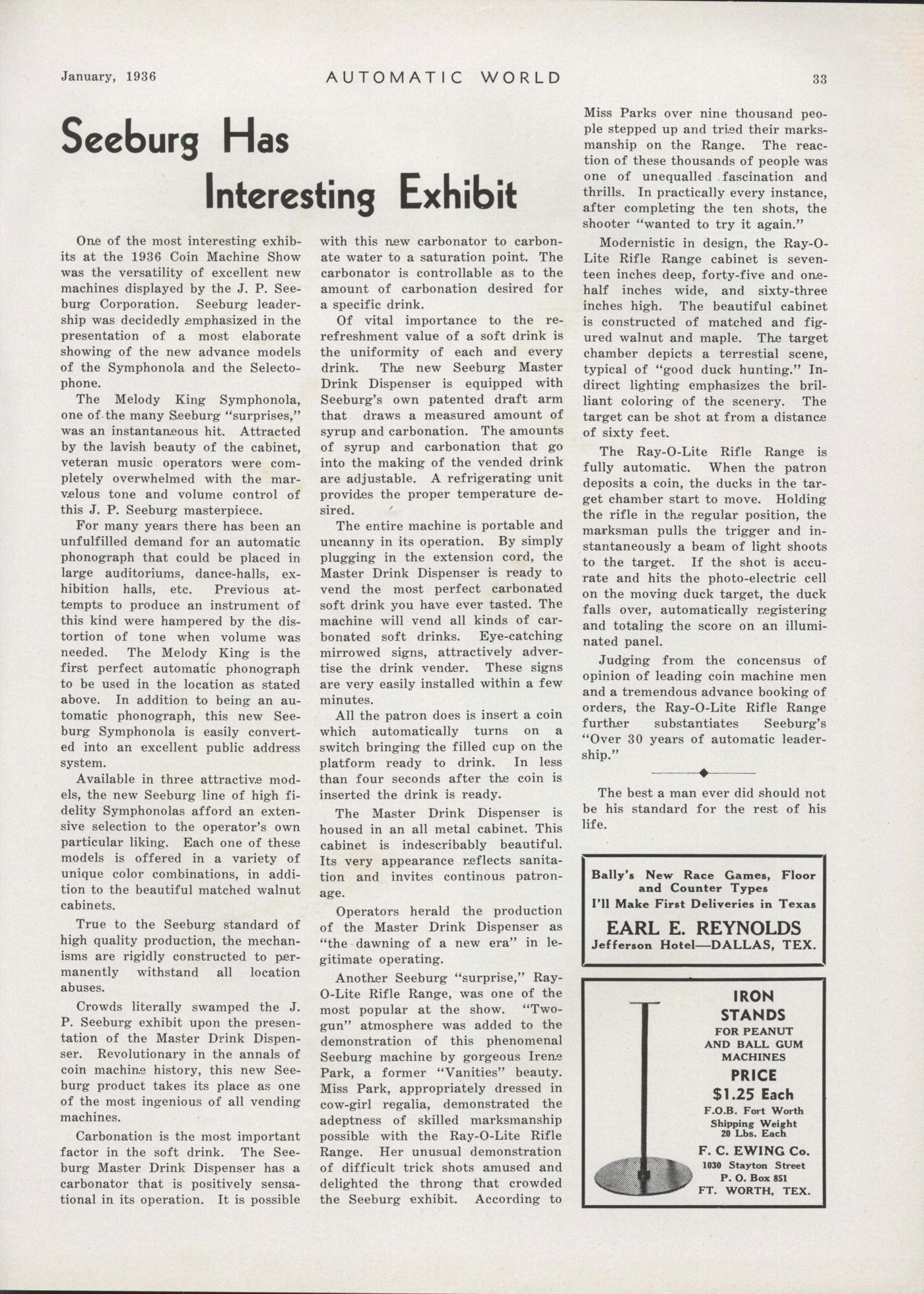
The machine went public at the coin machine industry’s January 1936 show in Chicago. The trade magazine Automatic World called it “Another Seeburg ‘surprise,’ Ray-O-Lite Rifle Range” and “one of the most popular at the show”, demonstrated by “Irene Park, a former ‘Vanities’ beauty” in cowgirl dress doing trick shots; “over nine thousand people stepped up and tried their marksmanship”.4 The same report gives the clearest period description of play:
“The Ray-O-Lite Rifle Range is fully automatic. When the patron deposits a coin, the ducks in the target chamber start to move. Holding the rifle in the regular position, the marksman pulls the trigger and instantaneously a beam of light shoots to the target. If the shot is accurate and hits the photo-electric cell on the moving duck target, the duck falls over, automatically registering and totaling the score on an illuminated panel.”4
The cabinet was sixty-three inches high in “matched and figured walnut and maple”, with a target chamber showing “a terrestial scene, typical of ‘good duck hunting’”, and the target “can be shot at from a distance of sixty feet”.4 Sixty feet is worth noticing. A light gun that works at sixty feet is a light gun with a narrow beam and a sensitive, well-hooded detector; it is a long way from a toy.
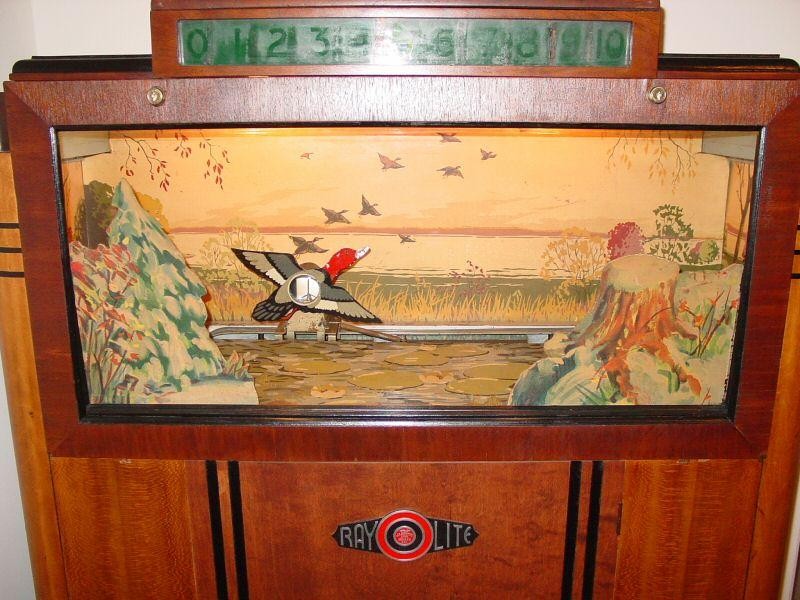
The Rayolite name became a product family. By December 1936 the trade press was reporting a Ray-O-Lite Distributing Company in Los Angeles, managed by W. P. Falkenberg, who had just “visited the factory of the J. P. Seeburg Corp. and completed arrangements for extending their activities in Southern California on Ray-O-Lite rifle machines”, promising warehouse stock in Los Angeles and parts service as “protection to all operators interested in Ray-O-Lites”.5 Falkenberg was also an inventor: his own patent, filed in January 1937 and assigned to the Rayolite company (by then of Chicago), describes “electric target rifle ranges of the type in which an aimable member fires a flash of light at a target which may include a photoelectric or light sensitive element”, with a target that drops when hit.6
Competitors followed within the year. Automatic World for December 1936 reported the first showing of Exhibit Supply’s “Shoot-A-Lite”, a “photo-electric rifle-target game” with “four different moving targets instead of one — four different kinds of ducks”, in “a massive, solid-walnut cabinet”, played for a nickel, with a rifle “an exact duplicate in size, ‘feel’ and appearance of a real gun … equipped with precision sights”.7 The Ford Amusement machine in the 1936 lawsuit was another. The photocell rifle range had become a category.
1.6 How the targets learned to tell one duck from another
One duck and one photocell is simple. Four ducks, or ten, raise the question every later light gun had to answer: which target was hit? The Rayolite patents show two answers.
The first is mechanical: put a photocell on each moving target and let it travel with the duck, as the Ray-O-Lite did. The cell’s wiring has to reach a moving belt, which is a maintenance problem, but each cell can only ever report its own duck.
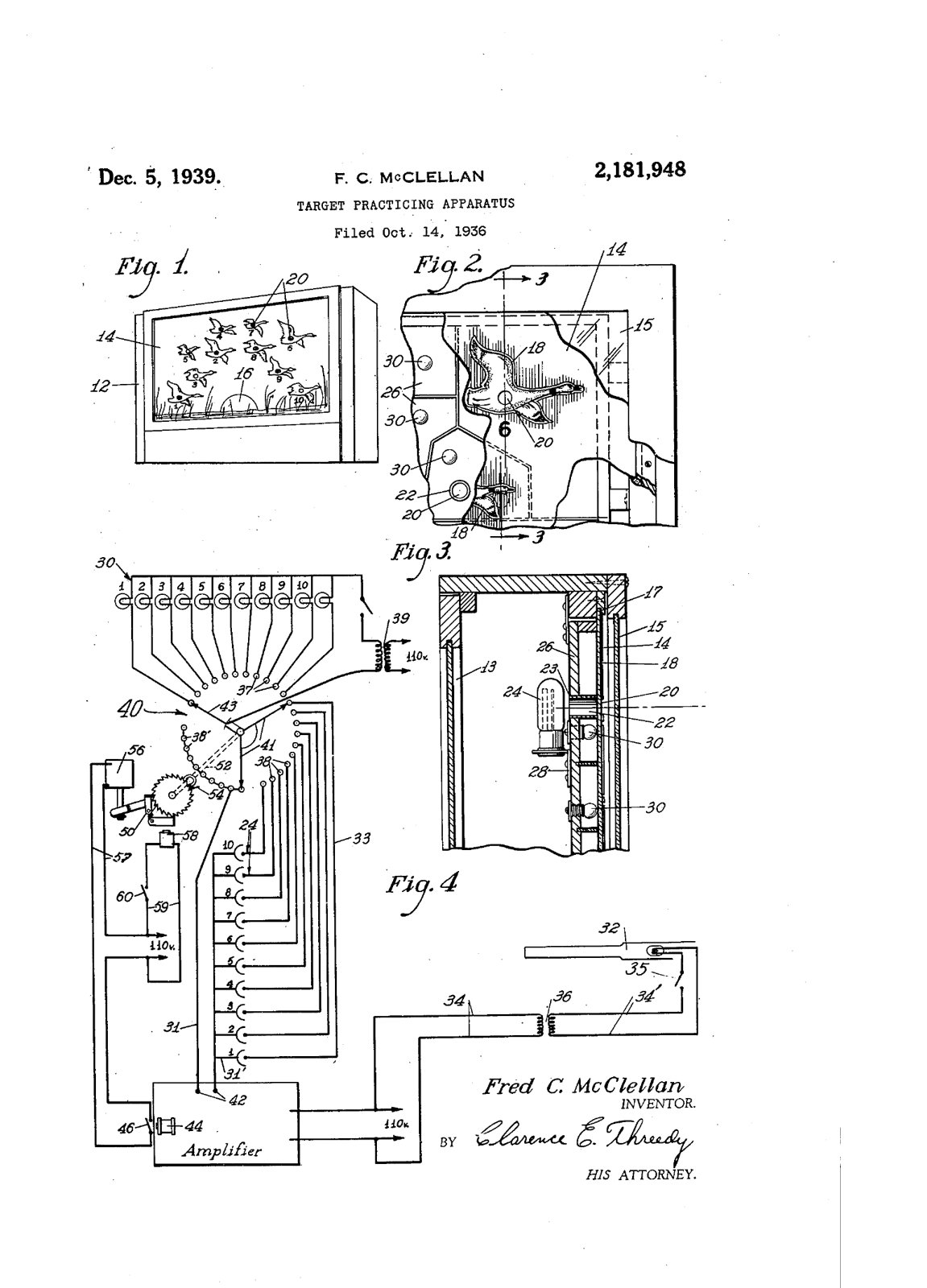
The second is optical and fixed. Fred C. McClellan’s patent, filed 14 October 1936 and assigned to Rayolite, puts ten ducks on a fixed panel of “glass or Celluloid”, each duck opaque with a translucent “bull’s eye” spot and a translucent outline lit from behind. Behind each spot “a suitable conduit member in the form of a tube” carries the flash “to be directed upon a photo-electric cell”. When a duck is hit, its outline lamp goes out: the target “will no longer be illuminated about its marginal edge portions”.8 The light tube is the important idea. It makes each photocell see only its own patch of the panel, which is spatial discrimination, done with geometry. Thirty years later, television light guns had to do the same thing with time, because a screen offers no tubes.
The 1936 transcript also shows that the lamp-and-shutter variations were already understood as equivalents. Counsel argued that “in flashing guns the shutter and the instantaneous make and break of a circuit for the bulb were equivalent” — a gun could flash by switching the lamp or by opening a shutter in front of a lamp that stayed lit.3 The equivalence matters later: once the gun stops emitting and starts sensing (Volume 2), the “flash” moves to the screen, and the question becomes how short and how well-timed the screen’s flash can be.
1.7 The war, Chicken Sam and Shoot the Bear
The light-ray range was well enough established by the Second World War to be converted rather than replaced. A Cash Box classified page of 26 October 1943 lists, among used arcade machines, “1 Ray-O-Lite less motor, $29.50”, offers “Chicken Sam — Jap & Hitler Conversions” next to “Seeburg Rayolite Gun”, and sells “new war film depicting Jap, Hitler and Mussolini for Radio rifles, 100 ft. roll, $4.50”.9 Two things are visible there. The Seeburg machines had been re-skinned with wartime targets, and a second family of light-gun arcade machines — rifles shooting at projected film rather than at moving models — was running on 16 mm loops. That film approach comes back in 1974 with Nintendo’s Wild Gunman (§1.8).
Seeburg’s Chicken Sam (a farmhand stealing chickens) and its post-war successor Shoot the Bear are the machines most people remember. Restorers date Shoot the Bear to 1947–1949 and describe a bear with three lenses — one on each side and one in its chest — that rears up, lights its eyes and reverses direction when a lens is hit, read by “a tube style amplifier”; play was “a quarter for three games or a dime for one”, twenty shots a game.10 That is the Griffith architecture unchanged thirteen years on: lamp in the gun, hooded cells on the target, a valve amplifier between.
1.8 Nintendo’s solar cells, 1970 to 1974
The last pre-video light guns came from Kyoto, and they connect the electro-mechanical gallery directly to Duck Hunt.
Nintendo’s Kōsenjū (光線銃, “light-ray gun”) SP toys of 1970 used the same emitter-gun, sensing-target arrangement as the Rayolite ranges, with one change that made them cheap enough for a toy: the target sensor was a solar cell. Japanese accounts credit the concept to Gunpei Yokoi and the sensor and circuit work to Masayuki Uemura, then in the photodetector sales side of Hayakawa Electric (Sharp), who helped Nintendo design the circuit and a low-cost detector and moved to Nintendo, by most accounts in 1971.11 Uemura went on to lead the design of the Famicom.
Nintendo then scaled the idea up. Its own corporate history records that in 1973 it “developed a commercial leisure system, the ‘Laser Clay Shooting System’” (業務用レジャー・システム「レーザークレー射撃システム」を開発), a clay-pigeon range built into converted bowling alleys with projected targets.12 It opened in 1973 and was hit almost at once by that year’s oil crisis, which left Nintendo heavily indebted, by the usual account. A smaller coin-operated derivative followed, and in 1974 Wild Gunman put a projected 16 mm film of a gunfighter on a screen and asked the player to out-draw him — the film-loop light gun of the 1940s “radio rifles” in a new cabinet. The Famicom game of the same name in 1984 is a direct descendant, and so is the Famicom light gun itself (Volume 3).
1.9 What the first forty years settled
By 1974 the light gun had already worked out most of what still matters:
Table 1 — By 1974 the light gun had already worked out most of what still matters
| Problem | The 1930s answer | Where it comes back |
|---|---|---|
| A held trigger sweeping the beam | Star wheel: one short flash per pull (US 2,007,082) | Nintendo’s black-frame test, Vol 3 |
| Stray light from the room | Hooded cell behind a small aperture and lens | Odyssey’s threshold knob, Vol 2; IR filters and modulation, Vols 6–7 |
| Which of several targets was hit | A cell per target, or light tubes behind a fixed panel | Timing in the raster, Vols 3–4; camera geometry, Vols 7–8 |
| Aim versus beam | A wide beam so the sight line falls inside the spot | Camera offset calibration, Vol 8 |
| Feel | A full-size rifle, real sights, a coin for a fixed number of shots | Recoil and arcade cabinets, Vol 5 |
What the period could not do was put the target on a television. A television has no photocell behind each duck. Turning the arrangement round — the screen emits, the gun senses — is the subject of Volume 2.
1.10 What could not be verified
- The outcome of Phoebus Corp. v. Ford Amusement Devices (1936). The surviving transcript ends with the evidence.
- The often-repeated launch price of $475 for the first Seeburg Ray-O-Lite (collector sites only), and the claim that Seeburg bought out the Rayolite company around 1945. No primary source was found for either; neither is stated as fact above.
- The Kōsenjū SP’s exact launch date and Uemura’s year of moving to Nintendo (1970 and 1971 are both given); the primary source, Uemura’s own book 『ファミコンとその時代』, was not read.
- The maker of the 1940s “Radio Rifle” film machines named in Cash Box.
Sources
Footnotes
-
Charles W. Griffith, “Marksmanship Practicing Means”, US Patent 2,007,082, filed 12 April 1934, granted 2 July 1935, assignor by mesne assignments to Rayolite Rifle Range Company, Tulsa, Okla. Read from https://patentimages.storage.googleapis.com/pdfs/US2007082.pdf, 2026-10-19. ↩ ↩2 ↩3 ↩4
-
Charles W. Griffith, “Shooting Gallery”, US Patent 2,007,083, filed 6 August 1934, granted 2 July 1935, same assignee. https://patentimages.storage.googleapis.com/pdfs/US2007083.pdf, read 2026-10-19. ↩ ↩2
-
Phoebus Corporation and Rayolite Range Company v. Ford Amusement Devices, Inc., H. E. Schayer and Nathan E. Squire, US District Court, Northern District of Illinois, Eastern Division, In Equity No. 15,014, proceedings transcripts of 27–28 May and 29 June–1 July 1936 (court stenographer Alice M. Rankin). Internet Archive item
phoebus-corporation-v-ford-amusement, https://archive.org/details/phoebus-corporation-v-ford-amusement, read 2026-10-19. ↩ ↩2 ↩3 ↩4 ↩5 -
“Seeburg Has Interesting Exhibit”, Automatic World (Fort Worth, Texas), January 1936, p. 33. Internet Archive item
automatic-world-1936-01, https://archive.org/details/automatic-world-1936-01, read 2026-10-19. ↩ ↩2 ↩3 -
“Falkenberg Back”, Coin Machine Review, Review Supplement, 25 December 1936, p. 7. Internet Archive item
coin-machine-review-1936-12-25-supplement, read 2026-10-19. ↩ -
William P. Falkenberg, “Electric Rifle Range”, US Patent 2,159,141, filed 11 January 1937, granted 23 May 1939, assignor to Rayolite Rifle Range Company, Chicago. https://patentimages.storage.googleapis.com/pdfs/US2159141.pdf, read 2026-10-19. ↩
-
“Exhibit’s Shoot-A-Lite Has Player Appeal”, Automatic World, December 1936. Internet Archive item
automatic-world-1936-12, read 2026-10-19. ↩ -
Fred C. McClellan, “Target Practicing Apparatus”, US Patent 2,181,948, filed 14 October 1936, granted 5 December 1939, assignor by mesne assignments to Rayolite Rifle Range Company, Chicago. https://patentimages.storage.googleapis.com/pdfs/US2181948.pdf, read 2026-10-19. ↩
-
The Cash Box, 26 October 1943, classified advertisements. Internet Archive item
cashbox05unse_3, read 2026-10-19. ↩ -
Cliff Dennison, “1947 Seeburg Shoot the Bear”, pinrepair.com, https://pinrepair.com/arcade/shotbea.htm, and “1936 Seeburg Ray-O-Lite”, https://pinrepair.com/arcade/rayolit.htm, read 2026-10-19 (restorer’s notes; dates as given there). ↩
-
Masayuki Uemura obituaries and profiles, e.g. Denfaminicogamer news, 9 December 2021, https://news.denfaminicogamer.jp/news/211209i, and SBBIT, 15 December 2021, https://www.sbbit.jp/article/refers/76772, read 2026-10-19. Secondary; Uemura’s own account is in 『ファミコンとその時代』 (Chikuma Shobō), not read. ↩
-
Nintendo Co., Ltd., 沿革 (Corporate history), https://www.nintendo.co.jp/corporate/history/index.html, entry for 1973, read 2026-10-19. ↩
Comments (0)