The History of Light Guns · Volume 7
Infrared and Motion — The Wii Remote, GunCon 3, PlayStation Move and Top Shot Elite, 2006 to 2012
How the industry answered the flat panel: put infrared markers by the screen and a blob-tracking camera in the controller, or turn it round and watch the controller from the screen; and why the gun became a plastic shell
7.1 An absolute reference point near the TV
Volume 6 ended with the only way out of the flat-panel crisis: stop asking the screen when it is lit and start asking where it is. The first mass-market product to do that was not a light gun at all. It was the controller of Nintendo’s Wii, launched in 2006.
Nintendo’s own account of the design, in its Iwata Asks interviews, shows the team arriving at the light gun’s problem from the other side. The controller’s motion sensors alone could not point reliably. Its designer, Ikeda, explained that “we would need an absolute reference point near the TV in order to improve reliability of control”, that without one “you won’t know where the pointer is directed due to the margin of error that arises”, and that “the Sensor Bar was absolutely indispensable”. The obstacles were the ones every light gun had met since Ralph Baer’s children found the fluorescent lamp (Volume 2): “the controller would react to fluorescent light, for example”, and the work included “creating a mechanism that prevents the controller from responding to fluorescent light and sunlight”. Iwata called the result, a beam “connecting the user and the television”, “something that had never been attempted before”; Miyamoto predicted that “when this kind of technology is eventually integrated into televisions, there may no longer be any need for the Sensor Bar”.1
7.2 How the Wii Remote points
The arrangement is the light gun of the CRT era turned inside out twice. The screen is no longer the light source the gun reads; a separate bar of infrared emitters beside it is. And the gun — the controller — no longer contains a single photodiode but a small camera.
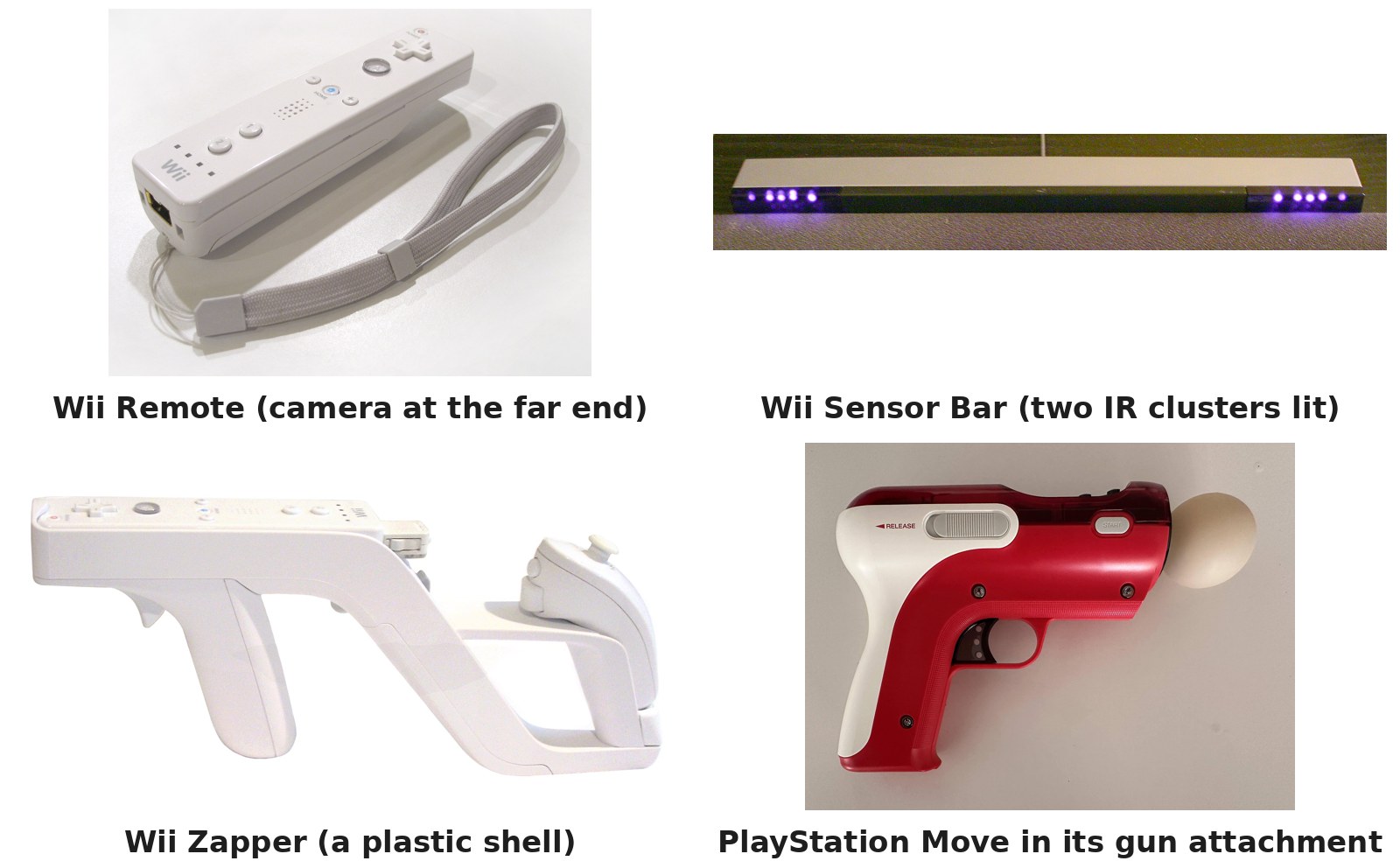
Johnny Chung Lee, whose 2007–2008 demonstrations of the Wii Remote as a PC input device made its camera famous among engineers, summarised the hardware on his project page: the remote “contains a 1024x768 infrared camera with built-in hardware blob tracking of up to 4 points at 100Hz. This significantly out performs any PC ‘webcam’ available today.”2 “Blob tracking” is the key phrase. The camera does not send a picture; it sends the coordinates of up to four bright infrared spots, computed in the sensor itself, so a slow microcontroller and a Bluetooth link can handle it. The Sensor Bar is a strip of infrared LEDs in two clusters at a known spacing, and its cable carries only power.3 The controller sees two spots; where they fall in its image, how far apart they are and at what angle, give where it points, how far away it is and how much it is rolled.
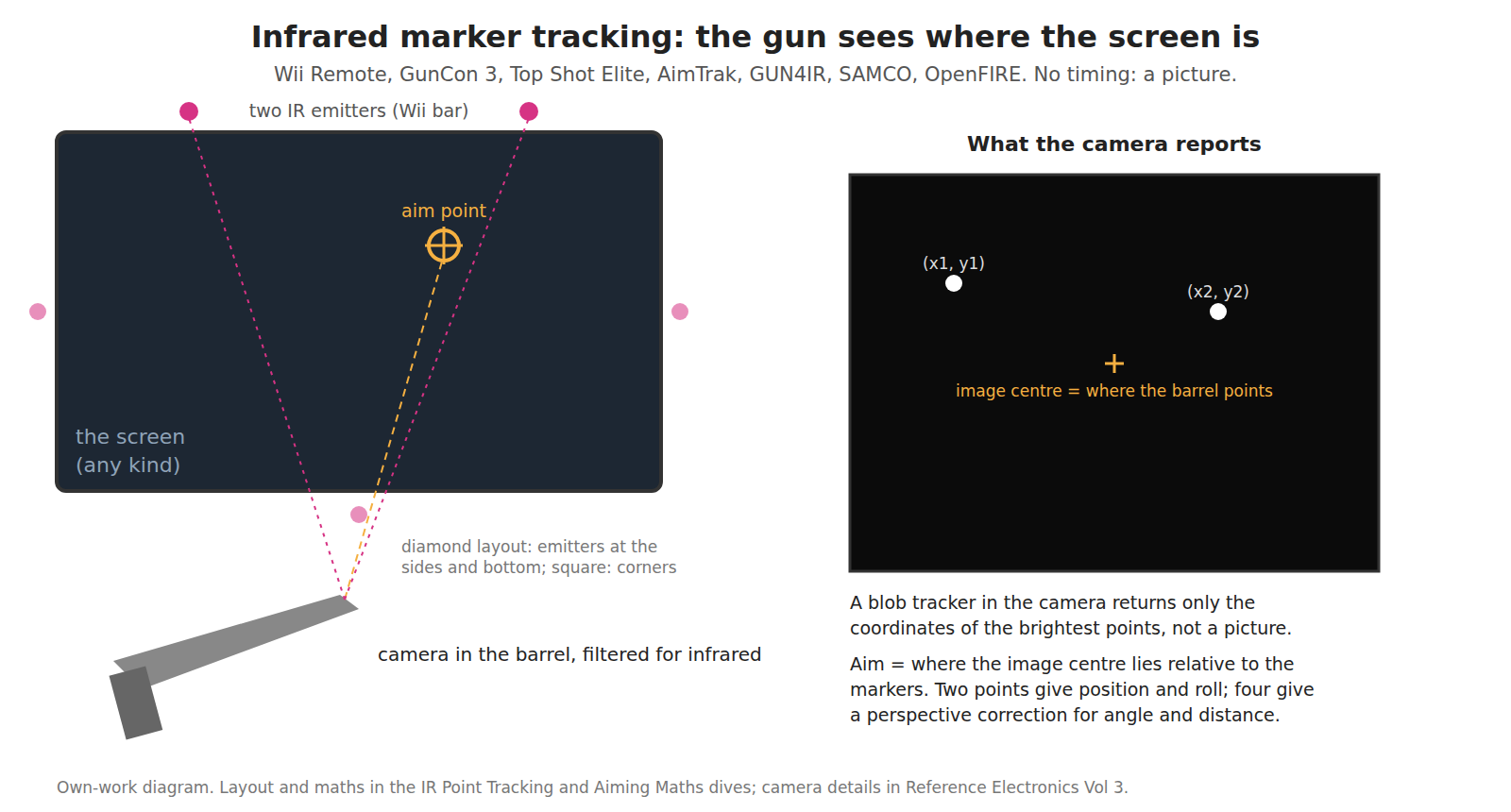
This is the architecture of every infrared light gun since, including the one this project is building. The camera class the Wii introduced, its successors from PixArt, and the choice of camera for a kit gun are worked through in Reference Electronics, Volume 3; the emitters and their wavelength in Volume 6 of the same dive; the tracking itself in IR Point Tracking; and the maths from points to aim in Aiming Maths and Calibration.
7.3 The Wii Zapper: the gun becomes a shell
A year after the console, Nintendo released its light gun for it. The press release of 10 September 2007, “Nintendo’s New Wii Zapper Targets Fun — First Wii Game-Play Accessory Comes Packaged with Zelda Software”, described it in one line: “The Wii Zapper casing houses both the motion-sensitive Wii Remote and Nunchuk controllers … in a single unit for precision targeting.” It went on sale on 19 November 2007 at “an MSRP of just $19.99”, with Link’s Crossbow Training.4
The Wii Zapper is a moulding. All the sensing is in the Remote clipped into it. That changed the economics of the light gun permanently. A gun no longer had to contain optics and electronics matched to a particular console’s video; it could be a cheap plastic shape built round a controller the buyer already owned, and every third-party accessory maker sold one. It also changed the feel. The sight line of a shell is wherever the moulding puts it, and the camera’s line of sight is wherever the clipped-in Remote points, so the two agree only by calibration, the old Super Scope problem (Volume 4, §4.4) without a dedicated optic to make it small.
7.4 GunCon 3: Namco follows
Namco’s third home gun, the GunCon 3 for the PlayStation 3 (released with Time Crisis 4 in 2007 in Japan and 2008 elsewhere), took the Wii’s approach rather than the GunCon 1 and 2’s video timing (Volume 5). Two infrared emitters are placed at the left and right of the screen and a sensor in the muzzle reads their positions, so it works on a flat panel, a CRT or a projector alike. It also carried two analogue sticks, one on a forward sub-grip and one at the rear, for games that mixed aiming with movement.5 The three GunCons together — in the photograph at the head of Volume 5 — are the whole history of this dive in one family: raster timing from the console’s video, raster timing from a video tap, and then infrared markers.
7.5 PlayStation Move: the camera moves to the screen
Sony took the opposite arrangement. The PlayStation Move motion controller, announced in June 2010 for release on 15 September 2010 in Europe and Asia, 19 September in North America (US$49.99) and 21 October in Japan, put a coloured, illuminated sphere on the end of the controller and required the PlayStation Eye camera at the television: “Users will need to use the PlayStation Eye camera to enjoy PlayStation Move motion controller on PS3.”6 The camera finds the sphere’s position in the image and its size, which gives distance; motion sensors inside the controller give its orientation.
Sony’s release also announced a shooting attachment, “designed to place the PlayStation Move motion controller horizontally”, at US$19.99 for autumn 2010, with Namco’s Time Crisis: Razing Storm among the games to support it.6 The gun, again, was a shell.
The Move is not a light gun in this dive’s sense, and the difference is instructive. A marker-tracking gun measures where it points: the screen’s markers appear in its camera, so the aim point is a direct measurement. A Move measures where the controller is and, separately, which way it is turned, and the game combines them to estimate where it points, so the aim is only as good as the orientation estimate and the calibration that ties the two together. That family of methods — position plus inertial sensing — is covered in Positional and Inertial.
7.6 Top Shot Elite and the hunting-game rifles
The genre that kept the full-size rifle alive in this generation was the hunting game. Activision’s Cabela’s series shipped with plastic rifles by PDP, of which the 2011 Top Shot Elite was the most capable. Its Xbox 360 and PlayStation 3 versions used a battery-powered infrared LED bar at the screen and a “high-sensitivity camera” in the rifle, connected to the console over 2.4 GHz wireless; the Wii version used the Wii’s own Sensor Bar.7 Reviews show the method’s limits as clearly as its strengths: one reviewer found it unusable closer than about eight feet from the bar, and that the on-screen reticle and the rifle’s scope did not line up even after calibration.7 Both are geometry problems — the camera’s field of view must contain the markers, and the sight line and camera axis must be reconciled — and both reappear in Aiming Maths and Calibration.
7.7 What infrared tracking gave up, and what it gained
Table 1 — 7.7 What infrared tracking gave up, and what it gained
| CRT raster timing | Infrared markers and a camera | |
|---|---|---|
| Works on | CRTs only | Any screen, any size, with markers placed round it |
| What is measured | When the beam lit the aimed patch | Where known markers appear in the gun’s view |
| Accuracy limited by | Sensor-chain jitter, about 1 µs | Camera resolution and field of view; marker geometry; calibration |
| Lamp and sunlight rejection | Line-rate filter, dark-interval tests | Infrared filter, blob-size and brightness thresholds; still sensitive to sunlight and some lamps (Nintendo’s own complaint) |
| Delay | Under one frame, fixed | Camera frame plus processing plus the TV’s own lag |
| Range | Set by optics and brightness | Set by field of view: too close and markers leave the frame |
| Needs at the screen | Nothing | Markers, powered and placed |
| The gun’s own aim | Lens axis; calibrated | Camera axis; calibrated, and a shell’s sights may not match |
The trade is plain. Infrared tracking freed the gun from the screen technology at the cost of something to mount at the screen and a calibration that is never quite as good as a lens aimed at a raster. Nothing in this generation recovered the CRT gun’s best property, that the screen itself told the gun where it pointed. That idea comes back only with border tracking (Volume 8).
7.8 The hobbyists pick up the camera
The motion-control boom faded and no console maker of the following generations shipped a dedicated light gun of its own that this research could find. But the Wii had put millions of blob-tracking infrared cameras into homes, and Johnny Lee had shown how to read one from a PC.2 His whiteboard code’s perspective maths still sits, credited, in the source of the open light-gun firmware this project uses (Open-Source Firmware, Volume 1). The do-it-yourself revival of Volume 8 began, quite literally, with Wii Remote cameras taken out of their shells.
7.9 What could not be verified
- The GunCon 3’s release dates and details (sensor, marker wavelength, how the markers are powered) come from press reports, not a Namco document.
- The Top Shot Elite’s camera and the eight-foot minimum come from reviews; PDP’s own documentation was not found.
- Whether any console maker after the PlayStation 3 and Wii generation released a first-party light gun. None was found.
- The Wii Remote camera’s native resolution: Lee’s 1024 × 768 is the reported output resolution; Reference Electronics, Volume 3 records the 128 × 96 sensor with sub-pixel interpolation.
Sources
Footnotes
-
Nintendo, Iwata Asks: Wii Remote, part 3, “Towards a New Standard” (Satoru Iwata with Shigeru Miyamoto, Genyo Takeda and the controller designers), https://www.nintendo.com/en-gb/Iwata-Asks/Iwata-Asks-Wii/Iwata-Asks-Wii-Remote/3-Towards-A-New-Standard/3-Towards-A-New-Standard-232496.html, read 2026-10-19. ↩
-
Johnny Chung Lee, “Projects — Wii”, johnnylee.net/projects/wii/, Internet Archive capture of 2008, read 2026-10-19. ↩ ↩2
-
WiiBrew wiki, “Sensor Bar”, https://wiibrew.org/wiki/Sensor_Bar, read 2026-10-19 (secondary; community documentation). ↩
-
Nintendo of America, press release, “Nintendo’s New Wii Zapper Targets Fun”, Redmond, Washington, 10 September 2007, as reproduced at https://nintendoworldreport.com/pr/14364/wii-zapper-details, read 2026-10-19. ↩
-
GamesRadar, “PS3 light gun adopts Wii tech”, https://gamesradar.com/ps3-light-gun-adopts-wii-tech, read via search 2026-10-19 (secondary). ↩
-
Sony Computer Entertainment, press release, “PlayStation Move Motion Controller to Hit Worldwide Market Starting This September”, 15 June 2010, https://sony.mediaroom.com/2010-06-15-PlayStation-Move-Motion-Controller-to-Hit-Worldwide-Market-Starting-This-September, read 2026-10-19. ↩ ↩2
-
Co-Optimus, “Cabela’s Big Game Hunter 2012 Co-Op Review”, 24 October 2011, https://www.co-optimus.com/review/910/page/1/cabela-s-big-game-hunter-2012-co-op-review.html, read via search 2026-10-19 (secondary). ↩ ↩2
Comments (0)