MP7 Light Gun: Machined Aluminum · Volume 2
Never a Firearm — the Design Rules for a Metal MP7
Why a machined aluminium MP7 shell needs written design rules that a printed one could leave implicit: what federal law calls a frame or receiver, what 'readily' means and why this lab's own skill counts against relying on difficulty, why an MP7-shaped receiver would be a machine-gun receiver, seven rules that keep every part of the shell out of those definitions, what to do with the starter file's modelled internals, and where the look-alike law and the house rule take over
2.1 Why this volume exists
A light gun propels nothing, and a printed PETG MP7 shell is plainly a plastic case for a camera and a solenoid. A metal shell machined to the real gun’s outside dimensions is a different-looking object to anyone who picks it up, and a machinist building it is working with the same material, the same machines and some of the same geometry as someone building a firearm’s receiver. That is reason enough to write the rules down before any metal is cut, put them in the CAD as fixed features, and keep them with the gun.
There are two separate legal questions, and they must not be confused:
- Is any part of it a firearm? Federal firearms law reaches not only working guns but a gun’s frame or receiver, including one that is incomplete. A light gun is outside that law only as long as no part of its shell is, or could readily become, a frame or receiver. This volume is about that question.
- Is it an imitation firearm? It is, whatever it is made of. The Imitation Firearm Law dive found that “the material is irrelevant”: a realistic MP7 is a look-alike under federal law and under every state and city rule it read (Vol 6 §6.1). That answer applies to the aluminium gun unchanged, and Section 2.8 links to it rather than repeating it.
Nothing here is legal advice. It is a design discipline built from the regulation’s text, so that the answer to question 1 is obvious from the part itself.
2.2 What the law calls a frame or receiver
The definitions are in 27 CFR 478.12, read from the eCFR on 24 October 2026. A frame is
“the part of a handgun, or variants thereof, that provides housing or a structure for the component (i.e., sear or equivalent) designed to hold back the hammer, striker, bolt, or similar primary energized component prior to initiation of the firing sequence, even if pins or other attachments are required to connect such component (i.e., sear or equivalent) to the housing or structure.”
A receiver is
“the part of a rifle, shotgun, or projectile weapon other than a handgun, or variants thereof, that provides housing or a structure for the primary component designed to block or seal the breech prior to initiation of the firing sequence (i.e., bolt, breechblock, or equivalent), even if pins or other attachments are required to connect such component to the housing or structure.”
So the test is functional: housing or structure for a sear, or for a bolt or breechblock. Paragraph (c) extends both terms to “a partially complete, disassembled, or nonfunctional frame or receiver, including a frame or receiver parts kit, that is designed to or may readily be completed, assembled, restored, or otherwise converted to function as a frame or receiver”, and excludes “a forging, casting, printing, extrusion, unmachined body, or similar article that has not yet reached a stage of manufacture where it is clearly identifiable as an unfinished component part of a weapon”. Two of the regulation’s own examples set the line: an AR-15 billet “without critical interior areas having been indexed, machined, or formed” is not a receiver; “a complete frame or receiver of a weapon that has been disassembled, damaged, split, or cut into pieces, but not destroyed” still is. In deciding, the Director “may consider any associated templates, jigs, molds, equipment, tools, instructions” that come with it.
The definition of firearm in 27 CFR 478.11 then includes “the frame or receiver of any such weapon”. The Supreme Court upheld this rule against a facial challenge in Bondi v. VanDerStok (2025), as the SIG P320-M17 dive records.
For the light gun the consequence is direct. What decides the question is what the shell houses, not what it is made of or what it looks like. A polymer MP7 receiver is a real H&K part; an aluminium MP7 shape with no housing for a sear or a bolt is not a receiver of anything.
2.3 “Readily”, and why skill cuts the wrong way
27 CFR 478.11 defines “readily” as “a process, action, or physical state that is fairly or reasonably efficient, quick, and easy, but not necessarily the most efficient, speediest, or easiest process, action, or physical state”, and lists eight factors: time, ease, expertise (“what knowledge and skills are required”), equipment (“what tools are required”), parts availability, expense, scope (“the extent to which the subject of the process must be changed to finish it”) and feasibility.
Read those factors against this shop. The owner is an experienced gunsmith with a CNC router, a CNC mill, a manual mill with a DRO and a lathe (the hub’s lab-capability catalogue). Expertise and equipment, two of the eight factors, would be read against a shell made here, not for it. A design that is “safe” only because finishing it into a receiver would be hard is exactly the wrong kind of safe. The rules in Section 2.5 are therefore written so that the shell is not an unfinished receiver at any stage: it never has, and never had, the housing the definitions describe, and the space where that housing would be is filled with structure that something else depends on.
2.4 Why an MP7 raises the stakes
The real MP7 fires automatically. Under 26 U.S.C. § 5845(b) a “machinegun” includes “the frame or receiver of any such weapon”, and 18 U.S.C. § 922(o) bars a private citizen from possessing a machine gun made after May 1986; the HK MP7 dive sets out why no private citizen can own one. An object held to be an MP7 receiver would not be a paperwork problem; it would be a felony. That is the reason this build’s rules are stricter than the general look-alike advice.
A second reason is newer. A semi-automatic firearm built to resemble the MP7 is now listed for sale: UO Arms’ NT7 in 4.6×30 mm, “Anticipated delivery … Q4 2026” at $3,499.00 on 18 October 2026 (HK MP7 Vol 8, “MP7-styled semi-automatics”). Its internals are unpublished. An MP7-shaped aluminium shell that happened to accept a real gun’s bolt or fire-control parts would be one that someone could finish. The rules below make that impossible by construction rather than by luck: the shell has no raceway, pocket or pin pattern for anything but the light gun’s own modules.
2.5 The seven rules
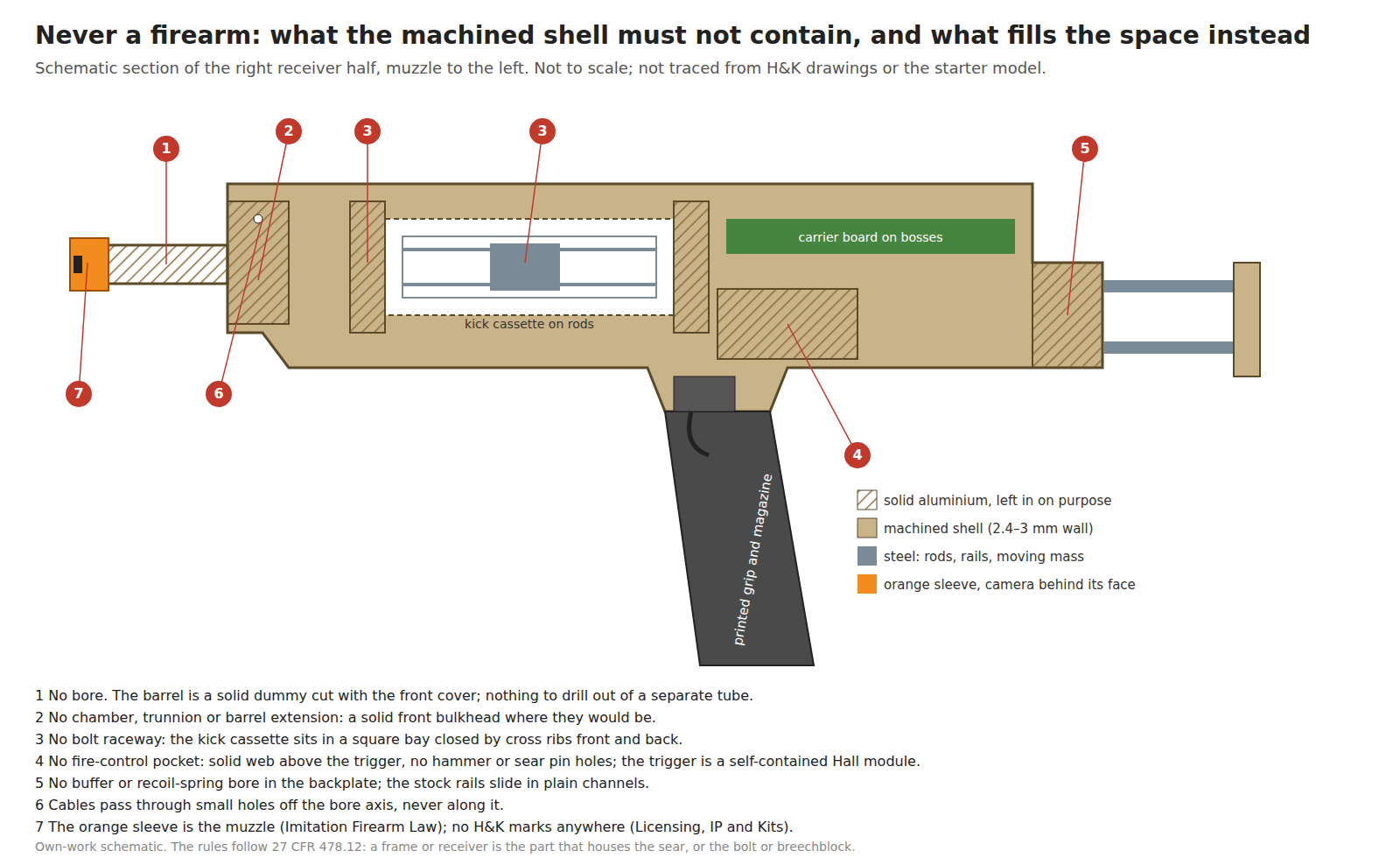
Each rule is a fixed feature in the CAD (a named body or feature the owner never suppresses) and is checked on the part before it is finished.
- No bore. The barrel is a solid dummy, cut in one piece with the front cover from the same block, with no hole along its axis. There is no separate barrel tube that could be swapped or drilled. Its outside need only look right at arm’s length; it should not reproduce any real barrel’s outside diameter, thread or flash-hider interface. If the camera sits at the muzzle (mount A, D43), it sits in the orange sleeve in front of the solid dummy, wired through a hole off the axis (rule 6), never through the dummy’s centre.
- No chamber, trunnion or barrel extension. Where a barrel would seat in the receiver, a solid bulkhead at least as thick as the shell’s wall closes the front of the receiver. The real gun locks its bolt “in a barrel extension” (HK MP7 Vol 5, “The mechanism in numbers”); the light gun has nothing there but aluminium.
- No bolt raceway. The real bolt “runs directly behind [the barrel] inside the top of the receiver” (HK MP7 Vol 5). In the light gun that space holds the kick cassette: the moving mass on two steel guide rods in its own frame (Moving Ejection Port Vol 6 proposes a 101 × 24 × 16 mm cassette). The receiver halves give it a square-cornered bay with solid cross ribs front and back that tie the halves together. There is no cylindrical or rail-guided path on the bore axis running from the front bulkhead to the backplate, and the ribs are structural, carrying screws that hold the halves together, so removing one is not a trim job.
- No fire-control pocket. Above and behind the trigger, where a real gun’s hammer, sear and disconnector live, the halves are solid web, with the carrier board’s mounting bosses on top. No hole is drilled at any position a real fire-control pin would occupy, and the starter model’s internals are never used to locate anything (Section 2.6). The trigger is a self-contained module, a printed or machined housing carrying its own pivot, return spring and Hall sensor (Controls and Inputs), screwed into a plain rectangular opening.
- No buffer or recoil-spring bore. The backplate is solid where the real gun’s buffer and spring guide sit. The stock rails slide in plain channels with a ball detent (Volume 5), not in a tube on the bore axis.
- Cables off the axis. The camera, trigger and solenoid cables pass through small holes placed away from the bore axis and away from the cassette’s line of travel. A wire hole on the bore axis through the bulkhead would look, on a part, like the start of a bore.
- Marking and marks. The muzzle carries the orange sleeve (Volume 6; Imitation Firearm Law Vol 1 §1.7). No H&K name, logo, model designation, calibre marking or serial-number-like plate appears anywhere (Licensing, IP and Kits Vol 2; proposal LK-2). Selector markings, if any, say what the control does in the game.
What the rules cost. Almost nothing. The kick cassette already wants a square bay and anchor points front and back; the carrier already wants a flat deck; the camera already sits in the sleeve or the sight block; the solid dummy barrel and bulkhead add a little weight forward, which the balance can use (Volume 7). The rules forbid only features the light gun has no use for.
2.6 The starter file’s internals
The starter STEP chosen for the printed gun models the internals as well as the shell: its listing preview, with the receiver hidden, shows “barrel, bolt and recoil spring, trigger and hammer” among other bodies (MP7 Printed Build Vol 2). Whatever those modelled internals are worth as a reference, they are the one place where firearm geometry could leak into this build by accident: a hole located from a modelled hammer pin, a pocket offset from a modelled bolt.
- Delete the internal bodies from the design before the machining split (Volume 3) begins, not merely hide them, and keep the deletion in the design history.
- Locate every internal feature from the light gun’s own parts: the carrier outline (D44), the cassette (ME-5), the camera mount (D43), the trigger module, the magazine and GX plug (D31).
- Use only the outside surfaces of the starter, as reference, and check them against H&K’s published outside dimensions as the printed build does (Vol 7 §7.2).
There is a licence question here too, separate from the legal one: whether a machined shell made from the starter’s outside surfaces is “private use” under the file’s CULTS PU licence. It is raised in Volume 3, Section 3.6.
2.7 Papers, files and photographs
The regulation lets the Director consider “templates, jigs, molds, equipment, tools, instructions” that go with an item. For a private gun that never leaves the house this mostly means: keep nothing alongside the gun that suggests otherwise. The CAD is private by decision D12; it should contain no suppressed firearm features, no “for drilling later” sketches, and no internal bodies from the starter. The machining setups and fixture plates in Volume 4 are generic.
Two optional steps, neither required for a private light gun:
- A short design note kept with the gun, listing the seven rules and the parts that occupy each space, with photographs of the open shell before assembly. It costs an hour and answers the question for anyone who asks.
- A voluntary ATF classification. 27 CFR 478.92(c) lets the Director “issue a determination (classification) to a person whether an item, including a kit, is a firearm” on a written request with “a sample for examination”. That is the route for a product, and it is the reason a metal shell should never be offered as a kit without one (Licensing, IP and Kits, proposal LK-1 already keeps realistic shells out of any kit). For the single private gun it is not proposed.
2.8 The look-alike law and the house rule
Everything the law dives say about the printed MP7 applies to the aluminium one, and none of it is repeated here:
- Federal marking (16 CFR part 1272, the orange band, “permanently affixed”): Imitation Firearm Law Vol 1. Volume 6 of this dive covers how the band is fixed to a metal muzzle.
- Michigan and Ovid (no state imitation-firearm statute, no Ovid replica ordinance, the light gun propels nothing; D27): MP7 Donor Build Vol 3 and Imitation Firearm Law Vol 6 §6.6.
- The house rule (D29) for storage and any trip out of the house: MP7 Donor Build Vol 3 §3.9.
- Kits: a realistic shell is barred from sale into California, New York, Connecticut, New York City, Chicago and abroad (IF-1, IF-3), and a metal one adds the classification question in Section 2.7. The proposal here (MA-3) is that the aluminium gun is never a kit.
One point is specific to metal. A machined aluminium MP7 is heavier, colder and harder than any toy, and it will be read as real by anyone who handles it out of context, more readily than the printed gun. The house rule’s “cased, out of sight” matters more for this gun than for any other in the category.
2.9 Why this, and why not the others
Table 1 — 2.9 Why this, and why not the others
| Option | Status | Reason |
|---|---|---|
| Seven fixed design rules in the CAD, checked on the part (MA-2) | Proposed | Keeps every part outside 27 CFR 478.12 by construction; costs nothing the light gun needs |
| Rely on the shell being “hard to finish” | Rejected | ”Readily” weighs expertise and equipment; this shop has both, so difficulty is no defence |
| Use the starter’s internal bodies to locate features | Rejected | The one route by which firearm geometry could enter by accident (Section 2.6) |
| A voluntary ATF classification for the private gun | Not proposed | Not needed for a private non-firearm; it is the route for any product (Section 2.7) |
| Offer the aluminium shell as a kit (MA-3) | Rejected | Look-alike sale bans (IF-1, IF-3), H&K trade dress (LK-1), and the classification question |
2.10 What could not be verified
- The NT7’s internal design and whether any MP7-form shell geometry would interface with it: unpublished, and the NT7 had not shipped when HK MP7 Vol 8 was written.
- How ATF would classify any particular light-gun shell: only a classification answers that, and none has been sought.
- The real MP7’s fire-control pin positions are deliberately not looked up or used.
Sources
- 27 CFR 478.11 (“Firearm”, “Readily”) and 478.12 (a), (c), (e), eCFR, https://www.ecfr.gov/current/title-27/part-478, read 24 October 2026; 27 CFR 478.92(c), same date.
- 26 U.S.C. § 5845(b), Cornell LII, https://www.law.cornell.edu/uscode/text/26/5845, read 24 October 2026; 18 U.S.C. § 922(o) as set out in HK MP7 Vol 8.
- Bondi v. VanDerStok (2025), as recorded in SIG P320-M17 Vol 5.
- HK MP7 Vols 5 and 8; Imitation Firearm Law Vols 1 and 6; Licensing, IP and Kits Vol 2; MP7 Donor Build Vol 3; MP7 Printed Build Vols 2 and 7; Moving Ejection Port Vol 6.
Comments (0)