MP7 Light Gun: Machined Aluminum · Volume 3
Alloy, Stock and the Parts List
Which aluminium, and in what form: 6061-T651 against 7075-T651 and cast tool plate (MIC-6 and its 5083-based rivals), with the reasons each wins or loses; why stiffness does not separate them; plate thickness and blank size for the receiver halves at dated prices; how the printed gun's design is re-split for machining; wall, floor and corner rules that a router can actually cut; and why the outside surfaces come from the builders' own geometry, not the starter file
3.1 What the alloy has to do
In order of how much each criterion should weigh for this gun:
- Anodise evenly. The visible parts are finished by anodising or Cerakote (Volume 6). A shell whose colour varies from part to part, or blotches across a face, fails the “looks like an MP7 at a metre” test the printed build set (Vol 7 §7.1).
- Stay flat after most of it is cut away. Each receiver half keeps only about a tenth of its blank, and most of what is cut away comes out of the inside face (Volume 4). Locked-in stress released by heavy pocketing bows a long thin part.
- Machine cleanly on a light router. The receiver halves go on the Shapeoko 3 XXL, which wants alloys that make chips, not smears.
- Take threads and resist dents. Screws go straight into the shell or into inserts (Volume 5), and the gun will be knocked.
- Cost and availability in cut pieces from a supplier who sells to individuals.
Strength in the structural sense barely matters: nothing in a light gun loads the shell near any alloy’s yield. Section 3.3 explains why stiffness does not separate the candidates either.
3.2 The candidates
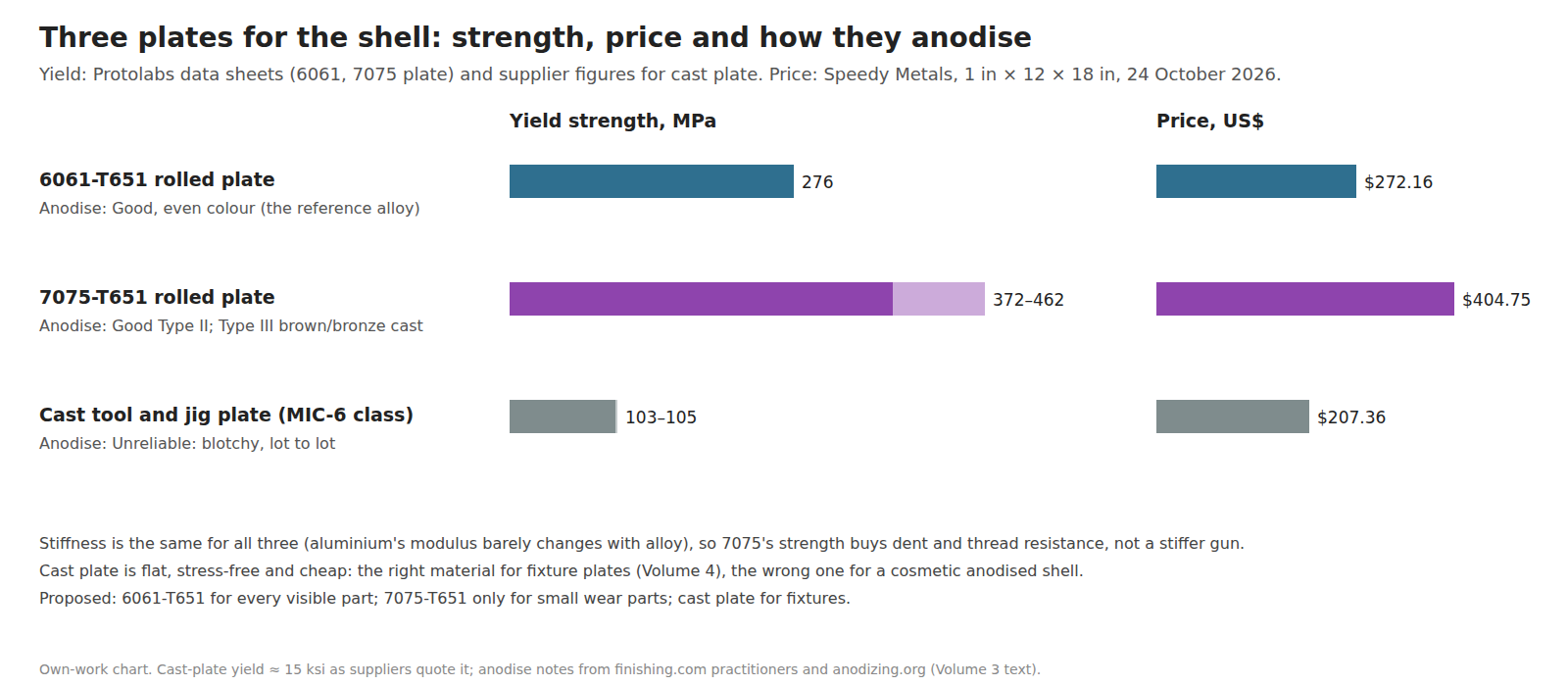
6061-T651 rolled plate. The general-purpose machining alloy. Protolabs’ data sheet gives 310 MPa tensile, 276 MPa yield, 17 % elongation, Brinell 95, a modulus of 68.3 GPa and 2.70 g/cm³, and lists “Appearance After Anodizing” among its benefits. T651 is the solution-treated and aged temper that has also been stretched to relieve stress, which is the property criterion 2 asks for in a rolled plate. It machines well on light machines: a Shapeoko user in Carbide 3D’s forum put it plainly: “6061-T6 cuts great. 3003 is super gummy and cuts like crap.” (Craig Green, 26 December 2022). It anodises to the even, predictable colour every anodiser expects, because it is the alloy their processes are tuned on.
7075-T651 rolled plate. The high-strength aerospace alloy. Protolabs gives T651 plate from 6.35 to 101.6 mm at 462 to 538 MPa tensile, 372 to 462 MPa yield, 3 to 9 % elongation and Brinell 150. It machines beautifully (harder, crisper chips, finer finish) and holds a thread better than 6061. Against it: it costs about half as much again (1 in × 12 × 18 in at $404.75 against $272.16, Speedy Metals, 24 October 2026); in hard anodise its zinc gives a colour cast (the Anodizing Reference Guide: “zinc over 5% will produce brown tinted coating”, with a “bronze overtone” in Type III); and its strength is not needed. Its place in this build is small parts that wear or take point loads: the foregrip hinge block and the stock latch.
Cast aluminium tool and jig plate (MIC-6 and similar). Cast, stress-relieved and machined flat on both faces. Speedy Metals’ material page says it “is readily machined with very little distortion”, is “free from internal stresses”, holds thickness to ”+/- .005"" with both faces at “32 micro-inches or better”, and is used “where strength is not a requirement”; suppliers quote about 15 ksi (103 MPa) yield. It is the cheapest of the three (1 in × 12 × 18 in at $207.36). For the shell it fails criterion 1. On the anodisers’ forum finishing.com, Marc Green wrote that “Mic 6 is a heavily alloyed tooling plate, and won’t clear anodize consistently from lot to lot”, and another anodiser, Matthew Kaye, that the alternatives “(K100s and ATP5) are a modified 5083 alloy, which should anodize much better” (finishing.com thread 384/88). Practitioners’ reports, not a test, but consistent with each other and with the alloy’s high alloying content. Cast plate is the right material for fixture plates (Volume 4), where flatness and stability are everything and nobody sees the colour.
5083-based cast tool plate (ATP-5, K100-S). Named on the same thread as anodising better than MIC-6. Not proposed: no individual-quantity listing with a price was found, and 6061-T651 already meets every criterion.
The also-rans.
- 2024-T351. Strong, machines well, anodises poorly (the Anodizing Reference Guide limits it to 0.0015 in in Type III with a bronze overtone) and corrodes. Rejected.
- 5052 and 3003. Sheet alloys, soft and gummy under a cutter (“3003 is super gummy” in the same forum thread). Rejected for machined parts; 5052 sheet is fine for a bent bracket.
- 6082-T651. Europe’s equivalent of 6061; fine if that is what a supplier stocks.
3.3 Stiffness does not decide it
It is tempting to buy 7075 “for a stiffer gun”. Stiffness is set by the elastic modulus and the section, and aluminium’s modulus hardly varies with alloy: Protolabs gives 68.3 GPa for 6061, and 7075 is in the same low-70s range. A 7075 shell of the same wall is essentially no stiffer than a 6061 one. What 7075’s strength buys is resistance to denting and to stripped threads, which is why it is proposed only for the small parts that see those loads.
The stiffness that matters for the IMU and the kick comes from geometry: a closed box section (the two halves screwed together across ribs), the cross ribs that Volume 2’s rule 3 already requires, and a flat machined deck under the carrier. All of that is free in a machined part.
3.4 Plate, thickness and blank size
The receiver halves. The printed build estimates the receiver at about 315 mm long and 170 mm tall including the grip (MP7 Printed Build Vol 6 §6.1), a photo estimate the CAD will replace. H&K gives the width as 42, 45 or 51 mm depending on what is counted (HK MP7 Vol 4), so each half is about 21 to 23 mm thick at the body, more where side-rail bushes stand proud.
- Thickness: 1¼ in (31.75 mm) plate. It leaves 4 to 5 mm of facing allowance on each side of a 23 mm half: enough to face both sides clean, true and parallel, which a sawn plate needs. 1 in (25.4 mm) would leave about 1 mm a side over the body and nothing over the bushes. Rolled plate is not flat to a few hundredths over 380 mm; the allowance is what makes the part flat.
- Blank size: about 230 × 380 mm (9 × 15 in) for each half, the part plus 20 to 25 mm all round for fixture tabs and dowel holes (Volume 4).
- What to buy. Speedy Metals sells 1¼ in 6061-T651 in listed sizes of 12 × 12 in ($263.52), 12 × 18 in ($338.81) and 12 × 24 in ($395.28), cut to ±¼ in, on 24 October 2026. A 9 × 15 in blank needs a 12 × 18 in piece; two halves need two ($677.62), and the offcuts (12 × 3 in strips and a 3 × 9 in end from each) serve the small parts. The supplier also offers custom cutting, which may be cheaper for two exact blanks; the page says to “call or e-mail” for it.
- 1 in 6061-T651 for the butt plate and thinner parts, if the offcuts run short: 12 × 12 in at $211.68.
- A cast plate fixture plate, 1 in × 12 × 18 in at $207.36 (Volume 4).
Shipping and tax are extra and were not priced.
3.5 Re-splitting the gun for machining
The printed gun splits the receiver into a clamshell plus one transverse cut per half, because a 315 mm receiver does not fit a 250 × 210 mm printer bed (MP7 Printed Build Vol 6 §6.2). The machined gun drops the transverse cut. The Shapeoko’s bed takes a whole half, so each half is one piece: no seam across the side, no joint to bridge, and a stiffer box.
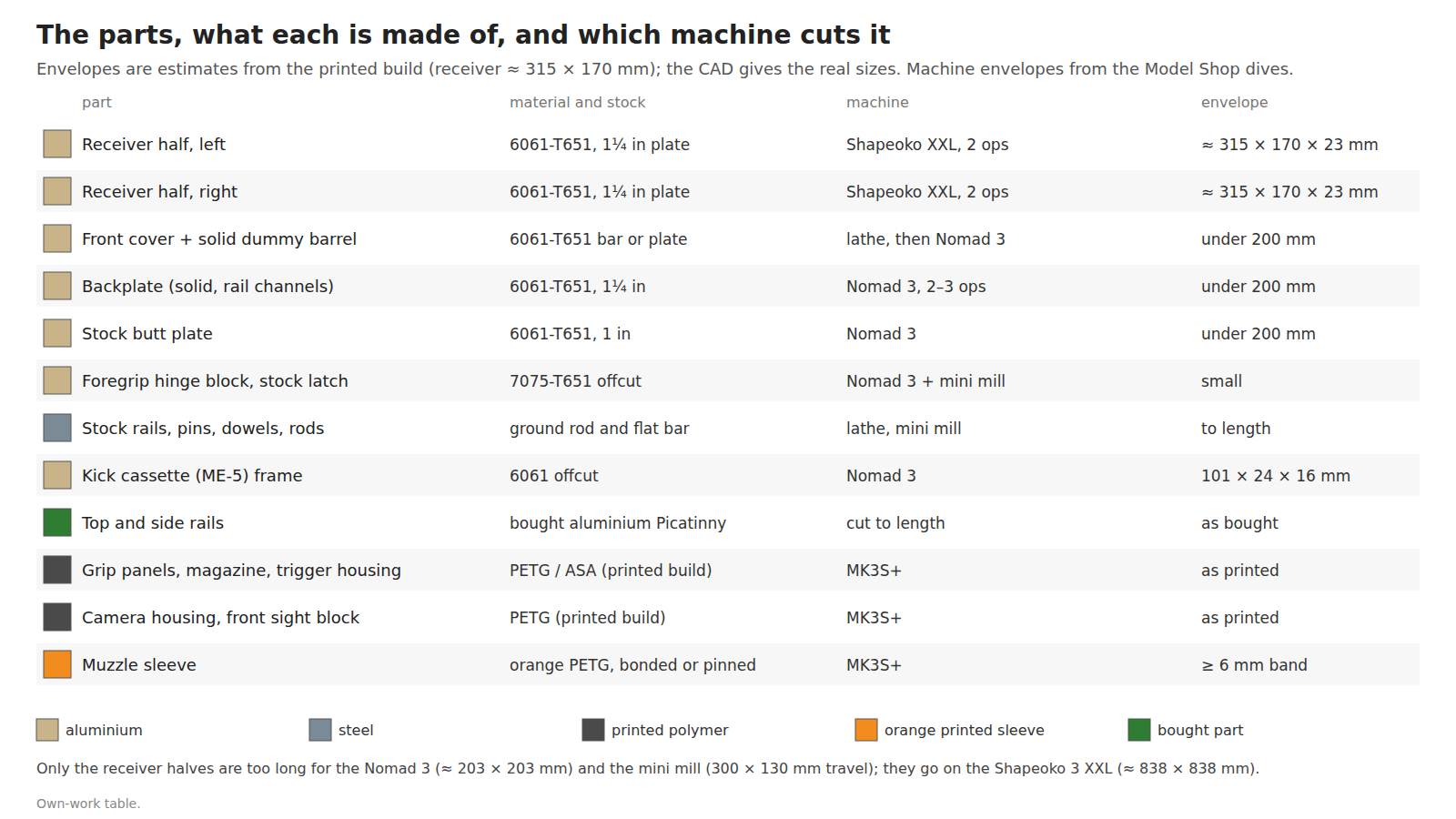
The split follows H&K’s own assembly groups, which the printed build already uses: receiver, backplate with the stock, front cover, magazine (HK MP7 Vol 5). The decisions specific to metal:
- The grip is printed panels on a machined aluminium core, not solid aluminium. The real grip carries moulded texture that a 3-axis router cuts badly (a texture of that kind needs a small ball-nose tool and many hours, and still looks machined). The core, part of each receiver half, carries the panel screws and the magazine well walls; the panels are printed from the model with its texture. Weight lost by not making the grip solid metal is small and sits in the hand, where the magazine’s ballast can replace it if wanted.
- The magazine stays printed. It is the cable exit with the GX plug (D31, P-PB-9), a possible battery bay (LiPo Batteries), and the most obvious radio window (Volume 7). A metal magazine would block a radio, add a second conductor at the cable entry, and cost more machine time than the receiver.
- The front cover is aluminium, with the dummy barrel solid and integral (Volume 2, rule 1): turned on the lathe as a stub on a bar end, then milled to the cover’s shape on the Nomad 3. The camera housing and the front sight block, which carry the camera (D43) and may need reprinting as the camera changes (D32 is still open), stay printed and bolt to it.
- The top and side rails are bought aluminium Picatinny sections, as the printed build proposes (Vol 5 §5.8), screwed into the shell. Milling a rail into the receiver half is possible but turns a clean 2.5D top into a fiddly profile and gains nothing.
- The kick module keeps its own cassette frame (ME-5), now bolted into the receiver’s square bay through the cross ribs (Volume 2 rule 3). The printed build’s separate aluminium carrier plate (P-PB-4) disappears: the receiver is the plate.
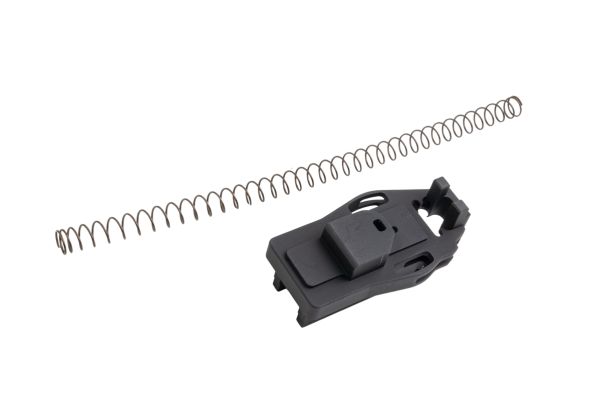
A machined MP7 part is not a novelty in itself. The airsoft aftermarket sells them, as the next figure shows, which confirms that the material and the method suit the shape; it is also a reminder that what a part fits matters (Volume 2).
3.6 Whose outside surfaces
The starter STEP is licensed CULTS PU, which lets the buyer “Print and use the 3D prints of the 3D model for private use” and forbids “modification or adaptation of the 3D model for public sharing or sale” (MP7 Printed Build Vol 3 §3.3). A private machined gun is not shared or sold, so the second clause does not bite. But the licence’s grant speaks of printing, and a machined shell is not a print. Whether “private use” stretches to machining is a question the licence’s words do not answer.
The printed build already concluded that the starter’s outside surfaces do not carry forward to the metal gun “for the licence reasons in Volume 3” (Vol 7 §7.10), and the owner has decided that any kit geometry is the builders’ own, drawn in a separate project (D42). The proposal here (MA-4) is to machine the aluminium gun from that own geometry, with the starter used only as a dimensional cross-check, exactly as the printed build uses H&K’s figures. It removes the licence question, it is the geometry the owner is drawing anyway, and it is the same discipline Volume 2 asks for on the internals. If the own geometry is not ready, the alternative is to ask the starter’s author for permission in writing (MP7 Printed Build Vol 3 §3.11).
3.7 Walls, floors and corners
The printed gun’s wall is 2.4 mm (its Vol 7 estimate). For the metal gun:
- Wall: 2.4 mm nominal on the large faces, 3 mm round bosses and at edges that will be radiused on the outside. Volume 1’s weight estimate puts a 2.4 mm aluminium shell at about 1.4 kg with the internals; ribs, bosses and the solid features of Volume 2 add mass toward the real gun’s 1.9 kg. Pocketing then trims the balance (Volume 7).
- Wall height. A 2.4 mm wall standing 20 mm tall is a thin fin when the cutter finishes it. Leave the wall thick in roughing, finish it last in light passes from both sides, and keep the inside pocket’s last few millimetres for the finishing tool (Volume 4).
- Internal corners. Every inside vertical corner has a radius at least slightly larger than the finishing tool’s: 1.6 mm minimum with a ⅛ in end mill, 3.2 mm with ¼ in. A corner radius exactly equal to the tool’s makes the tool wrap the corner at full engagement and chatter. A slightly larger radius lets it arc through.
- Pocket depth against tool reach. A half is about 21 to 23 mm deep inside. A ¼ in end mill with a 1¼ in length of cut reaches it with margin (Volume 4); a ⅛ in tool does not reach the bottom of a deep pocket without excessive stick-out, so small inside features near the floor are drawn to be reached from above with the larger tool or by the outside operation.
- Floors. Where a pocket has a floor (the carrier deck, the grip core), 3 mm minimum, flat, with the bosses rising from it.
- No undercuts. Everything is cut from one side or the other on a 3-axis machine. The real gun’s moulded shapes include a few features that would be undercuts from both sides; they are simplified in the own geometry or made as separate screwed-on parts.
- Edges. The outside edges of the real receiver are crisp with small radii (Printed Build Vol 7 §7.4). Draw them as 0.5 to 1 mm radii and cut them with a corner-rounding or ball-nose tool in the outside operation; a sharp machined aluminium edge cuts hands and chips the anodise.
3.8 Why this, and why not the others
Table 1 — 3.8 Why this, and why not the others
| Choice | Pick | Status | Why, and why not the others |
|---|---|---|---|
| Shell alloy (MA-5) | 6061-T651 | Proposed | Even anodise, stress-relieved plate, cuts well on a light router, cheapest wrought plate. 7075: half again the cost, colour cast in Type III, strength not needed. Cast plate: blotchy anodise lot to lot. 2024: poor anodise and corrosion. 3003/5052: gummy |
| Small wear parts | 7075-T651 offcuts | Proposed | Holds threads and edges; colour less critical on small parts |
| Fixture plate | Cast tool plate | Proposed | Flat, stable, cheap; nobody sees its colour |
| Plate for the halves | 1¼ in, two 12 × 18 in pieces | Proposed | Facing allowance both sides; fixture margin; listed size at a dated price |
| Receiver split | One-piece clamshell halves, no transverse cut | Proposed | The Shapeoko bed takes a whole half; no side seam; stiffer box |
| Grip | Printed panels on a machined core | Proposed | Texture prints, does not mill; polymer is what the real grip is |
| Outside geometry (MA-4) | The builders’ own (D42), starter as a check | Proposed | Removes the CULTS PU machining question; same discipline as Volume 2 |
3.9 What could not be verified
- The receiver’s real length, height and half-thickness: photo estimates until the own geometry exists.
- 7075’s modulus and density from the data sheet actually used (Protolabs gives strength and hardness only; the low-70s GPa and 2.81 g/cm³ are standard handbook figures not re-read here).
- Cast tool plate’s yield (15 ksi) is a supplier figure seen through search results; Speedy Metals’ own page gives no strength figure, only the qualitative description quoted.
- Which tradename of cast plate Speedy Metals supplies: the product page names none.
- ATP-5 and K100-S prices for individual quantities: not found.
- Whether CULTS PU’s “private use” covers machining: the licence text is silent.
Sources
- Protolabs, Aluminum 6061-T651/T6 and Aluminum 7075-T651/T6 CNC material data sheets (2026), https://www.protolabs.com/media/h54d0gnp/2026-026-cnc-material-data-sheet_aluminum-6061-t651_t6.pdf and https://www.protolabs.com/media/2tyj14s3/2026-026-cnc-material-data-sheet_aluminum-7075-t651_t6.pdf, read 24 October 2026.
- Speedy Metals product pages, read 24 October 2026: 1 in 6061-T651 (p-2415), 1¼ in 6061-T651 (p-2416), 1 in 7075-T651 (p-2728), 1 in cast tool and jig plate (p-2931); “Cast Aluminum Tool & Jig Plate” information page, https://speedymetals.com/information/material8.html.
- finishing.com, thread 384/88 on anodising MIC-6 (Jeff Wilkinson, 2 April 2021; Marc Green, 2005; Matthew Kaye, 14 September 2014), https://finishing.com/384/88.shtml, read 24 October 2026.
- Anodizing Reference Guide (summary of MIL-A-8625F), https://www.anodizing.org/anodizing-reference-guide/, read 24 October 2026.
- Carbide 3D community, “Regularly Placed Chatter on Shapeoko 3”, post by Craig Green, 26 December 2022 (“6061-T6 cuts great. 3003 is super gummy and cuts like crap.”), https://community.carbide3d.com/t/regularly-placed-chatter-on-shapeoko-3/55462, read 24 October 2026.
- Redwolf Airsoft, “TAGART VFC MP7 GBB Back Plate (Original Part # 04-7, CNC Aluminum 6061T6)”, https://www.redwolfairsoft.com/tagart-vfc-mp7-gbb-back-plate-original-part-04-7-cnc-aluminum-6061t6.html, read 24 October 2026.
- MP7 Printed Build Vols 3, 5, 6, 7; HK MP7 Vols 4 and 5; Moving Ejection Port Vol 6.
Comments (0)