MP7 Light Gun: Machined Aluminum · Volume 4
Fixturing and Machining in This Shop
Which of the lab's machines can cut which part (only the Shapeoko 3 XXL can hold a receiver half), why an online machining service is not an option, a cast-plate fixture plate with dowels, the two operations of a receiver half with a nest under the thin walls, tooling chosen and priced, a starting feeds-and-speeds recipe worked from the router's real limits, distortion control, the coupons to cut first, and an estimate of the machine hours
4.1 Which machine cuts what
The lab’s machines are catalogued in the Model Shop project, one dive per machine, and summarised in the hub’s lab-capability notes. The four that matter here:
Table 1 — The lab's machines are catalogued in the Model Shop project, one dive per machine, and summarised in the hub's lab-capability notes. The four that matter here
| Machine | Envelope (from the Model Shop dives) | Spindle | Role in this build |
|---|---|---|---|
| Carbide 3D Shapeoko 3 XXL (heavily modified: cabinet, lead-screw Z, CNCjs) | about 838 × 838 mm cutting area; stock Z travel about 76 mm (belt) | Trim router in a 65 mm mount: the Carbide Compact Router (about 12,000 to 30,000 rpm) or a DeWalt DWP611 (about 16,000 to 27,000 rpm) | The receiver halves, the fixture plate’s own facing, the nests |
| Carbide 3D Nomad 3 | about 203 × 203 × 76 mm | Brushless, about 130 W, 9,000 to 24,000 rpm, ER-11 | Front cover, backplate, butt plate, hinge block, cassette frame |
| HiTorque 3990 mini mill (TouchDRO) | table 460 × 120 mm; travel X 300, Y 130, Z 270 mm | 500 W brushless, 100 to 2,500 rpm, R8 | Drilling, reaming dowel holes, tapping, squaring small stock, tab stubs |
| HiTorque 7×16 mini lathe | 7 in swing, 16 in between centres | Dummy-barrel stub, pins, rods, bushes |
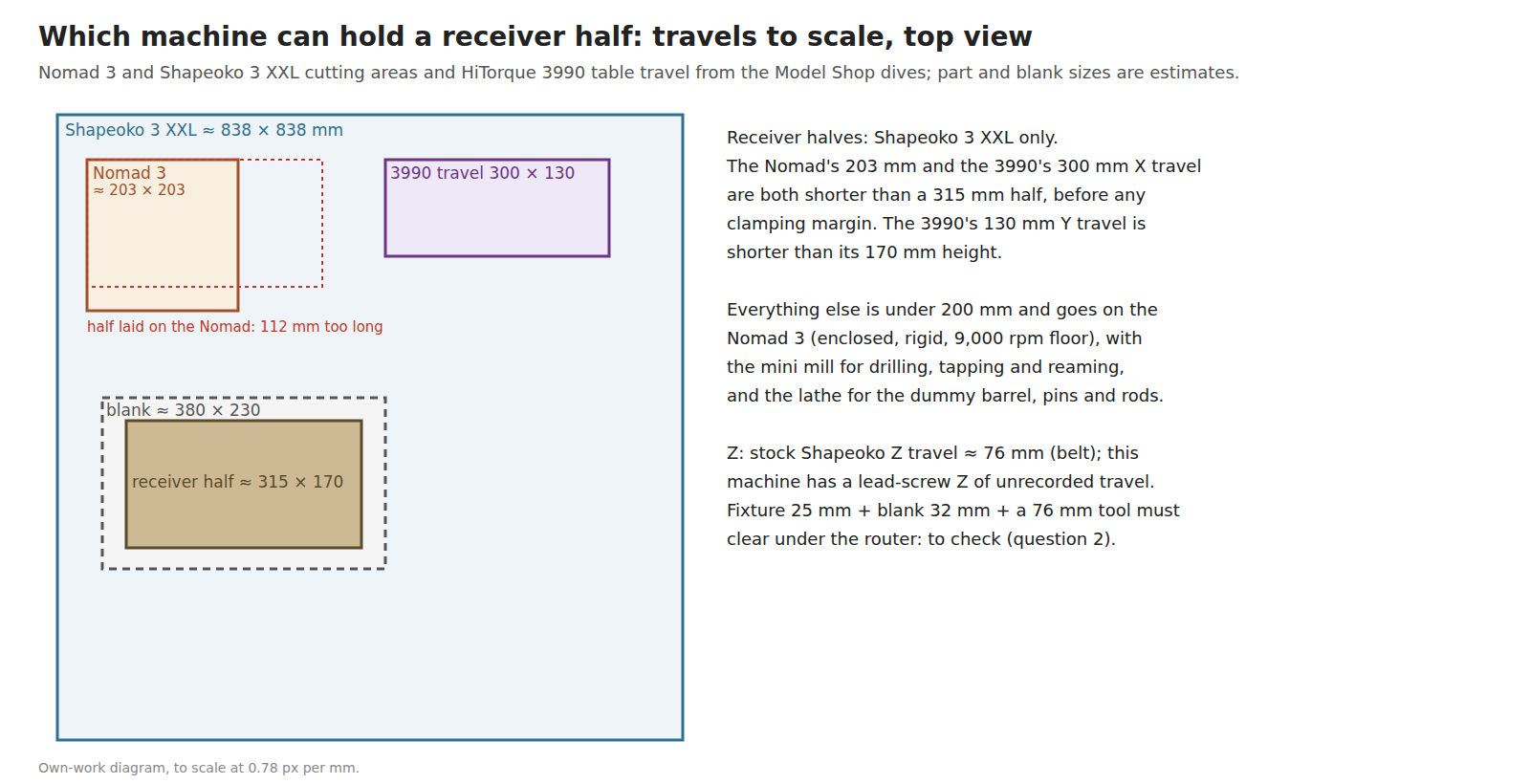
Only the Shapeoko can hold a receiver half. A half is about 315 mm long (the printed build’s estimate). The Nomad’s 203 mm and the mini mill’s 300 mm X travel are both short of it before any clamp margin. Everything else in the gun is under 200 mm and goes on the Nomad, which is enclosed, stiff and able to run as low as 9,000 rpm, which is what aluminium wants (Model Shop, Nomad 3 dive).
4.2 Why not send it out
An online machining service would cut a receiver half on a real VMC in an afternoon. The largest of them will not. Xometry’s published Firearm Policy (last updated 9 June 2022) says:
“As a company policy, Xometry will not produce any look-alike weapons, including those which are fully solid or cannot function by design, regardless of legality. Look-alike weapons may be in violation of 15 U.S. Code § 5001.”
It adds that Xometry “does not carry a Federal Firearms License” and cannot make “receivers, suppressors, bump stocks, automatic conversion kits, weapon replicas, and any serialized component of a weapon”, that it will make “accessories like grips, handguards, holsters, standard stocks, and other peripheral items”, and that a flagged order is placed “ON HOLD” and cancelled. An MP7-shaped receiver half is a look-alike part under that policy whatever its internals. Other services’ policies were not read; the safe assumption is that a shell drawing will be refused or, worse, held for questions.
There is a second reason that applies to every service: uploading the CAD discloses it, and D12 keeps the CAD private. Flat internal parts with no gun shape (the cassette frame, a bracket) could be sent out without either problem, but they are small and the Nomad cuts them easily.
4.3 The Shapeoko in aluminium
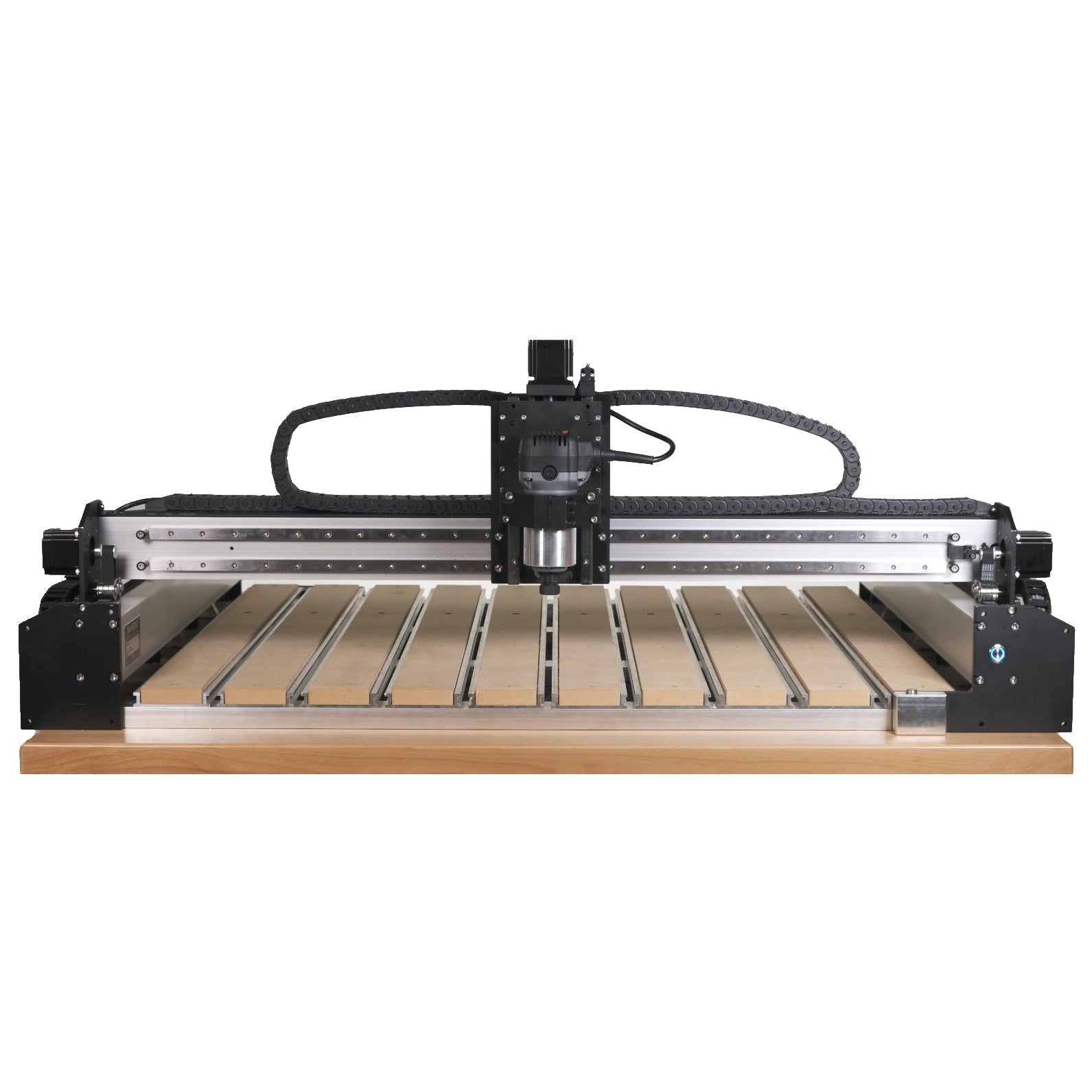
The Shapeoko is a belt-driven extrusion-frame router. The Model Shop dive sums up its rigidity: a frame “that can rack if not kept flat; a long gantry beam that bows a little under hard cutting; carriages that ride on preloaded polymer V-wheels …; belt drives that stretch slightly under load”. It also notes the remedy this machine already has, a screw-driven Z replacing “the softest drive (the belt Z)” (Model Shop, Shapeoko 3 XXL dive, Vol 2).
What that means in aluminium, using the Shapeoko community’s own reference, Shapeoko CNC A to Z (Julien, “Feeds and speeds basics”, read 24 October 2026):
- Cutting force is the limit, not power. The guide puts the machine’s practical cutting-force limit at roughly 20 lbf (about 90 N) and a trim router’s real cutting output at around 450 W. In aluminium the machine runs out of stiffness long before the router runs out of power.
- The router cannot run slow. “10k to 30k for the Makita/Carbide router, 16k to 27k for the Dewalt router.” Aluminium wants a lower surface speed than wood, so the feed must come up to keep the chip load real, and too low a feed for the rpm makes aluminium “melt instead of shearing”.
- Light, constant engagement. For metals the guide gives two patterns: wide and shallow (depth 5 to 10 % of the tool diameter, width 40 to 100 % roughing) or narrow and deep (width 10 to 25 % roughing, 5 to 10 % finishing, depth up to one to three diameters), the latter “very popular … when cutting metals on the Shapeoko” with adaptive clearing. Slotting is the worst case: “Deep slotting is notorious for causing issues when chips cannot be evacuated quickly enough.”
- Chip load floors. For metals: 0.0005 to 0.001 in per tooth with ⅛ in tools, 0.001 to 0.002 in with ¼ in tools, starting above 0.001 in and raising it.
Four consequences for this build: adaptive (constant-engagement) toolpaths for all roughing; an air blast to clear chips from deep pockets; the lowest rpm the router allows, with feed to match; and no full-width slotting except the final profile, which is cut in steps.
4.4 The fixture plate
A dedicated fixture plate makes the two operations of each half repeatable, and the same plate serves both halves and the nests.
- Material: 1 in cast tool plate, 12 × 18 in ($207.36, Speedy Metals, 24 October 2026). Flat to the supplier’s ±0.005 in thickness tolerance with both faces machined, stress-free, cheap. Volume 3 rules it out for the shell and in for exactly this job.
- Mounting: screwed to the Shapeoko’s wasteboard or T-slots, then skimmed in place with a surfacing tool so its top is coplanar with the machine’s own X–Y motion, whatever the wasteboard’s flatness.
- A tapped grid (M6 on a 50 mm pitch is a common choice) for screws through the blank’s margin, and two reamed dowel holes per half position, one round and one a short slot along the line between them, so the blank can come off and go back on, flipped, in the same place.
- Machined in place on the Shapeoko, so the dowel holes are where the machine thinks they are.
4.5 Two operations for each half
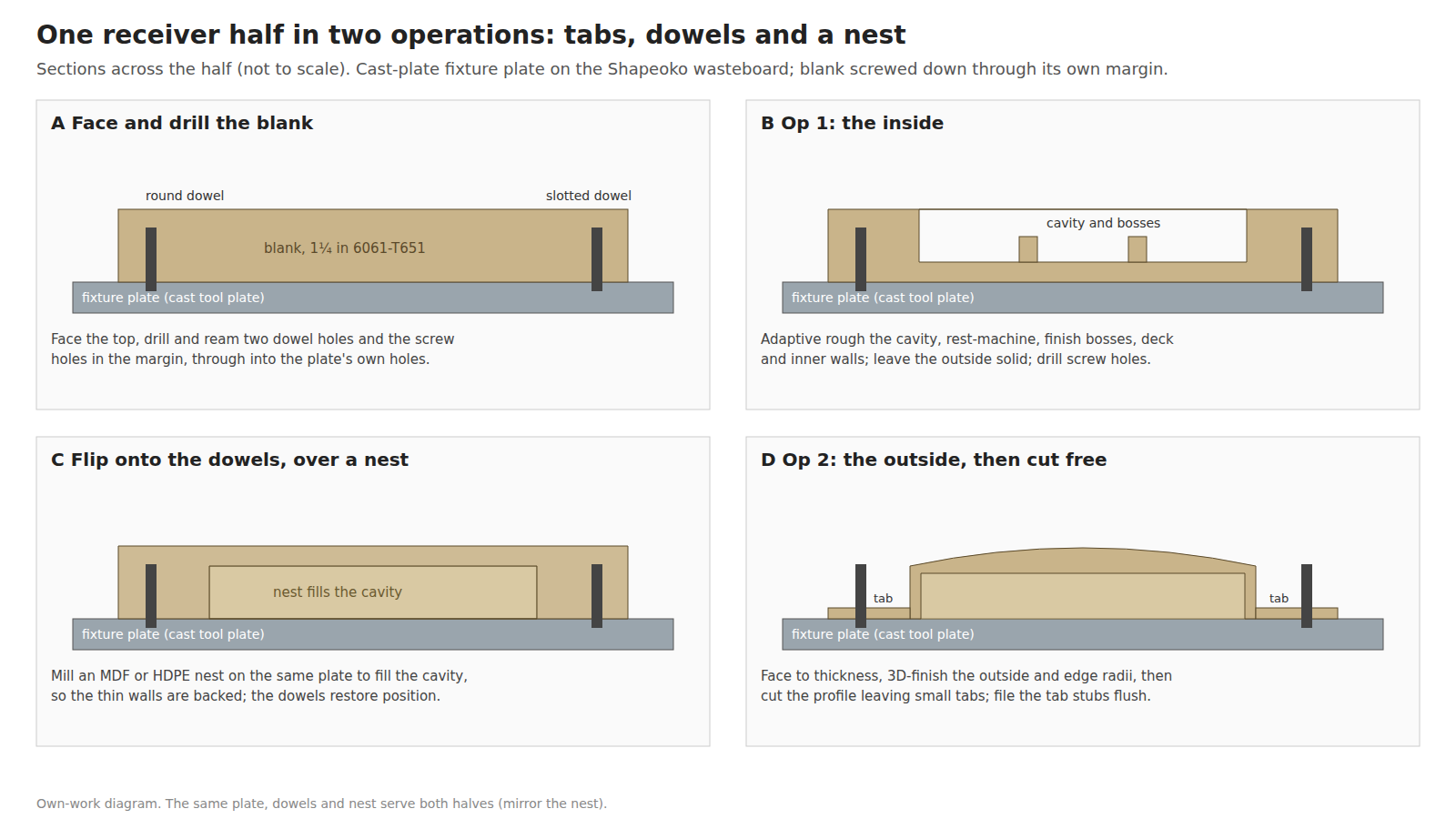
Operation 0: prepare the blank. Saw or have the supplier cut the 9 × 15 in blank (Volume 3). Screw it to the fixture plate through its margin, face the top clean, then drill and ream the two dowel holes through the margin and into the plate’s dowel holes. Its sawn edges never need squaring: the dowels are the datum.
Operation 1: the inside (B). In order:
- Adaptive-rough the cavity with the ¼ in end mill, leaving 0.5 mm on walls and floors.
- Rest-machine the corners the ¼ in tool could not reach with the ⅛ in tool.
- Finish the carrier deck, boss tops and the joint face (the face that meets the other half) flat in one setup: these are the datums every internal part locates from.
- Finish the inner walls, in light passes, while the outside is still solid and holds them rigid.
- Spot and drill every hole that runs at right angles to the joint face: screw clearances, dowel holes between the halves, the cable holes (Volume 2, rule 6). Tap or insert later (Volume 5).
Between operations. Unscrew the half and let it sit unclamped for a while; any bow from released stress shows now, while there is still stock to correct it (Section 4.8).
The nest (C). On the same fixture plate, mill a block of MDF or HDPE to the cavity’s shape, 0.2 mm under all round, screwed to the plate at the half’s position. Flipped onto the dowels, the half sits on the nest, so every thin wall is backed when the outside is cut and cannot ring or deflect. HDPE survives coolant and repeated use; MDF is cheaper and easier to remake for the other (mirror-image) half.
Operation 2: the outside (D).
- Face to final thickness, so the half’s total thickness is right relative to the joint face cut in operation 1.
- Rough and finish the outside surfaces. Most of an MP7’s receiver side is flat or nearly so (HK MP7 Vol 5); the radii along the top and round the grip are finished with a ball-nose or corner-rounding tool at a small stepover.
- Cut the profile in steps, down to the plate, leaving four to six small tabs (3 mm wide, 1 mm thick) tying the half to its margin.
- Unscrew, cut the tabs with a fine saw, and file or mill (on the 3990) the stubs flush.
4.6 Tools
Table 2 — 4.6 Tools
| Tool | Pick, priced | Why | Why not the alternatives |
|---|---|---|---|
| Roughing and wall finishing | ¼ in 3-flute carbide, 45° helix, ZrN coated, 1¼ in length of cut (TITAN USA TC63516, $64.67 at Dixie Tool, 24 October 2026) | Reaches the bottom of a 21–23 mm pocket with margin; aluminium geometry and coating resist built-up edge; three flutes keep chip load real at the router’s high minimum rpm without impossible feeds | Single-flute “O-flute”: the guide’s fallback if chips weld, but at 10,000 rpm it needs a third of the 3-flute feed for the same chip load, so it removes metal slowly. 2-flute: a fair middle choice. Standard-length ¼ in tools (¾ in cut) do not reach the floor |
| Rest machining, small features | ⅛ in 3-flute ZrN, ¾ in length of cut (TITAN TC63508, $41.22, same seller and date) | Corners and narrow slots the ¼ in tool cannot reach | Smaller tools (1/16 in) break easily at the Shapeoko’s stiffness; draw the geometry so they are not needed (Volume 3, §3.7) |
| Outside radii | ⅛ in ball-nose and a small corner-rounding tool | 3D finishing of the top and grip radii | Not priced; buy with the first order |
| Holes | Spot drill; jobber drills at tap or insert sizes; a reamer for dowel holes | Holes on the 3990 with the DRO are more accurate than interpolated on the router | Interpolating dowel holes on the Shapeoko works but is less round |
| Facing the fixture plate and blanks | A ¼ in shank surfacing tool or the ¼ in end mill at a wide stepover | The router collet takes ¼ in shanks at most | A fly cutter needs a spindle and rigidity a trim router lacks |
Buy two of each end mill: one for roughing, one kept sharp for finishing.
4.7 Feeds and speeds: a starting recipe
These are starting numbers for test coupons (Section 4.10), worked from the guide’s chip loads and limits, not a tested recipe. The machine’s sound, its chips and the coupon’s surface decide the final ones.
Roughing with the ¼ in 3-flute, adaptive.
- Spindle: 10,000 rpm (the Carbide router’s low end; a DWP611 cannot go below about 16,000, so scale feed by the same factor, as the guide notes).
- Width of cut: 10 % of diameter, 0.025 in (0.64 mm). Depth of cut: one diameter, 0.25 in (6.35 mm).
- Chip thinning: at 10 % engagement the real chip is thinner than the programmed feed per tooth. The radial chip-thinning factor is 1 / √(1 − (1 − 2 × 0.10)²) = 1 / √(1 − 0.64) ≈ 1.67. For a real chip of 0.002 in (the top of the guide’s ¼ in range), programme 0.0033 in per tooth.
- Feed: 10,000 × 3 × 0.0033 ≈ 100 in/min (2,500 mm/min). If the machine cannot hold that feed cleanly in its corners, use a 2-flute tool at the same chip load (about 66 in/min), not a lower chip load.
- Material removal: 0.25 × 0.025 × 100 ≈ 0.63 in³/min, about 10 cm³/min.
- Power check. The guide gives 6061-T6 a removal rate of 3.34 in³/min per horsepower. 0.63 / 3.34 ≈ 0.19 hp, about 140 W at the cutter: a third of a trim router’s useful output.
- Force check. Surface speed π × 0.25 in × 10,000 rpm ≈ 655 ft/min, about 3.3 m/s; 140 W / 3.3 m/s ≈ 42 N (about 10 lbf) tangential: half the guide’s 20 lbf limit. A first coupon should start at 60 to 70 % of this feed and work up.
Finishing walls: same tool, 5 % width (0.0125 in), full wall depth in one pass if the tool reaches, chip load raised for thinning, and a final spring pass. Plunging: ramp or helix at 10 to 30 % of feed, never a straight plunge with a non-centre-cutting tool.
On the Nomad, the Model Shop’s Nomad dive says to start from Carbide 3D’s published aluminium recipes in the machine’s tool library and adjust on a test cut. A Carbide 3D forum regular warns that the reverse also happens: Carbide Create’s rpm recommendations were “often being wrong for Shapeoko users since they are Nomad values” (Julien, 16 September 2019), so recipes are machine-specific. The Nomad is stiffer than the Shapeoko for its size and has the lower rpm floor, so the same chip loads apply at more conservative depths.
Chips and lubrication. An air blast clears chips from the pockets and keeps them from being recut, which the guide names as the cure for slotting problems; a light mist or cutting lubricant also helps aluminium resist built-up edge, and the coupon shows whether it is needed. Keep aluminium chips out of a dust collector that also takes wood dust, and clear the MDF bed of chips before the next wood job.
4.8 Keeping it flat
A 315 mm half with 2.4 mm walls, cut mostly from one face, will move if the plate’s locked-in stress is released unevenly. The sequence controls it:
- Stress-relieved plate: T651 is stretched after quenching for exactly this reason (Volume 3).
- Face both sides before deep pocketing if the plate arrives bowed: a few tenths off each face, alternating.
- Rough everything, then finish: rough the inside, unclamp and let it relax, re-face the joint face lightly, then finish the inside and go on to the outside. Finishing after the stress has moved is what makes the part flat.
- Clamp without distorting: screws through the margin into a flat plate, never a clamp pulling a bowed blank flat for the finishing passes.
- Measure: the joint face on a surface plate with feeler gauges or an indicator, and the two halves against each other. A flat surface plate is not in the lab’s catalogue; a granite plate is a cheap addition if there is not one (question 4).
4.9 The small parts
- Front cover and dummy barrel. Turn the barrel stub and its shoulder on the lathe as the end of a 6061 bar, part it off with a block of bar behind it, then mill the cover’s shape round it on the Nomad. One piece, no bore (Volume 2, rule 1).
- Backplate. Nomad, two or three operations in a vise; its stock-rail channels and the stock latch pocket are the critical features (Volume 5).
- Butt plate, hinge block, stock latch, cassette frame. Nomad, from offcuts; the 7075 parts here.
- Pins, dowels, guide rods, stock rails. Ground rod and flat bar, cut and faced on the lathe and the 3990.
- Secondary operations on the 3990 with the DRO: reaming dowel holes between the halves together (the two halves clamped as a pair, so the holes line up), tapping, and cleaning tab stubs.
4.10 Coupons first
Before the first receiver half, cut four coupons from the same plate:
Table 3 — Before the first receiver half, cut four coupons from the same plate
| Coupon | What it settles |
|---|---|
| Adaptive pocket 60 × 40 × 22 mm deep, with a 2.4 mm × 20 mm wall on one side | Roughing feed, chip evacuation, wall finish and whether the wall rings; measure the wall at top and bottom with a micrometer |
| Nest test: the same pocket flipped onto a nest, outside faced to leave 2.4 mm | Whether the nest backs the wall and the dowels return the position (measure the wall again) |
| Threads and inserts (Volume 5) | Tap drill, thread quality, insert pull-out by hand |
| Finish (Volume 6) | Bead blast, anodise or Cerakote on this plate, with the orange sleeve bonded on |
4.11 How long it takes
An estimate from the numbers above, to be replaced by the CAM package’s own times:
- Material to remove per half as chips: the facing allowance (about 4 mm off each face of a 380 × 230 mm blank, roughly 700 cm³), the inside cavity (roughly 400 cm² of outline at 20 mm deep, less bosses and ribs, roughly 700 cm³), the outside shaping and the profile slot (a few hundred cm³). About 2 litres a half. What lies outside the profile is offcut, not chips.
- Roughing at 4 to 10 cm³/min (the coupon decides): about 3.5 to 8 hours a half.
- Finishing, rest machining, drilling: 2 to 4 hours a half, mostly the outside radii at a small stepover.
- Setup, nest, flipping, measuring: 2 hours a half.
- So about 8 to 14 machine hours a half, 16 to 28 for the pair, plus about 8 to 15 hours on the Nomad, mini mill and lathe for the small parts. Call it 25 to 45 machine hours for the metal parts, before finishing.
Most of that runs unattended in the sense that the operator is watching, not working. It is also where the cost of a mistake lies, and the reason the printed gun goes first.
4.12 Why this, and why not the others
Table 4 — 4.12 Why this, and why not the others
| Choice | Pick | Status | Why, and why not the others |
|---|---|---|---|
| Where the halves are cut (MA-6) | Shapeoko 3 XXL, adaptive toolpaths, air blast | Proposed | Only lab machine that holds a half. Nomad and 3990 too short |
| Outsourcing the shell | No | Rejected | Xometry’s policy refuses look-alikes “fully solid or cannot function by design”; D12 |
| Workholding (MA-7) | Cast-plate fixture plate, blank screwed through its margin, two dowels, a nest for op 2 | Proposed | Repeatable flip, thin walls backed, no clamps in the toolpath. Vise: no vise holds 380 mm on this machine. Tape and glue: not for 2 L of aluminium removal at 10 lbf |
| Roughing tool | ¼ in 3-flute ZrN, long reach | Proposed | Reach and chip load at the router’s rpm floor; single-flute as fallback |
| Hole making | 3990 with DRO for dowels and taps | Proposed | Reamed holes are round and square to the face; the router interpolates them less well |
4.13 What could not be verified
- Which router the Shapeoko carries, the lead-screw Z’s travel, and the clearance under the collet (stock Z about 76 mm): unrecorded.
- Whether the Shapeoko as modified holds 100 in/min cleanly through adaptive corners: the coupon decides.
- Carbide 3D’s own aluminium recipes and end-mill prices: the shop site refused requests (HTTP 429) on 24 October 2026, so its catalogue was not read.
- Other machining services’ policies on look-alike parts: only Xometry’s was read.
- The “about 2 litres” and the hour estimates: arithmetic on estimated part sizes.
Sources
- Model Shop project, machine dives for the Shapeoko 3 XXL (Vols 2, 4, 5, 6), Nomad 3 (Vols 2–4), HiTorque 3990 (reference volume) and 7×16 lathe;
_shared/lab_capability.md. - Julien (shapeokoenthusiasts), Shapeoko CNC A to Z, “Feeds and speeds basics”, https://shapeokoenthusiasts.gitbook.io/shapeoko-cnc-a-to-z/feeds-and-speeds-basics, read 24 October 2026.
- Carbide 3D community, “Shapeoko & Nomad – Feeds & Speeds Charts” (2016), https://community.carbide3d.com/t/shapeoko-nomad-feeds-speeds-charts/2402, and “Default speeds with Aluminum” (Julien, 16 September 2019), https://community.carbide3d.com/t/default-speeds-with-aluminum/16267, read 24 October 2026.
- Xometry, Xometry’s Firearm Policy, last updated 9 June 2022, https://xometry-marketing.cdn.prismic.io/xometry-marketing/cd4fb3c5-5cbe-403a-be24-dcfad49cf638_Xometry+Firearm+Policy+June+2022.pdf, linked from https://www.xometry.com/legal/, read 24 October 2026.
- Dixie Tool, TITAN USA TC63516 and TC63508 product pages, https://www.dixie-tool.com/end-mill-1-4-3fl-se-long-45-deg-carb-zrn-coat-for-alum-150104 and https://www.dixie-tool.com/end-mill-1-8-3fl-se-long-45-deg-carb-zrn-coat-for-alum-150100/, read 24 October 2026.
- Speedy Metals, 1 in cast tool and jig plate (p-2931), read 24 October 2026.
- Carbide 3D, Shapeoko XXL product photograph, shop.carbide3d.com (via the Model Shop dive).
Comments (0)