Suppressors by Caliber · Volume 9
Ammunition — The Half of the System You Actually Control
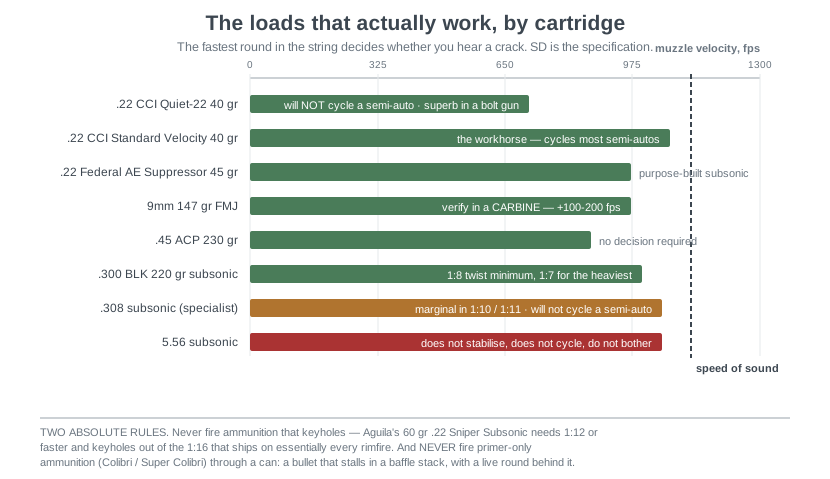
You will buy one suppressor and shoot ten thousand rounds through it. The suppressor is a fixed choice made once; the ammunition is a choice you make every time, and it has more influence over what you actually hear than any difference between two good cans.
This volume is the ammunition side of the whole dive, cartridge by cartridge, plus the two rules that are absolute.
9.1 The Sound Barrier Is a Moving Target
The speed of sound is about 1,125 fps at sea level at roughly 20 °C, and it rises with temperature — approximately 1.1 fps per °F. It does not depend meaningfully on pressure or altitude in the way people assume; temperature is the dominant term.
Practical consequences:
- A load chronographing 1,080 fps in January is comfortably subsonic. The same load in July, out of a hot barrel, on a 90 °F day, may not be.
- The industry’s ~1,080 fps subsonic labelling is a margin, not a threshold. It exists for exactly this reason.
- Chronograph in the gun you will shoot, in the season you will shoot it. A 16-inch PCC barrel adds 100–200 fps over a pistol; a long rifle barrel adds more still.
- If a load is borderline, treat it as supersonic. You will hear it if you are wrong.
9.2 The Loads, By Cartridge
9.2.1 .22 LR
Table 1 — .22 LR
| Load | Velocity | Cycles a semi-auto? |
|---|---|---|
| CCI Standard Velocity 40 gr | ~1,070 fps | Yes — the workhorse |
| CCI Suppressor 45 gr HP | Subsonic | Generally |
| Federal AE Suppressor 45 gr | Subsonic | Generally |
| CCI Quiet-22 Semi-Auto 45 gr | Subsonic | Engineered to |
| CCI Quiet-22 40 gr | ~710 fps | No. Single-shot only, and dramatically quieter |
| CCI Clean-22 | Standard/high velocity variants | Polymer coated — up to 60% less suppressor lead fouling by CCI’s claim |
Standard velocity is already subsonic; you do not need a “suppressor” label to get there, and the label mostly buys you a heavier hollow point.
9.2.2 9mm
147 grain. That is the answer. 115 gr is supersonic, 124 gr is borderline, 147 gr is subsonic in essentially every barrel and is widely available in cheap FMJ. Verify in a carbine.
9.2.3 .45 ACP
Anything. Standard 230-grain runs 830–900 fps and is subsonic by design accident. This is the only cartridge in the dive with no ammunition decision to make.
9.2.4 .300 Blackout
Subsonic: 190–220 grain, around 1,000 fps. Requires 1:8 twist or faster; 1:7 for the heaviest. Supersonic 110–125 gr exists and is a completely different zero.
🔴 A .300 Blackout round will chamber in a 5.56 rifle and destroy it. The mitigation is three layers, not one: colour-code the magazines, colour-code the magazine wells to match, and never store the ammunition or the magazines in the same boxes. Coding the wells is the layer most people skip and the one that does the work — it turns the check into “do these two colours agree?” rather than “which rifle is this?” Volume 5 §5.2.1. This is the most dangerous item in this entire dive.
9.2.5 NATO
There is no useful subsonic 5.56. Do not go looking for one. See Volume 4.
9.2.6 7.62×39, .308, 6.5 Creedmoor, .300 Win Mag
Supersonic in all normal use. Subsonic .308 exists as a specialist item — heavy bullets, reduced loads, marginal stability in the common 1:10 and 1:11 twists, and it will not cycle a semi-auto. It works in a bolt gun; .300 Blackout does the job better.
9.2.7 .22 WMR / .17 HMR
Supersonic, no meaningful subsonic option, and the .17 HMR in particular stays loud. A can is a comfort device on both.
9.3 Twist Rate Is a Suppressor Problem
Ordinarily twist rate is an accuracy question. Behind a suppressor it becomes a hardware survival question, because an unstable bullet does not travel along the bore axis and a bullet not travelling along the bore axis can hit a baffle.
The general rule: subsonic means heavy means long means fast twist. A bullet’s stability requirement is driven by its length, and heavy-for-caliber subsonic bullets are long.
Table 2 — 9.3 Twist Rate Is a Suppressor Problem
| Cartridge | Standard twist | Subsonic needs |
|---|---|---|
| .22 LR | 1:16 | 1:16 fine for standard weights; 1:12 or faster for 60 gr |
| .300 BLK | 1:8 | 1:8 minimum, 1:7 for 220 gr+ |
| .308 | 1:10 / 1:11 | 1:8 or faster for heavy subsonic |
| 9mm | 1:10 | Not a practical constraint |
Verify on paper before you verify in a baffle stack. Shoot the load unsuppressed at 25 yards at a clean target. Round holes: proceed. Oval or sideways holes: stop, and do not put that load through a can. This test takes five minutes and prevents the most expensive failure mode in the sport.
9.4 The Two Absolute Rules
Carried from the .22 Rimfire dive and from How Suppressors Work Volume 10, because they are the two ways ammunition destroys a suppressor.
Never fire ammunition that keyholes. The canonical case is Aguila’s 60-grain .22 Sniper Subsonic, which requires 1:12 twist or faster and keyholes out of the 1:16 that ships on essentially every rimfire made. A yawing bullet in a baffle stack is a baffle strike waiting for a trigger pull.
Never fire primer-only ammunition through a can, ever. Aguila Colibri and Super Colibri carry no powder charge at all — roughly 20 grains at 500–590 fps on priming impulse alone — and there are repeated, consistent reports of bullets stopping partway down a rifle barrel. A stalled bullet in a bore is a serious problem. A stalled bullet in a baffle stack, with a live round behind it, is a destroyed suppressor and possibly a destroyed gun. There is no version of this that is worth trying.
9.5 Fouling: What the Ammunition Leaves Behind
Table 3 — 9.5 Fouling: What the Ammunition Leaves Behind
| Ammunition | What it deposits | Consequence |
|---|---|---|
| Unjacketed lead .22 with wax lube | Lead, wax, heavy carbon | The worst. Service every 300–500 rounds |
| Polymer-coated .22 (CCI Clean-22) | Much less lead | Roughly doubles the service interval |
| Cast / plated pistol bullets | Lead, heavy carbon | Service a pistol can regularly |
| Jacketed pistol (FMJ) | Carbon, some copper | Much cleaner |
| Jacketed rifle, supersonic | Carbon, copper traces | Effectively self-clearing |
| Steel-cased, dirty surplus | More carbon, more residue | Cosmetic on a rifle can; real on a PCC |
The single best fouling decision available to a rimfire can owner is polymer-coated ammunition, and it costs nothing but a different box.
9.6 Handloading for Suppressed Use
Reloading is where a suppressed shooter gets the most control, and it is a natural fit for anyone already loading centerfire.
What you are trying to do: land velocity in a narrow window below the sound barrier, with enough consistency that the fastest round in the string is still subsonic, and enough energy to cycle the action if the host is a semi-auto.
What makes it harder than normal handloading:
- Consistency matters more than average. A 1,020 fps average with 40 fps of extreme spread means some rounds are at 1,060. That is fine. A 1,080 average with the same spread means some rounds crack. Standard deviation is the specification.
- Reduced loads have their own hazards. Very light charges of some slow powders in large cases carry a genuine and documented risk of detonation-type pressure excursions. Use published subsonic load data from a reputable manual; do not extrapolate downward from a supersonic load.
- Powder selection is specific. Subsonic loading generally wants fast-burning powders with good position-insensitivity, and the published data reflects that.
- A gas check or a suitable jacketed/coated bullet matters for lead-bullet subsonic loads.
And the specific note for anyone loading subsonic: verify stability on paper (§9.3) before the load ever goes near the can.
9.7 Ablatives
A few cc of water, wire-pulling gel or ultrasound gel in the blast chamber. The mechanism is energy absorbed by vaporisation, plus displacement of the oxygen that causes first-round pop.
- Genuinely effective, particularly on first-round pop, which is the shot that matters if signature is the point.
- Short-lived — a handful of shots.
- Messy, and it will drain out if the can points down.
- Appropriate in rimfire and pistol use. Inappropriate and pointless in a hot rifle can.
Nothing about an ablative is exotic or improper; it is simply a consumable you are spending to buy a few dB you did not have room to engineer in.
Comments (0)