Suppressors by Caliber · Volume 1
Overview — How to Choose, and the One-Can Fallacy
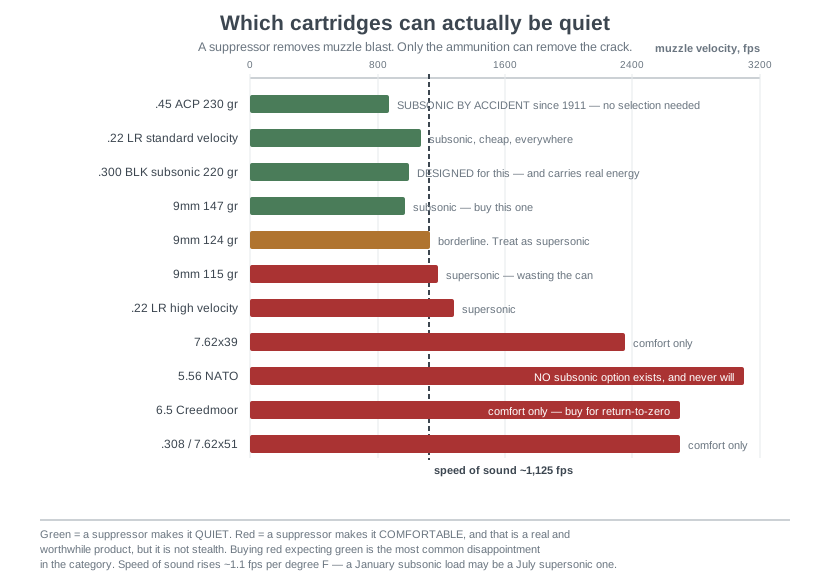
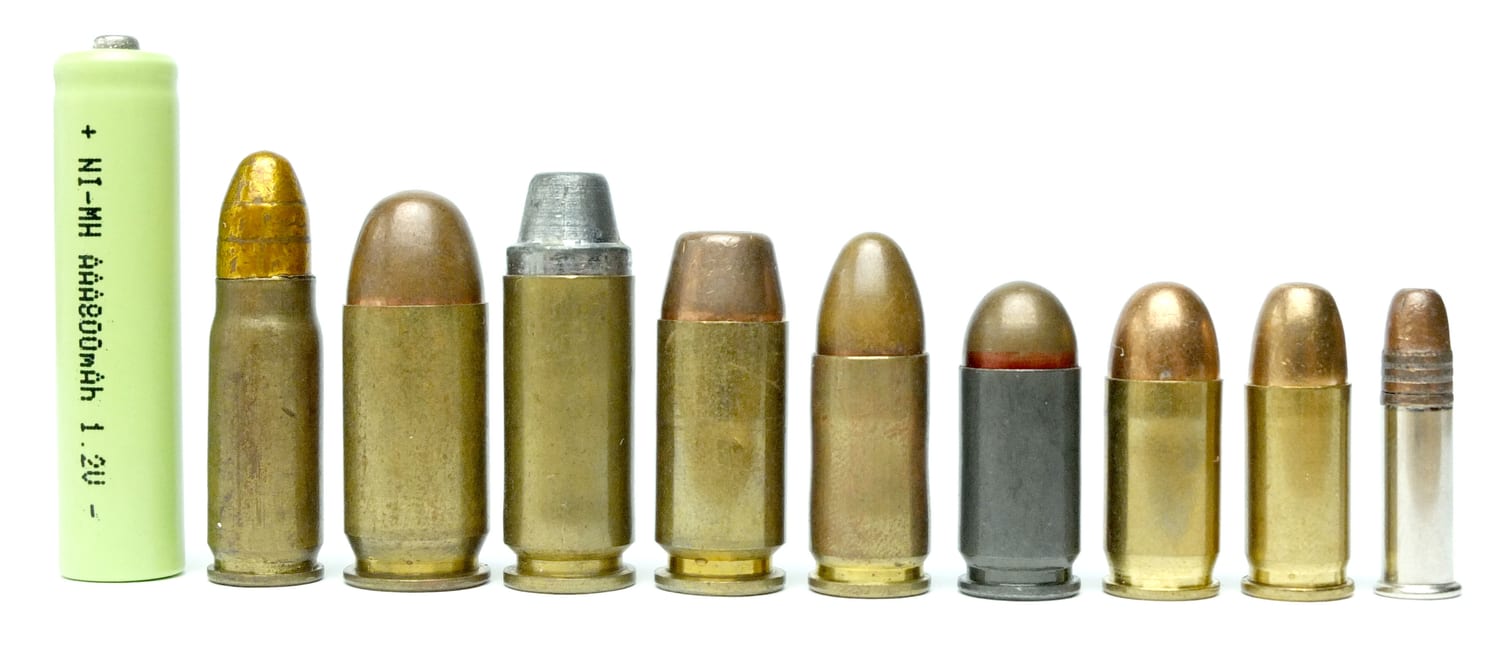
This dive turns the engineering in How Suppressors Work into purchases. It goes cartridge by cartridge through the calibers that actually matter in a typical mixed battery — .22 LR, 5.56 NATO, the 7.62 family, 9mm, .45 ACP, and 6.5 Creedmoor — and ends with a plan for the smallest set of cans that covers all of them.
It is also, deliberately, a snapshot. The law dive explains why: the federal transfer tax went to $0 on 1 January 2026, and the resulting demand — combined with additive manufacturing on the supply side — has the trade press calling 2026 “the year of the suppressor.”1 Prices are falling, new entrants are arriving, and any specific model recommendation written today has a shelf life. The framework is durable; the model names are not.
1.1 The Question That Comes First
Before any of the cartridge chapters, one question decides most of the outcome:
Are you buying quiet, or are you buying comfortable?
They are different products and they sort by ammunition, not by suppressor.
Quiet requires subsonic ammunition, because the ballistic crack is untouchable (How Suppressors Work, Volume 2). Only some cartridges can go subsonic with useful performance. For those, a suppressor is transformative: the gun becomes genuinely quiet, hearing protection becomes optional, and the whole character of shooting it changes.
Comfortable is what you get with supersonic ammunition. The blast is gone, the concussion is gone, the recoil is down 20–30%, the flash is gone, and your ears and your neighbours are enormously better off — but there is still a crack, and it is a loud one. This is a real and worthwhile product. It is not stealth, and buying it expecting stealth is the most common disappointment in the category.
Table 1 — 1.1 The Question That Comes First
| Cartridge | Natively subsonic? | What a can buys you |
|---|---|---|
| .22 LR | Yes, with the right load (~1,070 fps and below) | Quiet. The best in the category |
| .45 ACP | Yes, inherently — 230 gr runs ~830–900 fps | Quiet. No load selection needed |
| 9mm | With 147 gr; not with 115 gr | Quiet, if you buy the right box |
| .300 Blackout | Yes — designed for it | Quiet, and with real energy |
| 7.62×39 | Not practically | Comfortable |
| .308 / 7.62×51 | Specialist subsonic loads exist; marginal | Comfortable (mostly) |
| 6.5 Creedmoor | No | Comfortable |
| 5.56 NATO | No, and it never will be | Comfortable, and that is all |
That table is the whole dive in miniature. Everything else is detail.
1.2 The One-Can Fallacy
The most attractive idea to a first-time buyer, and the one that costs the most money in the end, is: buy one big can that is rated for everything, and use it on every gun.
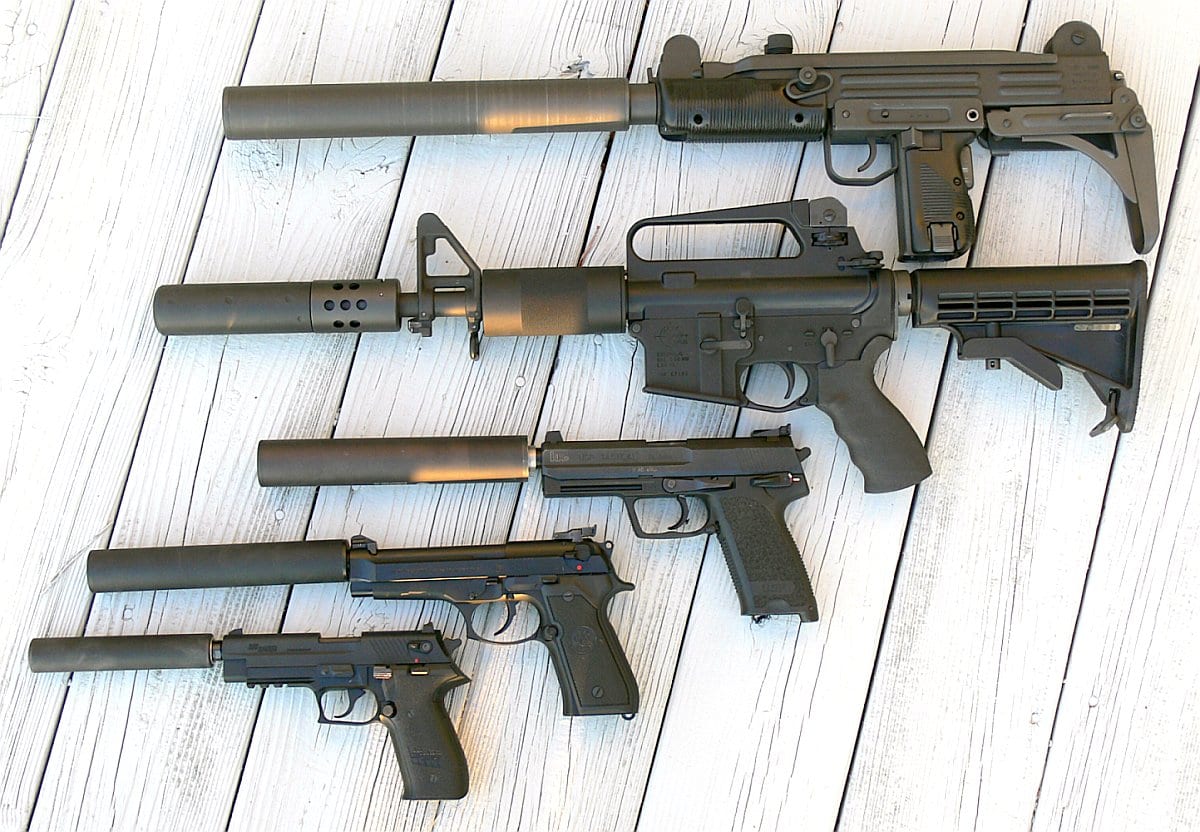
It is not wrong. A .30-caliber rifle can rated for .300 Win Mag will physically and safely work on 5.56, .300 BLK, 7.62×39, .308 and 6.5 Creedmoor. It will even work on a 9mm carbine. That is genuinely useful, and for a first purchase it is often the right call.
Here is what it costs:
Over-bore costs decibels. Every thousandth of clearance between the bullet and the end cap aperture is gas escaping forward instead of being trapped. A .30-cal can on a 5.56 rifle is measurably louder than a 5.56-bore can of the same size. A .45 can on a 9mm is likewise. This is a real, consistent, and unfixable penalty — except by interchangeable end caps, which some cans offer and which are the cheapest decibels available anywhere.
Rating up means weight up. A can rated for .300 Win Mag through a 16-inch barrel carries the material to survive .300 Win Mag through a 16-inch barrel, on every gun you put it on, including the .22.
Bore diameter is a one-way door. You can put a big can on a small cartridge. You cannot put a small can on a big one, and the attempt destroys the can and possibly the rifle. 1/2×28 fits both a .22 and a 5.56 barrel — the threads say nothing about the bore.
And rimfire is separate no matter what. A rimfire can must be user-serviceable (Volume 3, and How Suppressors Work Volume 6). Sealed centerfire rifle cans are not. You can legally and safely fire .22 LR through a .223 can — people do, and it works — but you are depositing lead and wax in a can you cannot open. Do it occasionally; do not make it the plan.
The honest resolution: the correct number of cans is usually two or three, not one and not eight. Volume 10 works out which two or three.
1.3 What Actually Decides the Purchase
Ranked by how much they should influence you:
- The ammunition you will actually shoot. Subsonic or supersonic decides what product category you are in.
- The host, and whether it is gas-operated. A bolt gun tolerates any can. An AR-15 you shoot a lot cares enormously about backpressure (How Suppressors Work, Volume 8).
- The mounting ecosystem. In 2026 the answer is 1.375×24 HUB on anything centerfire. Do not marry a proprietary mount.
- Length, then weight. Length is where suppression comes from. Weight is what you will actually notice.
- Serviceability, which is decided entirely by whether it is rimfire.
- Material and rating, which are the same question (Volume 4 of the engineering dive).
- Price, which in 2026 matters less than it did in 2024 and is falling.
- Published decibels, which should not influence you at all. See §1.5.
1.4 A Note on Thread Pitch
Every cartridge chapter assumes the host is threaded. The standard pitches:
Table 2 — Every cartridge chapter assumes the host is threaded. The standard pitches
| Cartridge | Usual thread |
|---|---|
| .22 LR | 1/2×28 |
| 5.56 / .223 | 1/2×28 |
| 9mm pistol (domestic) | 1/2×28 |
| 9mm carbine | often 1/2×36 |
| .45 ACP | .578×28 |
| .308 / 7.62×51, 6.5 Creedmoor, .300 Win Mag | 5/8×24 |
| .300 Blackout | 5/8×24 |
| 7.62×39 (AK pattern) | M14×1 LH, sometimes M13.5×1 LH |
If a host is not threaded, it can be — that is a lathe job, and it must be indicated off the bore, not the outside of the barrel. How Suppressors Work Volume 7 covers why, and Volume 10 covers what happens when it is done wrong.
1.5 The Decibel Warning, Restated
This dive names models and reports figures. It never compares a decibel number from one manufacturer to a decibel number from another, because that comparison is meaningless: different labs, meters, distances, positions, weightings and standards, on a logarithmic scale.
Where a number is comparable, it is because it comes from a single testing house measuring everything the same way — which in practice means PEW Science and its Suppression Rating.2 Those figures are host-specific, and this dive quotes them with the host attached or not at all.
The other honest caveat: most published “best suppressors of 2026” material is retailer content. It is commercially motivated, it recycles itself, and it is frequently written by people who have not fired the products. The model information in this dive is drawn from that literature and is therefore reported as reported. Anything that would actually change a purchase should be checked against PEW Science, a rental, or your own meter.
1.6 What Follows
Volume 2 is sizing — pistol cans versus rifle cans, why length beats diameter, modularity, and how much weight you can actually live with.
Volumes 3 through 8 are the cartridges, one at a time: .22 LR (including the specific question of what to do about a Mack Brothers Lima), 5.56, the 7.62 family (and a note on the 7.63×25 Mauser, which is a different cartridge and gets its own answer), 9mm, .45 ACP, and 6.5 Creedmoor and precision rifle work.
Volume 9 is ammunition — the subsonic loads that actually work in each cartridge, twist requirements, and the two things never to fire through a can.
Volume 10 is the plan: a decision matrix, and a worked recommendation for an example mixed battery.
1.7 Bibliography
Footnotes
-
The Truth About Guns, “[SHOT 2026] The Year of the Suppressor.” https://www.thetruthaboutguns.com/shot-2026-the-year-of-the-suppressor/ ↩
-
PEW Science, Suppression Rating™. https://pewscience.com/silencer-sound-standard-suppression-rating ↩
Comments (0)