Suppressors by Caliber · Volume 8
6.5 Creedmoor and Precision Rifle — Where Repeatability Beats Decibels
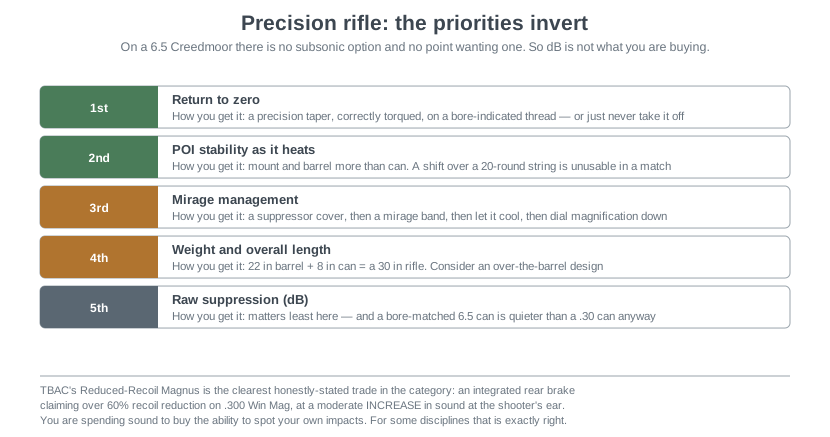
Everything in this dive so far has been about making guns quieter. Precision rifle work is the one place where that is not the first priority. On a 6.5 Creedmoor shot at distance, the questions that matter are does it return to zero, does it hold point of impact as it heats, and can the shooter still see the target through the mirage — and the decibel number is a distant fourth.
8.1 Why the Priorities Invert
There is no subsonic option and there is no point wanting one. 6.5 Creedmoor exists to push a high-BC .264 bullet at 2,700 fps and hold it supersonic past 1,200 yards. Slowing it down destroys the entire reason for the cartridge. So the ballistic crack is permanent, and everyone within a wide arc will hear it.
What you are buying is therefore, definitively, the comfort product from Volume 1:
- Blast and concussion gone, which on a braked magnum is a transformative change — a braked rifle is genuinely hostile to shoot next to.
- Recoil down, meaningfully, which on a precision rifle means better spotting of your own impacts. This is a real competitive advantage, not a comfort feature.
- Flash gone.
- Hearing preserved, over strings of hundreds of rounds.
But the reason a precision shooter chooses one can over another is almost never the dB. It is the mechanical behaviour.
8.2 The Three Things That Actually Matter
Return to zero. Take the can off, put it back on, and the rifle must shoot where it did. A repeatable one-MOA offset is fine; an unrepeatable quarter-MOA one is not. This is a function of the mount: a precision taper, correctly torqued, on a correctly threaded barrel. Direct thread is the most repeatable interface there is, which is why plenty of precision shooters simply leave the can on and never take it off — the most repeatable mount is the one you never disturb.
Point-of-impact stability as it heats. A can that shifts as it warms over a twenty-round string is unusable in a match. This is partly the can and mostly the mount and the barrel.
Mirage management. The one that costs actual shots. Hot air rising off a hot suppressor sits directly in a high-magnification sight line. At 20× over a hot can, the target boils and appears to move upward. Fixes, in order: a suppressor cover, a mirage band stretched over the barrel and can, letting it cool, and dialling magnification down. The precision-rifle world regards a mirage band as standard equipment; hunters buying their first can in 2026 mostly have not heard of one. (How Suppressors Work Volume 9 covers this in full.)
8.3 Weight, Balance, and Whether You Are Carrying It
The precision world splits hard here, and the split is between two hobbies that use the same rifle.
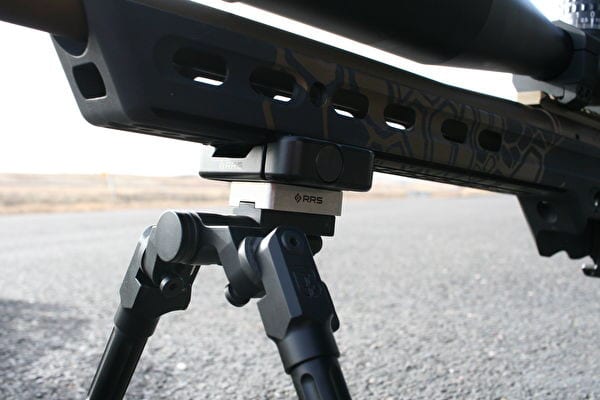
Match shooting from a bipod or a bag. Weight at the muzzle is nearly free and is arguably a benefit — it damps, it steadies, and nothing is carrying it. Buy the biggest, quietest can that clears your barricade.
Mountain hunting with a 6.5 Creedmoor. Every ounce is carried uphill all day, and the overall length matters in a pack and in a truck. This is titanium’s whole reason for existing, and it is the strongest case in the dive for an over-the-barrel design — a hunting rifle with a 22- or 24-inch barrel becomes a 30-inch-barrel-equivalent object with a conventional can, and a reflex can gives three to five inches of that back (Volume 2 §2.4, §2.7).
8.4 The Thunder Beast Reference Point
TBAC is the name that comes up first in precision circles, and its two lines illustrate the trade cleanly:
Ultra — the light line, built for carrying. The compromise is suppression.
Magnus — TBAC’s attempt at the lowest sound levels achievable in a titanium rifle can. On a 6.5 Creedmoor the Magnus is reported to measure under 112 dB at the shooter’s ear, and is described as significantly better-suppressing than the Ultra 9 Gen2.1 Note the measurement position is stated — at the ear — which is the only responsible way to quote such a figure, and it is still TBAC’s protocol and not comparable to anyone else’s.
Magnus Reduced-Recoil variants add an integrated rear brake, claiming over 60% recoil reduction on .300 Win Mag, at a moderate increase in sound at the shooter’s ear.1 That is the clearest example in the entire dive of a manufacturer stating a trade honestly: you are spending sound to buy recoil. For a magnum that gets shot from a bipod where spotting your own impact is the point, that can be exactly the right purchase.
8.5 The Rest of the 2026 Field
Reported positioning, with the standing caveats about retailer-sourced material:
Table 1 — 8.5 The Rest of the 2026 Field
| Can | Reported | Notes |
|---|---|---|
| Thunder Beast Magnus | — | Suppression-first titanium; CB / SR / HUB mount variants |
| Thunder Beast Ultra | — | Weight-first; the carrying can |
| FOR Systems Predator 6.5 | 8.8 in, 11.4 oz bare | Dedicated 6.5-bore — bore-matched, which is where the free decibels are |
| Energetic Armament LUX 6.5 | 8.9 oz | Very light; covers 6.5 Creedmoor and 6.5 Grendel |
| Dead Air Sandman-X | — | Additive manufacture in Haynes 282, full-auto rated. The durability answer |
| HUXWRX .30-cal flow-through | — | If the host is a gas gun rather than a bolt gun |
The bore-diameter point is worth pulling out. A dedicated 6.5-bore can — the Predator and the LUX are examples — is quieter on 6.5 Creedmoor than a .30-bore can of the same size, because the annulus around the bullet is smaller. If the rifle is a dedicated 6.5, that is real, free suppression. If the can also has to serve a .308, you need .30 bore and you pay the over-bore penalty on the 6.5. This is the one place in the dive where buying caliber-specific is clearly correct rather than merely defensible.
8.6 Competition Rules
A suppressor is, mechanically, also a muzzle brake — it decelerates gas that would otherwise leave as a recoil-producing jet. Different disciplines treat that differently, and rules change.
- Some PRS-style and NRL divisions permit suppressors freely; some regulate muzzle devices; some have weight limits a can pushes you over.
- Some ranges and clubs restrict suppressor use for reasons that have nothing to do with competition rules.
- Hunting regulations vary by state — Michigan permits suppressor use for hunting, but Connecticut and Vermont permit ownership while restricting hunting use, and eight states plus DC prohibit ownership outright. The law dive has the current picture.
Check before you buy, not after. This is the cheapest possible piece of due diligence and the one most often skipped.
8.7 A Worked Example: Two .308 Precision Rifles
Everything above is written for 6.5 Creedmoor, but the priorities it describes apply unchanged to .308 precision rifles — and the two in the example battery used in this dive are a useful pair, because they want opposite things.
The Ruger Precision Rifle .308 is the straightforward one. Threaded 5/8×24 from the factory, wearing a brake that a suppressor should replace, and a bolt action — so the backpressure question does not exist and you buy purely for suppression and return-to-zero. Direct thread it, zero it suppressed, and record the offset. The only real cost is length: 20 in of barrel plus 8 in of can is a 28 in barrel-equivalent rifle at 9.8 lb.
The home-built M40A1 clone is the one where the answer was never technical. It is a replica of a specific rifle, and the pattern’s muzzle is bare — so threading it traded the last of its clone fidelity for a suppressor mount. That trade has been made: the muzzle is threaded 5/8×24, cut by the builder. Volume 5 §5.4 records it. What matters here is only that the can now has two .308 hosts rather than one.
Both are supersonic-only behind a can. Neither twist rate supports heavy subsonic .308 (Volume 5 §5.4), so neither rifle is a “quiet” proposition; both are comfort-and-concussion propositions, and on a full-power .308 that is worth a great deal.
One can serves both, provided the clone’s muzzle is threaded 5/8×24 as in the Volume 5 example — which is another argument for buying the .30-calibre can once, and buying it well.
8.8 The Recommendation
For a 6.5 Creedmoor precision rifle:
- If it is a dedicated 6.5 that lives on a bipod: a 6.5-bore, suppression-first titanium can, direct thread, left on the rifle, zeroed once. Buy a cover and a mirage band with it.
- If it also has to serve a .308 or a magnum: .30 bore, rated to .300 Win Mag, HUB mount, and accept the over-bore penalty on the 6.5.
- If you carry it hunting: the lightest titanium can that meets the rating, and give serious thought to an over-the-barrel design.
- If you shoot it in matches: check the division rules first, and consider whether a reduced-recoil variant’s trade — sound for spotting ability — is the right one for your discipline.
- In every case: zero suppressed, record the offset, and treat return-to-zero as the specification that matters most.
8.9 Bibliography
Footnotes
-
Thunder Beast Arms Corporation, Magnus — designed for the lowest sound levels achievable in a titanium rifle suppressor; reported under 112 dB at the shooter’s ear on 6.5 Creedmoor; suppression significantly better than the Ultra 9 (Gen2). Reduced-Recoil variants add an integrated rear brake claiming over 60% recoil reduction on .300 Win Mag with a moderate increase in at-ear sound. https://thunderbeastarms.com/products/magnus ; https://www.capitolarmory.com/thunder-beast-magnus.html ↩ ↩2
Comments (0)