Suppressors by Caliber · Volume 4
5.56 NATO — The Hardest Common Host
5.56 is the cartridge most people suppress first and the one a suppressor helps least. Not because the cans are bad — 5.56 cans are the most developed products in the category — but because the cartridge itself is uncooperative in three separate ways at once.
Understanding why is worth more than any model recommendation, because it sets the expectation that decides whether you are happy with the purchase.
4.1 The Three Problems
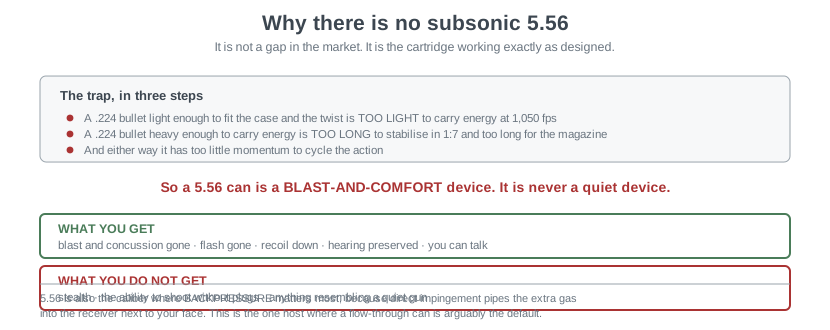
Problem one: there is no subsonic 5.56, and there never will be. The bullet is too light. A 55- or 62-grain .224 projectile slowed to under 1,100 fps has almost no energy, and — the killer — a 1:7 or 1:8 twist barrel spinning a short bullet slowly does not produce reliable stability. Heavy-for-caliber subsonic .224 loads exist as a curiosity; they do not cycle an AR, they do not stabilise reliably, and they do not do anything a .300 Blackout does not do better. The bullet was designed to be fast. Slowing it down removes its reason to exist.
Consequence: a 5.56 can removes muzzle blast and leaves ballistic crack. It is a comfort device. It is not, and cannot be, a quiet device.
Problem two: high pressure, high gas volume, short dwell. 5.56 runs at high chamber pressure with a fast powder and, in carbine and SBR lengths, a great deal of it is still burning at the muzzle. That is a hard thermal and erosive environment, and it gets dramatically harder as the barrel gets shorter.
Problem three: direct impingement. The AR-15 gas system taps bore pressure and pipes it into the receiver, which is next to your face. Add a suppressor and you raise muzzle pressure, which raises the gas the port sees, which sends more of it back down the tube. This is why suppressed AR shooters come home sooty. How Suppressors Work Volume 8 covers the mechanism and the fixes in full.
4.2 What You Are Actually Buying
Set expectations honestly and a 5.56 can is a genuinely excellent purchase:
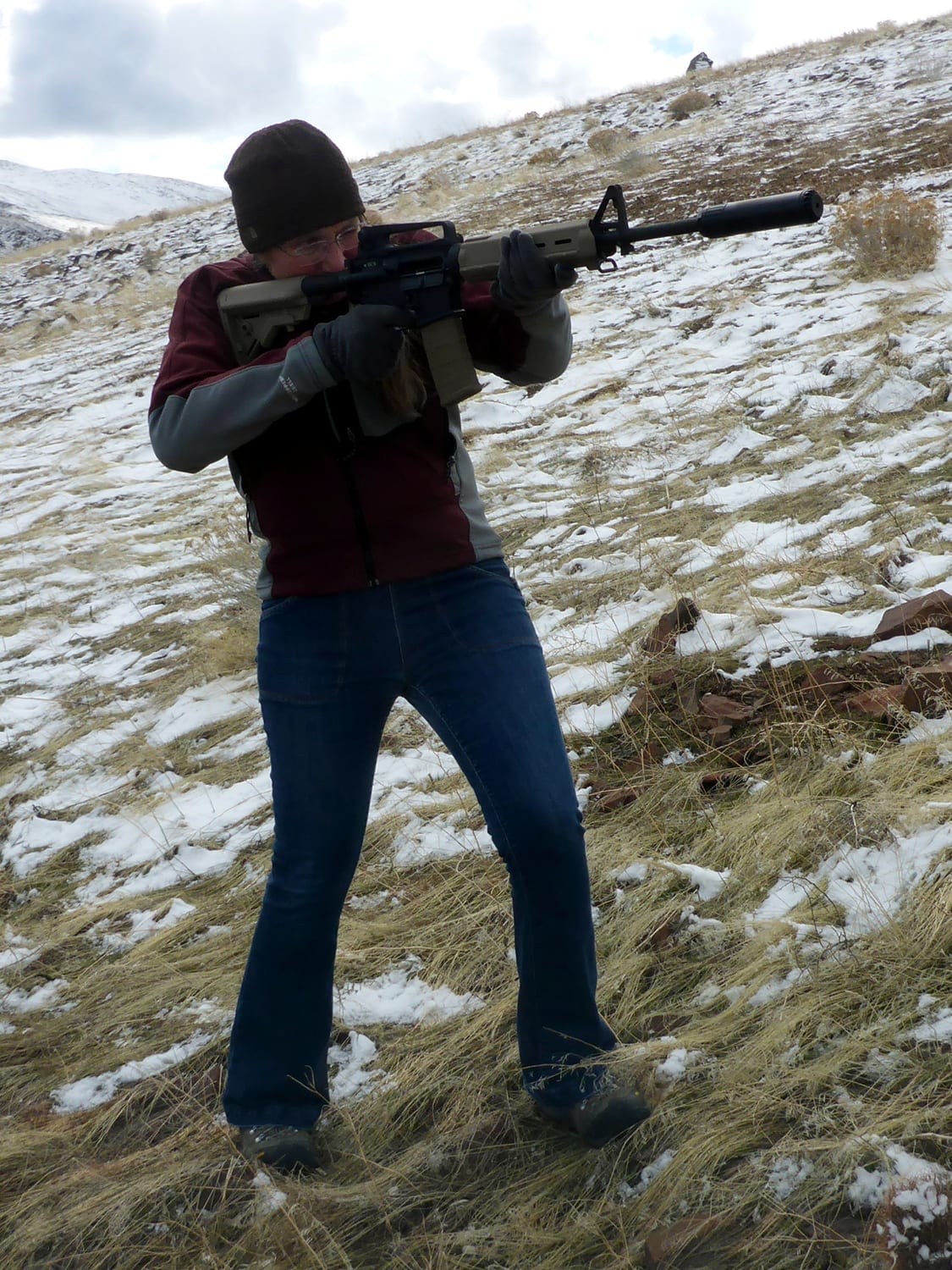
- Blast and concussion go away. The sharp, painful, percussive slap at the muzzle — the part that makes an SBR unpleasant to stand next to and that rattles a shooting bay — is gone. This is a much bigger quality-of-life change than the decibel number implies.
- Flash goes away, essentially completely.
- Recoil drops by a meaningful fraction.
- Your hearing is enormously better off, and so is everyone within fifty yards.
- Communication becomes possible at a distance where it was not.
What you do not get: stealth, or the ability to shoot without hearing protection. A suppressed 5.56 rifle is still above the threshold at which hearing damage accumulates. Wear plugs.
4.3 Backpressure Is the Deciding Variable
More than in any other cartridge, the 5.56 buying decision turns on backpressure, because the host makes it your problem.
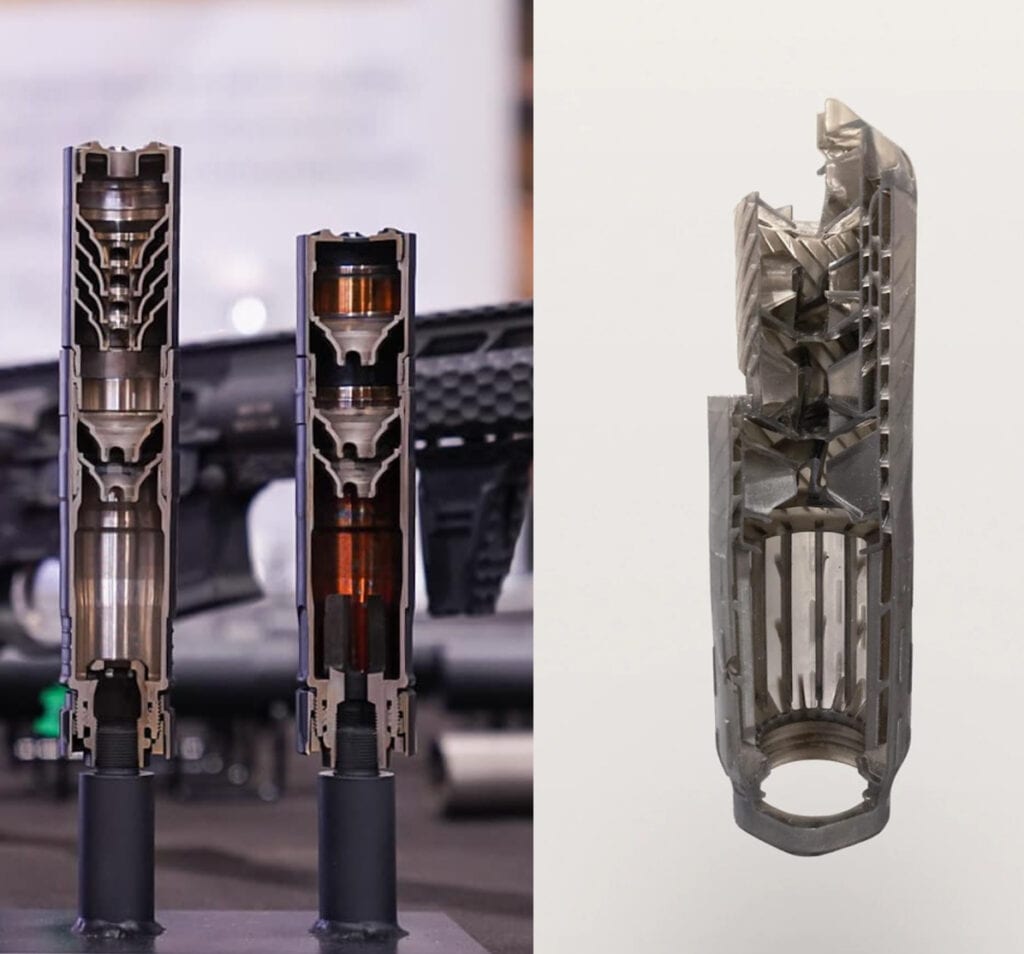
This is the caliber where flow-through and low-backpressure designs matter most. The HUXWRX FLOW series exists for this exact case: a printed monolithic core that routes gas forward instead of trapping it, so far less comes back down the gas tube.1 The trade — less muzzle-position suppression for a given size — is the right trade on a semi-auto AR that you shoot in volume, because much of what you hear as the shooter is gas venting out of the receiver beside your ear anyway.
If you prefer a conventional sealed can for the extra suppression, then tune the rifle instead: adjustable gas block first, heavier buffer second, gas-deflecting charging handle third. An adjustable gas block on a suppressed AR is the single most effective hundred dollars in the whole system.
4.4 Barrel Length Changes Everything
A 5.56 can on a 20-inch rifle and the same can on a 10.5-inch SBR are being asked to do very different jobs.
Table 1 — 4.4 Barrel Length Changes Everything
| Barrel | What reaches the can | Practical consequence |
|---|---|---|
| 20 in | Most propellant burnt, moderate residual pressure | Easy on the can; titanium is fine; quietest of the three |
| 16 in | The common case | Fine for any rated can |
| 10.5–11.5 in | Large unburnt fraction, high residual pressure, extreme blast | Requires a can rated for it. Superalloy blast baffle territory |
The minimum barrel length rating is not a formality — it is the materials statement described in How Suppressors Work Volume 4. A titanium can rated to 16 inches, run on a 10.5-inch SBR, is being asked to absorb an event it was not designed around, and titanium’s response to that is silent, permanent erosion.
An SBR is also the configuration where a can most obviously earns its place: 10.5 inches of barrel plus 6 inches of suppressor is about the overall length of an ordinary carbine, and it is far quieter than the bare SBR, which is one of the most unpleasant guns to stand next to in common use. Both SBRs and suppressors had their federal transfer tax go to $0 on 1 January 2026 — see the law dive.
4.5 The 2026 Field
Reported positioning, with the standing caveat that most of this literature is retailer content and that Suppression Ratings are host-specific and not interchangeable with anyone’s dB figures.
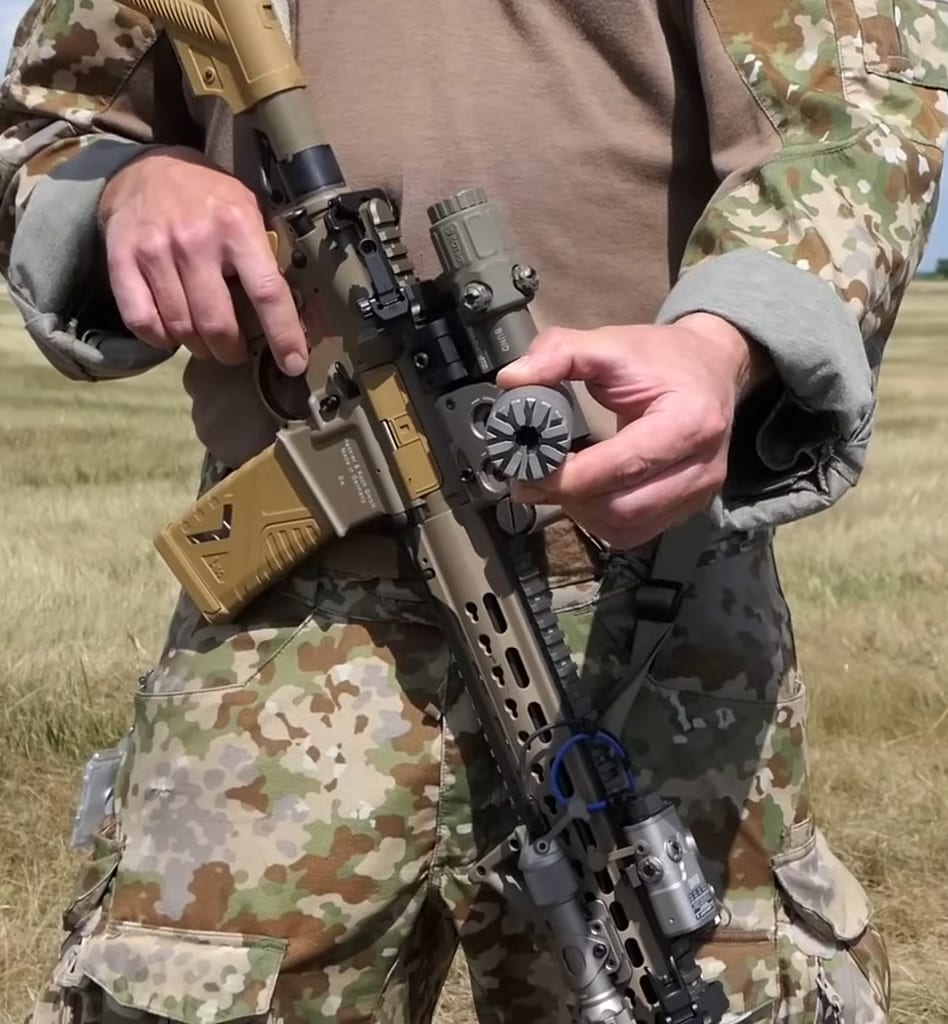
Table 2 — 4.5 The 2026 Field
| Can | Notes |
|---|---|
| HUXWRX FLOW 556 Ti | The reference low-backpressure can. Titanium, printed flow-through core. Reported PEW Suppression Ratings 41.3 on an MK18 and 41.1 on an M4A1 — unusually consistent across hosts |
| SAW Tisha Titanium | Reported 49.6 on an MK18, described as the highest 5.56 Suppression Rating measured. Sealed-baffle, suppression-first |
| SureFire RC2 | Duty-grade, Inconel baffles, the hard-use standard. Heavy, and unbothered by anything |
| Dead Air Sandman / Nomad family | Long-standing all-rounders; the Nomad TI OTB (2026) brings the over-the-barrel idea to 5.56 |
| Dead Air CT5P | New for 2026 — compact duty 5.56, also rated 6 ARC |
| Banish 556 | Inconel core, controlled-flow, retail-channel |
| Ambient Arms EXO 556 | New for 2026. Titanium, 14.5 oz, “Ambient Intake System” claiming up to 75% lower operating temperature; reported ~130 °F exterior after 40 rounds |
| Lyman Sonicore Rekkr / Paradox | ~$299 printed, including over-the-barrel variants. The new price floor |
Typical envelope for the class: 9–18 oz, adding 5–7 inches.
The FLOW 556 Ti versus SAW Tisha comparison is the clearest illustration of the whole category’s central trade. On the same host, measured by the same house, the sealed-baffle Tisha rates about eight points higher on suppression. The flow-through FLOW gives that up and returns a dramatically cleaner, cooler, less-gassy rifle. Neither is the right answer in general. The Tisha is right for a bolt gun or a rifle shot deliberately; the FLOW is right for a carbine you run hard.
4.6 Choosing, in Four Questions
- What barrel length? Under 14.5 in → the rating is the first filter, and superalloy is not optional.
- How much do you shoot it, and where? High round count or indoors → low backpressure, and read How Suppressors Work §8.2 on toxic exposure before deciding.
- Is this can only for 5.56? If yes, buy 5.56-bore for the decibels. If it will also serve a .308, buy a .30-cal can and accept the over-bore penalty on 5.56 (Volume 5).
- HUB? Yes. Always, on anything centerfire.
4.7 The Honest Recommendation
For an AR-15 shot regularly, in 2026, the defensible default is a HUB-mount low-backpressure titanium can, plus an adjustable gas block on the rifle. That combination fixes the actual complaint people have about suppressed ARs — the gas, the fouling and the heat — rather than chasing the last three decibels off a sound you cannot eliminate anyway, because the crack is still there and always will be.
If the rifle is a bolt gun, a varmint rifle, or something shot deliberately rather than in volume, invert that: buy the sealed-baffle can with the highest suppression you can carry, and ignore this volume’s backpressure argument entirely.
4.8 Bibliography
Footnotes
-
HUXWRX Flow-Through® technology and the FLOW 556 series. https://huxwrx.com/ ; Silencer Shop, “HuxWrx Suppressors Buying Guide.” https://www.silencershop.com/huxwrx-buying-guide ↩
Comments (0)