Suppressors by Caliber · Volume 5
The 7.62 Family — One Can, and Two Common .308 Cases
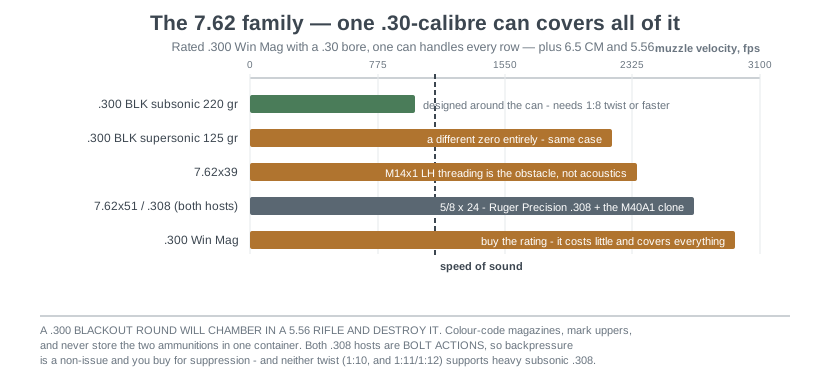
“7.62” is not one cartridge. It is a bullet diameter shared by several very different rounds, and the good news for a suppressor buyer is that one .30-caliber can covers essentially all of them. This is the single highest-leverage purchase in the whole category, and it is the reason a .30-cal rifle can is the right first centerfire suppressor for most people.
5.1 The Family
Table 1 — 5.1 The Family
| Cartridge | Also called | Case | Typical velocity | Subsonic option? |
|---|---|---|---|---|
| .300 Blackout | 7.62×35 | 5.56 case necked up | 2,100 fps super / ~1,000 fps sub | Yes — by design |
| 7.62×39 | — | Soviet intermediate | ~2,350 fps | Not practically |
| 7.62×51 NATO / .308 | — | Full-power | ~2,600–2,800 fps | Specialist, marginal |
| .300 Win Mag | 7.62×67 | Magnum | ~2,950 fps | No |
| 6.5 Creedmoor | — | .264 bullet, .30-cal-family case head | ~2,700 fps | No — see Volume 8 |
A can rated for .300 Win Mag with a .30-caliber bore will safely and legally handle every row of that table, plus 6.5 Creedmoor, plus 6mm, plus 5.56, plus 9mm carbines. That is the “one-can” argument in its strongest form, and unlike most such arguments it is largely true.
The cost is the over-bore penalty from Volume 1: a .30 bore around a .224 bullet leaks a lot of gas forward. On 5.56 that is measurable. Cans with interchangeable end caps claw most of it back and are worth seeking out.
5.2 .300 Blackout — The Cartridge Designed Around the Can
Of everything in this dive, .300 Blackout is the one cartridge that exists because suppressors exist.
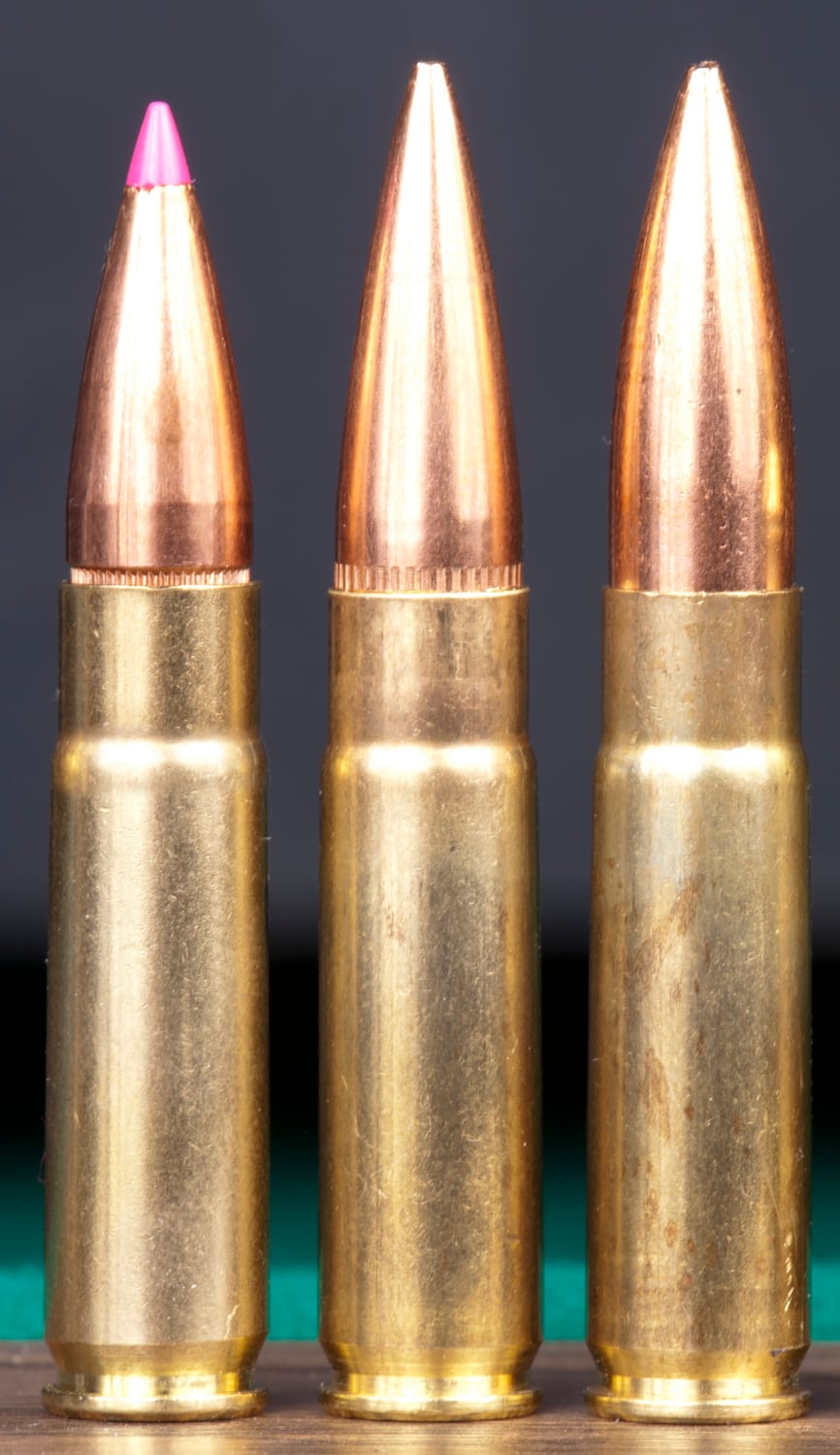
What it is: a 5.56 case necked up to take a .30-caliber bullet, dimensioned to feed from unmodified AR-15 magazines and to run in an AR-15 with nothing changed but the barrel. Bolt, magazines, lower — all the same.
Why that matters acoustically: a .30-caliber bullet can be heavy — 190 to 220 grains — and a heavy bullet at 1,000 fps carries real energy while staying comfortably subsonic. 5.56 cannot do this, because a .224 bullet heavy enough to matter is too long to stabilise and too long to fit the magazine. .300 BLK solved the problem by changing the bullet diameter rather than the platform.1
The result: subsonic .300 Blackout through a good can, especially from a bolt-action or single-shot host, is among the quietest centerfire combinations that exists.2 And it carries more energy than 9mm3 — a 220-grain bullet at 1,000 fps is a genuinely capable projectile at short range, where a 147-grain 9mm at the same velocity is not.
The catches, and they are real:
- Supersonic and subsonic .300 BLK are two different cartridges in one case. Zero, trajectory and point of impact are wildly different. You cannot swap between them casually.
- Cycling an AR on subsonic requires tuning — an adjustable gas block, the right buffer, and usually a pistol-length gas system. Many .300 BLK uppers are sold set up for one or the other.
- Subsonic .300 BLK needs adequate twist. 1:8 or faster for the heavy subsonic bullets; 1:7 for the heaviest. A 220-grain bullet out of a slow twist keyholes, and a keyholing bullet in a baffle stack is How Suppressors Work Volume 10.
- 🔴 A .300 Blackout round will chamber in a 5.56 rifle. It will not fire safely — it is a catastrophic kaboom, and it has destroyed a lot of rifles. This is the most dangerous thing in this dive and it has nothing to do with suppressors. The mitigation this series recommends is a three-layer one, and it is better than the usual advice — see §5.2.1.
5.2.1 The three-layer mitigation
Most published guidance stops at “colour-code your magazines.” That is one layer, and it is the weakest one, because a magazine is a loose object that travels between rifles and gets picked up in a hurry.
A better practice adds the two layers that actually close the gap, and it is worth writing down as the recommendation:
- Colour-code the magazines. The usual advice, and the first thing you see.
- Colour-code the magazine wells to match. This is the layer most people skip and it is the one that does the work — it moves the check from “is this the right magazine?” to “do these two colours agree?”, which is a match you can make without reading anything, in bad light, in a hurry. A coded magazine in an uncoded rifle still requires you to remember which rifle you are holding. Coded wells mean the rifle tells you.
- Never store the ammunition or the magazines in the same boxes. Separation at the source, so the wrong round is not in reach of the wrong magazine in the first place.
Add a fourth if you want belt and braces: mark the upper receivers as well, since on an AR the barrel is the only part that differs and the upper is what carries it.
The general principle is worth stating because it generalises past this cartridge: the reliable safeguards are the ones that do not depend on remembering. Colour agreement is a perceptual check; recalling which rifle takes which round is a memory check, and memory is what fails when you are cold, rushed or talking to someone.
5.2.2 Nine inches is not a compromise — it is the design point
.300 Blackout burns its powder in about nine inches, so a 9-inch barrel gives up almost nothing. That is not a happy accident. AAC developed the cartridge for the M4 carbine, with design objectives that explicitly included a subsonic round optimised for sound and flash suppression and conversion of a standard M4 by changing the barrel alone — and AAC’s own offering was a 9-inch barrel assembly in 1:8 twist with its gas system.4
So the configuration in the example battery used in this dive — 9-inch semi-automatic uppers, 1:8 or faster — is not an approximation of the cartridge’s intent. It is the cartridge’s intent, built to AAC’s own barrel specification.
Three things follow, and they are all good news:
- 1:8 covers the whole subsonic range, including 220-grain. No twist hedging required on these rifles, unlike the .308s in §5.4.
- The length arithmetic is excellent. A 9-inch barrel plus a 6–7-inch can is about 15–16 inches of barrel-equivalent — the overall length of a bare M4 carbine, but subsonic and quiet. This is the single best size-to-capability trade in the whole dive.
- The gas system is short, which is what makes subsonic cycling possible at all; a pistol-length gas system is standard on 9-inch BLK for exactly this reason.
And two things that are the price of admission:
🔴 A 9-inch barrel is a short-barrel rating question for the suppressor. A short barrel dumps far more unburnt propellant and far higher residual pressure into the blast chamber than a 16- or 20-inch barrel firing the same round — especially on supersonic loads. Any can you buy must be rated for a 9-inch .300 BLK barrel, and that rating is a materials statement: superalloy or 17-4 blast baffle territory, not bare titanium (How Suppressors Work Volume 4 §4.4). Subsonic is gentle; supersonic out of nine inches is not.
⚠ These are short-barreled rifles, which are NFA items in their own right. Worth knowing that the 1 January 2026 change zeroed the transfer and making tax on SBRs as well as on silencers — so short uppers and registered lowers got cheaper at the same moment the cans did. See the law dive Volume 3.
5.3 7.62×39
The AK cartridge. Suppressed, it is a comfort proposition only.
- Supersonic in every normal loading. Subsonic 7.62×39 exists, feeds poorly from AK magazines (which are shaped around the supersonic round’s profile), and is a niche.
- Threading is the real obstacle, not acoustics. AK-pattern barrels are typically M14×1 LH, sometimes M13.5×1 LH — metric, left-hand, and different between variants. Adapters exist and are common; a good adapter, correctly fitted and concentric, is the whole game, and a cheap one is a baffle strike.
- Many AK barrels are pinned, and some are not threaded at all. Check before planning.
- AKs are gas guns with generous port dimensions and no adjustable block from the factory. They overgas suppressed, cheerfully, and mostly do not care. Adjustable gas systems for AKs exist.
If you have a .30-cal HUB can, adding 7.62×39 to its duty roster costs you an adapter and nothing else. That is the sensible way to suppress an AK.
5.4 7.62×51 / .308
The general-purpose centerfire rifle cartridge, and the reference case for what a .30-cal can is designed around.
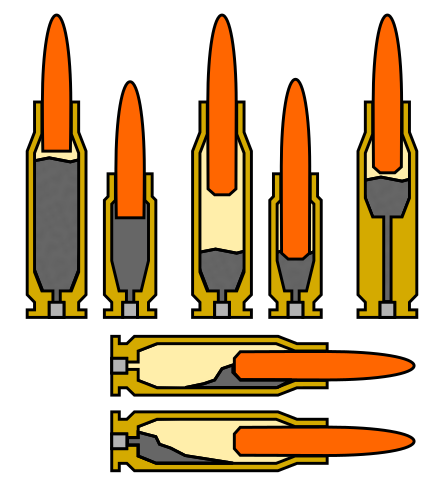
This is the cartridge most people mean by “7.62,” and it is the reference case a .30-caliber can is designed around. It is also, in the example battery used in this dive, the one with a rifle already waiting for a can.
The basics:
- 5/8×24 is the near-universal thread, and it is what the factory barrel wears.
- Supersonic in every normal loading, so a can here is a comfort and concussion device, not a stealth device. On a .308 that is a much bigger benefit than it sounds: a braked .308 is genuinely hostile to stand beside, because a brake works by aiming the blast sideways and backwards at exactly head height. Replacing a brake with a suppressor is the single largest quality-of-life change available on this rifle, and it improves life for everyone on the firing line as much as it does for you.
- Recoil drops meaningfully — the gas jet a can decelerates is a real component of felt recoil on a full-power cartridge — which on a precision rifle means you can spot your own impacts. That is a competitive advantage, not a comfort feature.
- On a semi-auto .308 (an AR-10 pattern gun) everything in Volume 4’s backpressure discussion applies and applies harder, because there is more gas to redirect.
5.4.1 The bolt gun changes the buying criteria
A Ruger Precision Rifle in .308 is a bolt action, and that single fact removes most of the difficulty from this purchase.
There is no gas system, so there is no overgassing, no gas in your face, no sooty brass, no accelerated bolt-carrier wear, and no argument to be had about flow-through versus sealed baffles. The entire backpressure discussion in How Suppressors Work Volume 8 simply does not apply to you here. Backpressure raises bore pressure for a moment behind a locked bolt and then dissipates.
So the criteria invert to the precision-rifle set in Volume 8: buy for return-to-zero, point-of-impact stability and suppression, and ignore low-backpressure marketing entirely. You are free to buy the quietest sealed-baffle can you are willing to carry.
What the factory rifle gives you to work with, from Ruger’s own specification for the .308 model: a 20-inch medium-contour barrel (0.75 in at the muzzle), 5R rifling, a 1:10 right-hand twist, 5/8×24 threads, and a Ruger Precision Rifle Hybrid Muzzle Brake already fitted.5
Four consequences worth acting on:
The brake comes off. It has done its job and a suppressor does that job better and quieter. Either direct-thread the can to the 5/8×24 or fit a suppressor mount in place of the brake. On a rifle that lives in one configuration, direct thread is the better answer — fewest interfaces, best concentricity, most repeatable zero (How Suppressors Work Volume 7 §7.3). Keep the brake in the case; it is worth having if you ever shoot the rifle unsuppressed in a match that bans cans.
20 inches plus a can is a long rifle. A 20-inch barrel and an 8-inch suppressor is a 28-inch barrel-equivalent object on a 9.8-pound rifle. From a bipod that is fine and the muzzle weight is arguably helping you. Getting it in and out of a truck, a blind or a case is where you will notice, and it is the argument for either a shorter can or an over-the-barrel design (Volume 2 §2.4 and §2.7).
The 1:10 twist is the interesting finding, and it is a limit. 1:10 is the modern all-round .308 standard and handles roughly 168 to 210 grain supersonic bullets well.6 Subsonic .308 is a different question. Heavy subsonic bullets — 200 to 220 grains at around 1,050 fps — are long and slow, and the consensus for a dedicated subsonic .308 is 1:8; reports of 1:12 failing to stabilise the 200-grain factory subsonic load are consistent, and 1:10 sits in between.6 The honest position: your rifle may or may not stabilise a given subsonic .308 load, and the only way to find out is on paper. Shoot it unsuppressed at 25 yards first and look for round holes. Oval holes mean stop — a yawing bullet in a baffle stack is the failure mode in How Suppressors Work Volume 10.
And the honest conclusion about subsonic .308: do not buy either rifle a subsonic diet. Factory subsonic .308 is expensive, stability in 1:10 is unresolved, and .300 Blackout does this job better and cheaper — which is precisely why .300 Blackout was invented (§5.2).
That conclusion is unusually easy to act on for a shooter who already owns several .300 Blackout rifles, because the division of labour is then settled without buying anything: the .308s are the supersonic-and-comfortable rifles, and the .300 BLKs are the genuinely-quiet rifles — and one .30-calibre can serves every one of them.
5.4.2 The M40A1 clone: a different problem entirely
A second common .308 case is not a modern precision rifle at all. It is a home-built clone of the USMC M40A1 — the Marine Corps sniper rifle — on a Remington 700 action. That makes it the most interesting suppressor question in the whole dive, and the answer is not primarily technical.
What the pattern is. The M40A1 is a blueprinted Remington 700 short action in 7.62×51, with a 24-inch heavy barrel — Atkinson stainless with a black oxide finish on the originals, straight-tapered to about .940 in at the muzzle — a McMillan HTG fibreglass stock, and a 10× fixed Unertl scope that replaced the 3–9× Redfield of the earlier M40. Rifles were built and rebuilt at the Marine Corps Precision Weapons Section at Quantico, and the barrel was cut for M118 Match.7
The twist rate, and why it matters here. Published figures disagree: the general references give the M40A1 a 1:12 twist,7 while the clone-building community commonly quotes 1:11 for A1-pattern barrels.8 Measure your own — on a home build, whichever blank went in is the only figure that counts.
But for this dive the disagreement does not matter, because both answers point the same way. 1:11 and 1:12 are optimised for 168–175 grain match bullets at full velocity. Heavy subsonic .308 wants 1:8, and there are consistent reports of 1:12 failing to stabilise the 200-grain factory subsonic load outright.6 So:
🔴 The M40A1 clone is a supersonic-only rifle behind a can. Do not feed it subsonic .308. If you want to try anyway, prove it on paper at 25 yards unsuppressed first — round holes or it does not go through a suppressor.
That is not a limitation of the clone. It is the barrel doing exactly what a 1966-vintage match cartridge asked of it.
In this example it is already threaded, cut by the builder.
The original M40A1 muzzle was not threaded — the rifle was issued with a bare, crowned muzzle and no muzzle device of any kind. So this decision was a real one, and it is worth recording that it was made deliberately rather than by default: the clone’s muzzle is threaded 5/8×24, cut by the builder, to match every other rifle in the battery.
That trade is closed. What it bought is a suppressor host that shoots exactly as well as it did before. What it cost is the last increment of clone fidelity — a threaded M40A1 is, strictly, a Remington 700 in a McMillan stock. Anyone rebuilding this rifle for display rather than for shooting should know the choice exists and that it only goes one way.
Two consequences follow, and both are practical rather than sentimental:
The thread is only as good as how it was indicated. A muzzle thread cut on the outside of the barrel rather than indicated off the bore puts the can on an axis the bullet does not share, and on a 24-inch heavy barrel that error is invisible until it prints as a baseline shift or a strike. If there is one thing to verify on a thread you cut yourself, it is concentricity — How Suppressors Work Volume 7 §7.2 is the check.
It is now a long rifle. 24 inches of barrel plus roughly 8 inches of can is a 32-inch barrel-equivalent, which is a substantial object to move around a bench, a bag or a blind. That is not an argument against it; it is the thing to expect the first time it comes out of the case.
5.4.3 Where this leaves the purchase
Two .308 rifles, both of them threaded — one from the factory, one on the builder’s own lathe — converts the .30-calibre can from a speculative purchase into a rifle-in-hand purchase — and it changes the priority order in Volume 10. It also means the can you buy will already cover 6.5 Creedmoor, .300 Blackout, 7.62×39 and 5.56 the day you acquire any of them, and it has two hosts waiting for it rather than one. That is the highest-leverage single purchase in the category, and it now has a host waiting for it.
5.5 What to Buy
For a .30-caliber rifle can in 2026, the specification that covers the whole family:
- .30 caliber bore, rated to .300 Win Mag — the rating costs little and buys the entire family plus room for a future magnum.
- 1.375×24 HUB rear thread. Not negotiable.
- Titanium body with a superalloy or 17-4 blast baffle, unless the intended host is a short-barreled semi-auto run hard, in which case buy the material rating up.
- Interchangeable end caps if the can will see both 5.56 and .30.
- Length: 7–9 inches for a serious can. Consider an over-the-barrel design if the host is a long-barreled hunting rifle, because the number that matters is what the rifle becomes, not what the can is (Volume 2 §2.7).
Reference points in the class: Dead Air Nomad family (including the 2026 Nomad TI OTB, 7.65 in but only +4.6 in, 10.5 oz), Dead Air Sandman-X (additive, Haynes 282, full-auto rated), Thunder Beast Ultra and Magnus series (Volume 8), HUXWRX flow-through .30-cal options, and the 2026 printed multi-caliber entries such as Dead Air’s RXD910Ti (9mm / 10mm / .300 BLK / .400 Legend).910
5.6 A Note on 7.63×25 Mauser
Kept as a short aside only because the two numbers differ by one digit, and because there is a C96 elsewhere in this project.
7.63×25 Mauser is the original C96 Broomhandle cartridge — bottlenecked, small-bore, driving an 85–88 grain bullet at roughly 1,400+ fps. It is a different cartridge from everything above, it is comfortably supersonic with no factory subsonic loading, and the C96’s barrel is integral to the barrel-extension assembly with no threaded muzzle. On a collectible C96 the answer is simply: don’t. Acoustically it would be a poor candidate anyway — high velocity, small bore, modest gas volume, all the crack and little to gain.
This project’s C96 work lives in Mauser C96, where the chambering target is 9×19 — which, unlike 7.63×25, has a well-developed subsonic answer (Volume 6).
5.7 Bibliography
Footnotes
-
Silencer Central, “Why You Should Shoot .300 Blackout Suppressed” — .30 bullets in a necked-up 5.56 case achieve subsonic velocity while retaining useful muzzle and terminal energy, feeding from standard AR magazines. https://www.silencercentral.com/blog/300-blackout-suppressed/ ↩
-
Ibid., and Primary Arms, “Best Suppressor For 300 Blackout” — subsonic .300 BLK from a closed-breech host among the quietest centerfire combinations available. https://blog.primaryarms.com/guide/best-suppressor-for-300-blackout/ ↩
-
Primary Arms, “Suppressed 9mm vs. .300 Blackout Subsonic: Which is Quieter?” — .300 BLK produces more energy than 9mm at comparable subsonic velocity. https://blog.primaryarms.com/guide/suppressed-9mm-vs-300-blackout-subsonic/ ↩
-
.300 AAC Blackout developed by Advanced Armament Corporation for the M4 carbine; design objectives included a subsonic round optimised for sound and flash suppression, supersonic ballistics comparable to 7.62×39, and conversion of a standard M4 by changing the barrel alone. AAC offered a 9 in barrel assembly in 1:8 twist with gas system; 9–10.5 in is the commonly recommended length for a suppressed compact setup. .300 AAC Blackout, Wikipedia https://en.wikipedia.org/wiki/.300_AAC_Blackout ; Small Arms Defense Journal, “The 300 AAC Blackout” https://sadefensejournal.com/the-300-aac-blackout/ ; AAC 300 BLK upper documentation https://advanced-armament.com/wp-content/uploads/300BLK-AAC-Upper.pdf ↩
-
Ruger Precision Rifle, .308 Win specification — 20 in medium-contour barrel (0.75 in at the muzzle), 5R rifling, 1:10 RH twist, 5/8×24 thread, Ruger Precision Rifle Hybrid Muzzle Brake fitted, 9.8 lb. https://ruger.com/products/precisionRifle/specSheets/18028.html ↩
-
Twist requirements for subsonic .308: 1:10 is the modern all-round standard for roughly 168–210 gr; a dedicated subsonic .308 with 200–220 gr bullets is generally specified at 1:8, and 1:12 is reported to fail to stabilise the 200 gr factory subsonic load. Ammoman, “.308 Twist Rate Chart” https://www.ammoman.com/blog/308-twist-rate-chart/ ; Accurate Shooter forum, “Subsonic 308 Winchester barrel twist rate?” https://forum.accurateshooter.com/threads/subsonic-308-winchester-barrel-twist-rate.4019995/ ; Barton Gunworks, “.308 Subsonic Project” https://bartongunworks.com/308-subsonic/ ↩ ↩2 ↩3
-
M40A1 pattern — blueprinted Remington 700 short action, 24 in Atkinson stainless heavy barrel with black oxide finish, 1:12 twist optimised for M118 Match, McMillan fibreglass stock, 10× fixed Unertl replacing the M40’s 3–9× Redfield; built and rebuilt at the Marine Corps Precision Weapons Section, Quantico. M40 rifle, Wikipedia https://en.wikipedia.org/wiki/M40_rifle ; Shooting Illustrated, “Classic Guns: USMC M40A1 Sniper Rifle” https://www.shootingillustrated.com/content/classic-guns-usmc-m40a1-sniper-rifle/ ; GlobalSecurity, “M40A1 Sniper Rifle” https://www.globalsecurity.org/military/systems/ground/m40.htm ↩ ↩2
-
Clone-community figures differ from the published references — 1:11 and a finished contour of 1.25 × 3 straight-tapered to .940 at 24 in from the lug are the commonly quoted build specifications, with Schneider a current barrel source. Treat the twist as contested and measure the actual barrel. Gunboards, “M40A1 Clone Build” https://www.gunboards.com/threads/m40a1-clone-build.1183812/ ; Charlie’s Custom Clones, M40 barrel https://charliescustomclones.com/m40-barrel-for-usmc-sniper-rifle-douglas-7-62-308-prefit-for-remington-700/ ↩
-
The Truth About Guns, “[SHOT 2026] The Year of the Suppressor” — Dead Air Nomad TI OTB and RXD910Ti. https://www.thetruthaboutguns.com/shot-2026-the-year-of-the-suppressor/ ↩
-
Silencer Shop, “Best Suppressor for 300 Blackout.” https://www.silencershop.com/blog/best-suppressor-300-blackout ↩
Comments (0)