Suppressors by Caliber · Volume 10
The Plan — The Smallest Set of Cans That Covers Everything
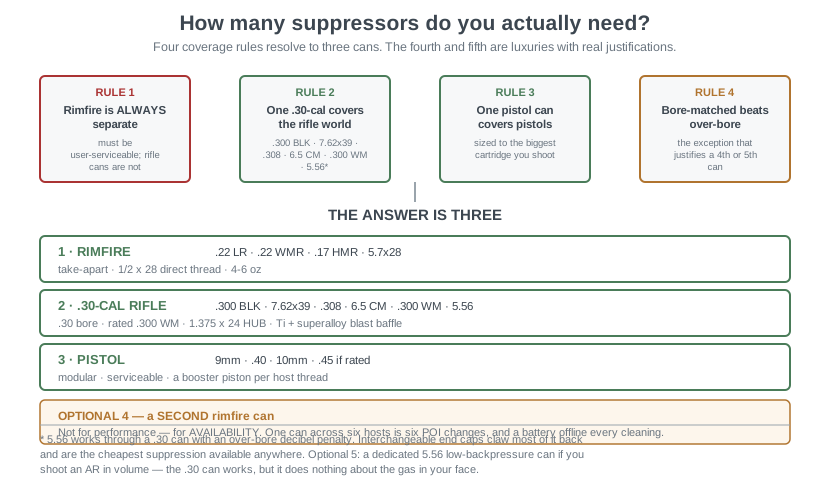
Nine volumes of theory resolve into one question: how many suppressors, and which ones? This volume answers it generally, then works it through for an example mixed battery.
10.1 The Coverage Rules
Four rules determine how many cans you actually need.
Rule 1: Rimfire is always separate. A rimfire can must be user-serviceable; centerfire rifle cans mostly are not. You can shoot .22 LR through a .223 can — it is legal and safe — but you are putting lead and wax into something you cannot open. Rimfire gets its own can. Always.
Rule 2: One .30-caliber rifle can covers the entire centerfire rifle world. .300 BLK, 7.62×39, .308, 6.5 Creedmoor, .300 Win Mag, and 5.56 with an over-bore penalty. Rated to .300 Win Mag, this is the highest-leverage single purchase in the category.
Rule 3: One pistol can covers the pistol world, sized to the largest cartridge you shoot. A .45-rated modular can runs 9mm through .45; a 9mm can runs 9mm and not .45.
Rule 4: A dedicated bore is quieter than an over-bore. The exception that justifies a fourth or fifth can: if you shoot one cartridge seriously — a match 6.5, a dedicated 5.56 carbine — a bore-matched can is free suppression you cannot get any other way.
So the answer is three, and the fourth and fifth are luxuries with real justifications.
10.2 The Three-Can Set
Table 1 — 10.2 The Three-Can Set
| # | Can | Covers | Specification |
|---|---|---|---|
| 1 | Rimfire | .22 LR, .22 WMR, .17 HMR, 5.7×28 | Take-apart, 1/2×28 direct thread, 4–6 oz. Rated beyond .22 LR |
| 2 | .30-cal rifle | .300 BLK, 7.62×39, .308, 6.5 CM, .300 WM, 5.56 | .30 bore, rated .300 Win Mag, 1.375×24 HUB, titanium body + superalloy blast baffle, interchangeable end caps |
| 3 | Pistol | 9mm, .40, 10mm, .45 (if .45-rated) | Modular, serviceable, correct booster pistons per host |
That is complete coverage of every cartridge in this dive, in three purchases.
The optional fourth and fifth, in order of how much they buy you:
- 4. A second rimfire can. Not for performance — for availability. A rimfire can shared across six guns is a can that is constantly being moved (a POI change every time) and constantly being cleaned (unavailable while it is). In 2026, with the transfer tax at $0 and $199 printed rimfire cans on the market, this is the cheapest capability increase available anywhere in the category.
- 5. A dedicated 5.56 low-backpressure can, if you shoot an AR in volume. The .30 can works; a 5.56-bore flow-through can works better and fixes the gas problem the .30 can does not (Volume 4).
10.3 The 2026 Arithmetic Changed
Worth spelling out, because it inverts advice that was correct eighteen months ago.
Before 1 January 2026: every additional can cost $200 in federal tax plus the can plus a dealer fee plus a wait. That tax was a strong argument for buying one expensive multi-purpose can rather than two cheaper specific ones — the stamp was often a third of the total.
After 1 January 2026: the transfer tax on a silencer is $0.1 The registration, the Form 4, the fingerprints, the background check and the wait all remain (see the law dive) — but the money argument for consolidation is gone. Combined with the price floor collapsing (Lyman’s printed Sonicore line opened at $199),2 the calculus now favours more, cheaper, more specific cans over one expensive compromise.
The remaining cost of an additional can is the paperwork and the wait, not the tax. Reported 2026 eForm 4 turnarounds vary enormously across trackers — figures from single-digit days to a couple of months appear depending on who is counting and when — but the order of magnitude is weeks, not the year-plus that paper filings still take. That is a very different obstacle from $200 and eleven months.
10.4 A Worked Example: A Mixed Battery
The example battery, carried over from the .22 Rimfire dive:
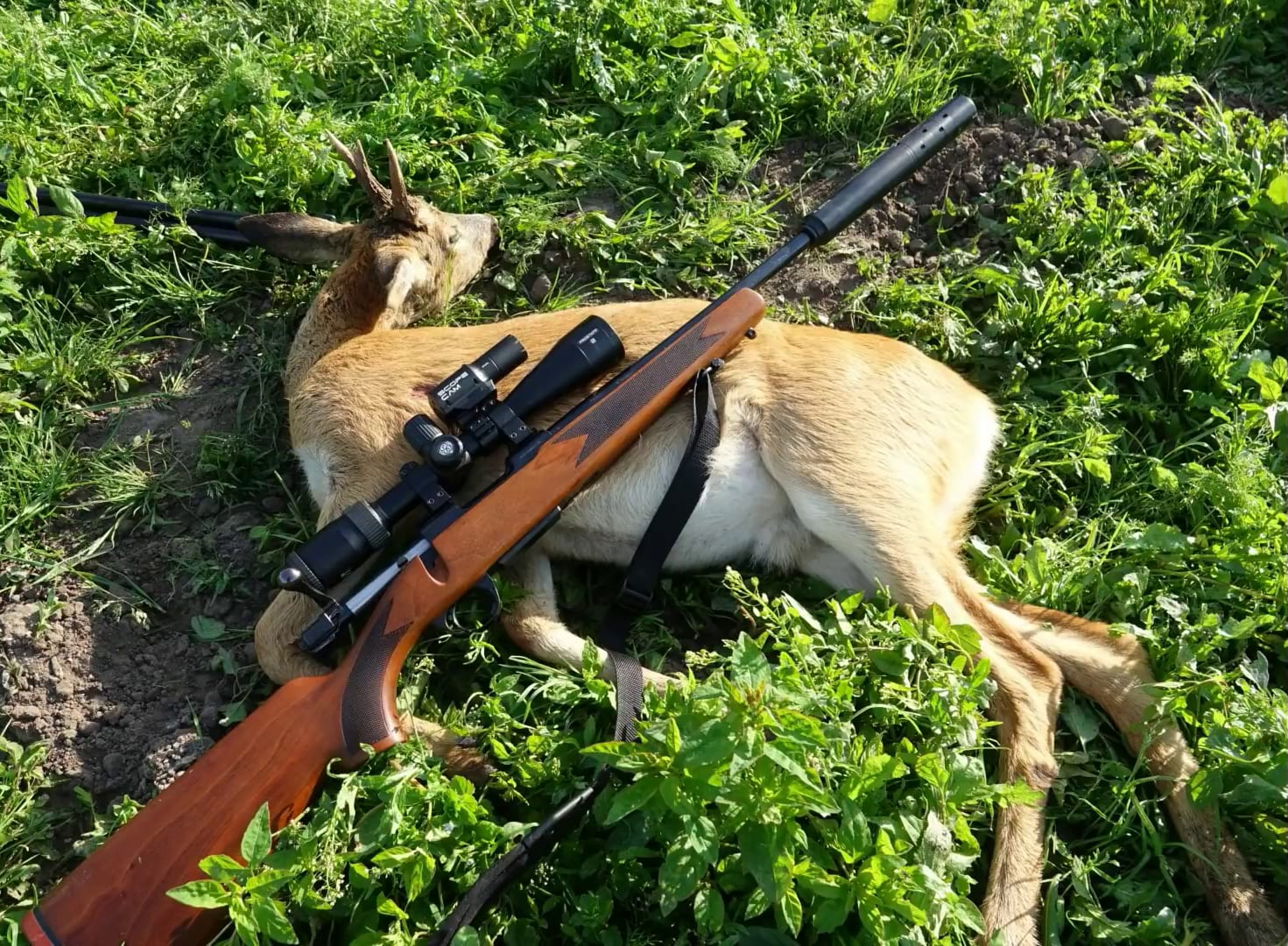
Six .22s — Ruger 10/22 DSP (blued, 18.5 in), Ruger 10/22 Stainless Takedown (18.5 in), Ruger Precision Rimfire (18 in), Ruger Mark III (5.5 in), Ruger Mark IV, S&W Model 41 (5.5 in heavy) — sharing one Mack Brothers Lima on 1/2×28.
Two .308s — a Ruger Precision Rifle in .308 (20 in, 1:10, threaded 5/8×24 from the factory, wearing Ruger’s hybrid brake) and a home-built M40A1 clone on a Remington 700 (24 in heavy barrel, 1:11 or 1:12, threaded 5/8×24 by the builder — a clone of the Marine Corps sniper rifle). Volume 5 §5.4 works through both.
Several .300 Blackouts — semi-automatic, 9-inch barrels, 1:8 twist or faster. These change the shape of the whole plan (§10.4.3), because .300 BLK is the one centerfire cartridge here that can actually be quiet rather than merely comfortable — and because 9 in of barrel is not a compromise but AAC’s own design point (Vol 5 §5.2.2).
Cartridges of interest: 5.56, the rest of the 7.62 family, .45, 9mm and 6.5 Creedmoor.
10.4.1 What is already right
One rimfire can serving six hosts on a common thread is a good system. It is the correct architecture. The threading is uniform, the can is light, and it works.
10.4.2 What to do next, in order
The order depends on what the battery contains. With only rimfire hosts, a second rimfire can leads, because a .30-calibre can has no host. Two .308s give it hosts. Several .300 Blackouts are what actually settle it, because they are the only centerfire rifles here that can be made genuinely quiet. With this battery, the .30-cal can is first by a wide margin.
10.4.3 One can, three jobs
The .30-calibre can is no longer a purchase for one rifle. It is the single component that serves every centerfire rifle in the battery, and the three jobs it does are genuinely different:
Table 2 — The .30-calibre can is no longer a purchase for one rifle. It is the single component that serves every centerfire rifle in the battery, and the three jobs it does are genuinely different
| Host family | Action | What the can is for | Ammunition |
|---|---|---|---|
| Two .308 bolt guns | Closed breech, 20 in and 24 in | Comfort and concussion. Replacing a brake that aims blast at head height | Supersonic. Neither twist supports heavy subsonic (Vol 5 §5.4) |
| Several .300 BLK SBRs | Semi-auto, 9 in, 1:8 | Actual quiet — the one place a centerfire rifle here disappears | Subsonic 190–220 gr. 1:8 covers the whole range |
| A future 5.56 / 6.5 / 7.62×39 | — | Comfort, with an over-bore penalty on 5.56 | Supersonic |
That is the whole argument for buying one good can rather than three adequate ones.
First: a .30-calibre rifle can, HUB mount.
Specification: .30 bore, rated .300 Win Mag, 1.375×24 HUB, interchangeable end caps if offered, 7–9 in — and rated for a 9-inch barrel.
10.4.4 The one real conflict, stated honestly
The two host families want genuinely opposite things, and the 9-inch semi-autos are what make it a real conflict rather than a preference:
Table 3 — The two host families want genuinely opposite things, and the 9-inch semi-autos are what make it a real conflict rather than a preference
| The .308 bolt guns want | The 9 in BLK SBRs want | |
|---|---|---|
| Baffle design | Sealed baffles — maximum suppression, backpressure irrelevant | Low backpressure — semi-auto, and subsonic is the hardest cycling case |
| Materials | Titanium is fine; 20–24 in barrels are gentle | Superalloy blast baffle — 9 in dumps far more unburnt propellant and residual pressure into the blast chamber, especially supersonic |
| Weight | Tolerable; shot from a bipod | Matters — it is a compact carbine and the point is handiness |
| Mount | Direct thread, left on, one zero | QD, because these get swapped |
The resolution, and it is a genuine judgement call rather than a free lunch:
Buy one can, and specify it to the harder host. The 9-inch SBRs set the floor: the can must carry a 9-inch .300 BLK rating with a superalloy or 17-4 blast baffle, because that rating is a materials statement and titanium alone erodes there (How Suppressors Work Volume 4 §4.4). A can that satisfies the SBRs will always satisfy the bolt guns; the reverse is not true, and buying the light suppression-first titanium can that the .308s would prefer is the mistake that shows up two thousand rounds later as a washed-out blast baffle.
Then fix backpressure at the rifle, not at the can. Fit adjustable gas blocks to the BLK uppers. That is the correct answer for subsonic AR reliability regardless of suppressors, it costs a fraction of a second can, and it lets you keep the sealed-baffle suppression the .308s benefit from. Add a gas-deflecting charging handle if the face-gas still annoys you.
Mounting: direct thread the Ruger Precision — it lives in one configuration, and direct thread is the lightest, most concentric and most repeatable interface. Fit a QD cap on the same HUB can for the BLK SBRs, which get moved around. One can, two mounting styles, bought once — exactly what HUB exists for.
When a second can becomes the better answer. If you find yourself running the BLKs hard and often, a dedicated short, low-backpressure can for the SBRs plus the suppression-first can for the bolt guns is a defensible two-can split — and in 2026, with the tax at $0, the only real cost is a second Form 4 and a wait (§10.3). That is a much easier call than it was in 2024.
Second: a second rimfire can. Still a strong move, just no longer the first one.
The reasoning is unchanged and it is about availability rather than performance.
- The Lima is out of production (Volume 3 §3.4) — Mack Brothers’ current rimfire model is the VAPOR, and while the company still trades and has a public record of servicing discontinued models, a shared, orphaned can is a single point of failure across six rifles.
- Six hosts, one can means six mount/dismount cycles’ worth of POI change and wear, plus every cleaning cycle taking the whole battery offline.
- The natural split: one can lives permanently on the Model 41 or the Precision Rimfire (the two guns where a fixed zero is worth the most), and the other floats across the 10/22s.
- Selection criteria for that second can, in priority order: cleaning ergonomics first (this is the constraint that actually governs rimfire ownership), then rating breadth (.22 WMR / .17 HMR / 5.7×28), then weight. Volume 3 §3.6 has the field; the click-together and all-stainless designs lead on the first criterion.
Second: a .30-caliber rifle can, HUB mount. This is the purchase that opens the most doors. It covers .300 Blackout, 7.62×39, .308, 6.5 Creedmoor and .300 Win Mag, plus 5.56 with an over-bore penalty. Buy it before buying any of the rifles it is for — a HUB can with the right mount adapters is ready for whatever arrives.
Specification: .30 bore, rated .300 Win Mag, 1.375×24 HUB, titanium with a superalloy blast baffle, interchangeable end caps if offered, 7–9 in. If the intended host is a long-barreled hunting rifle, seriously consider an over-the-barrel design — 30 inches of barrel-equivalent is a real handling problem (Volume 2 §2.7).
Third: a pistol can, if 9mm or .45 actually arrives. Sized to the largest cartridge intended. If both 9mm and .45 are on the list, a .45-rated modular can covers both in one purchase; if 9mm is the priority and .45 is a maybe, a 9mm-bore can is quieter on the cartridge you will actually shoot. Budget for a booster piston per host thread.
Fourth, and only if an AR gets shot in volume: a 5.56-bore low-backpressure can, plus an adjustable gas block on the rifle. Volume 4 makes this case.
10.4.5 The cartridge-by-cartridge recommendation
Table 4 — The cartridge-by-cartridge recommendation
| Cartridge of interest | Can | Ammunition |
|---|---|---|
| .22 LR | Rimfire can (have one; add a second) | CCI Standard Velocity; Clean-22 to halve the fouling |
| 5.56 | The .30 can, or a dedicated 5.56 flow-through | No subsonic option exists. Comfort only |
| .300 Blackout (in the example battery — 9 in semi-auto, 1:8) | The .30 can — this is the quiet one, and it sets the 9 in barrel rating | 190–220 gr subsonic. Adjustable gas block on each upper |
| 7.62×39 | The .30 can + an M14×1 LH adapter | Supersonic. Comfort only |
| .308 / 7.62×51 | The .30 can, direct thread 5/8×24 — both hosts are bolt guns, so buy for suppression, not backpressure | Supersonic. 1:10 unresolved and 1:11/1:12 a clear no for heavy subsonic |
| 9mm | Pistol can + booster (1/2×28) | 147 grain |
| .45 ACP | Pistol can + booster (.578×28) | Anything. It is already subsonic |
| 6.5 Creedmoor | The .30 can, or a 6.5-bore can if dedicated | Supersonic. Buy for return-to-zero, not decibels |
10.4.6 The three-line version
- Buy a .30-caliber HUB can rated to .300 Win Mag and to a 9-inch barrel, with a superalloy blast baffle. It serves three jobs across every centerfire rifle you own: comfort on the two .308 bolt guns, genuine quiet on the 9-inch .300 BLK SBRs, and whatever arrives later. Specify it to the SBRs — they are the harder host and they set the floor. Direct-thread cap for the Ruger Precision, QD cap for the BLKs, plus adjustable gas blocks on the BLK uppers.
- Buy a second rimfire can. Cheap, and it removes a single point of failure across six rifles.
- Buy a pistol can when a pistol host actually exists, sized to the biggest cartridge you will run.
And one decision that is not a purchase, for anyone building an M40A1 clone: whether to thread the muzzle at all. Volume 5 §5.4 covers the trade — a threaded clone is a better suppressor host and a less faithful clone, and the choice only goes one way.
10.5 Two Rifles That Pull the Plan in Opposite Directions
Both sit outside the plan above, and they pull in opposite directions — which is why they are treated separately here rather than folded silently into it.
A Barrett M82A1 does not join it. A .50 BMG is the one host in a battery like this where the answer is not “which can” but “not this rifle” — Barrett state in writing that fitting a suppressor to a Model 82A1 voids the warranty and may damage it, and that the M107A1 is their only suppressor-capable .50 semi-auto. Volume 11 works through why, what the military actually uses the combination for, and what you would buy if you had a rifle that could take one. The three-can set is unchanged.
A Henry Frontier would change the order. A 24-inch threaded lever-action .22 is the best-suited suppressor host discussed anywhere in this dive — a manual action can feed the ~710 fps CCI Quiet-22 that no semi-auto here will cycle, and a 24-inch rimfire barrel is slower than a 16-inch one, not faster. Volume 3 §3.9 has the argument. Its effect on this plan is simple: it makes the second rimfire can stop being a convenience purchase and become the obvious one, because the Frontier is the host that finally deserves a permanent mount and a settled zero rather than a place in the queue behind the Lima.
10.6 The Cheatsheet
Before buying
- Subsonic ammunition exists for this cartridge? If no, you are buying comfort, not quiet — set expectations
- Bore diameter correct, or deliberately over-bore with the penalty accepted
- 1.375×24 HUB rear thread on anything centerfire
- Rating covers the cartridge, the shortest barrel (9 in here) and the firing schedule you will actually use
- Serviceable if rimfire or pistol; sealed is fine for a rifle can
- Overall length arithmetic done: barrel + can = the rifle you will actually carry
- Booster piston in the right thread for every pistol host
- Adjustable gas block on any semi-auto host that will run subsonic
- State law checked — 8 states plus DC prohibit ownership; two more restrict hunting use
Before firing
- Alignment rod check. Every host, every time anything changes
- Threads indicated off the bore, shoulder square
- Anti-seize on the threads; can fully tight
- Correct end cap fitted if interchangeable
- The load has been shot on paper unsuppressed and printed round holes
- Nothing primer-only, ever
- 🔴 .300 BLK / 5.56 check: magazine colour and magwell colour agree (Volume 5 §5.2.1)
Living with it
- Weigh the can new; record the number
- Record a can-on / can-off zero offset per host
- Rimfire: service at 300–500 rounds or before the end cap stiffens
- Check tightness during a string; read the end cap after
- Never ammoniated cleaner on aluminium
10.7 Bibliography
Footnotes
-
One Big Beautiful Bill Act (H.R. 1), signed 2025-07-04 — NFA making and transfer tax set to $0 for silencers, SBRs, SBSs and AOWs effective 2026-01-01. Registration and approval requirements unchanged. Full treatment in the law dive. ↩
-
Lyman Sonicore Skarv 22 at $199, introduced SHOT Show 2026. https://www.lymanproducts.com/skarv-22 ↩
Comments (0)