Suppressors by Caliber · Volume 2
Sizing — Pistol Cans, Rifle Cans, and What Length Buys
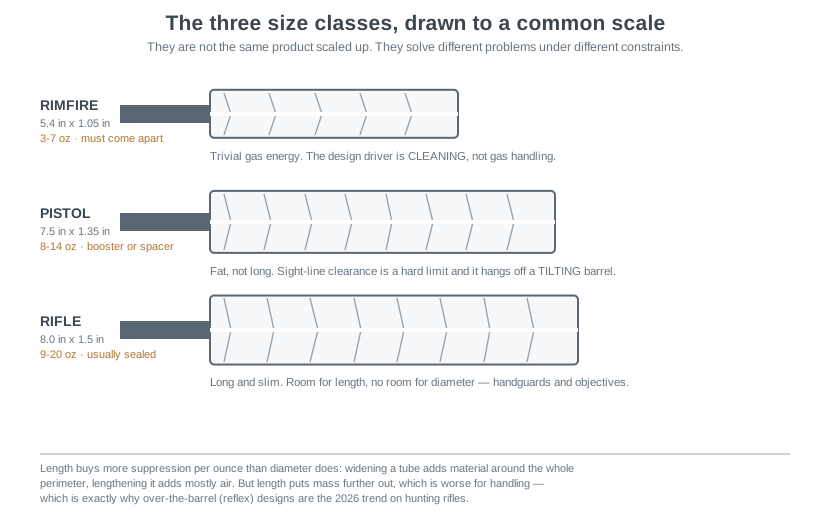
Suppressors sort into three physical classes that have almost nothing to do with each other, and the differences are not merely a matter of scale. A rimfire can, a pistol can and a rifle can are solving different problems with different constraints, and the reason a pistol can is short and fat while a rifle can is long and thin is not styling.
2.1 The Three Classes
Table 1 — 2.1 The Three Classes
| Rimfire | Pistol | Rifle | |
|---|---|---|---|
| Typical length | 4–6 in | 6–9 in | 5–9 in (plus 3–5 in more for full-size) |
| Typical diameter | 1.0–1.1 in | 1.2–1.4 in | 1.5 in (1.25 in slim, 1.75 in magnum) |
| Typical weight | 3–7 oz | 8–14 oz | 9–20 oz |
| Materials | Aluminium, titanium, stainless | Aluminium + stainless, titanium | Titanium, stainless, Inconel, Stellite |
| Mount | Direct thread, 1/2×28 | Booster or spacer | Direct thread or QD, usually HUB |
| Serviceable | Mandatory | Usually | Usually not, and that is fine |
| Gas energy handled | Trivial | Low, but dirty | High to extreme |
Rimfire cans are small because .22 LR produces almost no gas. Four ounces of aluminium genuinely does the job. Their design driver is not gas handling; it is cleaning, because unjacketed lead and wax fouls them faster than any other class.
Pistol cans are the awkward middle. The gas volume is modest, but the diameter of the bullet is large relative to it, subsonic pistol ammunition is dirty, and — the real constraint — the can has to hang off a tilting barrel and let the gun cycle. That mounting problem dictates the rear third of every pistol can. They are fat rather than long because a long can on a handgun is unmanageable and because sight-line clearance is a hard limit.
Rifle cans handle an order of magnitude more gas energy and much more heat, which is why the material argument in How Suppressors Work Volume 4 is a rifle-can argument. They are long and slim because on a rifle you have room for length and you do not have room for diameter — a 1.75-inch can will not clear most handguards or sit under most scopes.
2.2 Length Beats Diameter
Suppression comes from internal volume. Volume can be bought as length or as diameter, and length is the better buy:
- Weight per unit volume is lower. A tube’s wall area scales with its circumference; making it wider adds material around the whole perimeter. Making it longer adds material only at the ends of the added section, and the added section is mostly air.
- Diameter runs into hard limits fast. Handguard inner diameter, scope objective clearance, iron-sight height, and holster fit are all pass/fail. Length is merely inconvenient.
- Diameter increases the moment arm on the mount in exactly the direction that causes alignment problems.
The counter-argument, and it is real: length puts mass further from the receiver, which is worse for handling than the same mass closer in. A muzzle-heavy rifle swings slowly. This is why over-the-barrel designs exist, and why short-and-fat is the right shape for a handgun.
2.3 Modularity
Most modern pistol cans and many rifle cans are modular — a front section unscrews so the can runs full-length or short.
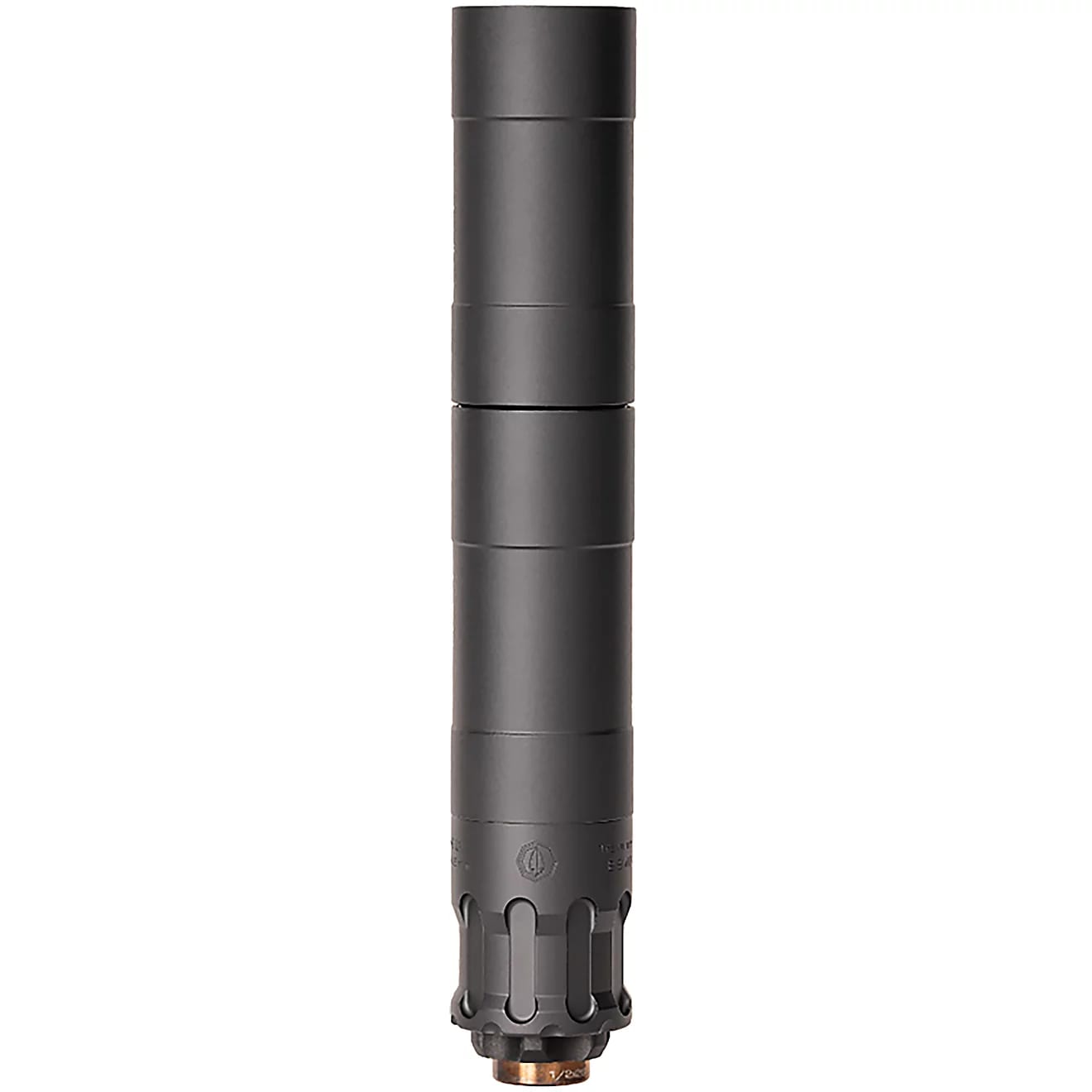
What modularity actually is: a switch between two suppressors, not a free lunch. The Rugged Obsidian 9 runs 8.6 inches full and 6.7 inches short;1 the short configuration is meaningfully louder, and it is meant to be. You are trading suppression for handling on purpose.
When it earns its keep:
- One can, two very different jobs — a full-length home configuration and a short configuration for a truck gun or a handgun that has to fit somewhere.
- Testing before committing. Shoot both and find out which you actually use. Most people discover they use one of the two, ninety percent of the time.
When it does not:
- A precision rifle. You want one configuration, one zero, one known offset. Every reconfiguration is a new POI.
- When it costs concentricity. Another threaded joint is another tolerance (How Suppressors Work, Volume 7).
A related and better-value form of modularity is interchangeable end caps — the same can with an aperture matched to the cartridge. Cheaper, lighter, no length change, and it directly attacks the over-bore penalty.
2.4 The Over-the-Barrel (Reflex) Idea
An over-the-barrel or reflex suppressor sleeves backward over the barrel, so a large part of its length occupies space the barrel already used. The Dead Air Nomad TI OTB introduced for 2026 is 7.65 inches long but adds only 4.6 inches to the rifle, at 10.5 ounces in titanium.2
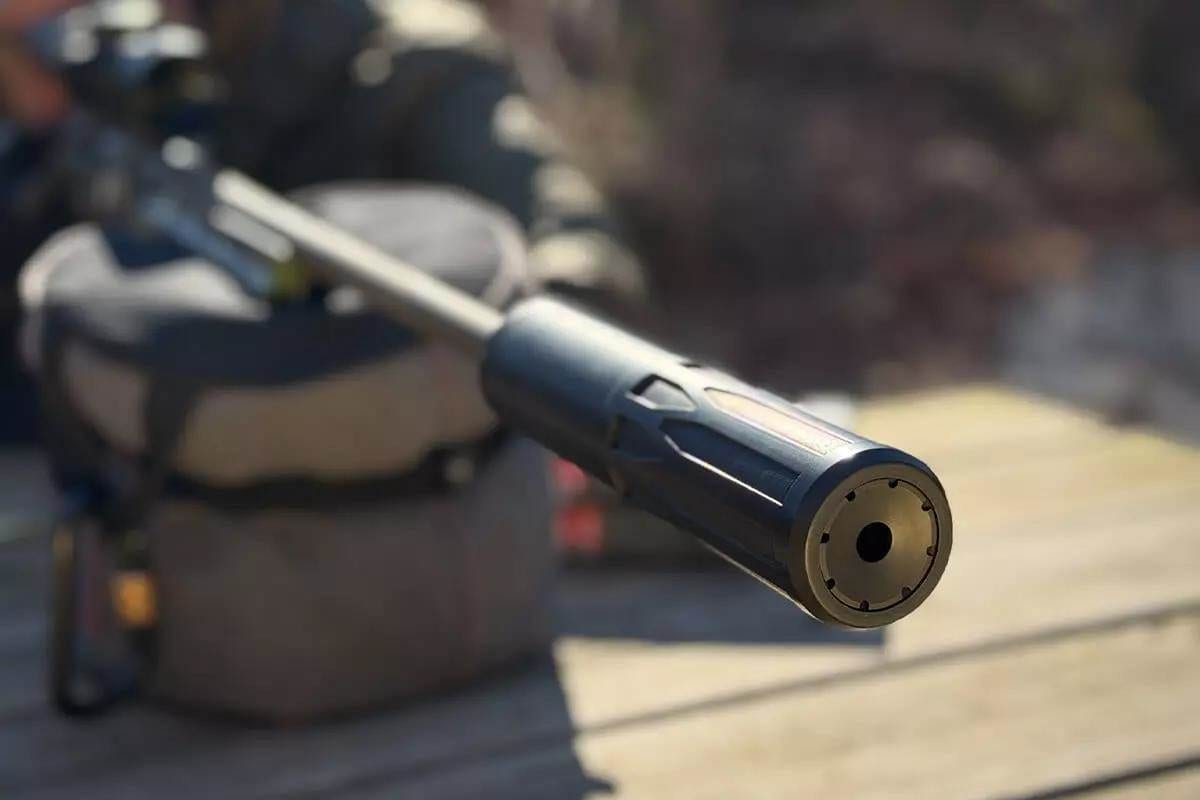
This is the most interesting current trend, and it exists because of who is buying. When suppressors were mostly bought for ARs, overall length past a 16-inch barrel was tolerable. Now that they are being bought for hunting rifles with 22- and 24-inch barrels, the number that matters is not how long the can is but how long the rifle becomes. A reflex can recovers three to five inches of that.
The costs: the barrel must be sufficiently narrow and the profile sufficiently uniform for the can to sleeve over it; the rear of the can gets hot from the barrel as well as the gas; and mounting is more complex. It is not universally applicable, and on a heavy-contour barrel it is not applicable at all.
2.5 The Weight Budget
The number people underestimate. Some anchors:
- 4 oz — a rimfire can. Genuinely unnoticeable on a rifle; noticeable on a target pistol, where it changes the balance of a gun you are holding at arm’s length.
- 9–11 oz — a light titanium rifle can. This is the “hunting rifle you carry all day” band and it is where titanium earns its price premium.
- 13–16 oz — a full-size rifle can in titanium, or a mid-size one in stainless. Fine on a bipod, tiring offhand.
- 18–22 oz — a hard-use or magnum can. This is a pound and a half at the end of a lever, and it is a deliberate choice you make for durability.
Two things to weigh besides the can: the mount (a QD muzzle device plus locking hardware is often 2–4 oz that nobody quotes) and the fouling in a rimfire or pistol can, which is genuinely ounces after a few thousand rounds.
The honest test: hold your rifle out at arm’s length for thirty seconds. Then imagine a large potato taped to the muzzle. That is roughly the difference, and it is the reason people who buy on decibels alone end up buying twice.
2.6 The Pistol Sight-Line Problem
Bolt a 1.3-inch-diameter tube to the muzzle of a handgun and it blocks the front sight completely. There are three answers:
Suppressor-height sights. Taller front and rear sights that clear the can. The standard solution, cheap, and it means the pistol wears sights you cannot use comfortably without the can.
A red dot. Mounted high enough on a slide-cut or a mount to see over the can. Increasingly the default answer, and the reason optics-ready pistols and suppressors sell together.
Eccentric geometry. The SilencerCo Osprey family’s distinctive rectangular body is offset so it hangs below the bore line, leaving the sight line clear — which means factory-height sights still work.3 It is a genuinely clever piece of design, and the trade is that the can is sealed and cannot be disassembled, and that it has an up-orientation you must index correctly.
2.7 What Adding a Can Does to Overall Length
Worth doing the arithmetic before buying, because this is what people actually regret:
Table 2 — Worth doing the arithmetic before buying, because this is what people actually regret
| Host | Barrel | Can | Total barrel-equivalent |
|---|---|---|---|
| Ruger 10/22 Takedown | 18.5 in | 5.4 in rimfire | ~23 in |
| AR-15 carbine | 16 in | 7 in 5.56 can | ~22 in (a rifle-length gun again) |
| AR-15 SBR | 10.5 in | 6 in | ~16 in (a carbine, quietly) |
| Ruger Precision Rifle .308 | 20 in | 8 in .30 can | ~28 in |
| M40A1 clone (Rem 700) | 24 in | 8 in .30 can | ~32 in |
| Bolt hunting rifle | 22 in | 8 in .30 can | ~30 in |
| Bolt hunting rifle | 22 in | 8 in OTB can, +4.6 in | ~26.6 in |
| Glock 19 | 4.5 in (threaded ~5 in) | 7 in pistol can | ~12 in |
The 30-inch hunting rifle is the one that surprises people. In a blind, a truck, thick cover, or a tree stand, that is a genuinely different gun to handle. This is the strongest single argument for a shorter can or a reflex design, and it is a bigger deal than three decibels.
The SBR line is the interesting one in the other direction: a short-barreled rifle plus a suppressor is close to the same overall length as an ordinary carbine, which is why SBRs and cans go together — and why the law dive matters, because both were on the list whose tax went to zero in 2026.
2.8 Bibliography
Footnotes
-
Rugged Suppressors Obsidian 9 — full 8.6 in / short 6.7 in modular configurations. https://www.ruggedsuppressors.com/ ↩
-
Dead Air Nomad TI OTB, introduced SHOT Show 2026 — 7.65 in overall, adds 4.6 in to the rifle, 10.5 oz titanium. The Truth About Guns, “[SHOT 2026] The Year of the Suppressor.” https://www.thetruthaboutguns.com/shot-2026-the-year-of-the-suppressor/ ↩
-
SilencerCo Osprey 45 — eccentric body sits below the sight line so standard-height sights remain usable; sealed, non-serviceable. Pew Pew Tactical, “Best 9mm & .45 ACP Suppressors [2026].” https://www.pewpewtactical.com/best-9mm-45acp-suppressors/ ↩
Comments (0)