Suppressors by Caliber · Volume 3
.22 LR — The Best Host, and What to Do About an Orphan Can
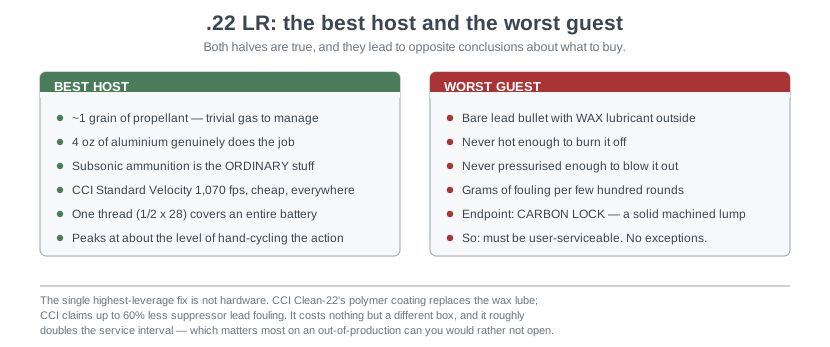
The .22 Long Rifle is the cartridge suppressors were made for, and it is the one where a suppressor most completely changes the experience. It is also the filthiest thing you can put in front of one. The .22 Rimfire dive covers the ammunition side in depth; this volume is the hardware.
3.1 Why .22 Is the Best Host
Almost no gas. A .22 LR carries on the order of a grain of propellant. The energy a can has to absorb is trivial by centerfire standards, which is why a four-ounce aluminium tube achieves what a rifle needs sixteen ounces of titanium to do.
Natively subsonic ammunition is cheap and everywhere. CCI Standard Velocity at 1,070 fps is not a specialty product; it is the ordinary stuff, it costs less than the high-velocity ammunition, and it is subsonic straight out of the box. Every other cartridge in this dive has to buy its subsonic performance with either money or compromise.
Everything is threaded 1/2×28. One thread pitch, one can, an entire battery.
The result is genuinely quiet. Not Hollywood quiet, but the practical benchmark from the rimfire dive: a subsonic 40-grain load through a good can peaks at roughly the same level as manually cycling the action of the gun firing it. Once you reach that, the can has done all it can do, and what you hear is the machine.
3.2 Why It Is the Worst Guest
A .22 LR bullet is bare lead with wax lubricant on the outside. Every shot atomises some of both into a chamber that is never hot enough to burn it off and never pressurised enough to blow it out. Add carbon and primer residue and a rimfire can accumulates fouling at grams per few hundred rounds.
Two consequences, both absolute:
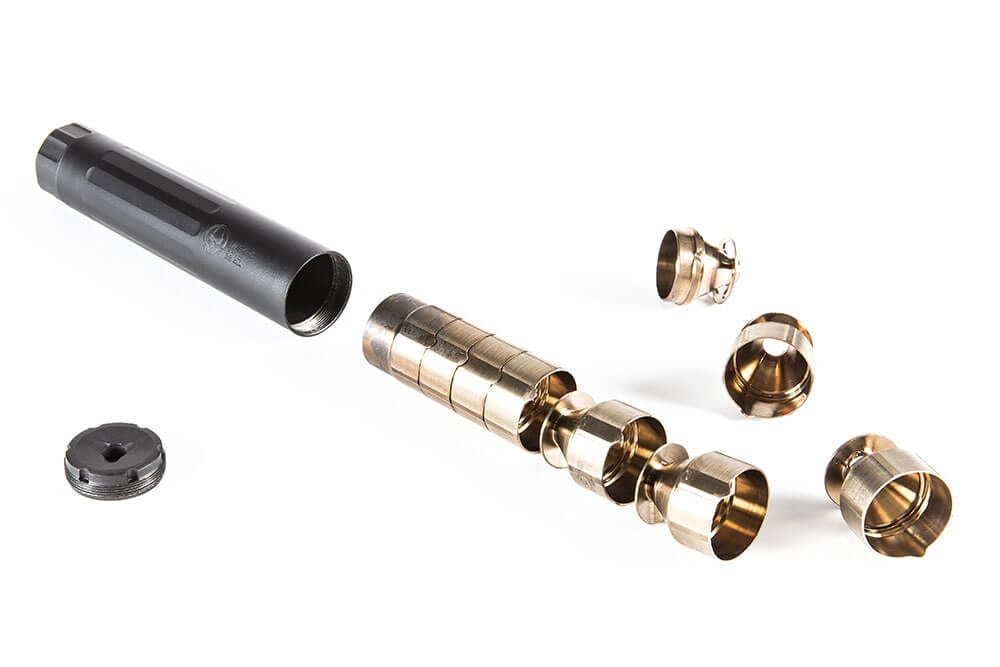
A rimfire can must be user-serviceable. No exceptions. A sealed rimfire can is a disposable object. (How Suppressors Work Volume 6 covers the mechanism, cleaning methods, and the ammonia-versus-aluminium warning that will otherwise destroy a can.)
Carbon lock is the way rimfire cans die. Left unserviced, the baffles fuse to each other and to the tube and the assembly becomes a solid machined lump. Clean at 300–500 rounds, or before the end cap gets hard to turn.
The one product that meaningfully changes this: CCI Clean-22, whose polymer coating replaces the wax lubricant. CCI claims up to 60% less suppressor lead fouling. For anyone running a rimfire can — and especially for anyone running one they would rather not disassemble more often than necessary — that is the highest-leverage change available, and it is just a different box.
3.3 The Cycling Constraint
The problem specific to semi-auto rimfire: the quietest ammunition has the least momentum, and a blowback action needs momentum to run.
Table 1 — 3.3 The Cycling Constraint
| Load | Velocity | Suppressed result | Cycles a 10/22? |
|---|---|---|---|
| CCI Standard Velocity, 40 gr | ~1,070 fps | Very good | Yes — the workhorse |
| CCI Suppressor, 45 gr HP | Subsonic | Better | Generally yes |
| Federal AE Suppressor, 45 gr | Subsonic | Better | Generally yes |
| CCI Quiet-22 Semi-Auto, 45 gr | Subsonic | Very good | Engineered to, yes |
| CCI Quiet-22, 40 gr | ~710 fps | Dramatically quieter | No. Single-shot only |
If a semi-auto will not run subsonic ammunition, the mechanical answers are a lighter recoil spring (commonly a 10% reduction) or a lighter bolt — with the standing warning that a lighter spring plus high-velocity ammunition batters the action unless a bolt buffer is fitted. Bolt mass is the primary control on cycling in a blowback; spring rate controls bolt velocity.
A bolt-action or single-shot .22 sidesteps all of it and is meaningfully quieter than any semi-auto with the same can and load, because the action noise that dominates a well-suppressed rimfire shot is not there.
3.4 A Worked Example: The Mack Brothers Lima
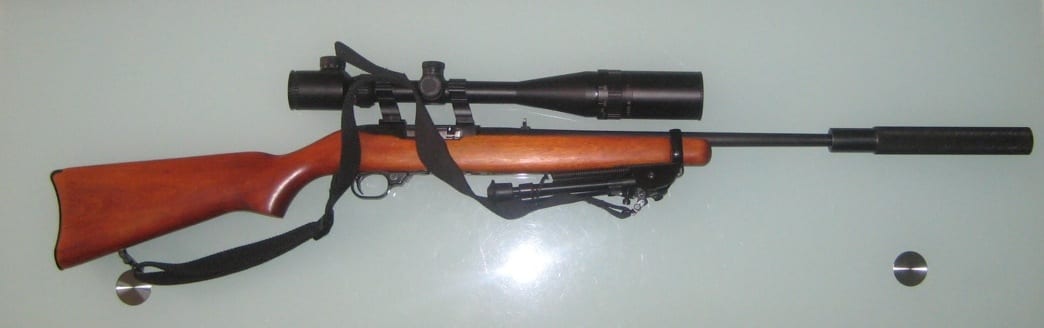
Take, as a worked example, a battery whose rimfire can is a Mack Brothers Lima on 1/2×28, moving between six .22s: two Ruger 10/22s (a blued DSP and a stainless Takedown), a Ruger Precision Rimfire, a Ruger Mark III, a Ruger Mark IV, and a S&W Model 41.
Its status, checked 2026-07-29. The Lima is not in Mack Brothers’ current catalogue. Their current rimfire model is the VAPOR: 100% titanium, 5 3/8 in, 4.3 oz, a stack of eight K-baffles, an integrated disassembly tool, rated .22 LR / .22 WMR / .17 HMR / 5.7×28.1
This is the good version of that problem, and the distinction matters. Mack Brothers is still trading, still building rimfire cans, and has a public record of continuing to service and repair discontinued models — they said exactly that when they ceased production of the MB762 and MB556 in 2024.2 An orphan product from a living company is a completely different situation from a dead company’s product.
What follows practically:
- You are the parts supply. Handle disassembled baffles like irreplaceable objects, because they may be.
- Photograph the stack in index order before the next disassembly, not after. Five minutes of insurance against a permanent mistake.
- Clean it more often, not less. Carbon lock on a supported can is a repair; on an orphan it is the end of the object. Clean-22 (§3.2) buys real margin here.
- Ask Mack Brothers directly what service they will still perform on a Lima, and get the answer in writing before you need it. Do this while the company is trading; the answer is worth more than the can.
3.5 Should It Be Replaced?
Not because it is discontinued. A working rimfire can does not become worse because the catalogue moved on, and there is no performance cliff between a good 2015 rimfire can and a good 2026 one — the physics have not changed and rimfire is where the least engineering headroom exists.
The arguments for adding a second rimfire can are better than the arguments for replacing this one:
- Six hosts, one can. Every mount and dismount is a POI change and a wear cycle. A second can means the Model 41 and the Precision Rimfire keep permanent zeroes.
- A can in cleaning is a can not shooting. Rimfire cans spend real time disassembled.
- The 2026 price floor. Lyman’s Sonicore Skarv 22 landed at $199,3 and the federal transfer tax is now $0. A second rimfire can costs less in 2026 than the tax stamp alone cost in 2024.
- Risk management on an orphan. If the Lima ever does become unserviceable, the battery is not disarmed.
3.6 The 2026 Rimfire Field
Reported specifications and positioning. All the usual caveats: retailer-sourced, dB figures not comparable across sources, verify anything that would change a purchase.
Table 2 — 3.6 The 2026 Rimfire Field
| Can | Construction | Notes |
|---|---|---|
| Dead Air Mask HD | Grade 9 titanium + 17-4 stainless | The consensus “best overall.” Click-together baffles — the best cleaning experience in the class. Full-auto rated, and rated for 5.7×28. Commonly quoted around 39 dB reduction (their protocol) |
| Rugged Oculus22 | 100% stainless | Modular full/short. Stainless is heavier but takes any cleaning chemistry and shrugs off abuse. Note it is not titanium despite common assumption |
| Mack Brothers VAPOR | 100% titanium | 5 3/8 in, 4.3 oz, 8 K-baffles, integral tool. The in-family successor to the Lima |
| OCL Titanium 22 | Titanium | Lightweight-first |
| HUXWRX FLOW 22 Ti | Titanium, flow-through | Flow-through applied to rimfire — less blowback into a semi-auto action, which on a dirty .22 is a genuine and underrated benefit |
| Lyman Sonicore Skarv 22 | 3D printed | $199. The new price floor, from a mainstream brand, printed |
How to read that list. For a shared can that lives on six guns and gets cleaned constantly, cleaning ergonomics outrank the last decibel — which puts the Mask HD’s click-together stack and the Oculus22’s stainless-anything-goes chemistry at the top on practical grounds. For a second can that will live permanently on one host, weight and length matter more. The FLOW 22 Ti is the interesting outlier: it targets the blowback that makes suppressed semi-auto rimfire dirty in the first place.
3.7 The Other Rimfire Cartridges
A .22 LR can that is also rated for .22 WMR, .17 HMR and 5.7×28 — as the VAPOR and the Mask HD are — is worth having, because those cartridges are considerably more energetic than .22 LR and a can rated only for .22 LR should not see them.
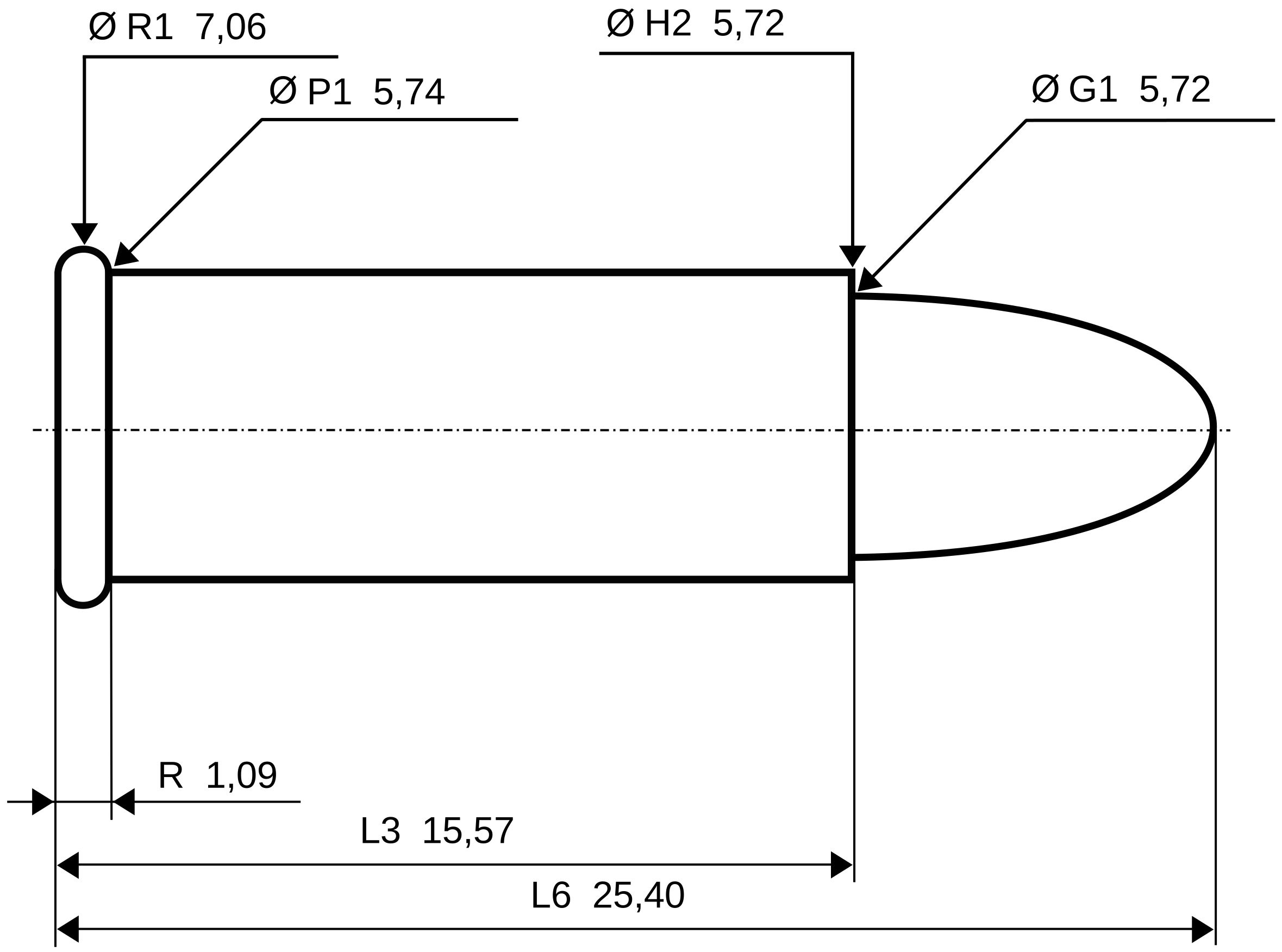
Note that .22 WMR and .17 HMR are supersonic in every normal loading. A can on them is a comfort device, not a quiet one, and no subsonic option meaningfully exists. The .17 HMR in particular is a small, fast, loud cartridge and stays loud.
5.7×28 is a centerfire cartridge in a rimfire-sized package and needs an explicit rating; do not assume.
3.8 The Backpacking Case
The .22 Rimfire dive Volume 11 works through a suppressed Ruger 10/22 Takedown as a backpacking rifle. The suppressor side of that argument in brief:
- The can is 4 ounces and rides in the pack half. It is the cheapest capability on the whole rig.
- A takedown rifle plus a can is a packed-length problem, not a weight problem. Measure the actual packed length with the can attached to the barrel half.
- Subsonic through a can, on a takedown host, means a rifle you can shoot without announcing it — which for small game is the whole point.
- The BDC reticle problem documented there is a suppressor problem in disguise: the reticle is calibrated for hyper-velocity ammunition and the load in use is subsonic. Because the scope is second focal plane, dialling magnification down increases the MOA each circle subtends, which is the correction needed. Those figures are estimates and need verifying on paper.
- Record a can-on/can-off zero offset per host. Six hosts, one can, six offsets. This is the number nobody else’s data can give you.
3.9 The Lever Gun — Henry’s Frontier, and Why It Is Not the Contradiction It Looks Like
A 24-inch lever-action .22 marketed as suppressor-ready looks, at first glance, like it argues with this dive. It does not. It is the clearest confirmation of §3.3 in the catalogue, and the reason is worth spelling out because it changes what to buy.
The rifle. Henry’s Frontier Model Threaded Barrel (H001TSPR): .22 S/L/LR, lever action, 24-inch octagon barrel, 1:16 twist, 1/2×28 threads with a .400-inch thread length, 10 rounds of Long Rifle or 16 of Short, 42.5 inches overall, 7.0 lb, American walnut.4
3.9.1 Why it is a better suppressor host than anything else in the example battery
It removes the cycling constraint entirely. §3.3 sets out the central problem of a suppressed rimfire: the quietest ammunition has the least momentum, and a blowback semi-auto needs momentum to run. Look again at that table and at the row that matters — CCI Quiet-22, 40 gr, ~710 fps, “dramatically quieter,” and “No. Single-shot only.” The quietest load in the whole list is the one the 10/22s cannot use.
A lever action can. It is a manual action, so it does not care what the load does or does not do to a bolt, which means the loudest thing left is the hammer falling. Henry’s own description of the result — a click, then the gong two-thirds of a second later — is the sound of a rifle that has run out of noises to make.5 Nothing else in the example battery can do that.
The 24-inch barrel helps twice, and this is the part that looks backwards. Longer barrels normally mean more velocity, and more velocity is the enemy of quiet. Rimfire inverts it: the .22 Rimfire dive establishes that .22 LR velocity peaks near 16 inches and then falls, because the powder is long since burnt and the bullet is still fighting friction. So 24 inches of barrel makes standard-velocity ammunition slower, not faster — more margin under the sound barrier — while also giving the gas more room to expand and cool before it ever reaches the can. Henry’s claim that a 24-inch barrel is “borderline ear-safe with subsonic ammunition all by itself”5 is not marketing; it follows from the same curve.
The manual action stays cleaner. Henry make this point too,5 and it matters more on a suppressed rimfire than anywhere else — a semi-auto blows fouling back through its own action every shot, and a suppressed one blows considerably more.
3.9.2 The genuine tension, which is not about the rifle
Buying it makes one problem in this dive worse, and it should be said plainly: §3.5 already argues for a second rimfire can on the grounds that six hosts sharing one Lima is six point-of-impact shifts and a battery offline every cleaning cycle. A seventh host does not improve that arithmetic.
So this purchase and the second-can recommendation are the same decision, not two. A Frontier bought without a second can is a seventh gun queuing for the Lima. Bought with one, it is the rifle that finally has a dedicated can — and the more sensible pairing is the new can on the Frontier, precisely because it is the host that justifies a permanent mount and a settled zero.
3.9.3 What to check before buying
- The thread is .400 inch long.4 Short threads are normal on rimfire and fine, but they leave less shoulder to square a can against — check that whatever can goes on it seats on the shoulder rather than bottoming on the threads.
- The tube magazine takes .22 Short, 16 of them. Short through a 24-inch barrel and a can is about as quiet as a firearm gets; it is worth a box purely to find out.
- It is a 42.5-inch rifle before the can. Add five or six inches and it is a genuinely long object — the opposite end of the spectrum from the takedown in §3.8, and not a pack rifle.
- 1:16 is the standard rimfire twist and stabilises everything from Short to 40-grain subsonic. No concern there.
The honest summary: this is the best-suited suppressor host discussed anywhere in this dive, and the only reason it comes last in this volume is that it is not part of the example battery. If one is added, §3.5’s second can stops being a convenience argument and becomes the obvious next purchase.
3.10 Bibliography
Footnotes
-
Mack Brothers, VAPOR 22LR – 5.7x28 Rimfire Suppressor — 100% titanium, 5 3/8 in, 4.3 oz, eight K-baffles, integrated disassembly tool. https://macbros.com/product/vapor-22lr-5-7x28-rimfire-suppressor/ ; https://macbros.com/suppressors-4/ ↩
-
Mack Brothers, suppressors page — MB762 and MB556 production ceased 2024, “but will still service and repair them.” https://macbros.com/suppressors-4/ ↩
-
Lyman Sonicore Skarv 22, $199, introduced SHOT Show 2026. https://www.lymanproducts.com/skarv-22 ↩
-
Henry Repeating Arms, Frontier Model Threaded Barrel, model H001TSPR — .22 S/L/LR, 24 in octagon blued steel barrel, 1:16 twist, 1/2×28 threads (.400 in thread length), 10 LR / 16 Short capacity, 42.5 in overall, 7.0 lb, American walnut. Specifications as published by the maker and repeated by retailers. ↩ ↩2
-
Henry Repeating Arms, “Peace and Quiet at the Range.” Source of the 24-inch “borderline ear-safe report with subsonic ammunition all by itself” claim, the manual-action-stays-cleaner point, and the click-then-gong description of a suppressed subsonic shot. A manufacturer’s own write-up about its own rifle, with no decibel measurements given — the physical reasoning above is what supports it, not the source. https://www.henryusa.com/the-henry-repeater/peace-and-quiet-at-the-range/ ↩ ↩2 ↩3
Comments (0)