Suppressors by Caliber · Volume 7
.45 ACP — Subsonic Since 1911
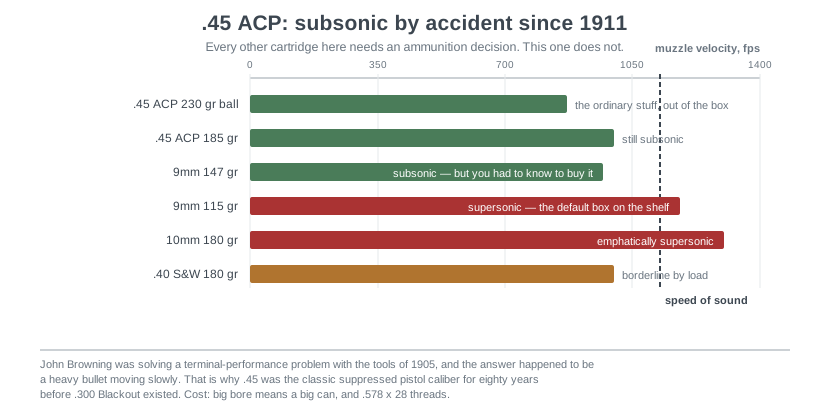
Every other cartridge in this dive requires you to make a choice about ammunition. .45 ACP does not. A standard 230-grain hardball load leaves a five-inch barrel at somewhere around 830 to 900 fps, and the speed of sound is about 1,125. There is no subsonic ammunition to seek out, no chronograph check, no temperature margin to worry about, and no 115-grain trap to fall into.
.45 ACP has been a subsonic cartridge since 1911, entirely by accident, because John Browning was solving a terminal-performance problem with the tools of 1905 and the answer happened to be a heavy bullet moving slowly. That is why .45 was the classic suppressed pistol caliber for eighty years before .300 Blackout existed, and why suppressed .45 is still one of the most satisfying things in the category.
7.1 What .45 Gives You
- No load selection problem. Buy ammunition. It is subsonic. Done.
- Low pressure. .45 ACP runs at roughly a third the chamber pressure of 9mm +P. That is easy on the can and permits lighter materials.
- Heavy, slow, large-diameter bullet — a genuinely capable terminal projectile at the velocity where it is also quiet, which is a coincidence 9mm does not enjoy.
- A big bore can suppresses smaller cartridges. A .45-bore can will run 9mm, .40, 10mm and .300 BLK if rated for them.
7.2 What It Costs
- Big bore means a big can. A .45 can is fatter and heavier than a 9mm can of comparable performance, because the bore has to pass a .451 bullet and the baffles have to be sized around it.
- Over-bore on smaller cartridges. Running 9mm through a .45-bore can works and is louder than a 9mm-bore can. If a can offers a smaller end cap for 9mm use, that is the cheapest suppression available.
- Ammunition is more expensive and there is less of it.
- Fewer hosts. The 9mm ecosystem is vastly larger.
- Sight-line problems are worse, because the can is fatter (§7.4).
7.3 Mounting
.578×28 is the domestic default thread for .45 ACP pistols and pistol-caliber carbines.1 It exists specifically so a .45 barrel cannot be threaded into a 9mm can.
Everything from Volume 6 about boosters applies identically. The 1911 is a tilting-barrel, short-recoil design — the original one — so it needs a booster, and the booster piston must be .578×28. The two-second test is unchanged: rack the slide, watch the barrel, and if it tilts you need a booster.
.45 carbines and fixed-barrel hosts take a rigid spacer.
7.4 The Osprey and the Sight-Line Problem
A 1.3–1.4 inch tube on the muzzle of a 1911 sits directly in front of the sights. The standard answers are suppressor-height sights or a red dot (Volume 2 §2.6).
The SilencerCo Osprey 45 takes a different route, and it is the most distinctive design in the pistol-can world: an eccentric, rectangular body offset below the bore axis, so the bulk of the can hangs under the sight line rather than through it. Standard-height factory sights still work.2
The trades, stated plainly:
- It is sealed. It cannot be disassembled for cleaning.2 For .45 shooting jacketed 230-grain hardball this is more defensible than it sounds — .45 ACP is a much cleaner cartridge than lead .22 or dirty subsonic 9mm — but it is a permanent limitation on a device you will own for decades.
- It has an orientation. The can must be indexed with the offset downward, which means the mounting system has to time it. This is a designed-in feature, not an afterthought, but it is a step.
- It is not round, which means it does not fit round things — holsters, cases, handguard bores.
For a dedicated suppressed .45 pistol where you want to keep iron sights, it remains the answer, and it has kept that position for over a decade.
7.5 The Modular Multi-Caliber Alternative
The other approach: buy a can rated for 9mm through .45 and let it be the only pistol can you own.
The Rugged Obsidian 45 is the reference: aluminium and stainless, modular full/short configurations, and rated from 9mm through .45 ACP, covering essentially every pistol cartridge a private owner is likely to run.3
This is a genuinely good answer for someone who owns a 9mm and a .45 and does not want two stamps, two waits and two purchases — and in 2026, with the transfer tax at $0, the arithmetic has shifted: the stamp no longer costs anything, so the argument for one multi-caliber can is now purely about money and clutter rather than about tax. Buying two purpose-bored cans is cheaper relative to the alternative than it was in 2024. (See the law dive — the wait and the paperwork remain, and those are now the real cost of a second can, not the tax.)
The trade remains what it always was: a .45-bore can on 9mm is louder than a 9mm-bore can on 9mm. If you shoot mostly 9mm and occasionally .45, buy a 9mm can and shoot .45 rarely somewhere else. If you shoot both seriously, one .45-rated modular can is a defensible single answer.
7.6 The Field
Table 1 — 7.6 The Field
| Can | Notes |
|---|---|
| SilencerCo Osprey 45 | The eccentric-body classic. Sight-line clearance with factory sights. Sealed |
| Rugged Obsidian 45 | Aluminium + stainless, modular, rated 9mm–.45. The multi-caliber default |
| Dead Air Ghost / Primal family | Full-size .45-rated cans; the Primal is the big-bore hard-use option |
| HUXWRX / flow-through .45 options | Backpressure is a minor issue on a .45 pistol; relevant on a .45 carbine |
Reported positioning. As everywhere in this dive: no cross-brand dB comparison, and specific claims are worth checking against PEW Science or a rental before committing.
7.7 Other Big-Bore Notes
.40 S&W and 10mm sit between. Both are supersonic in most standard loadings (10mm emphatically so), so both are comfort propositions unless you handload down or buy specialist subsonic. A 9mm-bore can generally will not pass them; a .45-bore can will, if rated. Threads are commonly 9/16×24.
.45 Colt, .450 Bushmaster, .458 SOCOM, .400 Legend are all big, slow, and often natively subsonic or nearly so — the same accident that makes .45 ACP quiet. They need big-bore rifle cans with explicit ratings, and the printed multi-caliber entrants of 2026 (Dead Air’s RXD910Ti spans 9mm to .400 Legend) are aimed squarely at this ground.
Revolvers cannot be usefully suppressed. The cylinder gap vents high-pressure gas sideways at every shot, and no muzzle device can address it. The Nagant M1895 with its gas-seal cylinder is the famous exception and is a museum curiosity, not an option.
7.8 Bibliography
Footnotes
-
Capitol Armory, “Suppressor Thread Pitch Guide by Caliber” — .578×28 as the domestic default for .45 ACP pistols and PCCs. https://www.capitolarmory.com/articles/suppressor-thread-pitch-guide ↩
-
SilencerCo Osprey 45 — eccentric body below the sight line so standard-height sights remain usable; sealed unit that cannot be disassembled for cleaning. Pew Pew Tactical, “Best 9mm & .45 ACP Suppressors [2026].” https://www.pewpewtactical.com/best-9mm-45acp-suppressors/ ↩ ↩2
-
Rugged Obsidian 45 — aluminium and stainless, modular full/short, rated 9mm through .45 ACP. Silencer Shop, “Best .45 ACP Suppressors of 2026.” https://www.silencershop.com/blog/best-45-acp-suppressor ↩
Comments (0)