How Suppressors Work · Volume 8
Backpressure — What the Can Does Back to the Gun
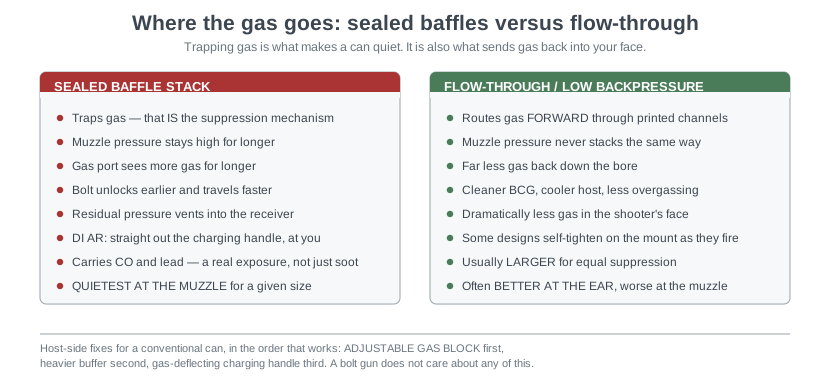
Everything so far has been about what the suppressor does to the gas going forward. This volume is about what it does to the gas going backward, which is the half of the subject that gets ignored until you have shot a suppressed AR indoors and come home with a headache and a black face.
8.1 Where Backpressure Comes From
A conventional suppressor works by restricting and trapping the gas column. That is not a side effect; it is the mechanism. But gas trapped ahead of the muzzle raises pressure at the muzzle, and pressure at the muzzle raises pressure everywhere upstream of it — including in the bore, for longer than would otherwise be the case.
On a bolt action or single shot, this costs you essentially nothing. The breech is locked, the case seals it, and the elevated bore pressure is dissipated by the time you lift the bolt.
On a gas-operated semi-automatic, it changes the whole operating cycle:
- The gas port sees higher pressure for longer, so more gas is tapped than the rifle was designed around.
- The bolt carrier unlocks earlier and travels faster.
- The case begins extracting while chamber pressure is still elevated.
- The residual pressure in the bore, with the bolt now opening, vents into the receiver — carrying carbon, unburnt propellant, lead and copper vapour with it.
The symptoms are diagnostic and every suppressed AR shooter knows them: gas in the face, black soot on the brass and on the shooter, a much dirtier bolt carrier group and trigger, an ejection pattern that rotates forward, more felt recoil, faster bolt speed, and accelerated wear on the extractor, gas rings, buffer and receiver extension.
On a direct-impingement AR the gas comes back down the gas tube and out the charging handle gap, straight into your face. This is the single worst case in common use, and it is why flow-through cans exist.
8.2 The Toxic Exposure Argument
The gas in your face is not merely unpleasant. It contains carbon monoxide and lead, and the exposure is measurable.
This is not a fringe concern; it is the driver behind the entire low-backpressure product category. Contemporary industry descriptions of flow-through technology lead with it — the claim is that venting gas forward “virtually eliminates back pressure and blowback, significantly reducing heat, wear, and toxic gas exposure.”1
The practical read for a private shooter:
- Outdoors, occasional use — a real but modest exposure.
- Indoors, or high round count, or an enclosed shooting position — this becomes the dominant health argument, and it is a bigger deal than the hearing argument you bought the can for.
- Suppressed pistol-caliber carbines and blowback guns are among the worst offenders, because a blowback action opens under residual pressure by design.
If you shoot suppressed indoors or in volume, ventilation and a low-backpressure design are worth more than the last three decibels.
8.3 Flow-Through
The engineering answer is to stop trapping the gas and start routing it.
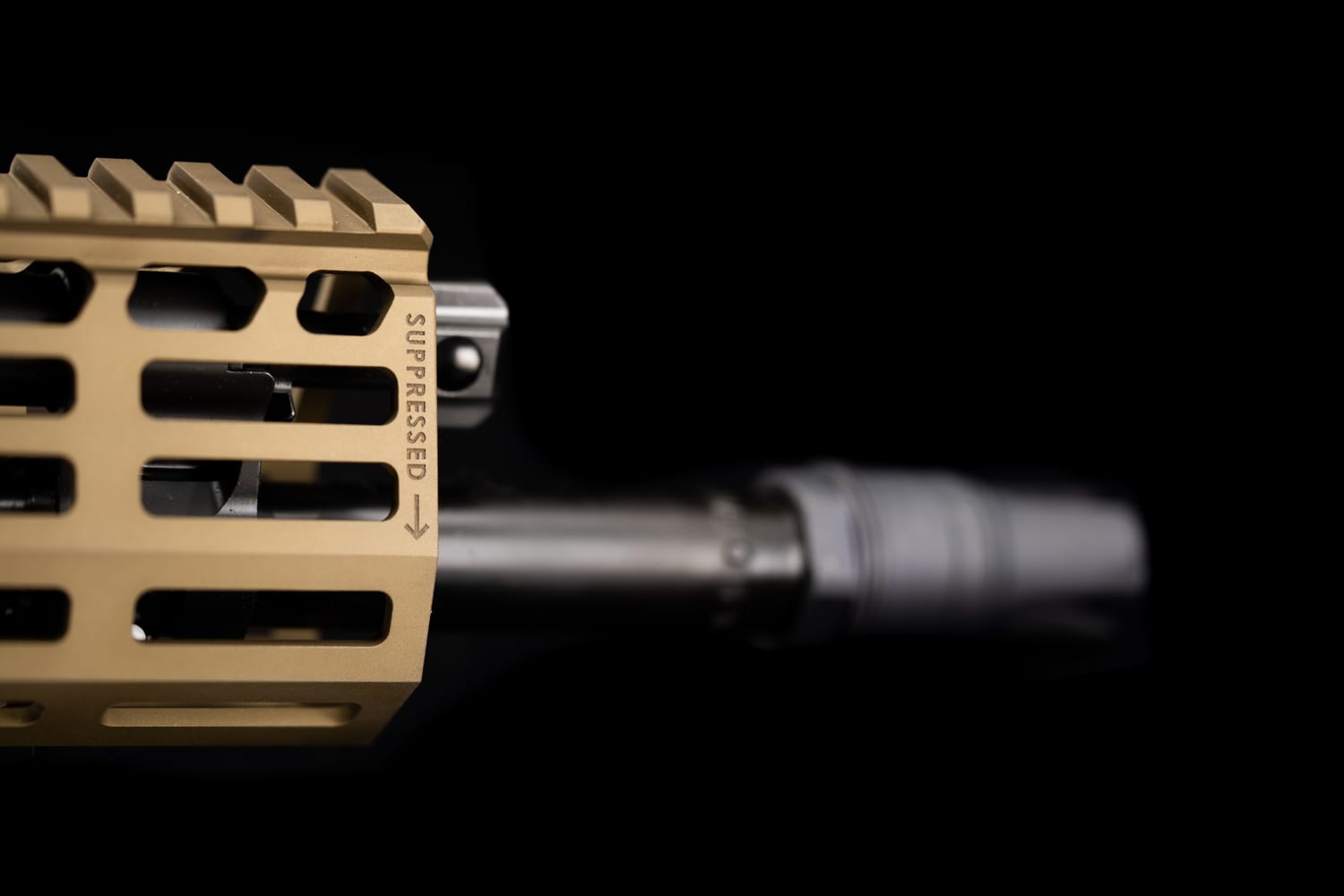
HUXWRX Flow-Through® — the technology formerly sold as OSS — uses a printed monolithic core whose passages direct high-pressure gas forward through the suppressor rather than trapping it and letting pressure stack up behind the bullet.2 The result at the host is dramatic: much less fouling on the bolt, far less gas in the face, and less overgassing of the operating system.3
The costs, stated honestly:
- For equal size, a flow-through can is generally not as quiet at the muzzle as a good sealed-baffle can. Trapping gas is what makes suppressors quiet, and a design that deliberately trades away some trapping trades away some suppression.
- But the at-ear experience often improves, because a large part of what you hear as a suppressed-AR shooter is gas venting out of the receiver next to your face — and that is exactly what the design removes. This is why flow-through cans can rate very well on at-ear metrics while measuring less impressively at the muzzle. It also illustrates why “how quiet is it” without a measurement position is a meaningless question (Volume 2).
- Flow-through cans are typically larger for a given level of suppression.
The 2026 field is broader than HUXWRX alone. Ambient Arms EXO takes a different route — an “Ambient Intake System” that draws outside air in, aimed primarily at temperature (claimed up to 75% reduction in operating temperature; the EXO 556 in titanium is reported to hold around 130 °F on the exterior after 40 rounds).4 Silent Steel USA’s Streamer line replaces baffles entirely with a turbine-and-filter gas-rotation arrangement targeting backpressure and blowback.4
All of these should be read as a category — “low backpressure” — rather than as a single technology, and all of them are trading muzzle dB for host health and shooter comfort.
8.4 Tuning the Host Instead
If you already own a conventional can, or you want the maximum suppression a sealed design offers, the other half of the answer is to fix the rifle.
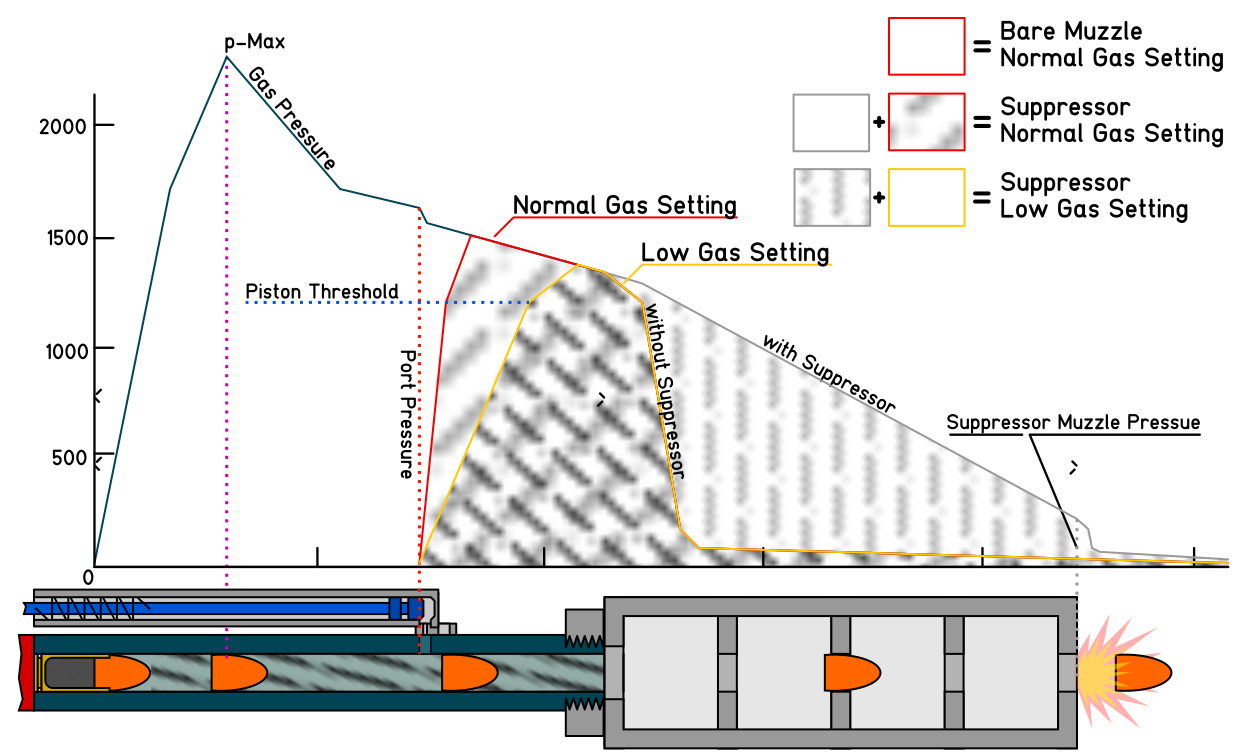
Adjustable gas block. The most effective single change on a gas gun. Dial the port down until the rifle cycles reliably suppressed with a margin, and the entire backpressure symptom list improves at once — less gas in the face, less fouling, slower bolt, less recoil, less wear. The cost is a second setting to remember when you take the can off, and a rifle that is now tuned around specific ammunition. Some blocks offer a two-position suppressed/unsuppressed detent, which is the practical answer for a rifle that runs both ways.
Heavier buffer, different spring. Slows the carrier and delays unlocking. Cheaper than a gas block, less precise, and it treats the symptom (carrier velocity) rather than the cause (gas volume). H2 and H3 buffers are the usual step. Effective and often sufficient.
Low-backpressure muzzle device / mount. Some QD mounts are designed to reduce the pressure the can reflects. A modest effect, but free if you are buying a mount anyway.
Charging-handle gas mitigation. Aftermarket charging handles with gas-deflecting geometry redirect what does come back out of the receiver away from your face. This treats none of the mechanism and all of the symptom, and for occasional suppressed use it is a genuinely sensible fifty dollars.
Ammunition. Slower-burning powders and heavier bullets change the gas curve. Real, small, and not usually a variable you get to control.
The stacking order that works: adjustable gas block first, buffer weight second, deflecting charging handle third. A low-backpressure can substitutes for the first two and does nothing the third does.
8.5 Piston Guns, Blowback, and Bolt Guns
Short-stroke piston ARs are less affected than direct impingement, because the gas is dumped at the block rather than routed into the receiver. They still overgas; they just do not blow it in your face. Many piston guns have adjustable regulators for exactly this reason.
Blowback guns — most pistol-caliber carbines, most .22 semi-autos — have no gas system to overgas, but they have the opposite problem: the breech opens under residual pressure by design, so adding a suppressor increases how much pressure is still present at that moment. The result is more blowback into the receiver, faster bolt velocity, and more battering. The fixes are mass and spring rate, not gas.
Bolt actions and single shots are unaffected mechanically and are, for that reason, the quietest hosts available with any given can and load. If your goal is maximum quiet, a bolt gun is worth more than a better suppressor.
8.6 The Practical Summary
Table 1 — 8.6 The Practical Summary
| If you are… | Prioritise |
|---|---|
| Suppressing a bolt-action hunting rifle | Maximum suppression. Backpressure is not your problem |
| Suppressing an AR-15 you shoot a lot | Low backpressure, or an adjustable gas block, or both |
| Suppressing an SBR / short barrel | Both, plus Volume 4’s material argument |
| Shooting suppressed indoors | Low backpressure and ventilation, above all else |
| Suppressing a pistol | Booster function first (Volume 7); backpressure is minor |
| Suppressing a rimfire | Ignore this entire volume, except that a dirty semi-auto .22 is normal |
8.7 Bibliography
Footnotes
-
HUXWRX Flow-Through® technology description — “virtually eliminates back pressure and blowback, significantly reducing heat, wear, and toxic gas exposure.” https://huxwrx.com/ ; Capitol Armory HUXWRX overview. https://www.capitolarmory.com/huxwrx ↩
-
Silencer Shop, “HuxWrx Suppressors Buying Guide.” https://www.silencershop.com/huxwrx-buying-guide ↩
-
The Firearm Blog, “Low Back Pressure Suppressors — Do They Really Make A Difference?” https://www.thefirearmblog.com/blog/low-back-pressure-suppressors-do-they-really-make-a-difference-44817520 ↩
-
The Truth About Guns, “[SHOT 2026] The Year of the Suppressor” — Ambient Arms EXO Ambient Intake System, EXO 556 titanium 14.5 oz / ~130 °F exterior after 40 rounds; Silent Steel USA Streamer / FLOW-IQ. https://www.thetruthaboutguns.com/shot-2026-the-year-of-the-suppressor/ ↩ ↩2
Comments (0)