How Suppressors Work · Volume 1
Overview — What a Suppressor Actually Does
A suppressor is a pressure vessel you deliberately shoot through. That is the whole device in one sentence, and almost every interesting engineering decision in this series follows from it: the thing has to survive a few thousand PSI and a couple of thousand degrees, several times a second, with a bullet passing down its centre at speed and a clearance measured in hundredths of an inch, while weighing less than a pound and threading onto a barrel someone else machined.
It is also the most misunderstood accessory in the sport. Hollywood spent seventy years teaching people that a silencer makes a gunshot sound like a cough, and the counter-reaction over the last decade has produced an equally wrong folk belief that suppressors “only take about 30 decibels off, so they’re basically earplugs.” Both are wrong in ways that matter when you are about to spend real money and wait on a federal approval.
This series is written for someone who already shoots, already understands pressure and heat, and wants the engineering. It assumes you know what a chamber is and do not need bluing explained. It is the first of three: this one is how the device works, the second is which one to buy for which cartridge, and the third is what the law is — which, as of 2026, is a genuinely moving target.
1.1 The One Idea
The muzzle of an unsuppressed firearm is a nozzle venting a few thousand PSI of hot gas directly into the atmosphere in under a millisecond. Pressure discontinuity that abrupt is the bang. Everything else about suppressor design is in service of one idea:
Give the gas somewhere to go, some time to get there, and something cold to touch on the way.
Volume, delay, and heat transfer. A suppressor traps the gas column in a series of chambers, forces it to change direction repeatedly, lets it expand into a volume far larger than the bore, and bleeds heat into the metal. By the time the gas reaches open air, its pressure and temperature — and therefore the discontinuity — are dramatically lower. The bang becomes a thump.
Every design decision downstream is a trade against that one idea. More internal volume is more reduction, but volume is length and diameter, and both are weight and handling. More gas-path complexity is more reduction, but complexity is backpressure, and backpressure is gas in your face and a battered rifle. More heat capacity is more durability, but heat capacity is mass.
There is no free variable. Anyone selling you a can that is lighter, shorter, quieter, and tougher than the competition is lying about at least one of them.
1.2 What It Cannot Do
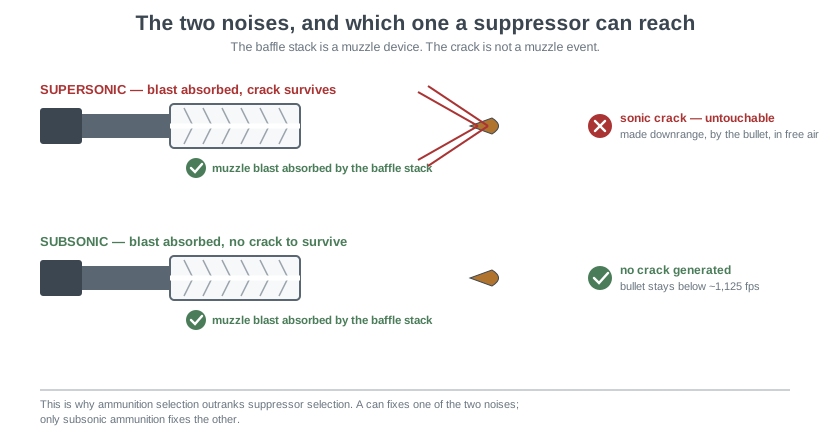
A suppressor can only suppress a muzzle event. This is not a limitation of current technology; it is a limitation of geometry, and it is permanent.
A supersonic bullet drags a shock cone behind it for its entire supersonic flight. That crack is generated in free air, tens and hundreds of yards downrange, by an object that left the suppressor microseconds earlier. There is no mechanism by which a device bolted to the muzzle can influence it. Volume 2 works this through properly; the practical consequence is stated here because it governs the entire buying decision:
If the ammunition is supersonic, the suppressor is a comfort device, not a stealth device.
That single sentence explains why .300 Blackout exists, why 147-grain 9mm is the only sensible suppressed pistol load, why .45 ACP was the classic quiet cartridge for eighty years, and why no amount of money spent on a 5.56 can will ever make a 5.56 rifle quiet. It is also why a $199 rimfire can shooting the right ammunition genuinely outperforms a $1,400 rifle can shooting the wrong ammunition, at the only job most people actually care about.
1.3 The Six Numbers
Every suppressor on the market can be usefully described by six numbers and one word. When you strip the marketing off a spec sheet, this is what remains.
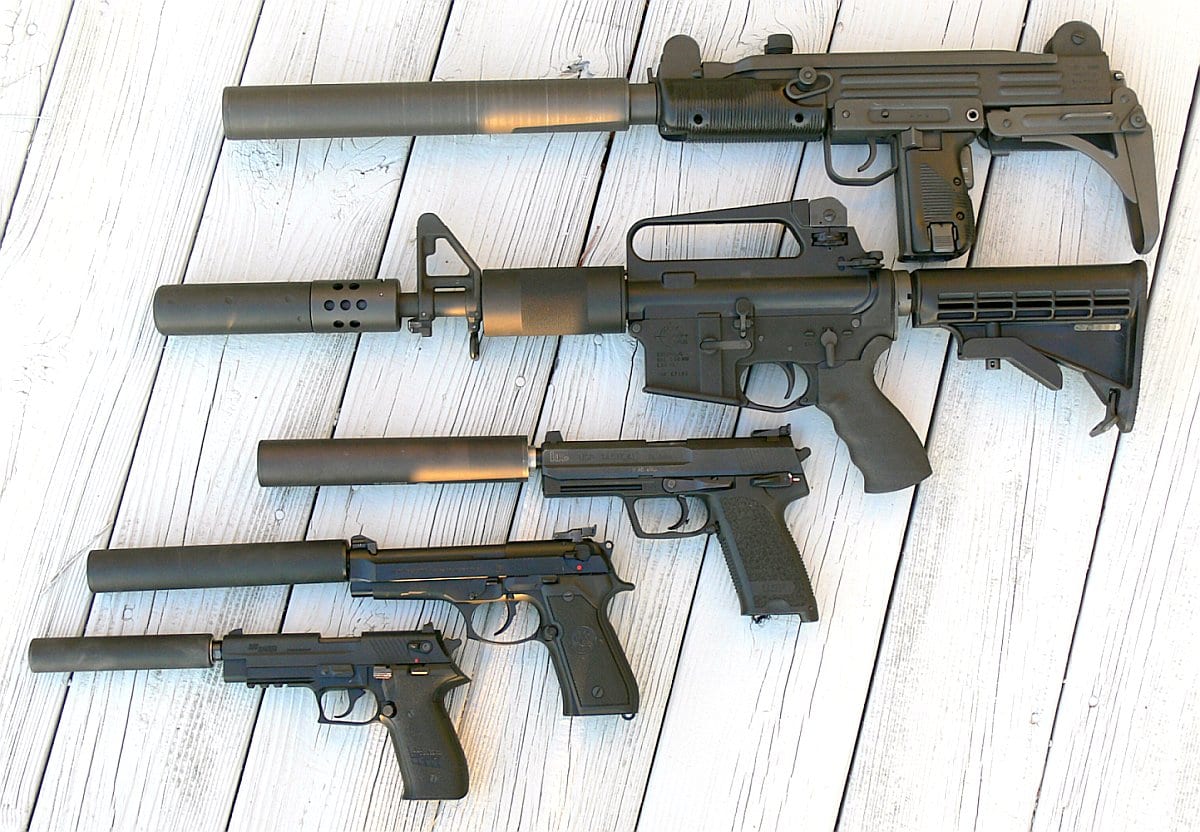
Table 1 — 1.3 The Six Numbers
| # | The number | What it actually tells you |
|---|---|---|
| 1 | Bore diameter | The largest caliber it can safely pass. Over-bore costs decibels — a .30 can on a 9mm host is quieter than nothing and louder than a 9mm can |
| 2 | Length | The dominant term in sound reduction. Length buys more quiet per ounce than diameter does |
| 3 | Diameter | Sight-line clearance, handguard clearance, and volume. 1.5 in is the modern rifle default; 1.0–1.25 in is a slim can |
| 4 | Weight | The number you will actually care about in the field, and the one materials get chosen to move |
| 5 | Rating | Cartridge, minimum barrel length, and firing schedule. This is a materials statement wearing a marketing hat |
| 6 | Rear thread | Whether you are locked into one mounting ecosystem forever. In 2026 the answer should be 1.375×24 HUB |
| — | Serviceable? | Take-apart or sealed. Non-negotiable in rimfire, largely irrelevant in centerfire rifle |
Notice what is not on that list: a decibel figure. That is deliberate, and Volume 2 explains why at length. The short version is that a manufacturer’s dB number is measured by the manufacturer, and dB numbers are not comparable across test protocols. Treating a spec-sheet dB as a comparison shopping input is the single most common mistake buyers make.
1.4 The Anatomy
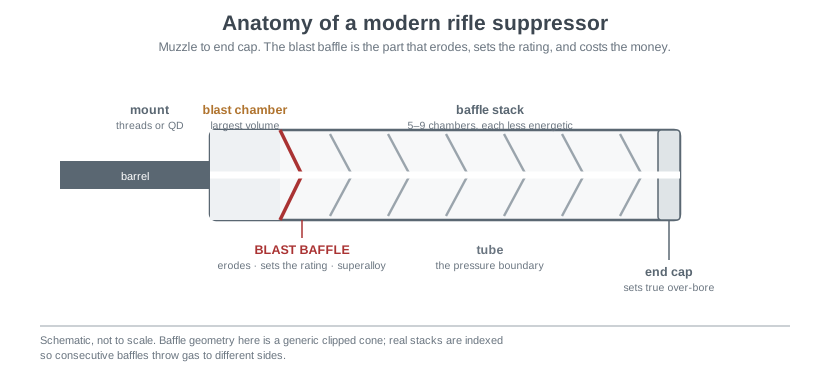
From the muzzle forward:
- The mount — either the barrel’s own threads (direct thread) or a muzzle device the can locks onto (QD). On a tilting-barrel pistol, a spring-loaded booster instead.
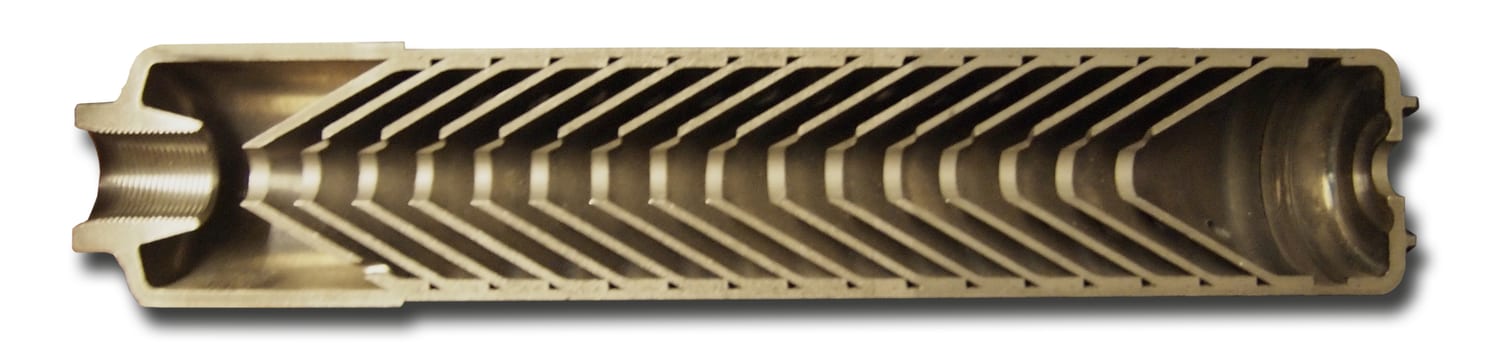
- The blast chamber — the first and largest volume, immediately ahead of the muzzle. It absorbs the worst of the pressure and temperature, and the baffle at its far end (the blast baffle) is the part that erodes, the part that dictates the rating, and the part made of the expensive alloy.
- The baffle stack — a series of chambers, each smaller in energy terms than the last, that repeatedly turn, shear and expand what the blast chamber did not absorb. Either discrete stacked baffles, or a single monocore with the chambers cut or printed into it.
- The tube — the pressure boundary. Titanium if weight matters, stainless if cost or cleaning matters, printed superalloy on the newest designs.
- The end cap — the last aperture the bullet passes through, and the one whose bore diameter determines the true over-bore.
Volume 3 dissects the baffle stack, Volume 4 the materials, Volume 5 the ways it gets manufactured, and Volume 7 everything at the mount end.
1.5 What a Suppressor Is Not
Three persistent confusions worth clearing before the technical volumes.
A suppressor is not a muzzle brake, and usually fights one. A brake redirects gas sideways and rearward to pull the rifle forward against recoil; it makes the gun louder at the shooter’s position because that is precisely where it is aiming the blast. A suppressor sends gas forward and makes it quieter. Some designs (TBAC’s Reduced-Recoil Magnus variants, for instance) put a brake inside the rear of the can, deliberately spending sound to buy recoil reduction. That is a real trade, not a free lunch.
A suppressor is not a flash hider, but it is an excellent one. Almost all remaining muzzle flash is unburnt propellant meeting atmospheric oxygen. A can does that combustion inside itself, in a volume that after the first shot contains almost no oxygen. Visible signature reduction is close to total. This is also, exactly, the mechanism behind first-round pop (Volume 9).
“Silencer” is not a wrong word. It is the statutory word — the National Firearms Act of 1934 and 18 U.S.C. § 921 both say “silencer,” Hiram Maxim’s company was the Maxim Silencer Company, and the ATF forms say silencer. “Suppressor” is the industry’s later, more accurate coinage. This series uses suppressor for the object and silencer whenever the law is speaking, and neither usage is a tell about the writer.
1.6 What This Series Covers
Volume 2 is the acoustics: the two noises, the third one you only hear once the others are gone, why decibel figures do not survive contact with a second laboratory, and what PEW Science’s Suppression Rating does about it.
Volume 3 is the inside of the can — blast chamber, cone, clipped cone, K-baffle, monocore, alternating-angle geometry, and the volume-versus-reduction relationship that governs all of it.
Volume 4 is materials, which is the volume that most changes purchasing behaviour: aluminium, titanium, 17-4 PH, Inconel 718, Haynes 282 and Stellite, and the fact that the material argument is really an argument about one part, the blast baffle.
Volume 5 is manufacturing, and it is the volume that dates this series to 2026. Direct metal laser sintering has stopped being a novelty and become the dominant way to make a high-end suppressor core, and it makes geometries that cannot be machined at all.
Volume 6 is take-apart versus sealed, and how to actually clean one without destroying it.
Volume 7 is threading and mounting — the thread-pitch table, concentricity, HUB, the QD ecosystems, boosters and Nielsen devices, and the alignment rod that will one day save you a thousand dollars.
Volume 8 is backpressure: what the can does back down the bore to the host, why flow-through designs exist, and the toxic-exposure argument that is quietly driving the whole low-backpressure category.
Volume 9 is behaviour on the gun — point-of-impact shift, return to zero, first-round pop, heat, mirage and covers.
Volume 10 is failure: everything that kills a suppressor, in rough order of how likely you are to do it.
The companion dives are Suppressors by Caliber, which turns all of this into purchases, and Suppressor Law, which covers the 1 January 2026 change and the litigation now moving through the federal courts.
1.7 The Honest Summary
If you read nothing else in this series:
- Subsonic ammunition or nothing. The can handles the blast; only the ammunition can handle the crack.
- Buy length before you buy anything else. Volume is reduction.
- The rating is a materials statement. Short barrel plus fast firing plus titanium equals a warranty conversation.
- Insist on a 1.375×24 HUB rear thread so you are not married to a mounting system.
- Check alignment with a rod, every host, every time.
- Rimfire cans must come apart. Centerfire rifle cans mostly should not.
- Ignore spec-sheet decibels. Use PEW Science, or your own meter, or your own ears — but do not compare two manufacturers’ own numbers to each other.
Comments (0)