How Suppressors Work · Volume 6
Take-Apart or Sealed — and How to Clean One Without Ruining It
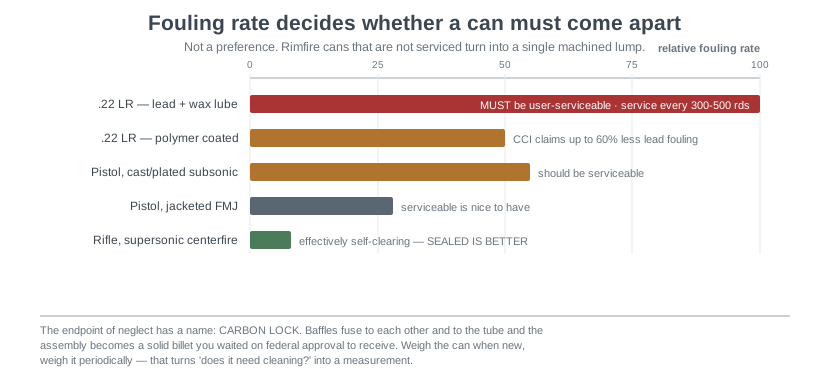
“Is it user-serviceable?” is the question most often asked in the wrong context. For a rimfire can it is the most important question on the spec sheet. For a centerfire rifle can it is close to irrelevant, and insisting on it costs you weight, strength and money for nothing.
The reason is entirely about what the ammunition leaves behind.
6.1 The Fouling Gradient
Table 1 — 6.1 The Fouling Gradient
| Cartridge class | What it deposits | Self-clearing? | Verdict |
|---|---|---|---|
| .22 LR and rimfire | Unjacketed lead, wax bullet lubricant, heavy carbon, primer residue — in quantity | No. Low pressure, low temperature, nothing burns it off | Must be serviceable |
| Pistol, subsonic centerfire | Lead from cast and plated bullets, heavy carbon, some jacket material | Partly | Should be serviceable |
| Rifle, supersonic centerfire | Carbon, jacket copper traces | Largely yes. Pressure and temperature keep the stack reasonably clear | Sealed is fine and usually better |
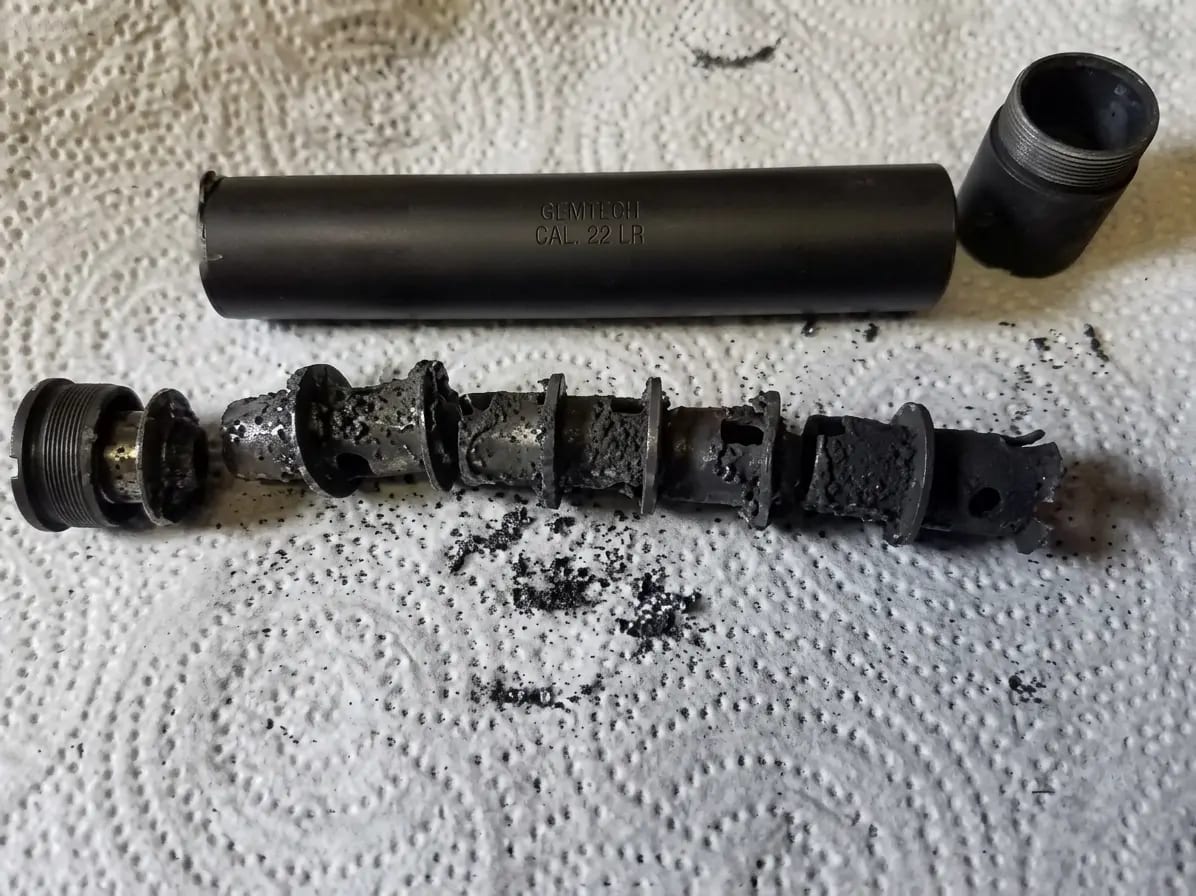
The mechanism behind the top row is worth being explicit about. A .22 LR bullet is bare lead with wax lubricant on the outside. Every shot atomises some of both into a chamber that never gets hot enough to burn it off and never sees enough pressure to blow it out. It condenses on the baffles and accumulates. Add the carbon and the primer residue and you are building up a soft, dense, sticky deposit at a rate of grams per few hundred rounds.
The endpoint has a name: carbon lock. A rimfire can left unserviced long enough becomes a single fused lump — the baffles seize to each other and to the tube, the end cap will not move, and the assembly is now a machined billet you paid several hundred dollars for and waited on federal approval to receive. It is a self-inflicted, entirely preventable, total loss. It is also the single most common way privately-owned suppressors die.
Rifle cans have the opposite problem, which is to say they do not have one. Two thousand degrees and thirty-odd thousand PSI several times a second is an excellent cleaning process. The carbon that does accumulate reaches an equilibrium thickness and stops. A welded rifle can that has fired ten thousand rounds and never been opened is normal, healthy, and exactly as intended.
6.2 What Sealed Construction Buys
Given that a rifle can does not need opening, sealing it is not a compromise — it is an optimisation:
- Strength and stiffness. A welded or printed monolithic core is one structure. A threaded, stacked one is held together by a threaded joint and by whatever preload the end cap applies.
- Weight. Threaded joints need material thickness that welded ones do not.
- Concentricity. Set once at manufacture, rather than re-established every time the owner reassembles it.
- No indexing errors. You cannot put the baffles back in the wrong rotational order if you cannot take them out.
- No loosening. A stack that can come apart can come apart under recoil.
The SilencerCo Osprey 45 is the canonical sealed pistol can — a design that accepts non-serviceability in exchange for its distinctive geometry. That is a defensible trade for .45 ACP, whose 230-grain jacketed loads are far cleaner than lead .22, but it is a trade, and it is the reason the modular serviceable pistol cans exist alongside it.
6.3 What Take-Apart Costs
Nothing dramatic, but it is not free:
- Weight and bulk from the threaded interfaces.
- A reassembly discipline. Indexed baffles must go back in order and orientation. Numbered or keyed stacks exist for exactly this reason; unnumbered ones are a trap.
- Thread galling, especially titanium-on-titanium, if you reassemble dry. Use a high-temperature anti-seize.
- The possibility of doing it wrong — a baffle in backwards is a baffle strike waiting for the next round.
Every rimfire can worth buying accepts these costs, because the alternative is carbon lock. The good designs minimise the cost: click-together baffles (Dead Air Mask), a captive integral disassembly tool (Mack Brothers VAPOR),1 or a monocore that comes out as a single indexed piece and cannot be mis-ordered at all.
6.4 How Often
There is no universal interval; there is a rule of thumb per class.
- Rimfire: every 300–500 rounds is the commonly quoted band, and the honest answer is before it gets hard to open, which is a thing you learn by feel on your specific can and ammunition. If the end cap needs more than firm hand pressure and a strap wrench, you have already waited too long. Shooting polymer-coated ammunition materially extends the interval (§6.7).
- Centerfire pistol: every few thousand rounds, or when accumulated weight becomes noticeable — a heavily fouled pistol can gains ounces.
- Centerfire rifle: effectively never. Wipe the exterior, check the mount, leave the inside alone.
Weigh your can when it is new and write the number down. A gram scale and a known baseline turns “does it need cleaning?” from a guess into a measurement. This is the single most useful five minutes of maintenance discipline available, and almost nobody does it.
6.5 Methods That Work
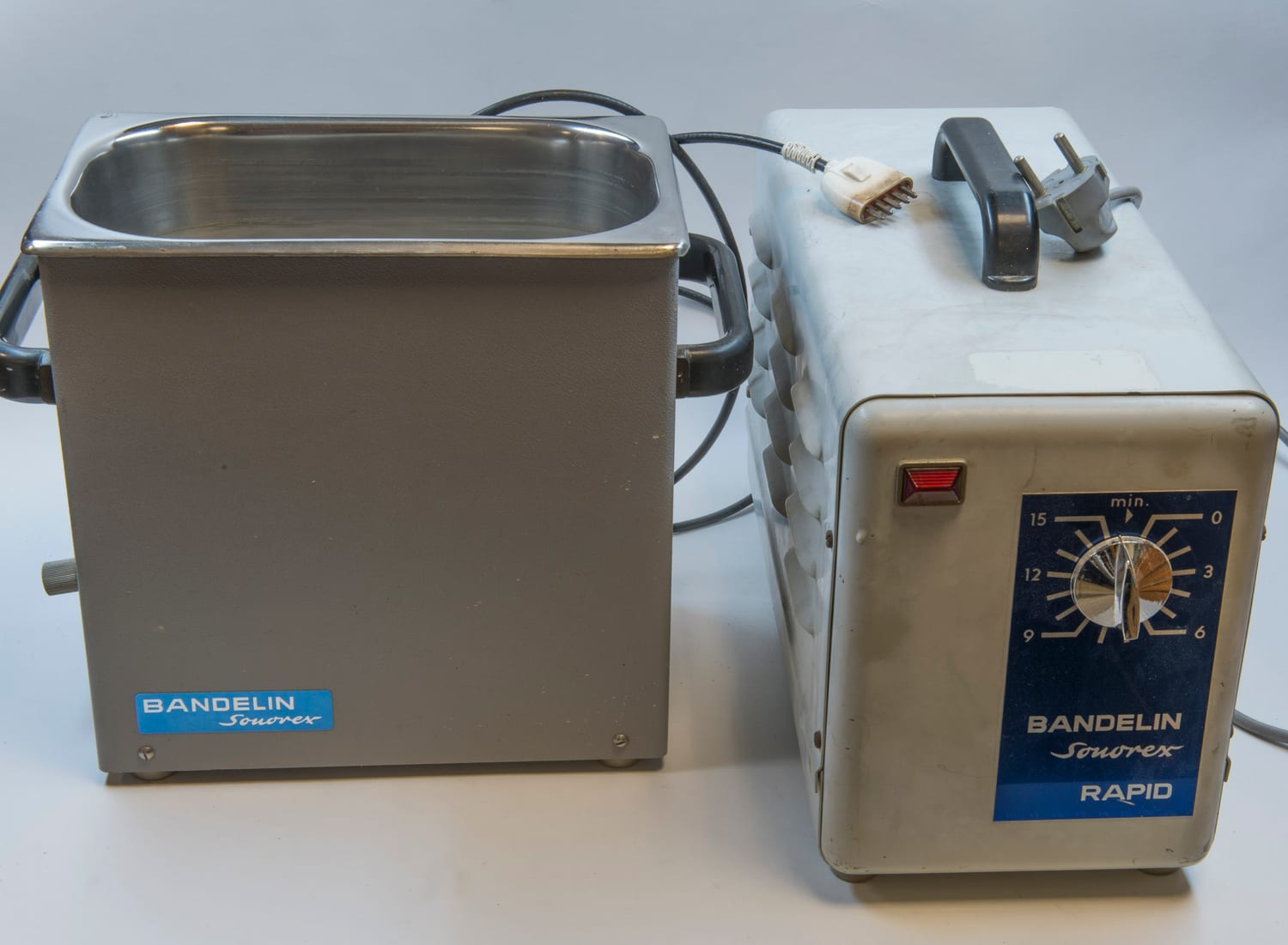
Ultrasonic cleaner with an appropriate solution. The best general answer. Disassemble, submerge, run warm, rinse, dry thoroughly. Use a solution rated for the material — a general metal cleaner for stainless and titanium, an aluminium-safe formulation if any part of the can is aluminium.
Mechanical removal. Nylon or brass brushes, picks, and a lead-removal cloth. Slow, tedious, completely safe. On heavily locked baffles, brass scraping and patience beats any chemical shortcut.
“The Dip.” The folk method: household ammonia-based cleaners (the classic is a 50/50 mix of an ammoniated cleaner and water), which dissolve lead effectively over hours. It works, and it is genuinely popular.
🔴 Ammonia attacks aluminium. “The Dip” is a stainless-and-titanium technique only. Put an aluminium rimfire baffle or tube in it and you will find pitting, or worse, a part that has partially dissolved. Anodising is not protection — it is a surface layer with an unsealed edge everywhere the part was machined. Know what your can is made of before any chemical touches it. Ammonia also causes stress-corrosion cracking in some copper alloys, so do not leave anything brass in it either.
Steam or boiling water with a detergent. Slow, safe, surprisingly effective on wax lubricant specifically, which is a large fraction of rimfire fouling by volume.
6.6 Methods That Cause Damage
- Bead blasting or abrasive media on a baffle. Changes dimensions, destroys surface finish, embeds media in the metal. Never.
- Wire wheels and power tools. Same reasons, faster.
- Ammoniated anything on aluminium — see above.
- Heat guns and torches to “burn off” fouling. Anneals or otherwise alters heat-treated parts. A 17-4 PH baffle is precipitation hardened; you can undo that with a torch.
- Firing it clean. The theory that you can burn the lead out of a rimfire can with a magazine of high-velocity ammunition is popular and wrong. It does not get hot enough, and if it did, you would be running an aluminium can well outside its temperature envelope.
- Reassembling wet. Trapped solvent corrodes, and steam on the next shot is not helping.
- Over-torquing the end cap. Hand tight plus a nudge. A strap wrench is for disassembly.
6.7 The One Real Product Innovation
The most useful development for rimfire suppressor owners is not a suppressor at all. It is CCI Clean-22, whose polymer bullet coating replaces the traditional wax lubricant. CCI claims up to 60% less suppressor lead fouling.2
For anyone running a rimfire can, and especially for anyone running an out-of-production one they would rather not disassemble any more often than necessary, that is the highest-leverage change available: no hardware, no disassembly, just a different box. It does not eliminate cleaning. It roughly halves how often you do it.
6.8 The Out-of-Production Case
A specific and increasingly common situation, and one that applies directly to the example battery in the caliber dive.
If you own a can the manufacturer no longer makes, the maintenance calculus changes:
- You are the parts supply. Lose or damage a baffle and there may be no replacement. Handle disassembled components like the irreplaceable objects they are — a soft tray, in order, nothing rolling off a bench.
- Document the reassembly before the first disassembly, not after. A photograph of the stack laid out in order, with the index features visible, is a five-minute insurance policy against a permanent mistake.
- Clean it more, not less. Carbon lock on a supported can is a warranty repair. Carbon lock on an orphan can is the end of the object.
- Check whether the maker still services it. This is the part people assume the worst about and are often wrong. Mack Brothers ceased production of the MB762 and MB556 in 2024 and publicly committed to continuing to service and repair them.3 A discontinued product from a living company is a very different situation from a dead company’s product.
That is precisely the position of the Mack Brothers Lima documented in the .22 Rimfire dive: not in the current catalogue, but from a manufacturer still trading, still making rimfire cans (the VAPOR), and with a stated policy of supporting discontinued models. The caliber dive works through what that means for whether to replace it.
6.9 Bibliography
Footnotes
-
Mack Brothers, VAPOR — “uses an integrated tool to allow for user disassembly and cleaning after a day in the field or on the range.” https://macbros.com/product/vapor-22lr-5-7x28-rimfire-suppressor/ ↩
-
CCI Clean-22 — polymer coating replacing wax lubricant; CCI claims up to 60% less suppressor lead fouling. Carried forward from the .22 Rimfire dive, Volume 10. ↩
-
Mack Brothers, suppressors page — production ceased on MB762 and MB556 in 2024, “but will still service and repair them.” https://macbros.com/suppressors-4/ ↩
Comments (0)