How Suppressors Work · Volume 10
Failure — Everything That Kills a Suppressor
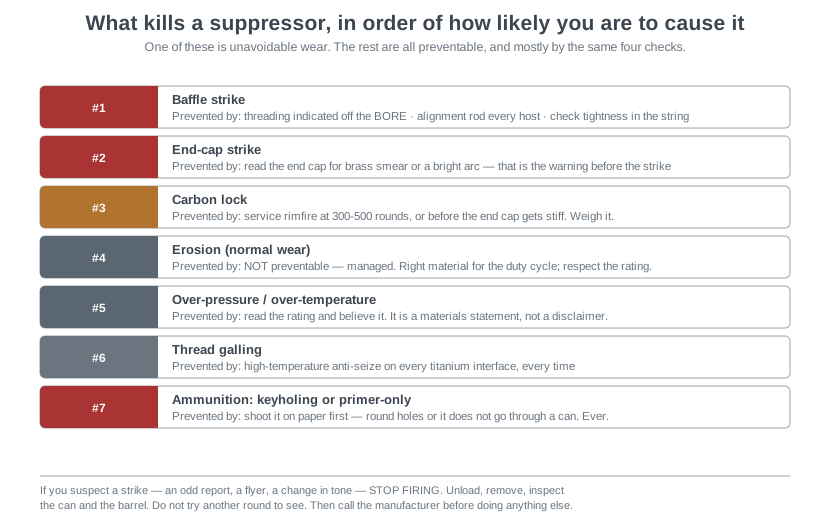
Suppressors are durable. A correctly matched, correctly mounted, correctly maintained can is a lifetime object, and the ones that die young almost never die of old age. They die of a small number of specific, identifiable, preventable causes — and one that is not preventable at all, only manageable.
This volume is ordered by how likely you are to be the cause.
10.1 Baffle Strike
What it is. The bullet hits a baffle instead of passing through its aperture. At a few thousand feet per second this is a violent, instantaneous event. Best case: a gouged baffle, a wrecked can, a bullet that continues downrange with unpredictable flight. Worst case: the can splits or is blown apart, and it is bolted to a barrel two feet from your face and inches from your support hand.
It is the number one killer of privately owned suppressors, and it is almost always the owner’s fault.
Causes, in order of frequency:
- Bad muzzle threading — threads cut off the barrel’s outside diameter rather than indicated off the bore. The can is aimed slightly sideways and nothing downstream can fix it.
- A non-square shoulder. Tightening the can against a shoulder that is not perpendicular to the bore levers it off axis.
- A loose can. Direct-thread cans walk loose under recoil. A can that has backed off half a turn is no longer square to anything.
- A worn, fouled, damaged or incorrectly timed QD mount. Carbon on a taper prevents full seating; a mount that has been over-torqued or crushed sits crooked.
- Unstable ammunition. A bullet that is yawing when it leaves the muzzle is not travelling along the bore axis. Twist rate mismatch is the usual cause. The canonical rimfire example is Aguila’s 60-grain Sniper Subsonic, which needs 1:12 or faster and keyholes out of the 1:16 that ships on essentially every .22 — a keyholing bullet in a baffle stack is exactly this failure mode with the ammunition as the culprit.
- A can screwed onto the wrong caliber. 1/2×28 fits both a .22 and a 5.56. Only one of them fits through a .22-bore can.
- Assembly error. A take-apart can reassembled with a baffle backwards, out of index, or missing.
Prevention is four things, all covered in Volume 7 and all cheap: thread indicated off the bore; check with an alignment rod on every host, every time anything changes; check tightness during a string; and read the end cap for contact marks after use.
10.2 End-Cap Strike
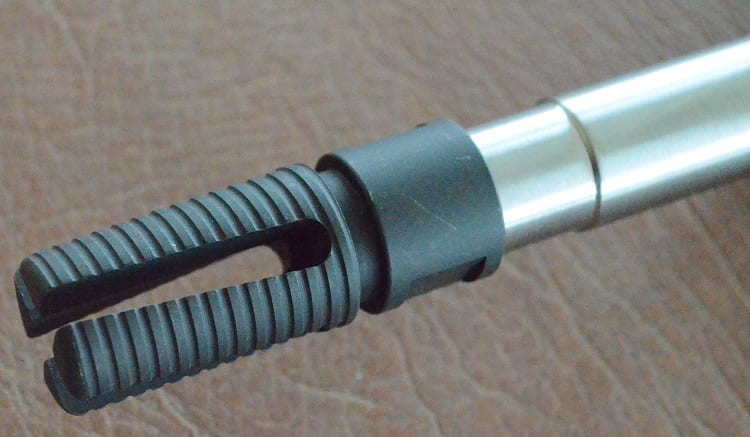
The same event at the last aperture. It is more common than a mid-stack strike because the end cap is the tightest constriction in the can and is furthest from the mount, so any angular error has the longest lever arm to work with.
Additional causes specific to it:
- A too-tight end cap for the application — a precision-bore end cap on a rifle with marginal stability.
- A caliber-specific end cap fitted to the wrong cartridge on a multi-caliber can with interchangeable caps. Check what is fitted before you mount it on a different host.
Diagnostic sign short of a full strike: a bright arc, brass or copper smear, or lead wash on one side of the end-cap aperture. That is the bullet’s slipstream, or the bullet itself, kissing the edge. It means you are one variable away from a strike. Stop and investigate.
10.3 Carbon Lock
The preventable, slow-motion death, and the most common one after baffle strike.
Covered fully in Volume 6: a serviceable can — overwhelmingly a rimfire can — left unserviced until lead and carbon fuse the baffles to each other and to the tube. The end cap will not move; the stack will not come out; the can is now a solid machined billet.
Recovery is sometimes possible with long chemical soaks (respecting the aluminium warning), heat cycling, penetrating oil and patience, and gunsmiths do occasionally rescue them. Often it is not, and it is never worth the anxiety.
Prevention is a calendar entry and a scale. Weigh the can new; weigh it periodically; clean at 300–500 rounds of rimfire, or before the end cap becomes hard to turn, whichever comes first.
10.4 Erosion
The one that is not preventable, only managed. This is normal wear, and every suppressor has it.
Where: the blast baffle, at the aperture and on the face. Occasionally the bore of the first one or two subsequent baffles.
What it looks like: the aperture gradually enlarges and loses its sharp edge; the face washes out and roughens; on titanium, the metal thins.
What accelerates it: short barrels (more unburnt propellant and higher residual pressure into the blast chamber), magnum pressures, high rates of fire without cooling, and running a material outside its thermal envelope.
What it costs you: decibels first — an enlarged blast-baffle aperture is a bigger leak — and eventually, in the terminal case, structural integrity.
What to do: buy the right material for the duty cycle (Volume 4), respect the barrel-length and firing-schedule ratings, and let it cool. Many manufacturers will re-core or rebuild a worn can; ask before you need to.
The reassuring part: at rates a private owner can actually afford, erosion is a non-event. This is a machine-gun and duty-rifle problem. It is why the ratings exist, not something that is going to happen to your deer rifle.
10.5 Over-Pressure and Over-Temperature
Running a cartridge, pressure or firing schedule the can was not rated for.
Over-pressure is a pressure-vessel failure and it is sudden. A can rated for .308 fired with .300 Win Mag, or a pistol can fired with rifle ammunition, or a rimfire can fired with 5.56.
Over-temperature is gradual and invisible: the metal softens, creeps, and loses strength permanently. A titanium can that has been past its envelope looks fine and is no longer what you bought. There is no inspection you can do at home to detect it.
Both are prevented by the same single act: read the rating and believe it. The rating is not a legal disclaimer; it is a materials statement (Volume 4). “Semi-auto only” means the metal needs time between rounds.
10.6 Mechanical and Assembly Failures
- Thread galling. Titanium galls readily against titanium. A galled mount is a can that will not come off, or a thread that is destroyed coming off. Anti-seize, every time, on any titanium interface.
- Cross-threading. Start every thread by hand, backwards, until it drops in. Never force.
- Weld failure on welded stacks — rare, essentially always a very high round count or a prior over-temperature event.
- Booster failure. Springs weaken, pistons foul, and the failure presents as a pistol that stops cycling. A maintenance item, not a catastrophe.
- Lost or damaged parts during cleaning — the specific hazard of owning an out-of-production can (Volume 6 §6.8).
10.7 Ammunition-Caused Failures
Two rules, both absolute, both carried over from the .22 Rimfire dive because that is where they bite hardest:
Never fire ammunition that keyholes. If you see oval holes in paper, the bullet is yawing, and a yawing bullet in a baffle stack is §10.1. Check twist rate before buying heavy-for-caliber subsonic loads; verify on paper before putting anything new through a can.
Never fire primer-only ammunition through a suppressor. Aguila Colibri and Super Colibri carry no powder charge at all and have repeatedly been reported to lodge partway down a rifle barrel. A bullet that stalls in a bore is a serious problem; a bullet that stalls in a baffle stack — with a live round behind it — is a destroyed suppressor at best.
A third, less absolute: cast lead through a rifle can is a fouling decision rather than a safety one, but a can full of lead is a can you now have to service.
10.8 The Prevention Checklist
Everything above, as a routine. It takes about two minutes.
Before mounting on a host you have not used before, or after any change to the muzzle:
- Threads cut indicated off the bore, shoulder square, crown undamaged
- Alignment rod check — rod passes freely, annulus concentric at the end cap
- Correct bore diameter for the cartridge, and correct end cap if interchangeable
- Correct booster or spacer for the host (barrel tilts → booster; barrel fixed → spacer)
- Anti-seize on the threads
- Mount fully seated, taper clean, muzzle device correctly timed and torqued
Every session:
- Can tight before the first shot, and checked during the string
- End cap inspected after firing for contact marks or wash
- Nothing fired that keyholes, and nothing primer-only
Periodically:
- Weigh it against the new-condition baseline
- Rimfire: service at 300–500 rounds, or before the end cap gets stiff
- Inspect the mount interface and booster for wear
- Check the blast-baffle aperture if the design allows
10.9 What to Do If It Happens
If you suspect a strike — an unexpected report, a flyer, a change in tone, a visible mark — stop firing immediately. Unload, remove the can, inspect it inside and out and inspect the barrel. Do not “try another round to see.”
If the can is damaged, contact the manufacturer before doing anything else. Most reputable makers will repair or replace, sometimes even where the cause was owner error, and they would all rather see the part than a photograph of it.
The legal note, which is not intuitive: a suppressor is a registered NFA firearm. You may not simply mail it to the manufacturer as if it were a scope. Repair returns to the original manufacturer are handled under a specific procedure, and a can that is destroyed still exists on the registry until ATF is notified properly. The law dive covers repair, replacement, loss and destruction. Do not improvise this part.
Comments (0)