How Suppressors Work · Volume 5
Manufacturing — The Additive Revolution, and What It Changed
This is the volume that dates the series. If you read a suppressor buying guide from 2015 and one from 2026, almost every difference between them traces back to one process: direct metal laser sintering. It has moved from exotic to dominant in about five years, and it has changed what the inside of a good suppressor looks like.
5.1 The Three Traditional Methods
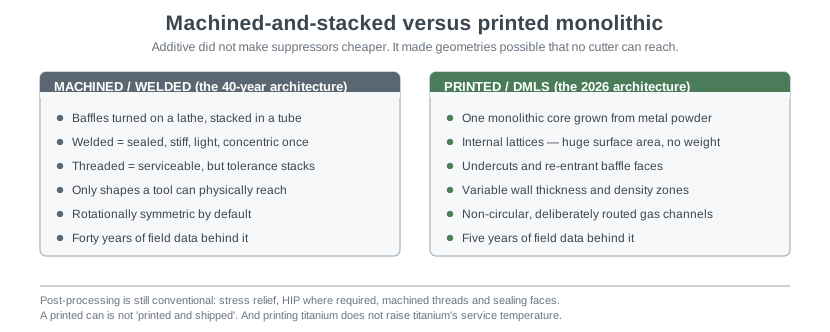
Machined-and-stacked. Each baffle turned on a lathe (and often milled for clipping and indexing features), the tube turned or drawn, the whole assembly held together by the end cap threading down onto the stack. Serviceable by design, because the stack was never bonded. Every take-apart can in the world is built this way. Tolerances stack across every part, so concentricity is a cumulative problem.
Welded stack. Same baffles, but welded to each other or to the tube into one permanent unit. Stiffer, stronger, lighter for the same strength (no threaded joints to keep thick), and sealed — it cannot be taken apart, which for a centerfire rifle can is a feature rather than a limitation. The overwhelming majority of rifle cans built before about 2020 are welded stacks. Fully welded stacks also solve the concentricity problem by fixturing everything once.
Machined monocore. A single bar of material with the chambers cut into it, dropped into a plain tube. Cleanable, simple, and limited by what a cutter can physically reach — which is the constraint that mattered, and the one that additive removed.
5.2 What DMLS Actually Is
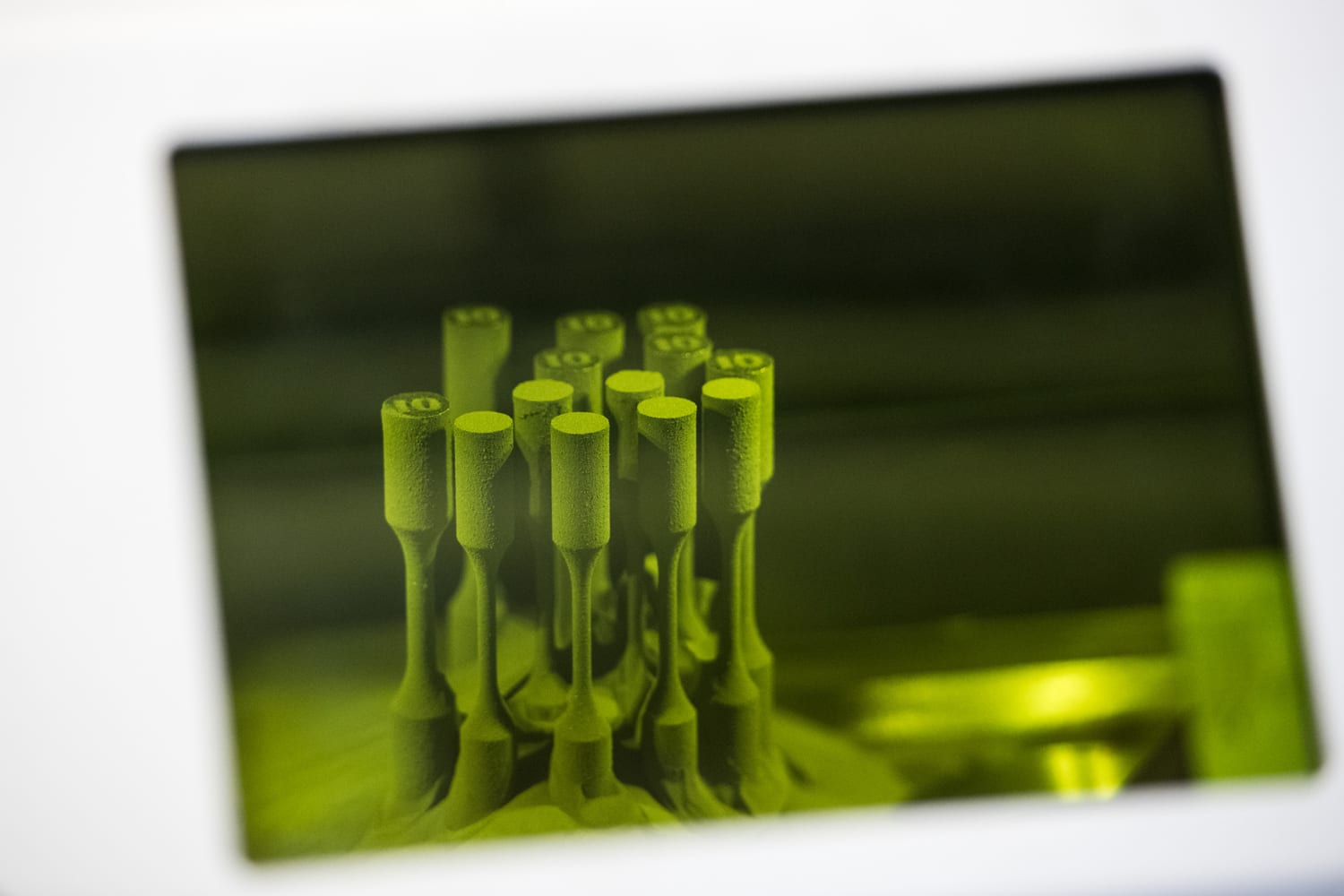
Direct metal laser sintering builds a part from powder: a thin layer of metal powder is spread across a build plate, a laser fuses the cross-section of the part, the plate drops, and the process repeats. What emerges is a solid, monolithic component grown from the bottom up.1
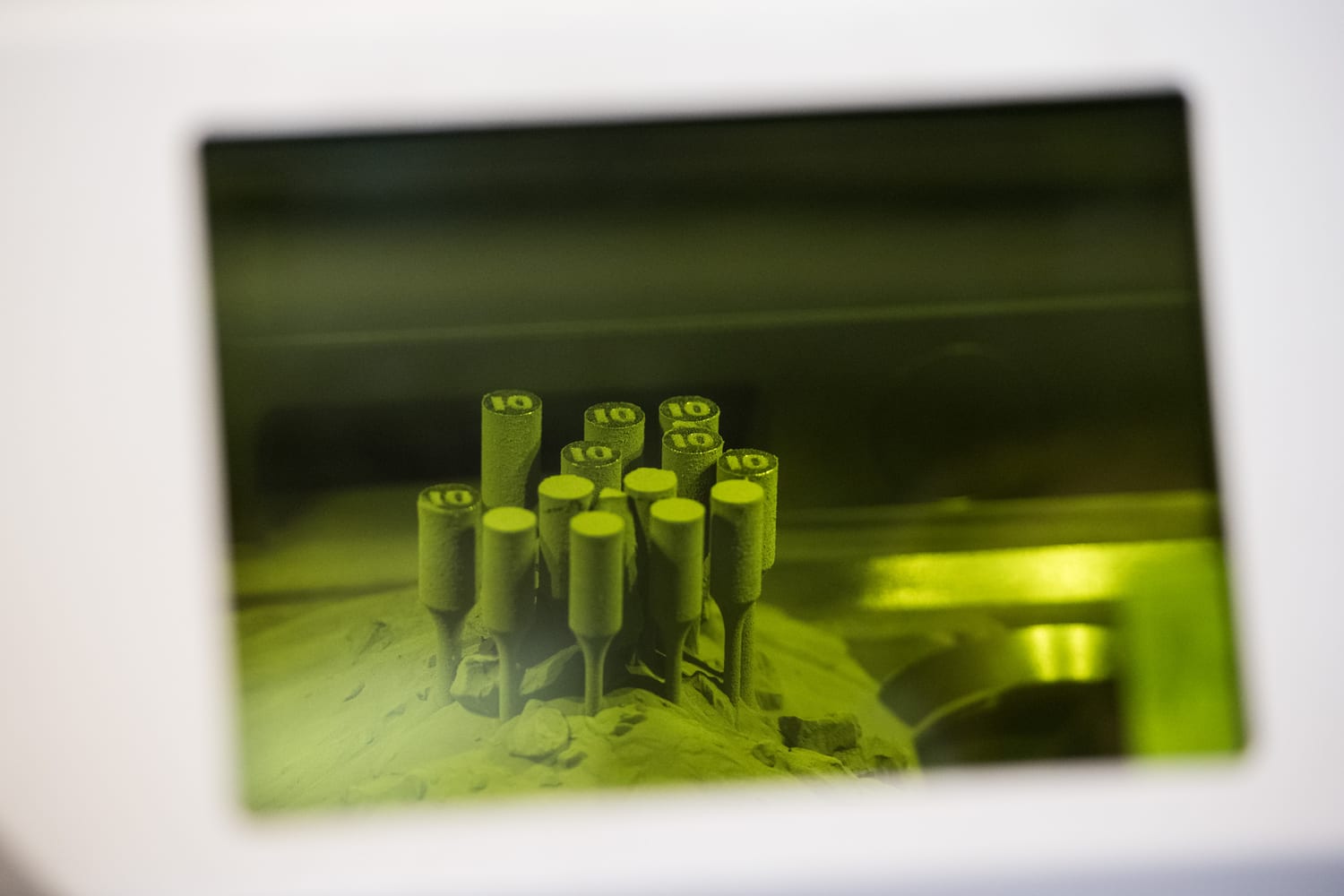
By 2026 this has matured into a scalable, production-grade process for suppressor cores, working in Ti-6Al-4V and in the nickel superalloys.2 Post-processing — stress relief, HIP where required, machining of the threaded interfaces and sealing surfaces — is still conventional, so a printed can is not “printed and shipped.” But the acoustic geometry is grown, not cut.
5.3 What It Buys You
The point is not cost, and it is not speed. It is geometry that no cutter can produce.
- Internal lattices — self-supporting structures inside the gas path that add enormous surface area for heat transfer while weighing almost nothing.
- Undercuts and re-entrant surfaces — baffle faces that curl back on themselves to trap gas that a machined cone would let past. A lathe tool cannot reach behind its own cut; a laser has no such problem.
- Variable wall thickness and density zones — thick and dense where the blast baffle needs mass and heat capacity, thin and light two inches further forward where it does not.
- Non-circular and asymmetric passages — deliberately routed channels rather than the rotationally symmetric shapes a lathe imposes.
- One part instead of nine — no tolerance stack, no indexing, no assembly, and concentricity set by the machine rather than by accumulation.
Contemporary industry summaries describe printed baffle structures “with internal lattices, variable-density zones, and gas flow channels that would be physically impossible to machine.”2 That is not marketing hyperbole; it is a straightforward statement about tool access.
5.4 The Flow-Through Case Study
The clearest demonstration of what additive enables is the flow-through architecture, which HUXWRX (formerly OSS) builds using DMLS.3
A conventional baffle stack traps gas and lets pressure build behind the bullet — some of which necessarily goes back down the bore. A flow-through core instead routes gas forward through deliberately designed channels, so that the pressure ahead of the shooter’s action never rises the same way. The geometry that does this is a set of curved, interleaved passages wrapping around the bore. You cannot machine it. You can print it in one piece.
A pleasing detail of the design: the passages are oriented such that the gas flowing through them torques the suppressor tighter onto its mount with every shot.3 That is the kind of thing you only get to do when the internal geometry is arbitrary.
Volume 8 covers what flow-through is actually for, and what it costs acoustically.
5.5 The Price Floor Collapsed
The second effect of additive manufacturing is commercial, and it arrived in 2026.
At SHOT Show 2026, Lyman — a reloading-equipment company, not a suppressor house — entered the market with the 3D-printed Sonicore line: the Skarv 22 rimfire can at $199, a Valor 9 aluminium 9mm can, and Rekkr DT and Paradox .223/.30 models including over-the-barrel variants at around $299.4 Hearing-safe suppressors in the two-to-three-hundred-dollar band, from a mainstream brand, is new.
Combine that with the federal transfer tax going to $0 on 1 January 2026 (see the law dive) and the arithmetic for a first-time buyer changed completely inside one year: a $199 can plus a $0 stamp plus a dealer fee, versus a $700 can plus $200 plus a dealer fee eighteen months earlier. The trade press has taken to calling 2026 “the year of the suppressor,” and for once the label is defensible — the demand driver and the supply driver arrived simultaneously.5
5.6 What Additive Does Not Fix
Worth stating, because the enthusiasm is running ahead of the engineering.
- Printed metal is not automatically better metal. As-printed microstructure differs from wrought, and porosity, residual stress and anisotropy are real. Reputable manufacturers stress-relieve and inspect; the process discipline is the product.
- A printed can is still bound by materials. Printing titanium does not raise titanium’s service temperature. The Volume 4 ratings argument is unaffected.
- Sealed is still sealed. A printed monolithic core cannot be disassembled. For a rifle can that is correct; for a rimfire can it would be a serious defect, which is why printed rimfire cans are usually printed monocores that still slide out of a tube.
- Novel geometry needs novel validation. A lattice that measures well over 200 rounds may behave differently at 5,000. The traditional welded-stack architecture has forty years of field data behind it. The printed ones have five.
None of that argues against buying a printed can. It argues for buying one from a manufacturer with a service history and a real warranty.
5.7 The Other 2026 Approaches
Additive has also enabled a small burst of genuinely unconventional designs, all of which should be read as interesting and unproven rather than as settled improvements:
- Ambient Arms EXO — a patent-pending “Ambient Intake System” that draws outside air into the can to manage heat. Claims include up to 75% lower operating temperature, with the EXO 556 (titanium, 14.5 oz) reported to hold roughly 130 °F exterior after 40 rounds; an Inconel EXO 5.56i MINI runs 19.4 oz.5
- Silent Steel USA Streamer / FLOW-IQ — replaces baffles altogether with a turbine-and-filter gas-rotation arrangement, aimed at backpressure and blowback.5
- Dead Air RXD910Ti — a printed multi-caliber can spanning 9mm, 10mm, .300 Blackout and .400 Legend, which is a caliber span that would be hard to justify in a machined design.5
- Over-the-barrel (reflex) designs returning in force — the Dead Air Nomad TI OTB is 7.65 in long but adds only 4.6 in to the rifle by sleeving back over the barrel, at 10.5 oz in titanium.5
That last one is the trend to watch. Now that suppressors are being bought for hunting rifles rather than for ARs, the length a can adds matters more than the length the can is, and reflex designs answer exactly that.
5.8 Bibliography
Footnotes
-
Description of DMLS in suppressor manufacture — “very precise lasers connect within a bed of fine metal powder, fusing the particles into a solid structure… fuse metal into solid one-piece shapes that would be near impossible to machine.” True Shot Academy, “Traditional vs Flow Through Type Suppressors.” https://trueshotammo.com/blogs/true-shot-academy/traditional-vs-flow-through-type-suppressors ↩
-
The Truth About Guns, “2026 Suppressor Technology: Modular Designs, 3D Printing, Alloys.” https://www.thetruthaboutguns.com/2026-suppressor-technology-innovations/ ↩ ↩2
-
HUXWRX Flow-Through® technology; DMLS construction and the gas-driven self-tightening effect. https://huxwrx.com/ and Silencer Shop, “HuxWrx Suppressors Buying Guide.” https://www.silencershop.com/huxwrx-buying-guide ↩ ↩2
-
Lyman Sonicore line, introduced SHOT Show 2026 — Skarv 22 at $199; Rekkr DT / Paradox at approximately $299. https://www.lymanproducts.com/skarv-22 ↩
-
The Truth About Guns, “[SHOT 2026] The Year of the Suppressor.” https://www.thetruthaboutguns.com/shot-2026-the-year-of-the-suppressor/ ↩ ↩2 ↩3 ↩4 ↩5
Comments (0)