How Suppressors Work · Volume 3
Inside the Can — Blast Chamber, Baffles, and Monocores
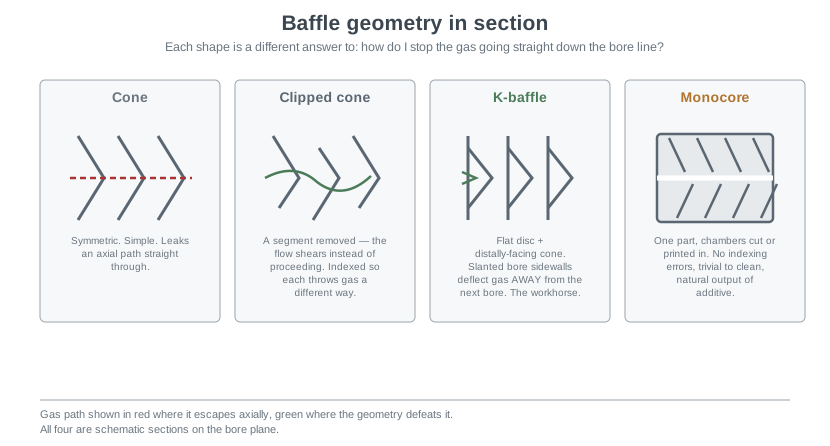
Cut a suppressor in half and you find a sequence of chambers separated by shaped obstructions. That is the entire architecture, and it has not fundamentally changed since Hiram Maxim. What has changed — enormously, and mostly in the last five years — is the geometry of the obstructions, because manufacturing finally caught up with the fluid dynamics.
3.1 The Blast Chamber
The first chamber, immediately ahead of the muzzle, is not like the others and should not be thought of as one.
When the bullet clears the crown, the gas column behind it is at something on the order of a few thousand PSI and a couple of thousand degrees Fahrenheit, and it is moving faster than the bullet. The blast chamber’s job is to catch that and let it expand into a volume many times the bore’s. Because it takes the event at full intensity, it is:
- The largest single volume in most designs — often as large as the next several chambers combined.
- The hottest and most eroded region. The baffle at its downstream end, the blast baffle, is the part that wears out. Every material argument in Volume 4 is really an argument about this one component.
- The place ablatives go. Water, gel, grease or oil in the blast chamber both absorbs energy through phase change and displaces the oxygen responsible for first-round pop.
A design that gets the blast chamber wrong cannot be rescued by the rest of the stack, because the rest of the stack never sees enough energy to matter.
3.2 Cones and Clipped Cones
The simplest useful baffle is a cone with a bore hole at its apex, pointing back toward the muzzle. Gas following the bullet hits the cone’s inner surface, is turned radially outward into the chamber, swirls, expands, and loses energy against the wall. Stack several and you get a serviceable suppressor. This is the geometry a first-time home builder draws, and it works.
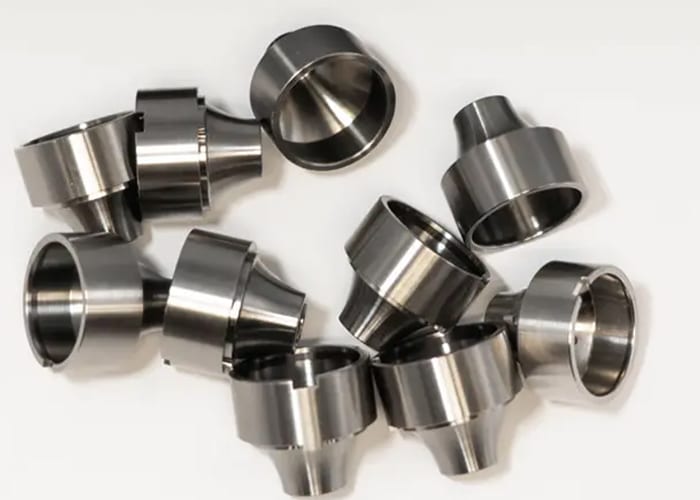
Its weakness is symmetry. A perfectly symmetric cone gives the gas a clean, axial escape route straight down the bore line, following the bullet. Some fraction of every chamber’s gas simply goes straight through.
The fix is the clipped cone: take a segment off the cone so the geometry is asymmetric. Now the gas turned by one side of the baffle is not balanced by an equal flow from the other, so the column shears and tumbles instead of proceeding neatly. Clipped baffles are usually indexed — each rotated relative to its neighbour — so that gas is thrown to a different side at each stage and never establishes a stable axial path.
Indexing is why some take-apart suppressors have keyed, numbered baffles that must be reassembled in the correct rotational order. Ignore the index marks and the can gets louder, and in a bad case the bore holes stop being concentric.
3.3 The K-Baffle
The workhorse of the modern industry. A K-baffle is a flat disc joined to a distally-facing cone such that its cross-section looks like the letter K.1 Two things distinguish it from a plain cone:
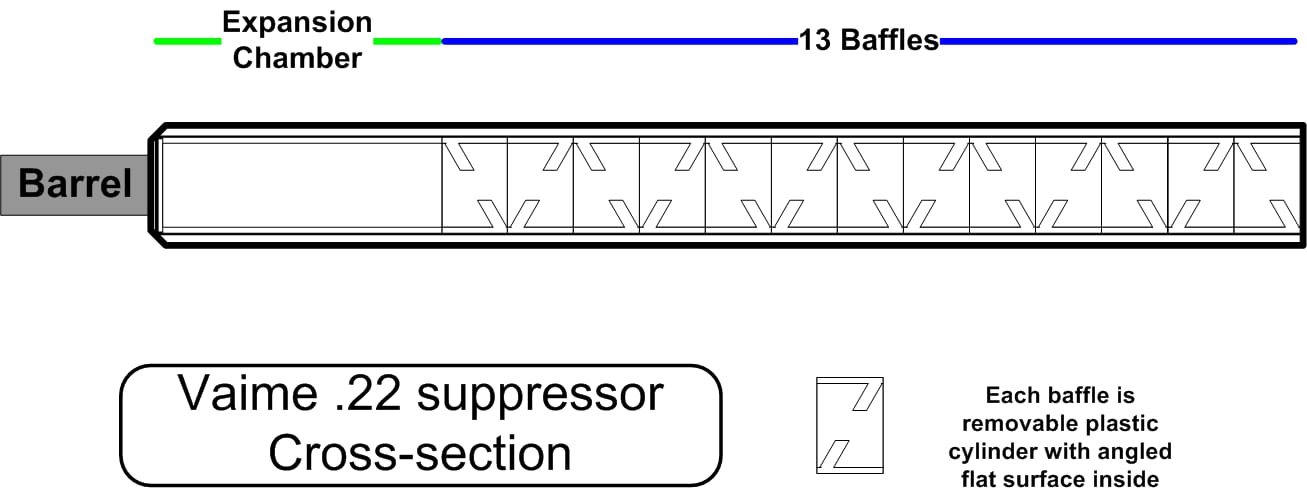
- The flat disc face presents a wall perpendicular to the flow, which is more aggressive at stopping the gas column than an angled cone alone.
- The bore sidewalls are slanted, so gas approaching the aperture is deflected away from travelling down the next baffle’s bore, rather than being funnelled into it.1
The result is a compact, efficient, mechanically simple baffle that stacks well, machines well, and is easy to key for indexing. It is why so many cans across so many price points are internally similar: the K-baffle stack is close to a solved problem for the machined-and-stacked construction method.
Mack Brothers’ current rimfire can, the VAPOR, uses a stack of eight K-baffles in titanium — a fair illustration of how far this geometry scales down.2
3.4 Monocores
A monocore replaces the stack of discrete baffles with a single part that has the chambers cut into it, usually as a set of scalloped pockets around a central bore, sitting inside a plain tube.
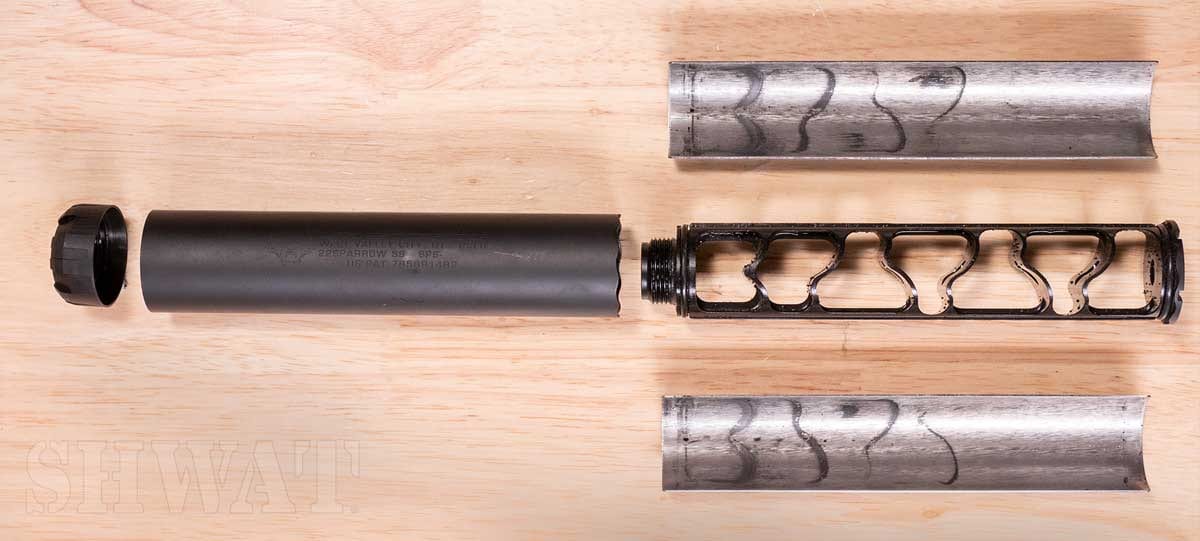
Table 1 — 3.4 Monocores
| Stacked baffles | Monocore | |
|---|---|---|
| Cleaning | Disassemble, clean each, reassemble in index order | One part in, one part out |
| Indexing errors | Possible | Impossible |
| Efficiency per unit volume | Generally slightly better | Generally slightly worse |
| Machining | Many simple parts | One complex part |
| Additive manufacturing | Awkward | Natural |
| Concentricity | Tolerance stacks across every baffle | Set once, on one part |
The efficiency gap is real but modest, and it is shrinking, because monocores are what additive manufacturing wants to produce. When you can print internal geometry rather than cut it, the “single part” constraint stops being a constraint at all — which is Volume 5’s subject.
Monocores dominate in two places: rimfire, where cleanability outranks the last decibel, and printed centerfire cores, where the manufacturing method chose the architecture.
3.5 Alternating and Asymmetric Geometry
The current patent literature is largely about making the gas do more work per inch. Two recurring ideas:
Alternating-angle walls. Baffle walls tilted at opposing angles in sequence, so gas leaving one chamber enters the next already turning the wrong way. The claimed benefit is both mechanical — flow is interrupted more aggressively — and acoustic, with the counter-rotating flows interfering destructively.3
Poly-conical and multi-surface baffles. Rather than a single cone angle, a baffle carries several conical surfaces at different angles, each catching a different portion of the expanding front.4
Neither is exotic any more. Both show up in mass-market cans, because printing them costs no more than printing a simple shape.
3.6 Wipes and Ablatives
Two ways to put something consumable in the gas path.
Wipes are elastomer or polymer discs the bullet punches through, sealing the bore between shots. They are extremely effective — historically the quietest suppressors ever made used them — and they are almost extinct commercially, for good reasons: they degrade rapidly, they shift point of impact as they wear, they are caliber-specific, they can deflect a bullet as they tear, and in US law a replacement wipe is itself a silencer part. A handful of specialist and integrally-suppressed designs still use them.
Ablatives are a consumable substance rather than a part: a few cc of water, wire-pulling gel, ultrasound gel, or a smear of grease in the blast chamber. The mechanism is phase change — vaporising the liquid absorbs a large amount of energy — plus displacement of the oxygen that causes first-round pop. Effects are real, immediate, and short-lived (a handful of shots). Common in rimfire and pistol use; pointless and messy in a hot rifle can.
Neither is a substitute for volume. Both are ways to spend consumables to buy a few dB you did not have room for.
3.7 Volume, Chamber Count, and Diminishing Returns
Given a fixed internal volume, how many chambers should it be divided into?
Not one, and not thirty. A single large expansion chamber is a poor suppressor — the gas expands but is never turned or sheared, and it exits as one coherent pulse. Too many small chambers and each is too small to expand into meaningfully, while the accumulated restriction drives backpressure (Volume 8) through the roof.
The practical answer, arrived at empirically by the whole industry, is a large blast chamber followed by a handful of progressively less energetic chambers — typically 5 to 9 in a full-size rifle can. The first chamber may remove a third or more of the energy; the last may remove a couple of percent. This is why cutting a modular can to its short configuration costs less than you would guess from the length ratio, and why adding a fourth inch to a three-inch can helps more than adding a tenth inch to a nine-inch one.
3.8 Over-Bore: The Hole at the Front
The end cap bore is the last aperture, and it defines the true clearance around the bullet.
Manufacturers set that clearance conservatively, because the alternative is an end-cap strike. Typical practice is a bore a few thousandths to a few hundredths over the projectile diameter — tighter on precision-oriented cans, looser on multi-caliber and hard-use cans.
Consequences:
- A caliber-specific can is quieter than a multi-caliber can on the same cartridge, because less gas escapes forward around the bullet.
- Running a big-bore can on a small cartridge always works and is always louder. A .30 can on 5.56 gives up meaningful dB; a .45 can on 9mm likewise.
- Some cans ship with interchangeable end caps so you can fit the aperture to the cartridge. If a can offers this, use it — it is the cheapest decibel available.
- A tighter bore is less forgiving of alignment error. This is the trade, and it is why over-bore exists at all.
3.9 Bibliography
Footnotes
-
US Patent 11,118,856 (self-cleaning firearms suppressor) and US 9,086,248 (sound suppressor) — K-baffle described as a flat disc joined to a distally-facing cone, K-shaped in section, with slanted bore sidewalls deflecting gas away from the downstream cone bore. ↩ ↩2
-
Mack Brothers, VAPOR 22LR – 5.7x28 Rimfire Suppressor product page. https://macbros.com/product/vapor-22lr-5-7x28-rimfire-suppressor/ ↩
-
Monocore and alternating-angle baffle-wall geometry as described in current suppressor patent literature; see US 11,118,856. ↩
-
US Patent 8,100,224, Suppressor with poly-conical baffles. ↩
Comments (0)