How Suppressors Work · Volume 4
Materials — Why the Argument Is Really About One Part
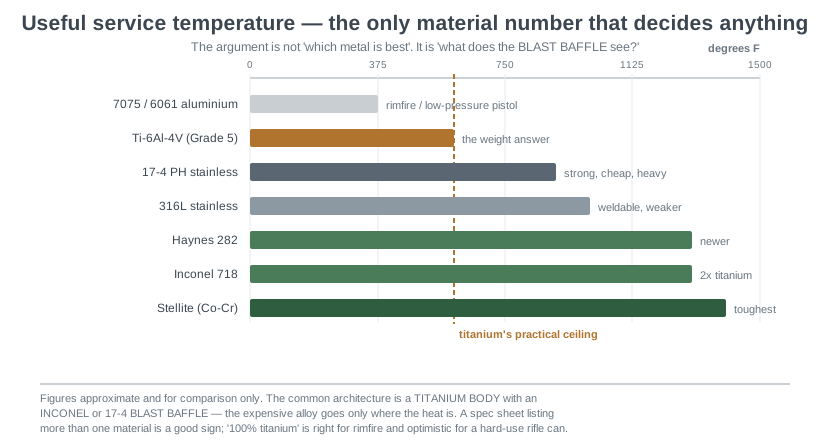
Ask which material is best and you will get an argument. Ask which material is best for the blast baffle of a 10.5-inch 5.56 rifle fired in magazine dumps, and you get an answer. The material question is meaningless without the duty cycle, and the duty cycle is set almost entirely by one component.
4.1 The Operating Environment
A suppressor’s internals see:
- Peak pressures of a few thousand PSI at the blast baffle, decaying rapidly down the stack.
- Gas temperatures on the order of 2,500–3,000 °F at the muzzle for centerfire rifle cartridges, though the metal never reaches that because exposure is milliseconds and the metal has thermal mass.
- Sustained metal temperatures that are the real design driver. A rifle can that has absorbed a magazine of 5.56 through a short barrel can glow. Externals in the 800–1,000 °F range are achievable and cans have been observed to soften and deform at that point.
- Erosive particulate flow — unburnt propellant, primer residue, bullet jacket and lead vapour, moving at supersonic speed, sandblasting the same spot every shot.
- Mechanical shock with each round.
The gradient down the can is steep. The blast baffle sees all of the above; the last baffle sees a fraction of it; the tube mostly just has to hold pressure and not melt. This is why hybrid construction is the norm and not a compromise.
4.2 The Materials
Table 1 — 4.2 The Materials
| Material | Density (rel.) | Useful service ceiling | Where it belongs |
|---|---|---|---|
| 6061 / 7075 aluminium | 0.10 lb/in³ | ~300–400 °F before real strength loss | Rimfire tubes and baffles; low-pressure pistol cans |
| Ti-6Al-4V (Grade 5 Ti) | 0.16 lb/in³ | ~600 °F / ~315 °C practical | Full-size rifle tubes and stacks where weight is the enemy |
| 316L stainless | 0.29 lb/in³ | ~1,000 °F, but weak | Weldments, printed tubes, cost-driven builds |
| 17-4 PH stainless | 0.28 lb/in³ | ~900 °F, strong and hard | Blast baffles behind Ti bodies; whole-can rimfire and pistol builds |
| Inconel 718 | 0.30 lb/in³ | ~1,300 °F / ~704 °C | Blast baffles and full stacks for short barrels and fast firing schedules |
| Haynes 282 | 0.29 lb/in³ | Comparable to 718, better above ~650 °C | Same niche; a newer entrant |
| Stellite (cobalt alloy) | 0.31 lb/in³ | Highest of the set | The hardest-use blast baffles; shortest barrel ratings, fastest schedules |
Numbers are approximate and stated to compare, not to design from.
Aluminium is the cheapest and lightest thing that works, and it works fine for .22 LR, where total gas energy is trivial. It is genuinely dangerous on centerfire rifle: it loses strength fast with temperature and it has no margin. Aluminium also rules out ammonia-based cleaning, which matters more than it sounds (Volume 6).
Titanium is the weight answer, and it is why a nine-inch .30-cal can weighs eleven ounces instead of twenty. Its problem is that its useful service ceiling is roughly half Inconel’s.1 Titanium does not fail dramatically; it creeps, thins and erodes at the blast baffle under sustained fire. A titanium can on a bolt gun shot at hunting rates will outlive you. The same can on a short-barreled AR run hard is a consumable.
17-4 PH stainless is the value engineering answer: precipitation-hardened, strong, hard, cheap, machinable, and easy to clean without chemistry that eats it. It is heavy. For rimfire and pistol cans, where total weight is small anyway, that is often the right call — the Rugged Oculus22 is all stainless for exactly this reason.
Inconel 718 is a nickel–chromium superalloy from the gas-turbine world. It retains its mechanical properties to about 1,300 °F, more than double Grade 5 titanium’s practical ceiling, and it resists the thinning and erosion that titanium blast baffles suffer under high-volume fire.1 It is expensive, it is unpleasant to machine, and it is heavy — which is exactly why it appears as one part in a titanium can rather than as the whole can.
Haynes 282 is a more recent superalloy in the same role. Reported comparisons suggest Inconel 718 is somewhat better on erosion resistance below about 650 °C, with 282 pulling ahead above that.2 Treat this as a genuine engineering fine point and not a purchasing criterion.
Stellite is a cobalt-chromium alloy, the toughest and most corrosion-resistant of the group. Cans using Stellite blast baffles carry the shortest barrel ratings and the most permissive firing schedules.3
4.3 The Hybrid, and Why It Is the Right Answer
The dominant modern architecture is a titanium body and stack with a superalloy or 17-4 blast baffle. It is not a cost compromise. It is the correct engineering response to a steep thermal gradient: put the expensive, heavy, heat-tolerant material exactly where the heat is, and the light material everywhere else.
Examples across price points:
- Faxon HARMONIX Ti-CONEL — titanium plus Inconel 718 explicitly, marketed on that basis, with identical externals across bore sizes and a full-auto rating.4
- Mack Brothers Helium — titanium body with a 17-4 stainless blast baffle, 7.25–8 in, 13.5–15 oz.5
- Dead Air Mask HD (rimfire) — Grade 9 titanium with 17-4 stainless where it counts.
The commercial signal to look for on a spec sheet is a material list with more than one entry. A can specified as “100% titanium” is either a rimfire can (fine — the Mack Brothers VAPOR is all titanium and appropriate),6 or a precision rifle can meant for deliberate fire (also fine), or optimistic.
4.4 The Rating Is a Materials Statement
Every suppressor carries three ratings, and all three are the materials answering:
Cartridge rating. Maximum chamber pressure and gas volume the design will tolerate. Exceeding it is the fastest way to destroy a can, and the failure is a pressure-vessel failure.
Minimum barrel length. A short barrel means the bullet exits with far more unburnt propellant and far higher residual pressure still behind it. A 10.5-inch 5.56 barrel delivers dramatically more energy into the blast chamber than a 20-inch one firing the identical round. A can rated to 16 in and run on a 10.5 in SBR is being asked to absorb an event it was not designed around.
Firing schedule. “Semi-auto only,” “full-auto rated,” “unrestricted.” This is a thermal statement. The gas energy per shot has not changed; what changes is whether the metal gets to shed heat between rounds. A titanium can rated semi-auto only is not weak — it is being honest about where Ti-6Al-4V loses strength.
Read all three together. Short barrel and fast schedule and magnum pressure is where superalloys stop being marketing and start being necessary.
4.5 Surface Treatments and Coatings
- Cerakote / high-temp ceramic — cosmetic and mildly protective externally. Will discolour and eventually burn off a hard-used rifle can. Not a performance feature.
- Nitride / QPQ on stainless internals — surface hardness and easier fouling release.
- Bare titanium develops a permanent gold–blue–purple heat oxidation pattern. This is normal, is not damage, and cannot be reversed. It is also the honest wear indicator on a titanium can.
- Anodising on aluminium rimfire cans: hard-anodised surfaces are more abrasion resistant and, importantly, still attacked by ammoniated cleaners. Anodising is not chemical armour.
4.6 What Actually Wears Out
In rough order of how you will encounter it:
- Blast-baffle erosion. The bore aperture of the first baffle gradually enlarges and its face washes out. Progressive, predictable, and the reason the rating exists.
- Thread wear and galling at the mount, especially titanium-on-titanium, which galls readily. Anti-seize on the mount threads is standard practice.
- Weld or joint fatigue on welded stacks after a very large round count.
- Tube deformation from an over-temperature event — rare, dramatic, and a warranty conversation.
- Fouling accumulation in rimfire and pistol cans, which is not wear at all but is what will actually make your can unusable first (Volume 6).
A well-matched centerfire rifle can, used at rates a private owner can afford, is effectively a lifetime item. The cans that die young die from being used outside their rating, from a baffle strike, or from neglect — not from age.
4.7 Bibliography
Footnotes
-
Silencer Shop, “Inconel 718 vs HAYNES 282: Best Suppressor Material for Hard Use” — Inconel 718 retains mechanical properties to ~1,300 °F (704 °C), “more than double the operating ceiling of Grade 5 Titanium”; resists deformation, thinning and erosion at the blast baffle under sustained fire. https://www.silencershop.com/blog/inconel-718-vs-haynes-282-suppressors ↩ ↩2
-
Ibid. — Inconel 718 described as somewhat more erosion-resistant than Haynes 282 below approximately 650 °C. ↩
-
Silencer Shop, “Silencer Build Materials” — Stellite tougher and more corrosion resistant than both stainless and Inconel; Stellite baffles enable shorter barrel ratings and faster firing schedules. https://www.silencershop.com/blog/silencer-build-materials ↩
-
Faxon Firearms, HARMONIX Ti-CONEL product and guide pages. https://faxonfirearms.com/suppressors/harmonix-ti-conel/ ↩
-
Mack Brothers, Helium — titanium with 17-4 stainless blast baffle, 7.25–8 in, 13.5–15 oz. https://macbros.com/suppressors-4/ ↩
-
Mack Brothers, VAPOR — 100% titanium, 5 3/8 in, 4.3 oz, eight K-baffles. https://macbros.com/product/vapor-22lr-5-7x28-rimfire-suppressor/ ↩
Comments (0)