How Suppressors Work · Volume 7
Threading and Mounting — Threads, HUB, QD, and Boosters
Everything in this volume is about one requirement: the bullet must pass down the middle of the tube, every time, forever. A suppressor is a device you deliberately shoot through with a few hundredths of an inch of clearance, and every element of the mounting system exists to guarantee that clearance is where it is supposed to be.
Get this wrong and you do not get a slightly worse suppressor. You get a baffle strike, which is Volume 10.
7.1 The Thread Pitch Table
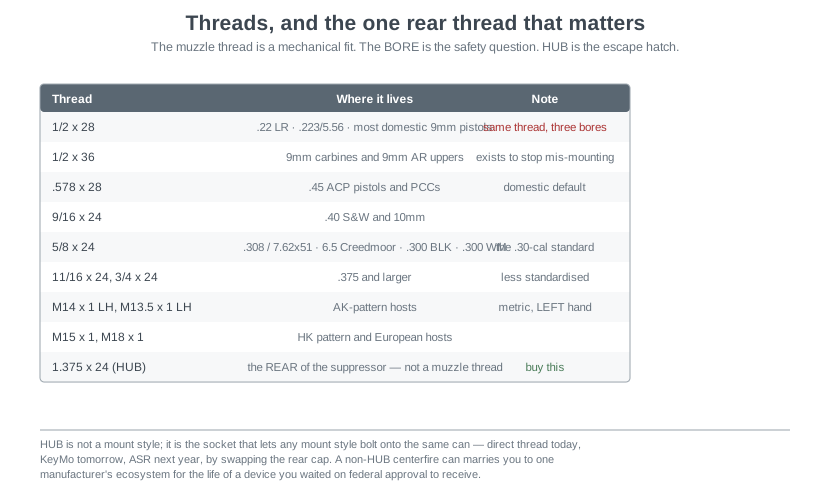
American convention writes a thread as major diameter × threads per inch: 1/2×28 is a half-inch major diameter with 28 threads to the inch. Metric convention writes diameter × pitch in millimetres, sometimes with LH for left-hand: M14×1 LH.
Table 1 — 7.1 The Thread Pitch Table
| Thread | Usual application |
|---|---|
| 1/2×28 | Essentially all .22 LR; .223/5.56 rifles; most domestically made 9mm pistols |
| 5/8×24 | .308 / 7.62×51 and most .30-caliber rifles; 6.5 Creedmoor; .300 Win Mag |
| .578×28 | .45 ACP pistols and pistol-caliber carbines — the domestic default |
| 1/2×36 | 9mm carbines and some 9mm AR uppers (deliberately different from 1/2×28 to prevent mis-mounting) |
| 9/16×24 | Some .40 S&W and 10mm |
| 11/16×24, 3/4×24 | .375 and larger; some big-bore. Less standardised |
| M13.5×1 LH, M14×1 LH | AK-pattern and other ex-Soviet hosts |
| M15×1, M18×1 | Various European hosts, HK pattern, some precision rifles |
| 1.375×24 | HUB — the standardised rear thread on the suppressor, not a muzzle thread |
Two warnings that catch people:
🔴 1/2×28 on a .22 and 1/2×28 on a 5.56 are the same thread. They will screw together perfectly. The thread tells you nothing about whether the can’s bore can safely pass the cartridge. A .22-bore can on a 5.56 barrel is a destroyed can and possibly a destroyed rifle. The thread is a mechanical fit; the bore is the safety question.
🔴 1/2×36 exists specifically to stop you doing that with 9mm carbines, and the fact that the industry felt the need to introduce a second half-inch thread tells you how often it happens.
7.2 What Actually Matters at the Muzzle
Thread pitch is the easy part. Three other things decide whether the can sits straight:
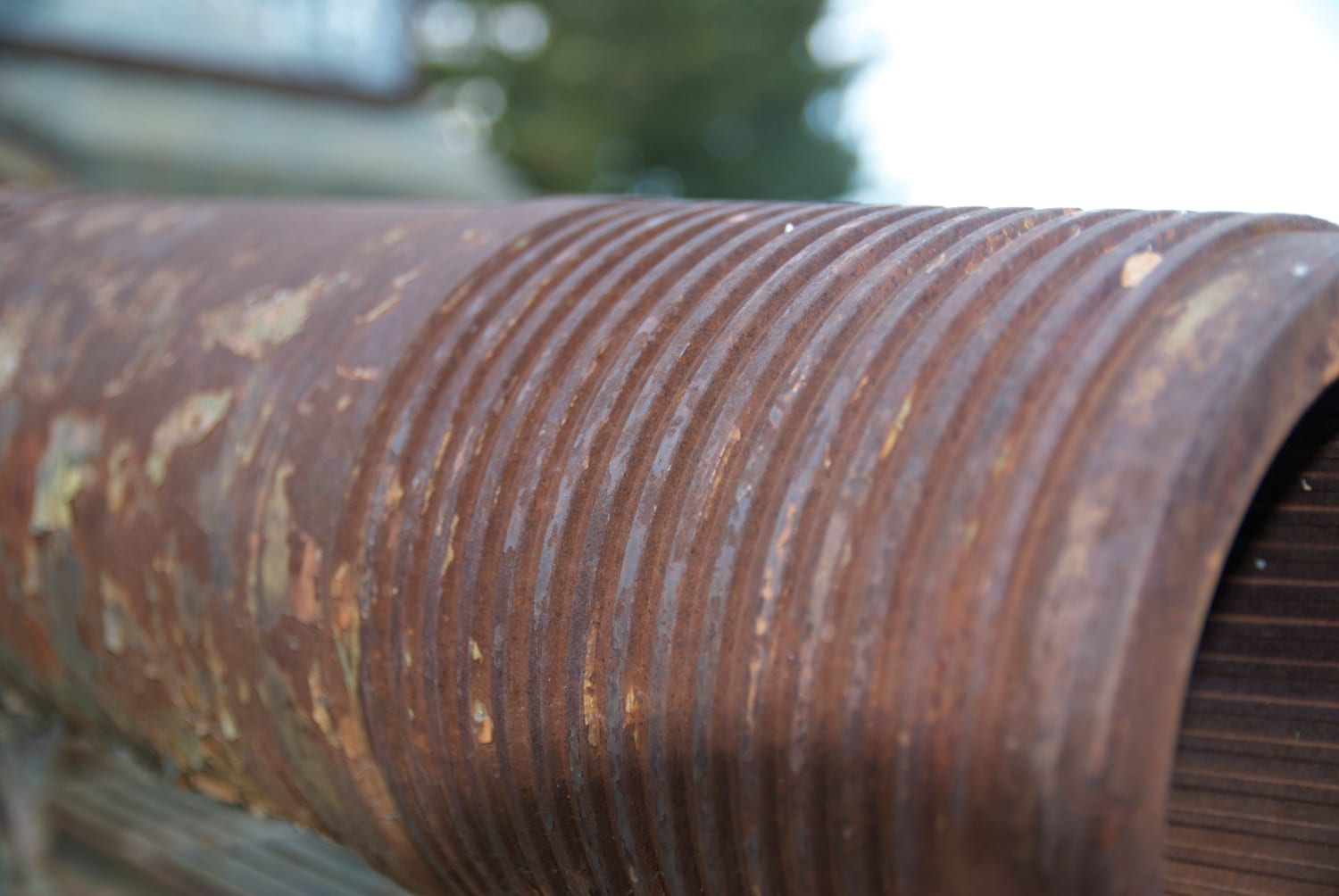
Concentricity of the thread to the bore. The threads must be cut on the same axis as the bore, not merely on the outside of the barrel. A barrel threaded on centres that do not match the bore will hold a suppressor at an angle no mount can correct. This is the single most common source of alignment problems, and it is a gunsmithing problem, not a suppressor problem. Threading should be done indicated off the bore.
The shoulder. The can (or mount) must square up against a flat, perpendicular shoulder at the base of the threads. If the shoulder is not square, tightening the can pulls it out of alignment. A shoulder that is undercut, burred, or has a radius that fouls the mount’s face is a real and common defect.
Thread length and engagement. Enough thread to fully engage the mount, and no more — excess thread protruding into the blast chamber is a gas leak and a stress riser.
Add a fourth for the pedantic: crown condition. A damaged crown behind a suppressor is an accuracy problem and, in a bad case, a bullet-yaw problem.
7.3 Direct Thread
The can screws onto the barrel. Nothing between them.
In favour: lightest (no muzzle device, no mount hardware), cheapest, shortest, fewest interfaces, therefore best concentricity and the most repeatable point of impact. For a precision rifle where the can lives on the gun, this is the correct answer and it is not close.
Against: slow to move between hosts. And it can loosen under fire — every shot applies a torque impulse, and a hand-tight can on a rifle with a brisk recoil impulse will walk itself loose over a string. A loose can is a baffle strike in waiting.
Mitigations: check tightness every few magazines, use a proper wrench flat where the design provides one, and use a high-temperature anti-seize on the threads (which prevents galling without preventing tightening). Some designs incorporate a locking feature; some shooters use a witness mark so a loosened can is visible at a glance rather than discovered by feel.
7.4 QD and Taper-Lock
A muzzle device — a flash hider, brake, or dedicated mount — is installed permanently on the barrel and timed. The can locks onto it, typically over a precision taper with a locking collar or ratcheting mechanism.
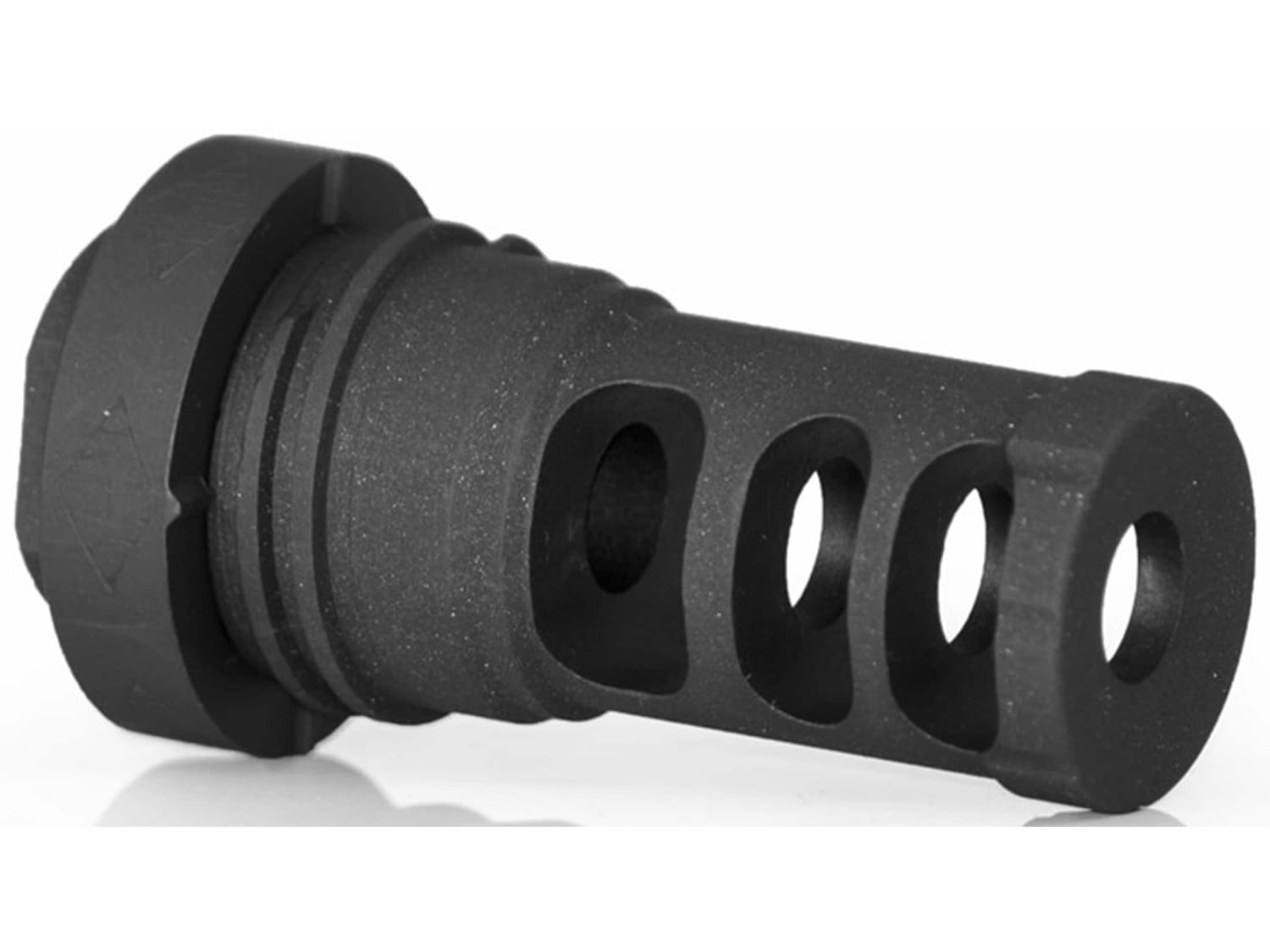
The taper is the important part. Two matching conical surfaces self-centre as they are drawn together, which is a much better repeatability mechanism than a cylindrical fit with clearance. Taper-lock designs give strong lock-up, repeatable point of impact, and easy servicing.
The major families:
Table 2 — The major families
| Family | Maker |
|---|---|
| ASR / Bravo / Charlie | SilencerCo |
| KeyMo, Xeno | Dead Air |
| Plan-B | Q |
| Atlas | Rearden |
| Dual-Taper | Rugged |
| Turbo / QD | YHM |
In favour: move the can between hosts in seconds; keep a mount on each rifle so every host is “can-ready”; the muzzle device does useful work (flash or recoil) when the can is off; and a brake-type mount can be a genuine benefit on a magnum.
Against: weight, cost, added length behind the can, and — the one that matters — another interface. Every joint adds tolerance stack-up and another opportunity for play, misalignment or failure. QD systems also need the muzzle device correctly timed and torqued, and carbon build-up on the taper is a maintenance item; a neglected taper eventually will not seat, which changes the alignment.
The honest split: if the can lives on one precision rifle, direct thread. If the can serves three hosts, QD. If it serves six hosts of the same thread — which is common with a battery of .22s — direct thread is still usually right, because rimfire pressures are trivial and rimfire cans are light.
7.5 HUB — Buy This
HUB (Hybrid Universal Base) is a standardised 1.375×24 thread on the rear of the suppressor.1 It is not a mounting style. It is the socket that lets you bolt any mounting style onto the same can.
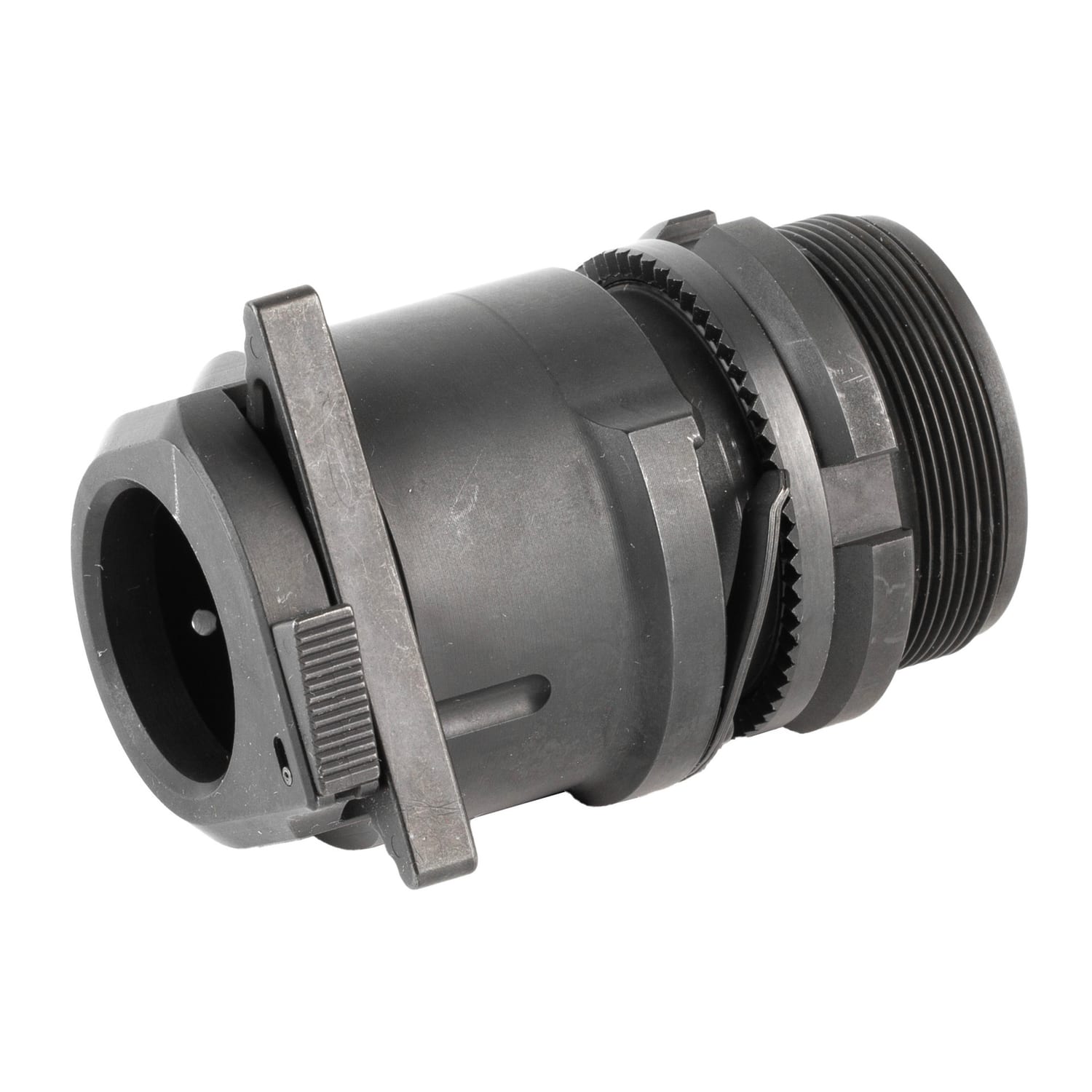
This is the most consequential thing to insist on when buying a centerfire can in 2026. A HUB can can be:
- direct thread today, by fitting a HUB direct-thread cap in whatever pitch your barrel wears;
- KeyMo tomorrow, by swapping the cap;
- ASR the week after, if you buy a rifle that came with an ASR mount;
- 5/8×24 on the .308 and 1/2×28 on the AR, by owning two caps.
Nearly every modern centerfire suppressor uses it.1 A non-HUB centerfire can marries you to one manufacturer’s mounting ecosystem for the life of a device you waited on federal approval to receive. There are good non-HUB cans; there is rarely a good reason to accept the limitation.
Rimfire is the exception — rimfire cans are small enough and cheap enough that fixed 1/2×28 direct thread is universal and fine.
7.6 Boosters and Nielsen Devices
This one is not optional, it is physics, and getting it wrong means the pistol does not work.
The problem. Almost all semi-automatic pistols above .380 are short recoil operated: barrel and slide recoil locked together for a short distance, then the barrel tilts down and unlocks, letting the slide continue. That unlocking depends on the barrel having enough momentum to move. Hang eight to twelve ounces of suppressor on the muzzle and the barrel does not move. The gun becomes a single shot.
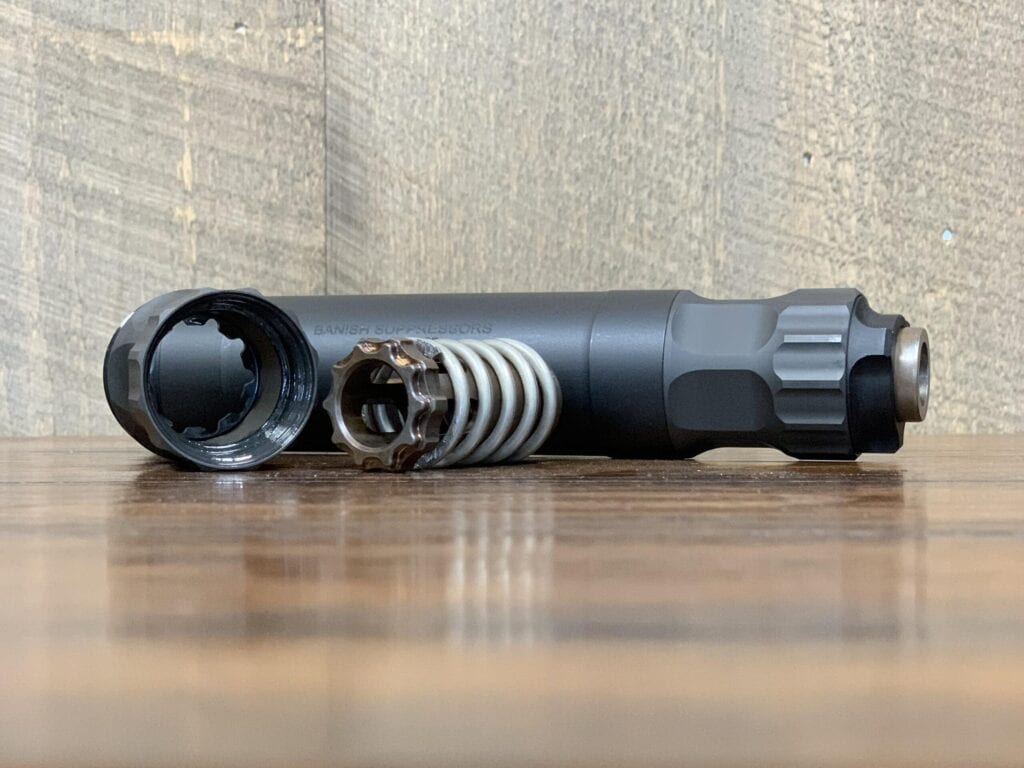
The fix. A Nielsen device, also called a linear inertial decoupler or muzzle booster: a spring-loaded piston that threads onto the barrel and lives in the rear of the can.2 On firing, expanding gas fills the space between piston and housing and pushes them apart — the barrel and piston recoil normally while the suppressor body momentarily stays put, decoupled by the spring. The spring then returns everything to battery.3
The test, which takes two seconds: rack the slide and watch the barrel. If the barrel tilts, you need a booster. If it does not — a fixed-barrel pistol, a blowback .22 pistol, a pistol-caliber carbine, a roller-delayed gun — you need a rigid spacer (often called a fixed-barrel spacer or fixed mount) instead, which is the same part with the spring replaced by solid metal.
Practical notes:
- The piston thread must match the host: 1/2×28 for most domestic 9mm, .578×28 for .45 ACP. Pistons are sold separately and are the consumable/adaptable part of a pistol can.
- Spring rate matters. Some hosts need a heavier or lighter booster spring; symptoms of a mismatch are failures to fully cycle, or a can that unscrews itself.
- Boosters wear. They are a moving part in a hot, dirty environment. Clean and inspect.
- A booster is not needed on a carbine and using one there is worse than useless — it introduces movement where you want rigidity.
7.7 Alignment — Do Not Skip This
Buy an alignment rod. Use it the first time you mount any can on any host, and again any time you change a muzzle device, rethread a barrel, or notice anything odd.
The tool is a precision-ground rod that slides through the can’s bore and into the barrel’s; if the rod passes freely and sits centred at the end cap, the alignment is good. If it binds, or if the visible annulus at the end cap is off-centre, stop. Do not fire it.
It costs on the order of a box of ammunition and it is the only thing standing between a mis-threaded barrel and the failure mode that destroys the can, the barrel, and possibly the shooter’s hand. Every host, every time you change anything. There is no other check in this series that returns so much for so little.
Complementary checks:
- Look through it. With the can mounted and the gun unloaded and safe, sight down the bore from the breech end. The end cap aperture should be concentric with the bore.
- Read the end cap. A can that has been mounted misaligned will show contact marks, brass or copper smear, or a bright arc on one side of the end-cap aperture. That is a warning, not a cosmetic issue.
7.8 Bibliography
Footnotes
-
HUB (Hybrid Universal Base), 1.375×24 rear thread — “HUB itself isn’t a mount style; it’s the interface that lets you bolt almost any modern QD or direct-thread mount onto the same can.” MyGunDeal, “Suppressor Mounting Systems Compared.” https://www.mygundeal.com/blog/2026-03-09-nfa-suppressor-mounting-systems-compared-direct-thread-vs-qd-vs-taper ↩ ↩2
-
SilencerCo, “What is a Nielsen Device?” https://silencerco.com/blog/what-is-nielsen-device ↩
-
Palmetto State Armory, “Nielsen Device Guide — How Muzzle Boosters Work.” https://palmettostatearmory.com/blog/nielsen-device-guide-how-muzzle-boosters-work.html ↩
Comments (0)