Console Light Guns · Volume 1
Reading the Catalogue — Every Console Light Gun on One Page, and What Each Field Means
Seventeen first-party and major guns from 1972 to 2011, the four ways they find the screen, the connectors and model-number systems behind the ID tables, and how the prices in this dive were taken
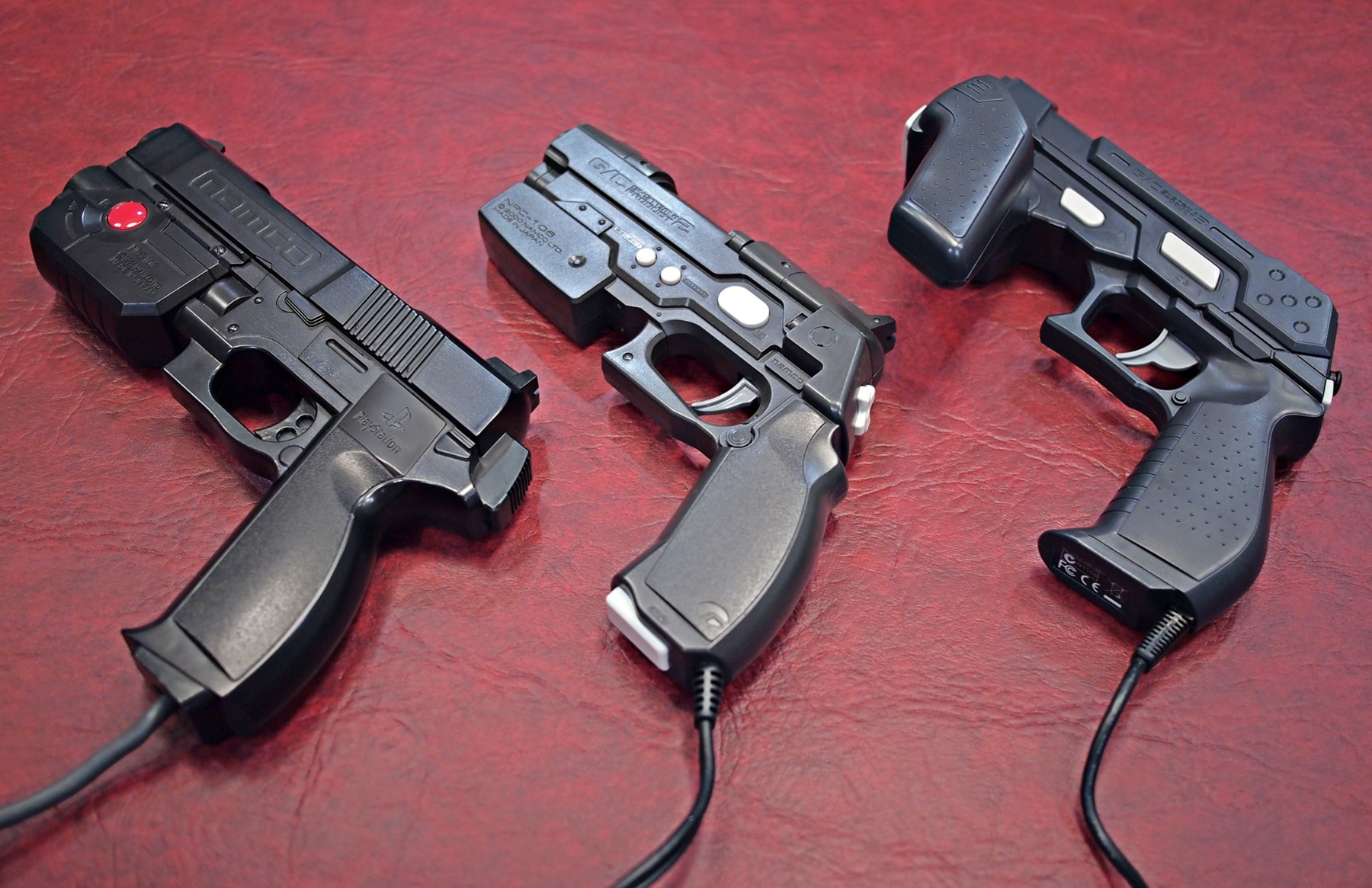
A console light gun is a narrow object. It was made for one family of machines, usually for one family of games, and nearly always for one kind of television. Most of the guns in this catalogue still work exactly as they did on the day they were sold, and most of them are useless on the television in a modern living room. Knowing which is which, and why, is what turns a second-hand listing from a gamble into a purchase.
This dive is the catalogue and the buyer’s guide. It gives every first-party console gun and the third-party guns that mattered an identification table, photographs, the tells that separate a genuine example from a clone or a later colourway, what the gun needs in order to work today, and a dated second-hand price from a named marketplace page. It does not retell the story of how light guns came to be: that is the History of Light Guns dive’s job, and this catalogue links to it rather than repeating it.
1.1 What This Catalogue Covers
In scope: guns sold for home video-game consoles, from the Magnavox Odyssey’s Shooting Gallery rifle of 1972 to the PlayStation Move Sharp Shooter of 2011, plus the dedicated first-generation consoles that shipped with a gun, the licensed and unlicensed third-party guns that collectors meet most often, and the clones that turn up in mixed lots.
Out of scope, and where it lives instead:
- Arcade guns — cabinet guns, positional guns, arcade recoil: Arcade Light Guns.
- Home-computer guns and light pens — Atari 8-bit, Commodore, Spectrum, Amstrad, MSX and the rest: Home-Computer Light Guns. The Atari XG-1 appears here because Atari sold it with the XE Game System console and it works on the 2600 and 7800; its life on the 8-bit computers belongs to that dive.
- The theory of how a gun reads a CRT: CRT Timing. Camera-and-marker sensing: IR Point Tracking.
- Getting an old gun working on today’s hardware, and repairing, converting or adding recoil to one: Original Consoles and Modding Classic Light Guns. Both are planned dives; this catalogue states what each gun needs and hands the how-to to them.
1.2 The Catalogue at a Glance
The table gives each gun’s first release in any region, the system it was made for, how it senses the screen, how it connects, and whether it has recoil. Regional dates, prices and model numbers are in each gun’s own identification table.
Table 1 — The Catalogue at a Glance
| Gun | Maker | First release | System | Senses the screen by | Link to console | Recoil | Volume |
|---|---|---|---|---|---|---|---|
| Shooting Gallery rifle | Magnavox | 1972 | Odyssey | Photocell sees a bright spot | Wired | No | 2 |
| Kōsenjū (light gun) | Nintendo | 1984 (Japan) | Famicom | Photodiode, flash frame | Wired, expansion port | No | 2 |
| Zapper | Nintendo | 1985 (US) | NES | Photodiode, flash frame | Wired, controller port 2 | No | 2 |
| Light Phaser | Sega | 1986 (US) | Master System | Photodiode, beam timing | Wired, controller port | No | 2 |
| XG-1 | Atari | 1987 | XE Game System, 7800, 2600 | Photodiode | Wired, joystick port | No | 2 |
| Super Scope | Nintendo | 1992 (US) | Super NES | Photodiode, beam timing | Infrared to a receiver in port 2 | No | 3 |
| Menacer | Sega | 1992 (US) | Mega Drive / Genesis | Photodiode, beam timing | Infrared to a receiver in port 2 | No | 3 |
| Justifier | Konami | 1993 | Mega Drive, Super NES | Photodiode, beam timing | Wired, port 2; player 2 daisy-chained | No | 3 |
| Virtua Gun / Stunner | Sega | 1995 (Japan) | Saturn | Photodiode, beam timing | Wired, controller port | No | 4 |
| Hyper Blaster / Justifier | Konami | 1996 | PlayStation | Photodiode, beam timing | Wired, controller port | No | 4 |
| GunCon / G-Con 45 | Namco | 1997 (Japan) | PlayStation | Photodiode, timed against tapped video | Controller port plus composite video lead | No | 4 |
| Dreamcast Gun | Sega | 1999 (Japan) | Dreamcast | Photodiode, beam timing | Wired, controller port | Vibration with a Puru Puru Pack | 5 |
| GunCon 2 / G-Con 2 | Namco | 2001 (Japan) | PlayStation 2 | Photodiode, timed against tapped video | USB plus composite video lead | No | 5 |
| Wii Zapper | Nintendo | 2007 | Wii | Wii Remote’s infrared camera sees the sensor bar | Bluetooth (the Wii Remote) | No | 6 |
| GunCon 3 | Namco Bandai | 2007 (Japan) | PlayStation 3 | Camera sees two infrared marker units | USB | No | 6 |
| Top Shot Elite | Activision | 2010 | PlayStation 3, Xbox 360 | Sensor bar at the screen (see Vol 6) | Wireless USB dongle | No | 6 |
| Move Sharp Shooter | Sony | 2011 | PlayStation 3 | PlayStation Eye camera tracks the Move controller | The Move controller’s own Bluetooth | No | 6 |
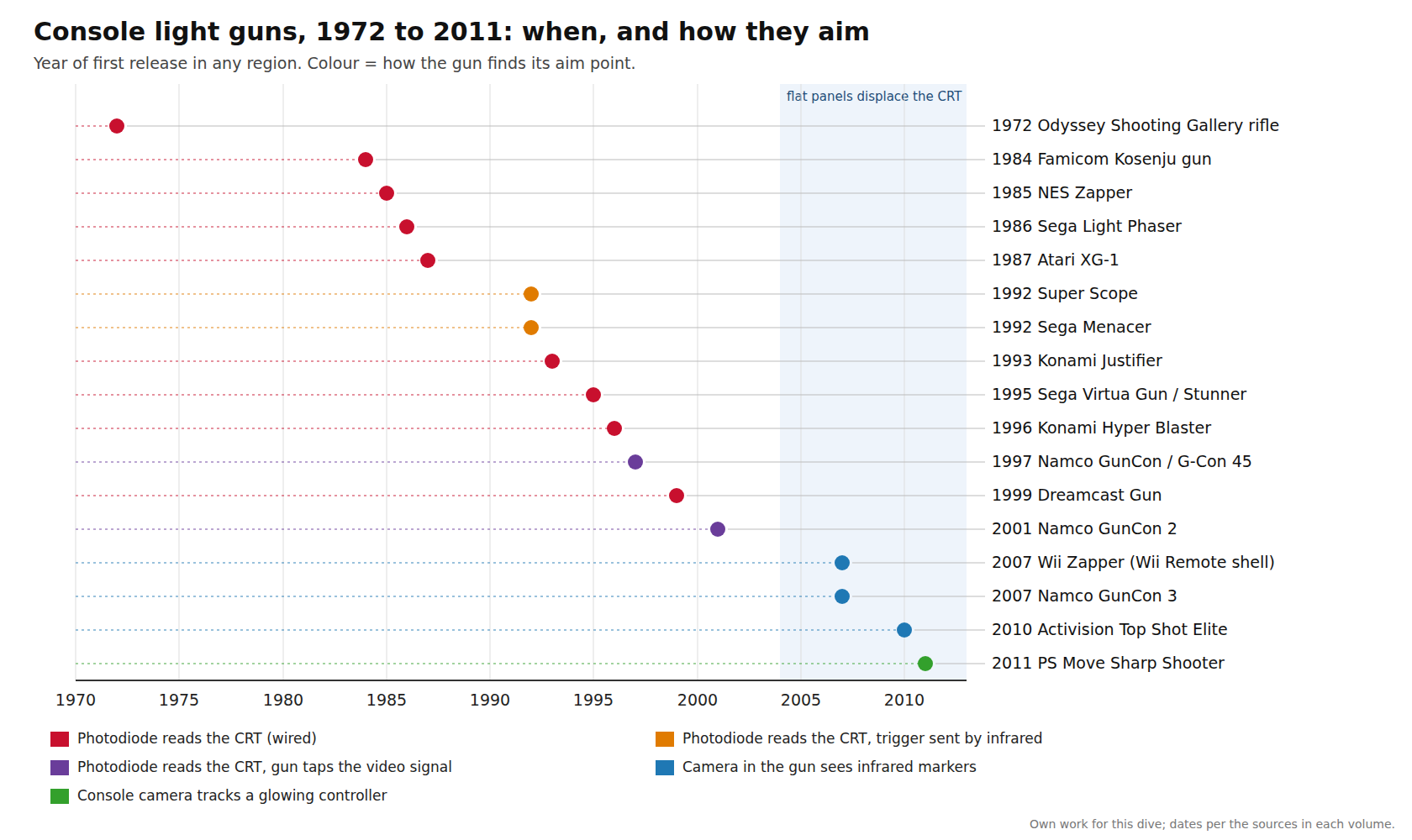
1.3 Four Ways a Gun Finds the Screen
For a buyer the sensing method is the first question, because it decides what the gun needs to work.
1. A photodiode that sees a flashed frame. The Zapper and the Famicom gun read light, not position. When the trigger is pulled the game blanks the screen and draws its targets as white blocks, and the gun reports whether its photodiode saw white. Nintendo’s own Zapper manual tells the owner to set the television so that “the characters should be as bright as possible while the background areas should be as dark as possible”, and that its range is “approximately 6 feet”, depending on screen size, adjustment and room light.1 The method needs a display that shows the flash in the frame the game expects it and at a brightness the photodiode can tell from black.
2. A photodiode timed against the electron beam. From the Light Phaser onward most CRT guns report a position. The photodiode fires as the beam sweeps past the point the gun is aimed at, and hardware in the console latches the beam’s horizontal and vertical counters at that moment. The SNES development manual, as summarised by the community reference that cites it, gives the Super Scope a resolution of about one character cell (8 by 8 dots) and notes that the gun is not sensitive to red because red phosphor decays slowly (about 1.2 ms, against 300 µs for green and 250 µs for blue).2 The method needs a CRT, because only a CRT draws the picture as a moving spot whose timing reveals position.
3. A photodiode timed against a tapped video signal. Namco’s GunCon and GunCon 2 do the timing in the gun rather than the console. Each takes a lead off the composite video on its way to the television (Vol 4 and Vol 5 show the wiring from Namco’s own manual), and community documentation of the PlayStation interface records that the gun reports X as 8 MHz clocks since horizontal sync and Y as scanlines since vertical sync.3 The method still needs a CRT; it also needs composite video in the cable path.
4. A camera that sees infrared markers, or a camera that sees the controller. The Wii Zapper is a shell for a Wii Remote, whose camera images the sensor bar’s infrared LEDs. The GunCon 3 carries its own image sensor and comes with two marker units that sit beside the screen; its director wrote at launch that the design “uses two sensors and allows users to play on any type of television”.4 The PlayStation Move Sharp Shooter is the reverse arrangement: a camera on the television tracks the glowing sphere of the Move controller held in the gun. These guns work on flat panels, and that is the whole reason they exist.
The theory of methods 1 to 3 belongs to CRT Timing, and of method 4 to IR Point Tracking. The practical consequence is short:
Table 2 — The theory of methods 1 to 3 belongs to [CRT Timing](/light-guns/sensing-and-aiming/crt-timing/), and of method 4 to [IR Point Tracking](/light-guns/sensing-and-aiming/ir-point-tracking/). The practical consequence is short
| Sensing method | Works on a CRT | Works on an LCD, OLED or plasma | Needs |
|---|---|---|---|
| Flash frame (Zapper, Famicom gun) | Yes | No in normal use | A CRT, or a modified gun or display chain (see the planned Original Consoles dive) |
| Beam timing (Light Phaser to Dreamcast Gun) | Yes | No | A CRT, with the original console’s video timing |
| Tapped video (GunCon, GunCon 2) | Yes | No | A CRT, and composite video in the path |
| Infrared markers or console camera (Wii Zapper, GunCon 3, Top Shot Elite, Sharp Shooter) | Yes | Yes | The marker unit, sensor bar or camera that came with the system |
Namco’s own European manual for the PlayStation G-Con 45 is blunt about which televisions do not work. It lists LCD televisions and projectors, Hi-Vision televisions, 100 Hz televisions, televisions with a screen-memory function, some wide-screen sets, small screens, some old sets, magnetised sets, and projection televisions, the last with the warning that “the screen may burn”.5 The 100 Hz entry matters to anyone buying a late European CRT: a 100 Hz set redraws each field twice from a frame store, which breaks the timing relationship the gun depends on, so a CRT alone is not enough.
1.4 How to Read an Identification Table
Each gun in Volumes 2 to 6 opens with an identification table. The rows are always the same:
Table 3 — Each gun in Volumes 2 to 6 opens with an identification table. The rows are always the same
| Row | What it records | Where it comes from |
|---|---|---|
| Maker | The company whose name is on the gun, and the distributor where a different firm sold it in a region | Packaging, manuals |
| First release | Date of first sale, by region where they differ | The maker’s own history pages or press releases where they exist; otherwise dated magazine references, cited |
| System | The console it was made for, and others it is documented to work with | Manuals, maker pages |
| Model numbers | The maker’s product codes, by region | Maker pages, labels, manuals; anything taken from a collector database is marked as such |
| Connector | The plug, the port it goes in, and anything else it needs (a receiver, a video lead, a marker bar) | Manuals |
| Pinout | Signal assignments, only where the maker or a service manual documents them; community reverse-engineering is labelled as such | See each entry |
| Sensing | One of the four methods above | Manuals, maker statements |
| Controls | Trigger and buttons by the maker’s own names | Manuals |
| Power | Console-powered, or the batteries it takes | Manuals, labels |
| Recoil | Whether the gun kicks or vibrates | Manuals |
| Regional variants | Colours, names and moulds that differ by market | Packaging, photographs, maker pages |
| Works today | What it needs to work, in one line | See “Four Ways” above |
| Price | Loose and complete-in-box, with the page and the date | See “How the Prices Were Taken” below |
A note on pinouts. None of the console makers published the pin assignments of their controller ports for consumers. Where this catalogue gives a pinout it says whose it is. For the Sega Light Phaser, for example, the widely copied table (5 V on pin 5, trigger on pin 6, light sensor on pin 7, ground on pin 8, all active low) comes from the community SMS Power development wiki, not from Sega.6 Pinouts for building a converter or an adapter belong in the planned Original Consoles and Modding Classic Light Guns dives, which will need to verify them on the bench.
1.5 Model Numbers: Decoding the Makers’ Systems
Model numbers are the fastest way to tell a genuine first-party gun from a clone, and each maker had a system.
Table 4 — Model Numbers: Decoding the Makers' Systems
| Maker | Pattern | Examples in this dive | Note |
|---|---|---|---|
| Nintendo, Famicom / NES era | HVC- (Japan, “Home Video Computer”), NES- (export) | HVC-005 and NES-005, the light gun | The number after the prefix is shared across regions |
| Nintendo, Super Famicom / SNES | SHVC- (Japan), SNS- (US), SNSP- (PAL) | SHVC-013 Super Scope, SHVC-014 receiver (collector database) | The SNS- number for the Super Scope was not confirmed from a label |
| Nintendo, Wii | RVL- | RVL-023, Wii Zapper (Japanese collector catalogue); RVL-A-ZA on the US manual | RVL-018, often given for the Zapper, is listed by the same catalogue as the Wii Remote wrist strap |
| Sega, 8- and 16-bit export | MK-, or a bare four-digit code in the US | 3050 Light Phaser (US), MK-1658-50 Menacer (UK) | The US Genesis Menacer box carries 1658 |
| Sega, Saturn and Dreamcast (Japan) | HSS- (Saturn), HKT- (Dreamcast) | HSS-0122 and HSS-0152 Virtua Gun, HKT-7801 Dreamcast Gun | From Sega’s own history pages |
| Sega, Saturn export | MK-8xxxx | MK-80113 Stunner (US) | |
| Sony licence codes | SLPH- (Japan), SLUH- (US), SLEH- (Europe) | SLPH-00014, SLUH-00017, SLEH-00005 for Konami’s PlayStation gun | Third-party hardware carried a Sony licence number as well as the maker’s own |
| Namco | NPC- | NPC-103 GunCon, NPC-106 GunCon 2 | The GunCon 3 is given as NC-109 in published references; no label was seen |
| Sony, PlayStation 3 | CECH- | CECHYA-ZRA1E, Sharp Shooter (European label) | Read from a photograph of the label |
Two corrections came out of checking these numbers. Sega’s own page gives the Dreamcast Gun as HKT-7801, not HKT-7800, and at ¥4,500, not the ¥3,000 that a widely used fan wiki records (Vol 5).7 And the “RVL-018” commonly attached to the Wii Zapper is, in the collector catalogue that lists every RVL number, the Wii Remote wrist strap (Vol 6).8
1.6 Connectors, Ports and Who Powers the Gun
The physical link sorts the catalogue into three groups.
Controller-port guns take power and return signals through an ordinary controller socket: the Zapper, the Light Phaser, the XG-1, the Justifier, the Virtua Gun, Konami’s PlayStation gun and the Dreamcast Gun. They need no batteries. Which socket matters: Nintendo’s Zapper manual says “Insert the ZAPPER’s connector into Controller Socket 2. (It will not work if connected into Controller Socket 1.)”,1 while Sega’s Light Phaser instructions say to plug it into Control 1.9 Konami’s SNES Justifier goes in port 2 with a control pad in port 1, and is rated on its own label at DC 5 V, 15 mA with the player-2 gun connected.10
Wireless 16-bit guns — the Super Scope and the Menacer — carry their own batteries (six AA and six AAA respectively) and an infrared emitter, and talk to a receiver that sits on the television and plugs into port 2 (Vol 3).
Guns that need more than a controller port: the GunCon (controller port plus a composite video lead), the GunCon 2 (USB plus a composite video lead), the GunCon 3 (USB plus two marker units), the Wii Zapper (no electrical connection at all: it is a shell for a Wii Remote), the Sharp Shooter (a shell whose buttons pass through the Move controller’s extension connector; its label reads 3.2 V, 5 mA), and the Top Shot Elite (a wireless gun with a USB dongle and a sensor bar).
The missing piece is the commonest reason a second-hand gun “does not work”: a Super Scope without its receiver, a GunCon 2 without its splitter cable, a GunCon 3 without its marker units, a Top Shot Elite without its dongle. Every identification table lists what has to come with the gun.
1.7 Recoil: Which Console Guns Kicked
None of the first-party console guns in this catalogue has solenoid recoil. The commonly repeated account of the original GunCon is that Namco left out the arcade gun’s force feedback to keep the price down, and added a second button in place of the arcade pedal; that account comes from secondary sources, not from Namco.11 The nearest a first-party console gun came to a kick is the Dreamcast Gun, whose expansion socket takes Sega’s Puru Puru Pack vibration unit; Sega’s own page says it gives “realistic vibration” matched to shots and damage.7 Vibration appeared in a few third-party guns too (the Predator 2 and the SRC Bio Gun, Vol 4 and Vol 5).
Recoil in the home arrived with the DIY guns. Its physics, parts and drivers are the subject of Solenoid Recoil, and fitting it to a classic shell belongs to Modding Classic Light Guns.
1.8 How the Prices Were Taken
Second-hand prices in this dive come from PriceCharting (pricecharting.com), which publishes a running price for each item computed from completed eBay sales and lists the recent sales behind it. Each gun’s page was read on 19 October 2026; the figures quoted are PriceCharting’s “Loose” (the gun alone) and “Complete” (with box and manual) prices on that date, with the date of the most recent sale shown on the page so that a stale figure can be recognised. The full table, with every page address, is in Vol 7.
Three cautions apply. A loose price for a gun is the price of the gun alone: the Super Scope’s receiver, the GunCon 2’s splitter and the GunCon 3’s marker units are often missing from loose lots and are priced separately or not at all. Region matters: PriceCharting keeps separate pages for Japanese, North American and PAL versions, and their prices differ by factors of two or more for the same mould. And a thin market gives a noisy price: where the most recent sale is more than a year old, the figure is noted as such.
1.9 Where Each Gun Is
Table 5 — Where Each Gun Is
| Volume | Generation | Guns |
|---|---|---|
| 2 | First generation to 8-bit (1972 to 1989) | Odyssey Shooting Gallery rifle; dedicated pong-era consoles with guns; Famicom Kōsenjū gun; NES Zapper in grey and orange; Famicom clone guns; Sega Light Phaser; Atari XG-1 |
| 3 | 16-bit (1992 to 1994) | Super Scope; Menacer; Konami Justifier for Mega Drive and SNES, blue and pink |
| 4 | 32-bit (1995 to 2000) | Sega Virtua Gun and Stunner; Konami Hyper Blaster and PlayStation Justifier; Namco GunCon and G-Con 45; the Predator family of dual-format third-party guns |
| 5 | 128-bit (1999 to 2005) | Dreamcast Gun and its US cancellation; Mad Catz Dream Blaster; SRC Bio Gun; GunCon 2 and G-Con 2 |
| 6 | Infrared and motion (2007 to 2011) | GunCon 3; Wii Zapper and third-party Wii shells; Activision Top Shot and Top Shot Elite; PlayStation Move Sharp Shooter |
| 7 | Buying one | Genuine versus clone, testing a second-hand gun, care, the full price table, and what works where |
Footnotes
-
Nintendo of America, Zapper Instruction Manual, ©1988, 1989 (revision 2), sections “Connecting the Zapper to the NES” and “Operation of the Zapper”. Scan: https://archive.org/details/Zapper_1989_Nintendo_US_rev_2 (read 2026-10-19). ↩ ↩2
-
SNESLab wiki, “Super Scope”, citing the official Super NES development manual, Book I p. 2-24-2 and Book II p. 4-1-3. https://sneslab.net/wiki/Super_Scope (read 2026-10-19). The development manual itself was not read for this dive. ↩
-
Martin Korth (nocash), PSX-SPX, “Controllers and Memory Cards”, Namco GunCon and Konami Justifier sections. https://psx-spx.consoledev.net/controllersandmemorycards/ (read 2026-10-19). Community reverse-engineering, not Sony or Namco documentation. ↩
-
Takashi Satsukawa (director, Time Crisis 4), “Time Crisis 4: Creating the Guncon 3, Part 2”, PlayStation Blog, 12 November 2007. https://blog.playstation.com/?p=278 (read 2026-10-19). ↩
-
Namco / Sony Computer Entertainment Europe, Time Crisis (PlayStation, PAL) instruction manual, G-CON45 section, “Care when using this equipment with a television”. Scan: https://archive.org/details/18082024-002 (read 2026-10-19). ↩
-
As reproduced by Sega Retro, “Light Phaser”, Pinout section, citing SMS Power, Development: Light Phaser, http://www.smspower.org/Development/LightPhaser. https://segaretro.org/Light_Phaser (read 2026-10-19). ↩
-
SEGA, “関連・周辺機器 | ドリームキャスト” (Dreamcast related and peripheral devices), entry for ドリームキャスト・ガン. https://www.sega.jp/history/hard/dreamcast/devices.html (read 2026-10-19). ↩ ↩2
-
maru-chang.com, Wii hardware list (English). https://maru-chang.com/hard/rvl/english.htm (read 2026-10-19). A collector’s catalogue, not Nintendo. ↩
-
Sega of America, The Sega Light Phaser instructions (1986). Scan: https://archive.org/details/Sega_Light_Phaser_Instruction_The_1986_U (read 2026-10-19). ↩
-
Konami (America), Lethal Enforcers (Super NES, US) instruction manual, “Setting up” and game gun specifications. Scan: https://archive.org/details/lethal-enforcers-usa (read 2026-10-19). ↩
-
Wikipedia, “GunCon” (read 2026-10-19). Secondary; no Namco statement located. ↩
Comments (0)