Console Light Guns · Volume 2
First Guns and the 8-Bit Pistols — Odyssey, Famicom, Zapper, Light Phaser and XG-1
The Odyssey's rifle and the pong-era guns, Nintendo's revolver and both colours of Zapper, the Famicom clones, Sega's Light Phaser and Atari's XG-1: identification, tells, what each needs today, and what they sell for
The first generation of console light guns read light and nothing else. A photocell in the barrel reported whether it could see something bright, and the game did the rest. The 8-bit guns kept that principle, and the two that followed Nintendo’s Zapper — Sega’s Light Phaser and Atari’s XG-1 — added beam timing so that a game could know where the gun pointed rather than only whether it pointed at a lit target. The story of how these guns came about is told in the History of Light Guns; this volume identifies them.
2.1 Magnavox Odyssey Shooting Gallery Rifle
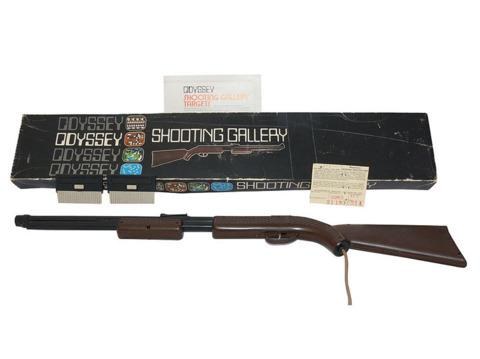
Table 1 — Magnavox Odyssey Shooting Gallery Rifle
| Maker | Magnavox |
| First release | 1972, United States |
| System | Magnavox Odyssey (console model 1TL200)1 |
| Model number | Not confirmed for the rifle; the reference tables consulted leave it blank2 |
| Connector | Wired to the console |
| Sensing | A photocell that reports light, with no position information |
| Controls | Trigger |
| Power | From the console |
| Recoil | No |
| Works today | Only with an Odyssey, its game cards and overlays, and a CRT; see below |
| Price | PriceCharting, Shooting Gallery (Odyssey), 19 Oct 2026: loose $107.07, complete $487.67; most recent sale on the page 16 Aug 2026 |
Guinness World Records lists the Shooting Gallery rifle as the first home-console light gun, designed by Ralph Baer in 1968 and sold from 1972, and also as the largest, with an estimated 20,000 sold.3 The rifle needed game card 10 for its games and screen overlays to provide the targets; the Odyssey drew only a moving spot.4 Because the photocell reported any light at all, aiming at a lamp scored a hit, a quirk that every account of the rifle repeats.
What to check when buying one. The rifle is useless without an Odyssey console, the game card and the overlays. Listings vary in what they include, and the gap between the loose and complete prices above is mostly the box and the paper. No published teardown or schematic of the rifle was found for this dive; its internals and Baer’s development of it belong to the History of Light Guns.
2.2 The Pong-Era Guns
Several of the dedicated “pong” consoles of the mid-1970s, which had their games built in, shipped with or offered a gun for target games. Two that are well photographed:
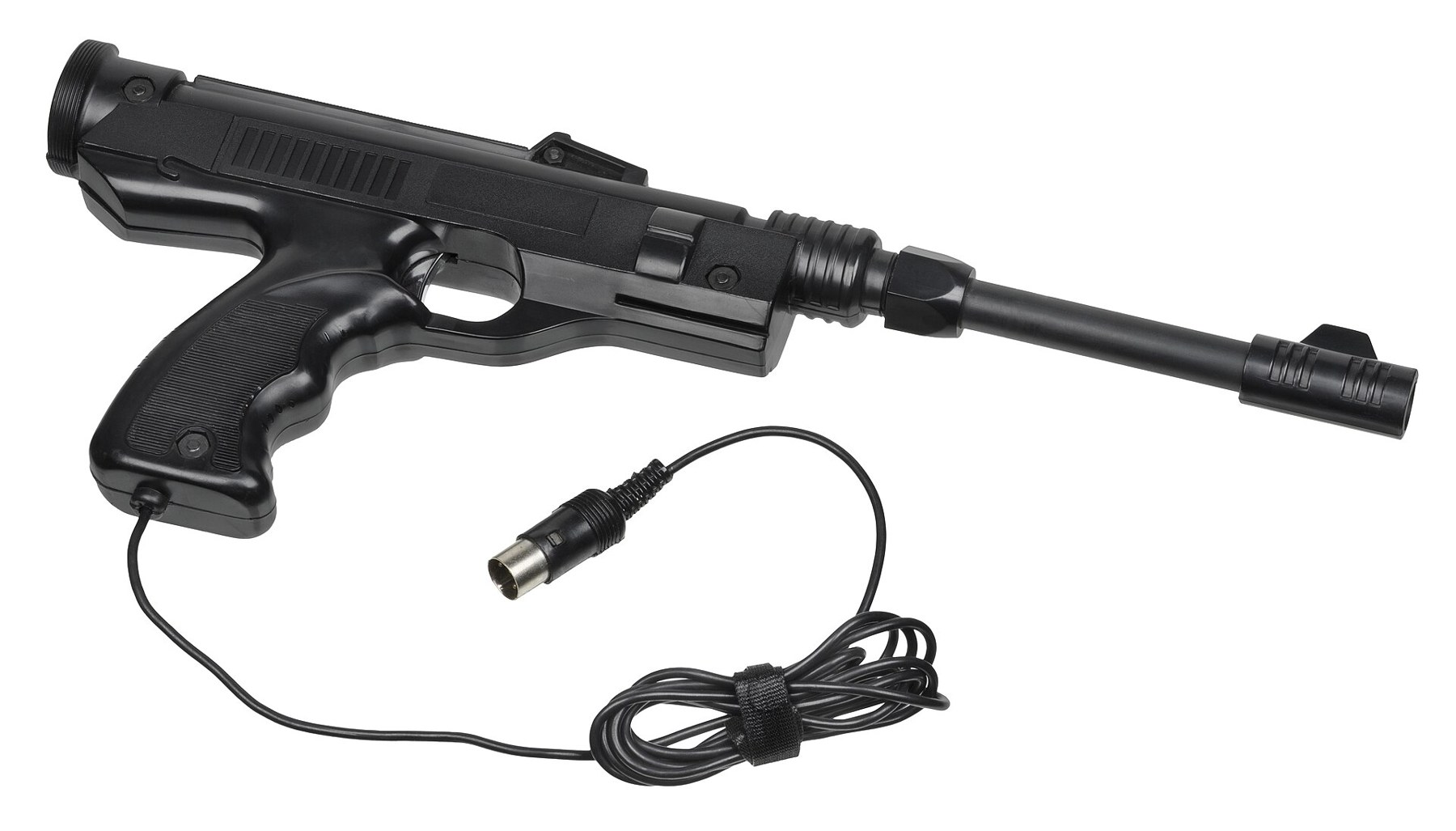
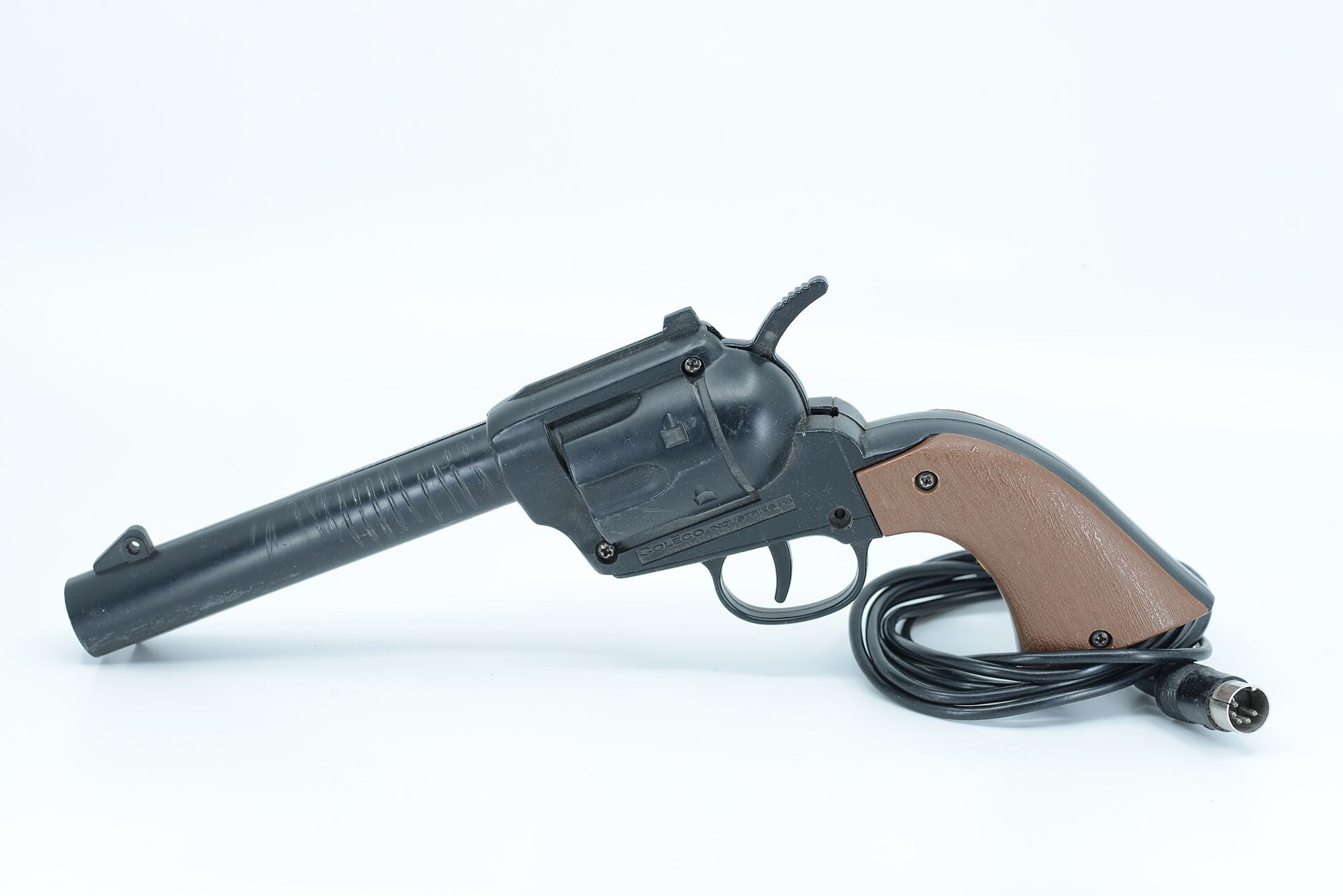
These guns work only with their own console, which must itself work, and a CRT. They are collected with the console rather than on their own, and no PriceCharting pages exist for them separately. The full list of pong-era guns is a history question; the History of Light Guns dive covers the generation.
2.3 Nintendo Famicom Light Gun
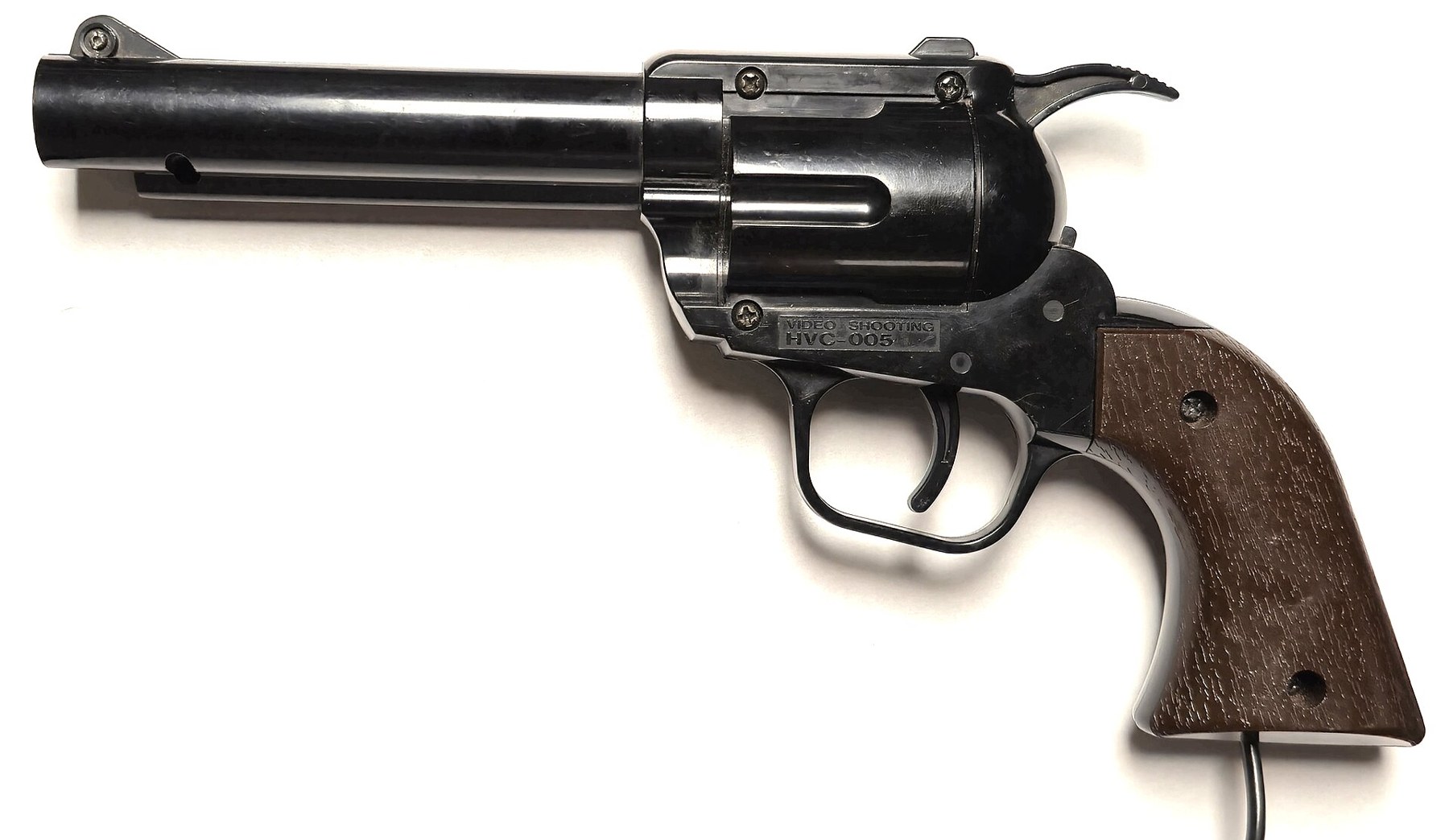
Table 2 — Nintendo Famicom Light Gun
| Maker | Nintendo |
| First release | 18 February 1984, Japan, with Wild Gunman, the first title of the Kōsenjū series5 |
| System | Family Computer (Famicom) |
| Model numbers | HVC-005 for the gun (shared numbering with the export NES-005); the Wild Gunman set box is coded HVC-GS |
| Connector | The Famicom’s 15-pin expansion port on the front of the console (the Famicom’s own controllers are hard-wired) |
| Pinout | Community documentation: the gun reads as light sense on bit 3 and trigger on bit 4 of the second controller register, exactly as an NES Zapper in port 2.6 Not Nintendo documentation |
| Sensing | Photodiode; flash frame |
| Controls | Trigger |
| Power | From the console |
| Recoil | No |
| Regional variants | Japan only, in this revolver form |
| Works today | A Famicom (or a console with a Famicom expansion port) and a CRT |
| Price | PriceCharting, Wild Gunman Set (Famicom), 19 Oct 2026: complete $275.22, no loose figure; most recent sale on the page 10 Jan 2026 |
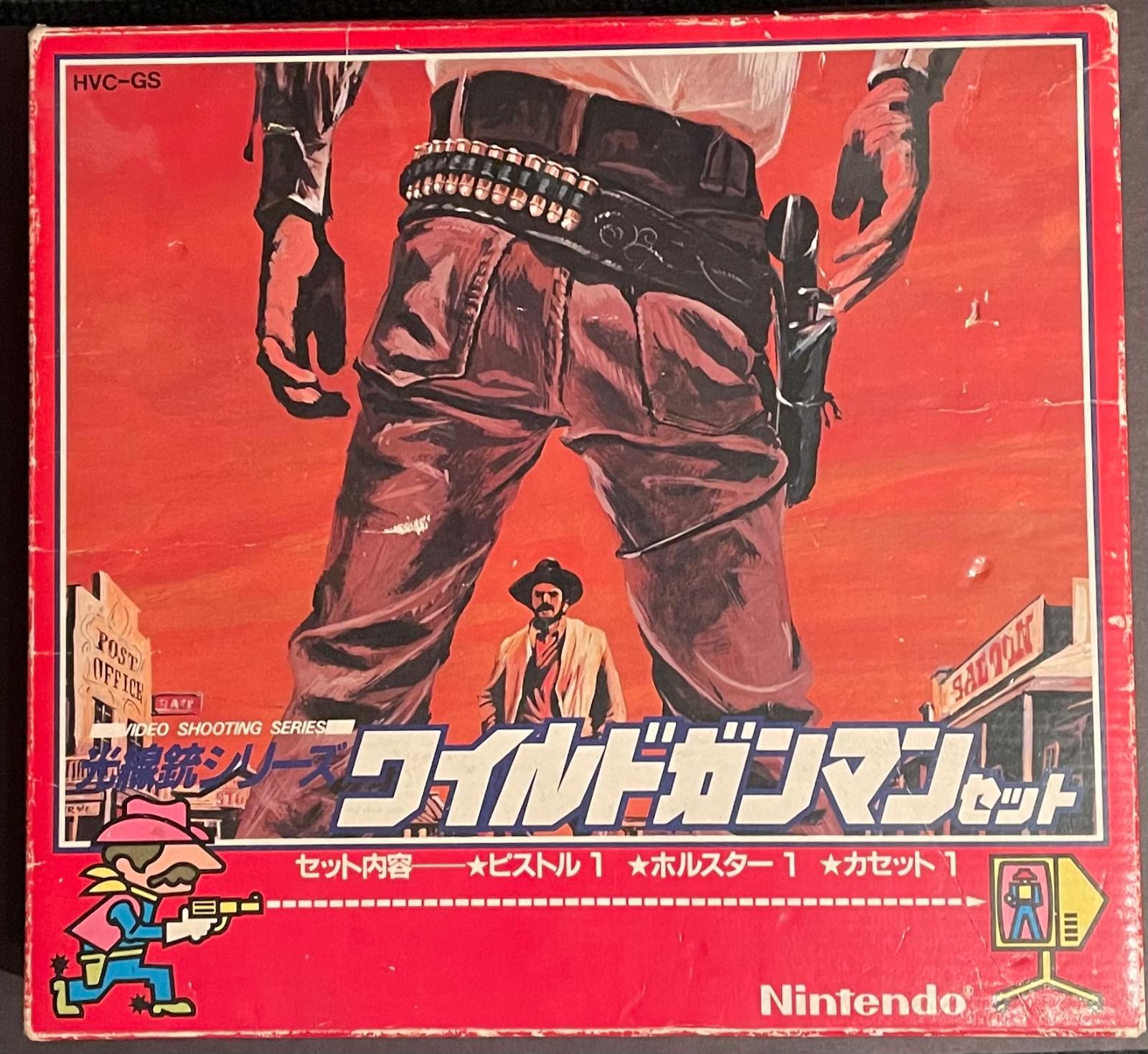
Famitsu’s 40th-anniversary account dates Wild Gunman to 18 February 1984, followed by Duck Hunt (21 April 1984) and Hogan’s Alley (12 June 1984), the three dedicated titles of the series, and describes the gun as the revolver-type controller supplied with the game.5 The set’s box confirms the contents: a pistol, a holster and a cartridge.
Telling it apart. The Famicom gun is a revolver; nothing else in this catalogue looks like it except toy cap guns. Collectors should not confuse it with Nintendo’s earlier electro-mechanical Kōsenjū toys of the 1970s, which were not video-game controllers and belong to the History of Light Guns.
2.4 Nintendo Zapper, Grey and Orange
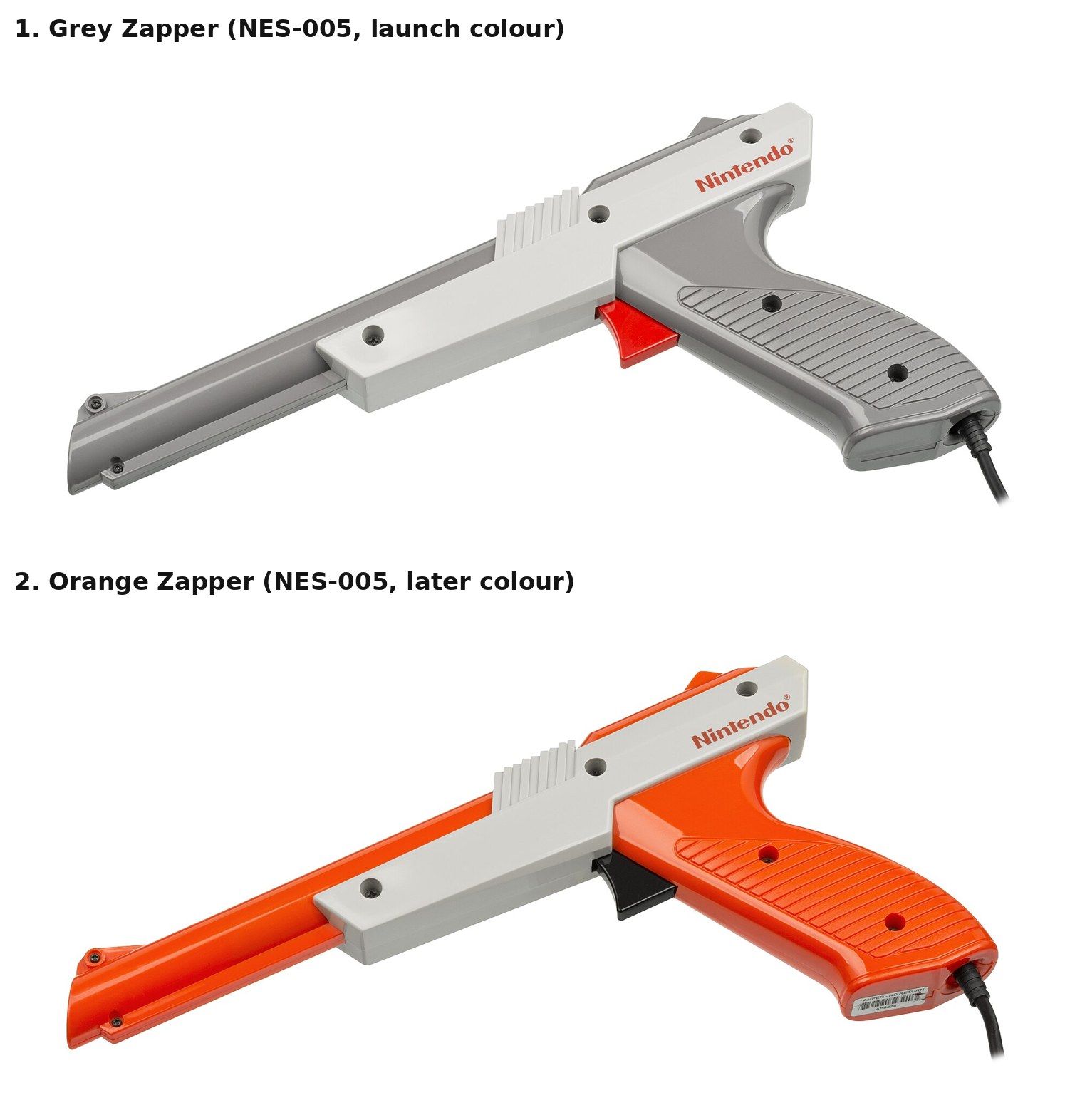
Table 3 — Nintendo Zapper, Grey and Orange
| Maker | Nintendo |
| First release | 18 October 1985, North America, with the NES launch (date as given by secondary sources)7 |
| System | Nintendo Entertainment System |
| Model number | NES-005 (both colours), confirmed by the Victoria and Albert Museum’s catalogue record of an orange example8 |
| Connector | NES 7-pin controller plug. Nintendo’s manual: “Insert the ZAPPER’s connector into Controller Socket 2. (It will not work if connected into Controller Socket 1.)”9 |
| Pinout | Community documentation: light sense on data bit 3 (0 = light seen), trigger on bit 4.6 Not Nintendo documentation |
| Sensing | Photodiode; flash frame |
| Controls | Trigger |
| Power | From the console |
| Recoil | No |
| Range | ”Approximately 6 feet”, depending on screen size, television adjustment and room light (Nintendo’s manual) |
| Regional variants | Grey (launch) and orange (later) in North America; PAL Zappers sold in Europe and Australia |
| Works today | A CRT. See “Why a Zapper fails on a flat panel” below |
| Price | PriceCharting, 19 Oct 2026: orange (listed as “Zapper Light Gun”) loose $14.99, complete $93.40, sales to 1 Oct 2026; grey loose $15.36, complete $72.25, sales to 17 Aug 2026; PAL loose $24.16, complete $88.44 |
Grey, then orange. The Zapper launched in two-tone grey and was later made with an orange body. The Victoria and Albert Museum dates its orange example to 1989 to 1991 and explains the orange as a further step away from realism, “as it was felt the original two-tone grey could still be too realistic from a distance”.8 The change coincides with the US federal rule on marking toy and look-alike guns, whose implementing regulation applies to devices produced or entered into commerce on or after 5 May 1989; the MP7 Donor Build dive quotes the statute and regulation, and the planned Imitation Firearm Law dive will own the subject. No Nintendo statement giving the reason for the colour change was found, so the link to the federal rule is a coincidence of dates, not an established cause.
Telling them apart.
Table 4 — Telling them apart.
| Feature | Grey Zapper | Orange Zapper | Where to look |
|---|---|---|---|
| Body and barrel | Two-tone grey | Orange, grey top cover | Whole gun |
| Trigger | Red | Black | Trigger guard area |
| Model number | NES-005 | NES-005 | Label or moulding |
| Price, loose | about the same | about the same | PriceCharting, above |
The grey Zapper sells for no more than the orange when loose, which surprises people who assume the earlier colour is rarer. Boxed, the orange version currently fetches more.
Why a Zapper fails on a flat panel. Two separate things stop it. The first is lag: a flat panel shows the flashed frame later than the console expects. The second is less well known. The community NESdev reference reports that the Zapper’s sensor circuit is filtered to respond to light flickering at about the CRT’s line rate (around 15 kHz), so it strongly attenuates the steadier light of many LCDs even when the timing is right; it records that clone Zappers with weaker filtering, together with game patches that compensate for lag, can make some games work.6 Converting a Zapper is the business of Modding Classic Light Guns; running one on original hardware with a modern display is for Original Consoles.
Care, from the manual. Nintendo’s Zapper manual covers connection, operation, “if the Zapper does not operate”, care and a 90-day warranty, with factory repair after that by return authorisation.9 It sets out the adjustment of the television (bright characters, dark background) as the first fix for missed shots. Internal repair is covered by Modding Classic Light Guns.
2.5 Famicom Clone Guns
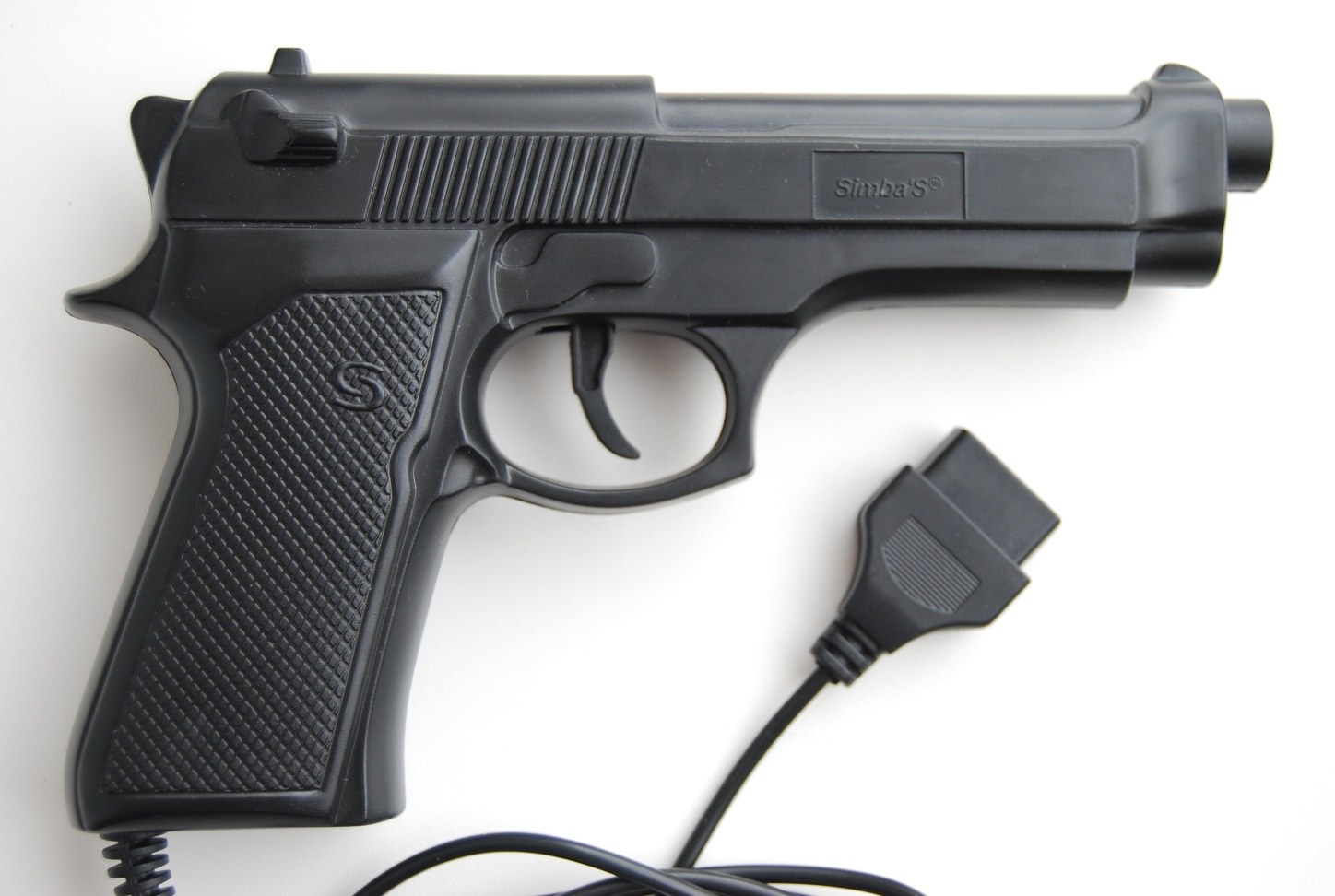
Famicom-compatible “famiclone” consoles were sold in large numbers in Eastern Europe, the former Soviet Union, South America and Asia, often with a gun in the box. These guns are electrically Zapper-like, but they are not Nintendo products and they come with whatever connector the clone console used.
Telling a clone from a Zapper. A genuine Zapper says Nintendo and NES-005, is grey or orange in the two patterns shown above, and has an NES 7-pin plug. Clone guns are usually black, shaped like a contemporary semi-automatic pistol, and fitted with a DE-9 or a 15-pin plug for a clone console. The NESdev note above suggests that some clones, with weaker light filtering, behave differently from a Zapper on a modern display; that is a reason some modders seek them out, not a reason to pay a premium for one.6
2.6 Sega Light Phaser
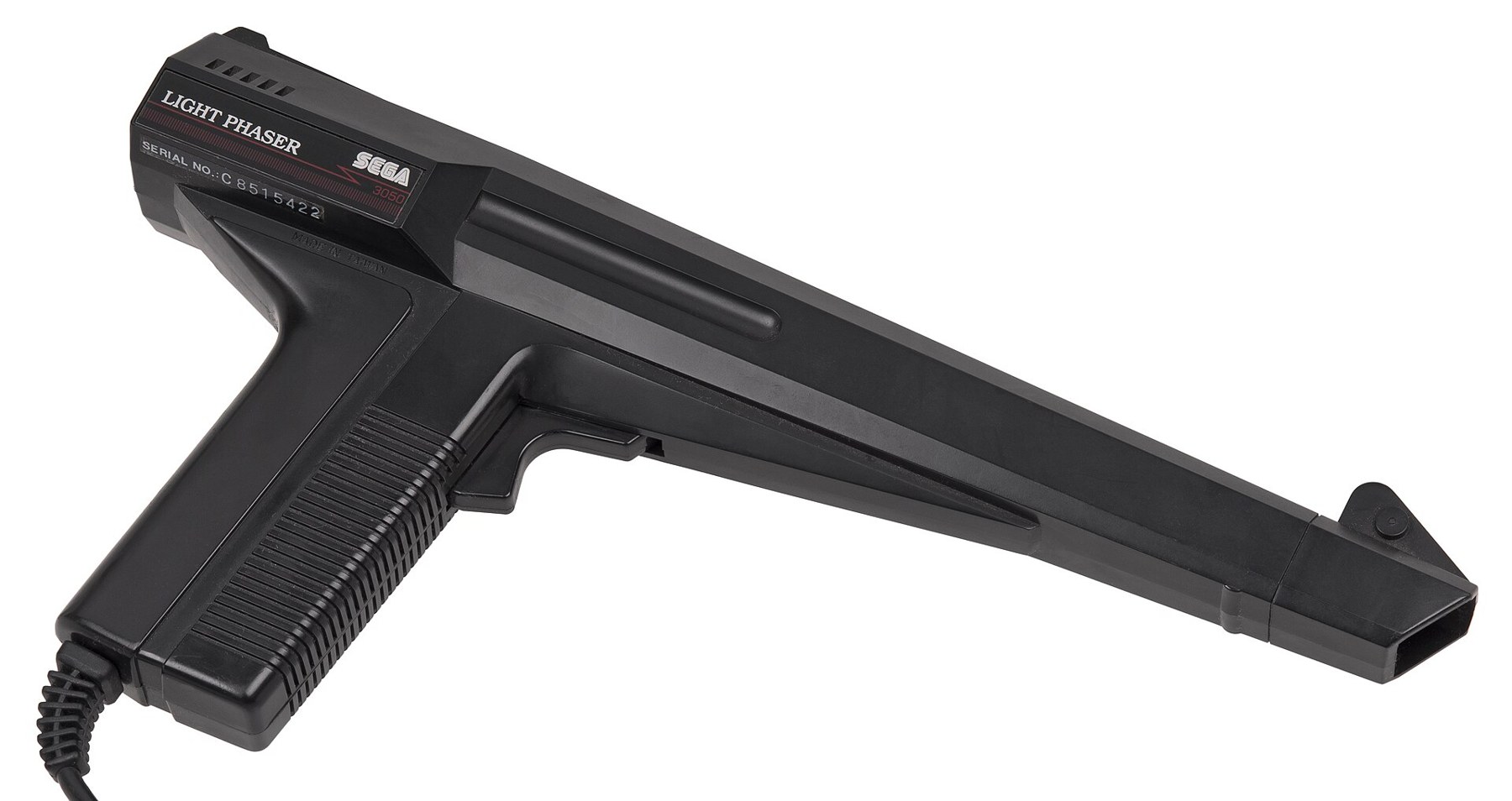
Table 5 — Sega Light Phaser
| Maker | Sega |
| First release | October 1986, United States (code 3050); United Kingdom August 1987 at £44.95; Brazil (Tec Toy) 4 September 198910 |
| System | Sega Master System. Not compatible with the Japanese Mark III, which lacks the TH signal the gun needs; compatible with the Japanese Master System10 |
| Model numbers | 3050 (US); MK-3097-50 (later European packaging)10 |
| Connector | DE-9 controller plug. Sega’s US instructions say to plug it into Control 1 on the Power Base, the opposite port to the Zapper11 |
| Pinout | Community documentation (SMS Power, via Sega Retro): pin 5 +5 V, pin 6 trigger (TL), pin 7 light sensor (TH), pin 8 ground; active low. Not Sega documentation |
| Sensing | Photodiode; beam timing (the TH line latches the console’s horizontal counter) |
| Controls | Trigger |
| Power | From the console |
| Recoil | No |
| Range | Four to six feet (Sega’s instructions) |
| Regional variants | All-black standard; US units after the federal marking rule with an orange tip; blue Light Phaser from Tec Toy in Brazil with the Master System III Compact; South Korean release |
| Works today | A Master System and a CRT |
| Price | PriceCharting, 19 Oct 2026: US loose $27.99, complete $64.17, sales to 18 Aug 2026; PAL loose $17.83, complete $18.81 |
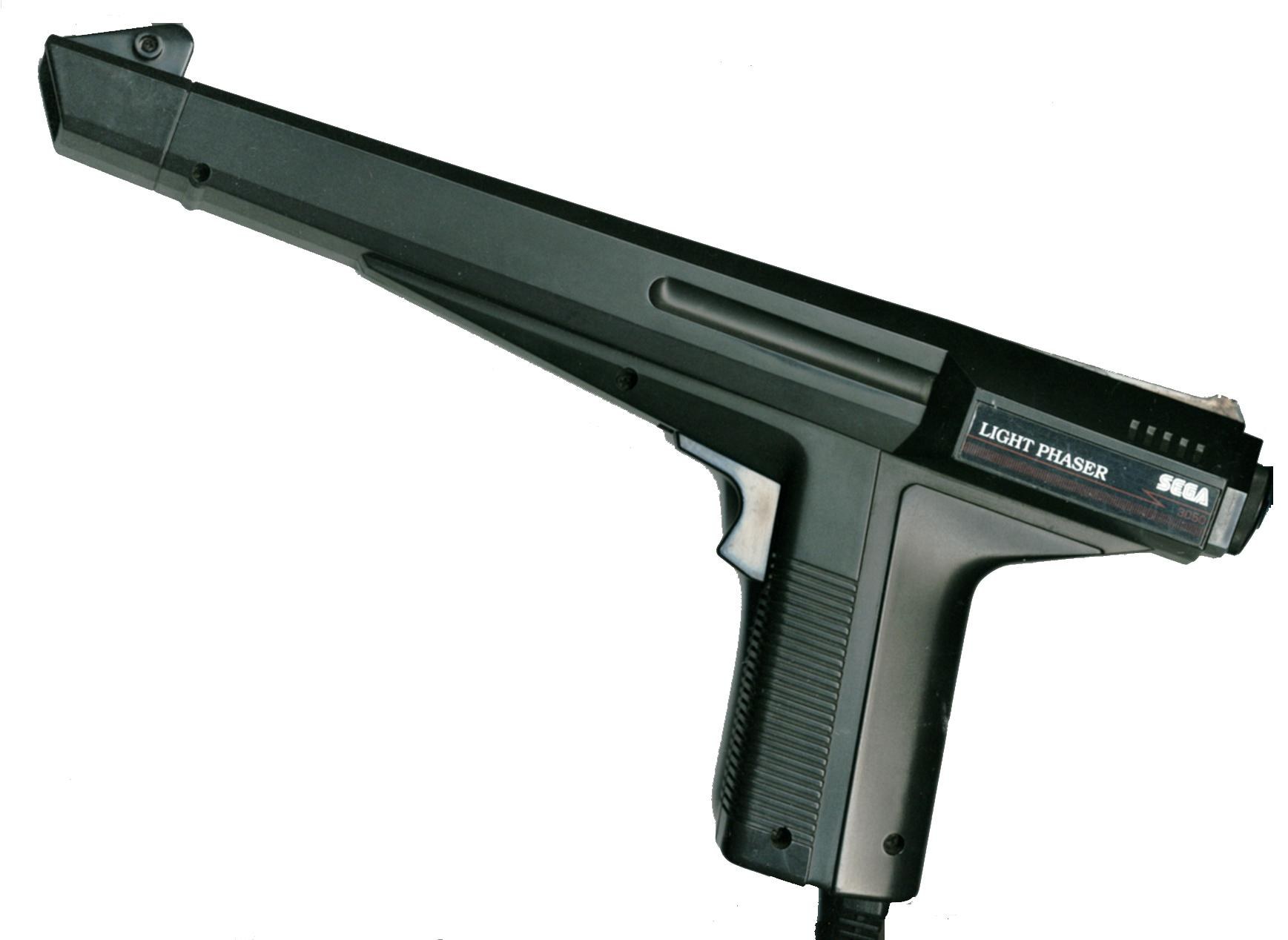
Sega’s instructions are short and practical: four to six feet from the screen, line the front sight up in the rear sight, raise brightness and contrast “especially when using an older television”, do not expose the lens to intense light, clean it only with a soft cloth and never with benzene, alcohol or thinner, and do not drop or crush the gun.11 The same leaflet says the warranty is void if “the serial number of the Sega Light Phaser has been altered, defaced, or removed”, which tells a buyer that a genuine Light Phaser carries a serial number to check.
Light Phaser or Magnum Light Phaser? By 1989, when the magazines reviewed it, Virgin Mastertronic was selling a “Magnum Light Phaser” for the Amstrad CPC, Commodore 64 and ZX Spectrum. Despite the name it is unrelated to Sega’s gun and will not work on a Master System.10 It belongs to the Home-Computer Light Guns dive.
The Zillion story. The Light Phaser is sometimes said to be modelled on the guns of the anime Red Photon Zillion. Sega Retro points out that the anime first aired in April 1987, months after the gun went on sale in the United States, so the borrowing ran the other way.10
2.7 Atari XG-1
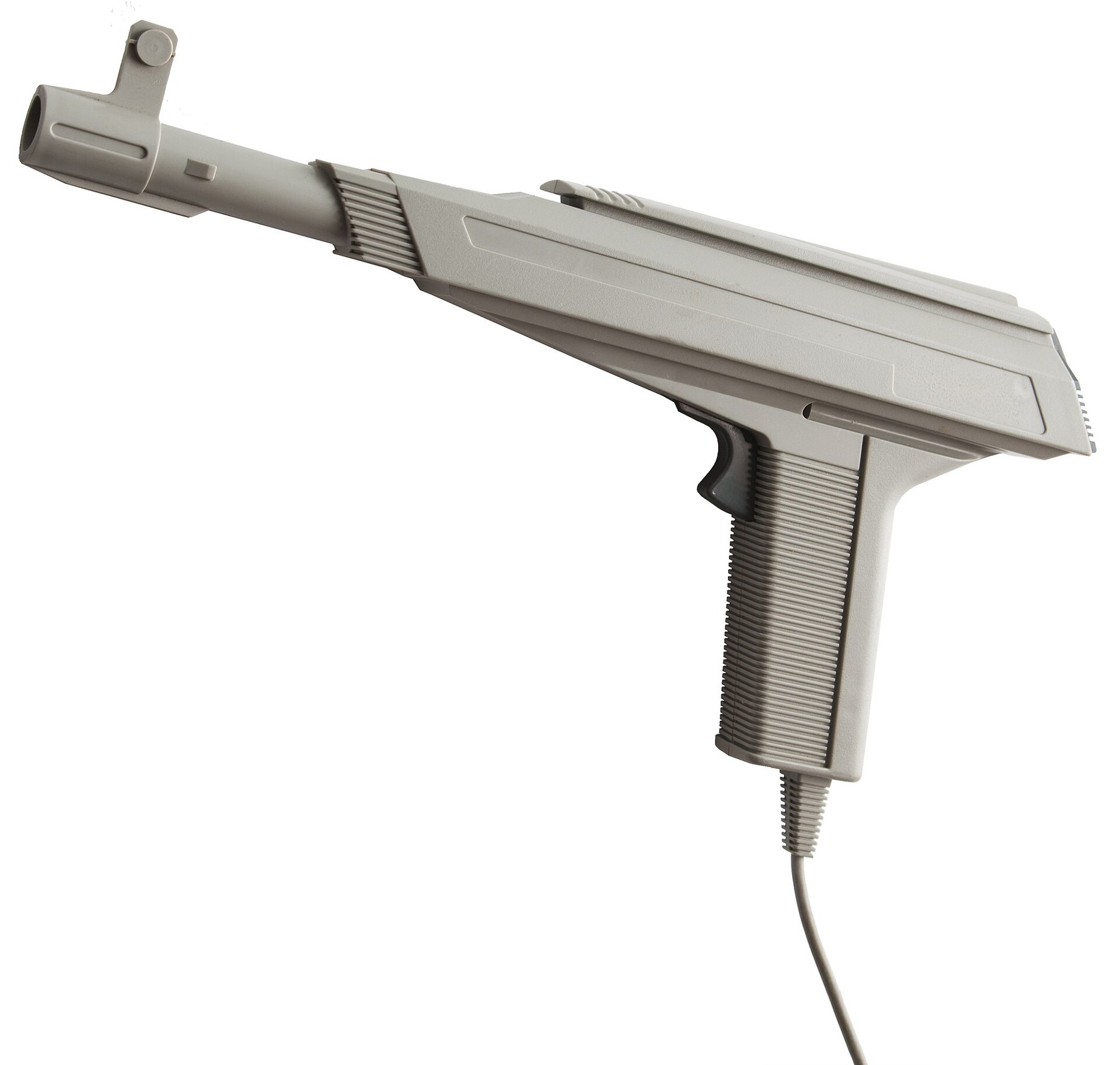
Table 6 — Atari XG-1
| Maker | Atari Corporation |
| First release | 1987 |
| System | Atari XE Game System (bundled with the XEGS deluxe set); compatible with the Atari 7800 and 2600; also usable on the Atari 8-bit computers (see Home-Computer Light Guns) |
| Model number | XG-1 |
| Connector | Atari DE-9 joystick plug |
| Pinout | Not confirmed from an Atari document; reconstructed from Atari’s joystick-port and light-pen documentation in Home-Computer Light Guns, Volume 2 |
| Sensing | Photodiode |
| Controls | Trigger |
| Power | From the console |
| Recoil | No |
| Works today | An XEGS, 7800, 2600 or Atari 8-bit computer, and a CRT |
| Price | PriceCharting, Atari XG-1 Light Gun, 19 Oct 2026: loose $36.15, complete $79.53; most recent sale 19 Mar 2026 |
The XG-1 is the console gun with the fewest games. Secondary sources agree that five light-gun games came out for the 7800 (Alien Brigade, Barnyard Blaster, Crossbow, Meltdown and Sentinel), one for the 2600 (Sentinel), and a handful for the XEGS and 8-bit computers, including Bug Hunt, Barnyard Blaster and Crossbow; the platform split differs between sources, so check per title.12 The same sources report a launch price of $34.95 and widespread complaints about the gun’s accuracy compared with the Zapper. No Atari manual for the gun was read for this dive; it is listed in the library candidates.
2.8 The 8-Bit Guns Side by Side
Table 7 — The 8-Bit Guns Side by Side
| Zapper | Light Phaser | XG-1 | |
|---|---|---|---|
| Port | Controller 2 (manual) | Control 1 (manual) | Joystick port |
| Plug | NES 7-pin | DE-9 | DE-9 |
| Reports | Light seen or not | Position, via the console’s counter latch | Position (beam timing) |
| Range in the manual | About 6 ft | 4 to 6 ft | Not checked |
| Colours | Grey; orange | Black; orange tip (US, later); blue (Brazil) | Grey |
| Cross-compatible | No | No | Across Atari’s own systems |
| Loose price, 19 Oct 2026 | about $15 | about $28 (US) | about $36 |
None of the three will work on the others’ consoles: the plugs differ, and even where an adapter could match the pins, each console reads its gun in its own way. Adapters and conversions are the business of the planned Original Consoles and Modding Classic Light Guns dives.
Footnotes
-
Computer History Museum, catalogue record for the Magnavox Odyssey, model 1TL200. https://www.computerhistory.org/collections/catalog/102752091 (search summary 2026-10-19; the record page renders client-side and was not read in full). ↩
-
David Winter, pong-story.com, “Contents of the Magnavox Odyssey”, Extensions table (“Shooting Gallery Electronic Rifle”, reference column blank). https://pong-story.com/odyitems.htm (read 2026-10-19). ↩
-
Guinness World Records, “First home-console light gun”. https://www.guinnessworldrecords.com/world-records/92331-first-home-console-light-gun (read 2026-10-19). ↩
-
VoxOdyssey, “Shooting Gallery” (game card 10, the rifle and the four target overlays). https://voxodyssey.com/magnavox-odyssey/shooting-gallery-game/ (read 2026-10-19). A collector’s site. ↩
-
Famitsu, February 2024 article on the 40th anniversary of Wild Gunman. https://www.famitsu.com/news/202402/18334556.html (read 2026-10-19). ↩ ↩2
-
NESdev Wiki, “Zapper”. https://www.nesdev.org/wiki/Zapper (read 2026-10-19). Community documentation from test ROMs, not Nintendo. ↩ ↩2 ↩3 ↩4
-
Wikipedia, “NES Zapper” (search summary 2026-10-19). Secondary. ↩
-
Victoria and Albert Museum, object O1382422, “Zapper”, Nintendo, 1989–1991, NES-005. https://collections.vam.ac.uk/item/O1382422 (read 2026-10-19). ↩ ↩2
-
Nintendo of America, Zapper Instruction Manual, ©1988, 1989 (revision 2). Scan: https://archive.org/details/Zapper_1989_Nintendo_US_rev_2 (read 2026-10-19). ↩ ↩2
-
Sega Retro, “Light Phaser” (release table citing Computer & Video Games November 1987 p. 132 and others; pinout citing SMS Power). https://segaretro.org/Light_Phaser (read 2026-10-19). A fan wiki; dates are given as it cites them. ↩ ↩2 ↩3 ↩4 ↩5
-
Sega of America, The Sega Light Phaser instructions (1986). Scan: https://archive.org/details/Sega_Light_Phaser_Instruction_The_1986_U (read 2026-10-19). ↩ ↩2
-
Wikipedia, “Atari XG-1 light gun”, and ConsoleMods, “Atari 7800: Light Gun Games” (search summaries, 2026-10-19). Secondary sources; an Atari manual was not read. ↩
Comments (0)