Console Light Guns · Volume 3
The 16-Bit Guns — Super Scope, Menacer and the Konami Justifier
Nintendo's shoulder-fired bazooka and its receiver, Sega's three-piece Menacer, and Konami's blue and pink revolvers for two consoles: identification, the parts that go missing, what each needs today, and prices
The 16-bit generation produced three guns that matter, and all three still read the picture of a cathode-ray tube. What changed was the link back to the console. Nintendo and Sega went wireless, with battery-powered guns that talked by infrared to a receiver on the television. Konami, which needed accuracy for its arcade port Lethal Enforcers, went back to a wire and built its own gun for both consoles. The consequence for a collector today is that the two wireless guns are often sold without the receiver that makes them work, and that the Konami gun will not play most of the other guns’ games, nor they its.
3.1 Three Ways Back to Port 2
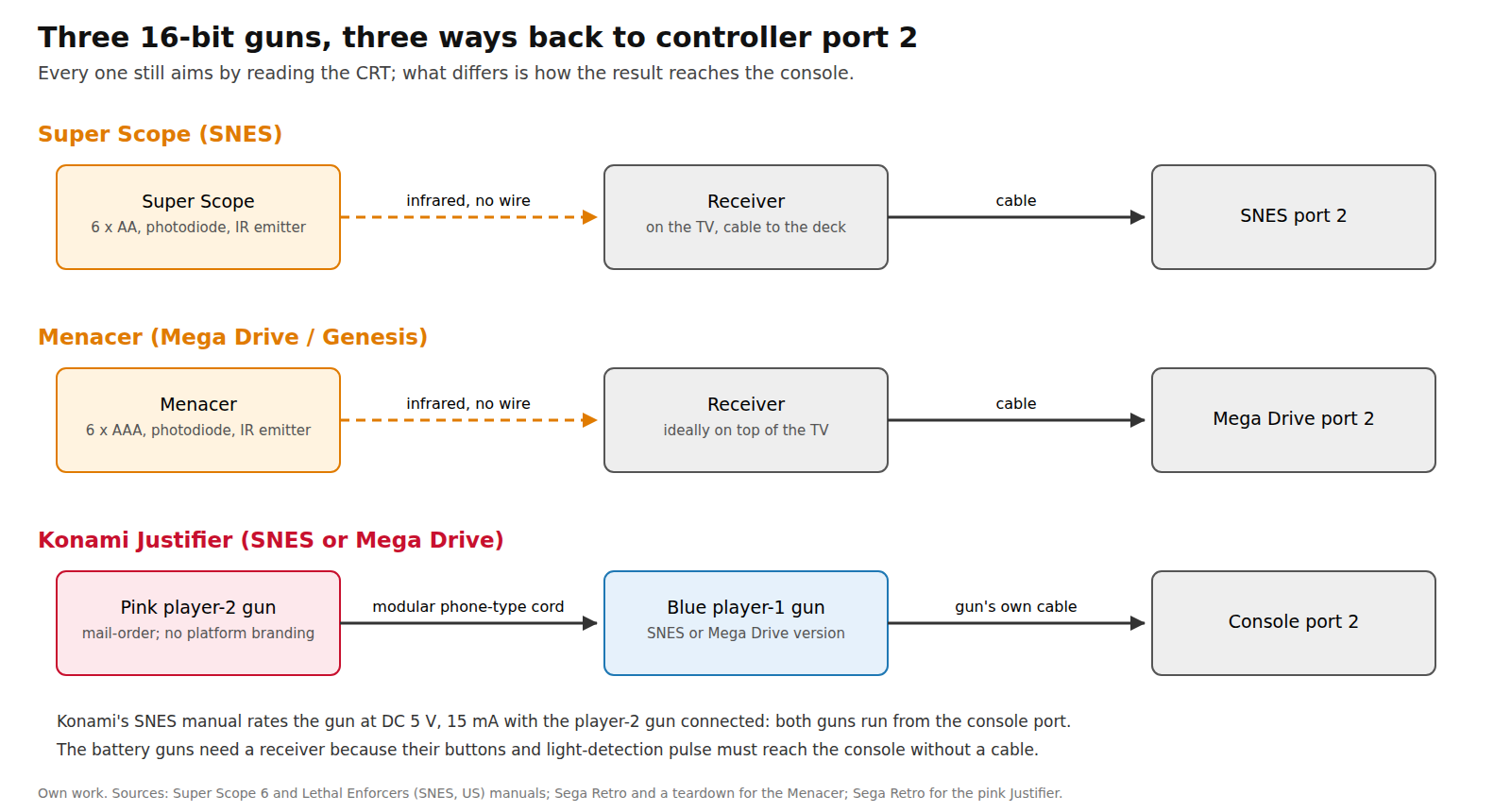
All three use controller port 2. That fact matters when testing a gun: a working gun in port 1 does nothing, and a control pad in port 1 is often needed for menus.
3.2 Nintendo Super Scope
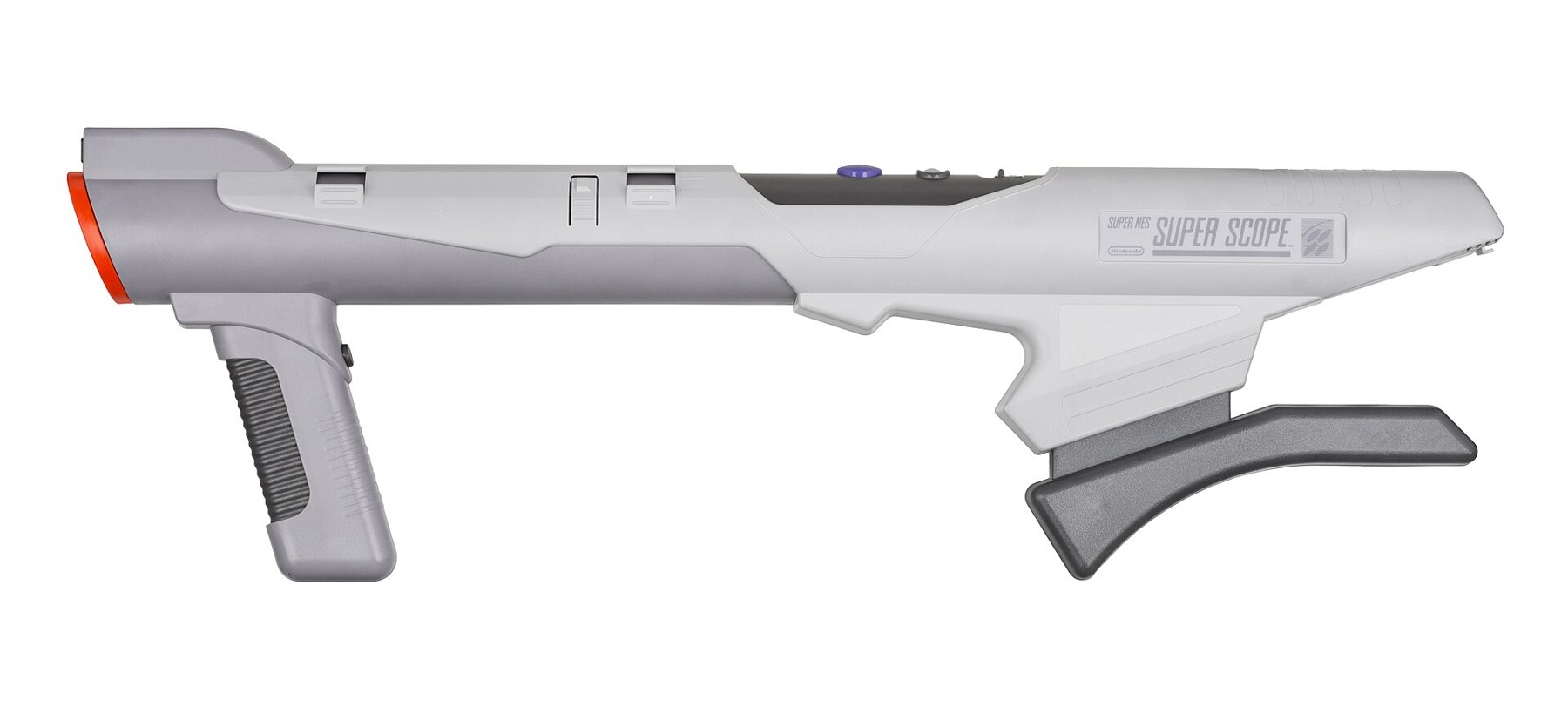
Table 1 — Nintendo Super Scope
| Maker | Nintendo |
| First release | Early 1992, United States, bundled with Super Scope 6; 21 June 1993, Japan; 1993, PAL regions as the Nintendo Scope1 |
| System | Super NES / Super Famicom |
| Model numbers | SHVC-013 (scope) and SHVC-014 (receiver), per a collector database; the US SNS- number was not confirmed from a label2 |
| Connector | None on the gun. An infrared receiver sits on the television and plugs into controller port 21 |
| Sensing | Photodiode; beam timing. Documented range 3.28 to 16.4 ft, resolution about one 8 x 8 character cell, lens focal length 150 mm; not sensitive to red because red phosphor decays slowly3 |
| Controls | FIRE button, CURSOR button, PAUSE button, and a POWER switch with OFF, ON (centre) and TURBO positions4 |
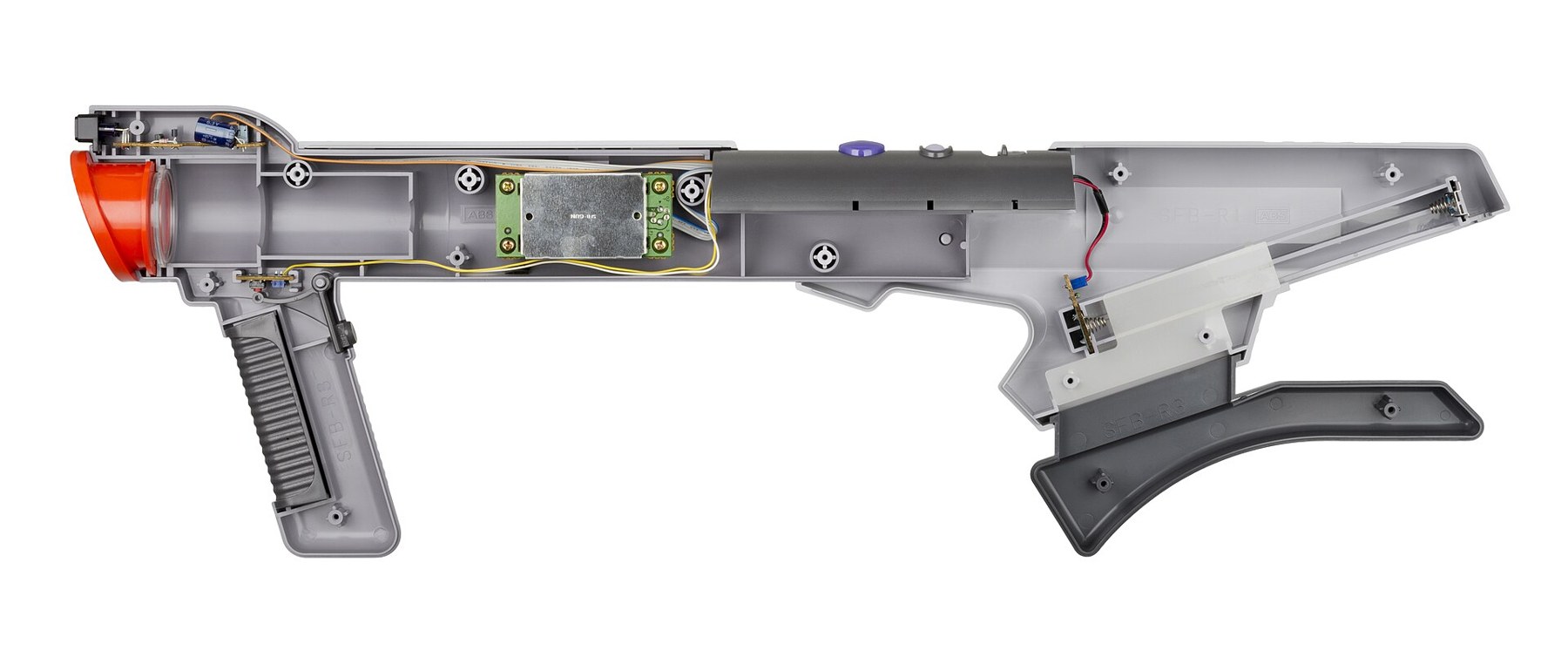
| Power | Six AA batteries |
| Recoil | No |
| Regional variants | ”Super Scope” (US, Japan), “Nintendo Scope” (PAL); Japanese pack with Super Scope 6 at ¥9,800 (secondary) |
| Works today | The receiver, six fresh AA cells, a Super NES and a CRT |
| Price | PriceCharting, 19 Oct 2026: Super Scope 6 gun bundle loose $65.00, complete $188.50, most recent sale 21 Apr 2026; receiver alone (“Super Scope Sensor”) loose $15.40. The PAL and Super Famicom pages are for the Scope 6 game, whose loose price is the cartridge alone, so they are not gun prices |
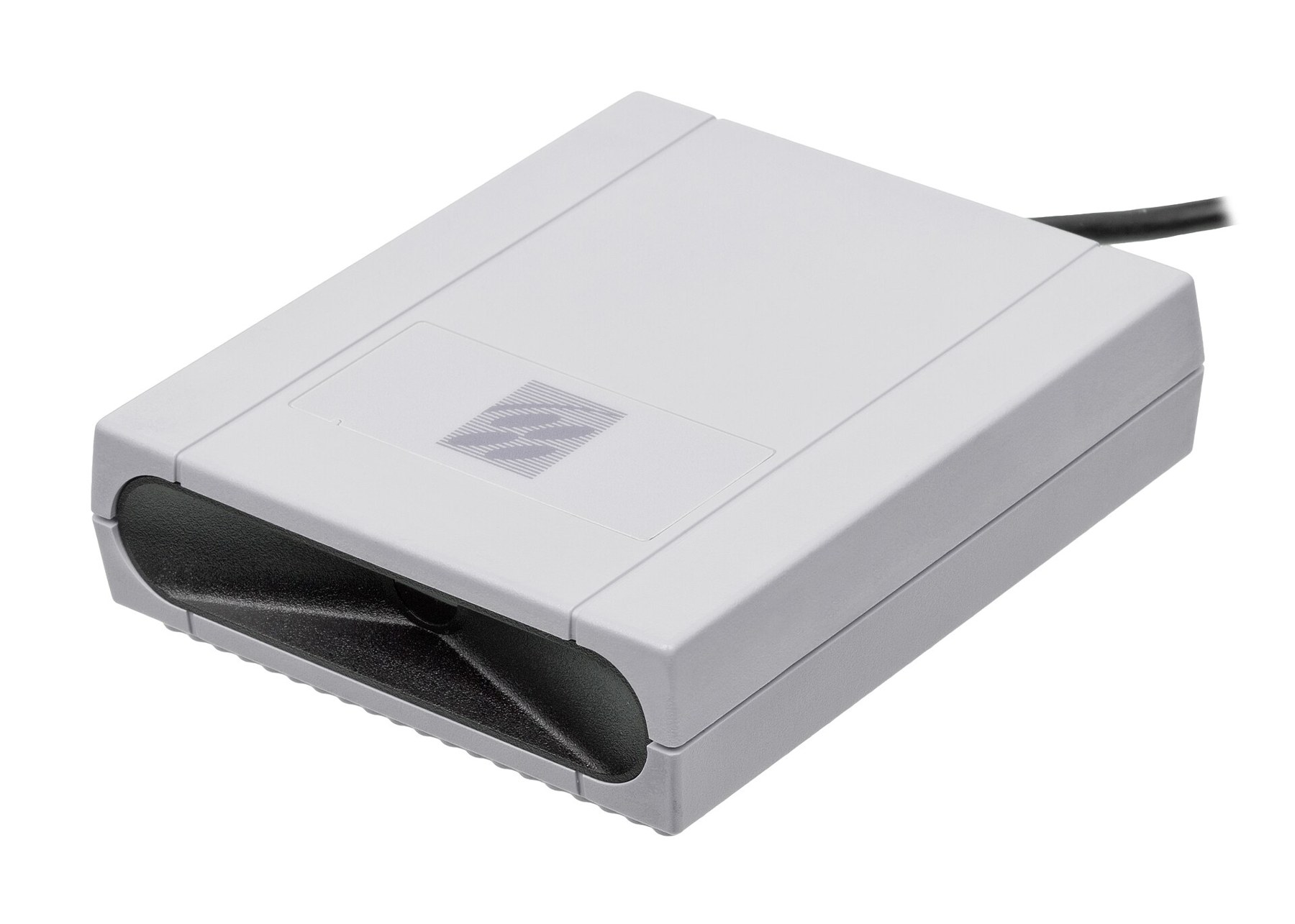
How it is used. The Super Scope 6 manual describes the routine every Super Scope game follows: set up the receiver, switch the console and the scope on, shoot once at the title screen, then shoot the centre of the ADJUST AIM target “by sighting it through the Sight Tube and the Front Sight”. The PAUSE button lets the player re-aim at any time. In that game the TURBO position has no effect: “You will only shoot a single shot even if the POWER Switch is in the TURBO position”.4
Why the games look washed out. SNES Central notes that Super Scope games could not use red, and the development-manual figures explain it: red phosphor glows for about 1.2 ms after the beam passes, against 300 µs for green and 250 µs for blue, so a red pixel would trigger the photodiode long after the beam had moved on.3 1
The games. SNES Central lists Super Scope 6, Battle Clash, Bazooka Blitzkrieg, X-Zone, The Hunt for Red October (bonus levels), Yoshi’s Safari, T2: The Arcade Game, Lamborghini American Challenge (optional mode), Metal Combat: Falcon’s Revenge, Operation Thunderbolt, Tin Star and, as an easter egg, Lemmings 2.1
Batteries and corrosion. Six AA cells sit in the shell for months or years in a stored Super Scope, and leaked cells are a common fault in second-hand units. Check the battery compartment before paying for one; repair belongs to Modding Classic Light Guns.
3.3 Sega Menacer
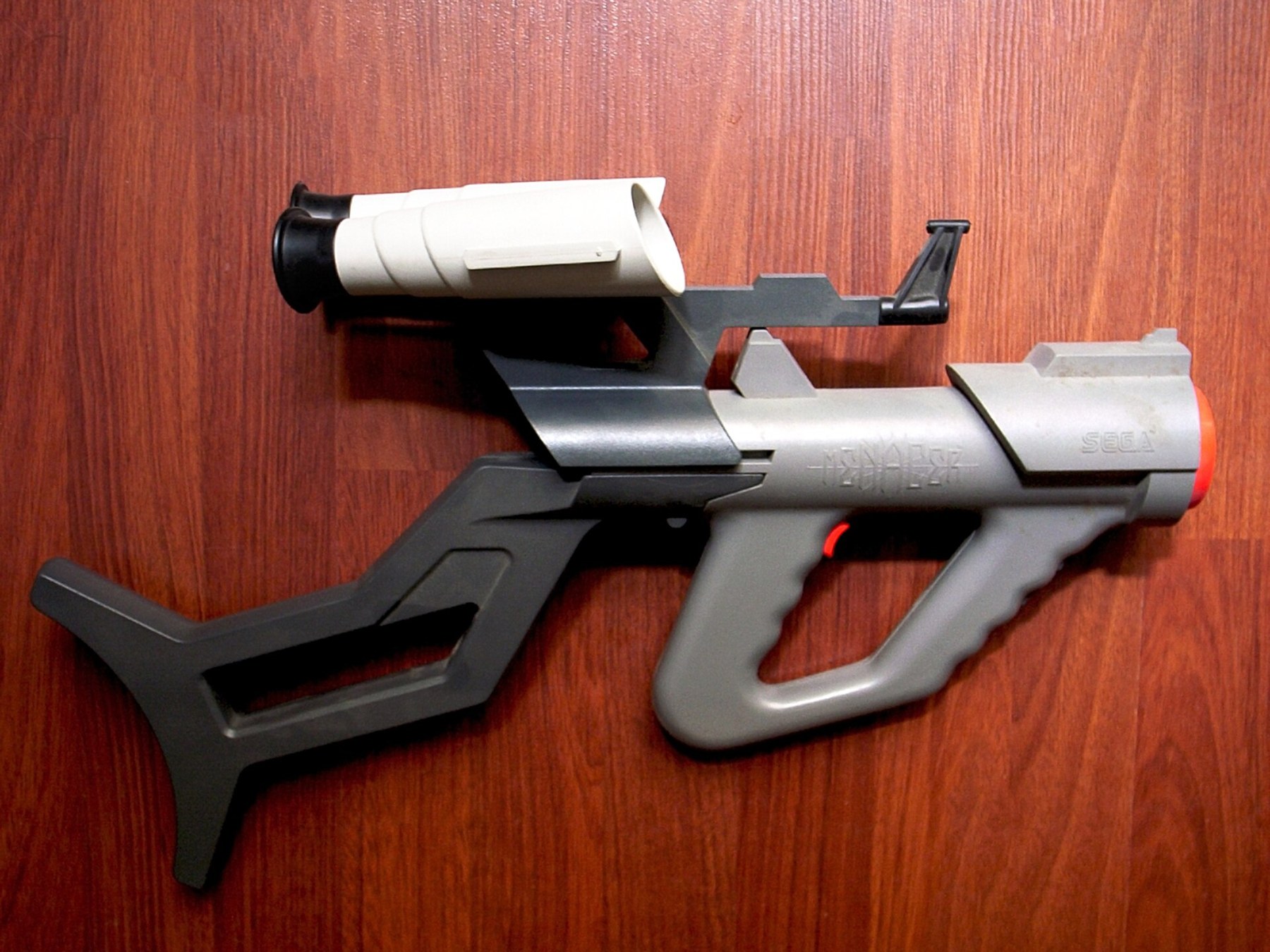
Table 2 — Sega Menacer
| Maker | Sega |
| First release | October 1992, United States, at $59.95; 19 November 1992, United Kingdom, at £59.99; also France, Portugal, Australia, Canada (distributed by Irwin) and Brazil (Tec Toy). No Japanese release5 |
| System | Mega Drive / Genesis, and Mega-CD / Sega CD games |
| Model numbers | 1658 (US); MK-1658-50 (UK)5 |
| Connector | None on the gun. An infrared receiver box sits on top of the television and plugs into controller port 25 6 |
| Sensing | Photodiode; beam timing |
| Controls | Trigger and thumb buttons on the pistol section; their names were not confirmed from a Sega manual for this dive |
| Power | Six AAA batteries in the pistol section6 |
| Recoil | No |
| Construction | Three pieces: the pistol, a skeleton shoulder stock, and a removable twin sight that clips to the top |
| Regional variants | Standalone with the Menacer 6-Game Cartridge; US bundle with T2: The Arcade Game (1993, $89.99) |
| Works today | The receiver, six fresh AAA cells, a Mega Drive or Genesis, and a CRT |
| Price | PriceCharting, 19 Oct 2026: Genesis Menacer 6-Game Cartridge gun bundle loose $65.17, complete $134.79, but the most recent sale shown is February 2025, so the figure is stale; PAL Menacer gun bundle complete $211.94, last sale December 2023 |
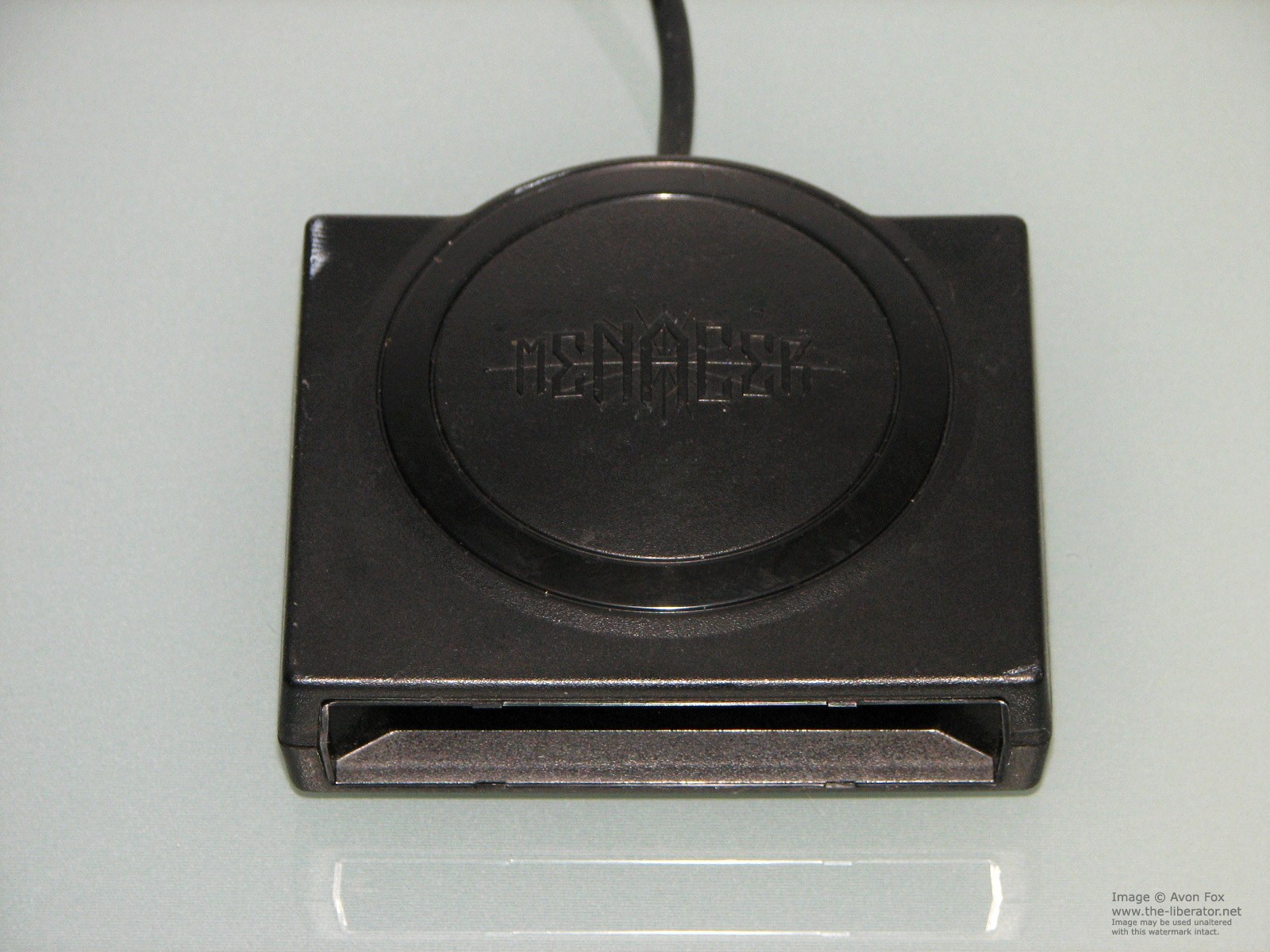
The twin sight. Sega Retro describes the clip-on twin sight as widely seen as impractical, because looking through it hides what is being shot at.5 It is also a separate part that is often missing; a “complete” Menacer has the pistol, the stock, the sight, the receiver and its cable.
A price discrepancy in the sources. The same fan wiki that gives the cited US launch price of $59.95 also says in its text that the Menacer “retailed for $100”. The $59.95 figure is the one it attributes to GamePro (December 1992, p. 46), and is the one used here.5
What it will not play. Sega Retro notes that the Menacer does not work with Lethal Enforcers, which requires Konami’s Justifier.5 The Menacer’s games are the Menacer 6-Game Cartridge, Body Count and T2: The Arcade Game on the Mega Drive, and the Mega-CD titles Corpse Killer, Crime Patrol, Mad Dog McCree, Mad Dog II and Who Shot Johnny Rock?
Patent. Sega Retro lists US patent 5,351,969 against the Menacer. It was not read for this dive and is listed in the library candidates.
3.4 Konami Justifier for Mega Drive and Super NES
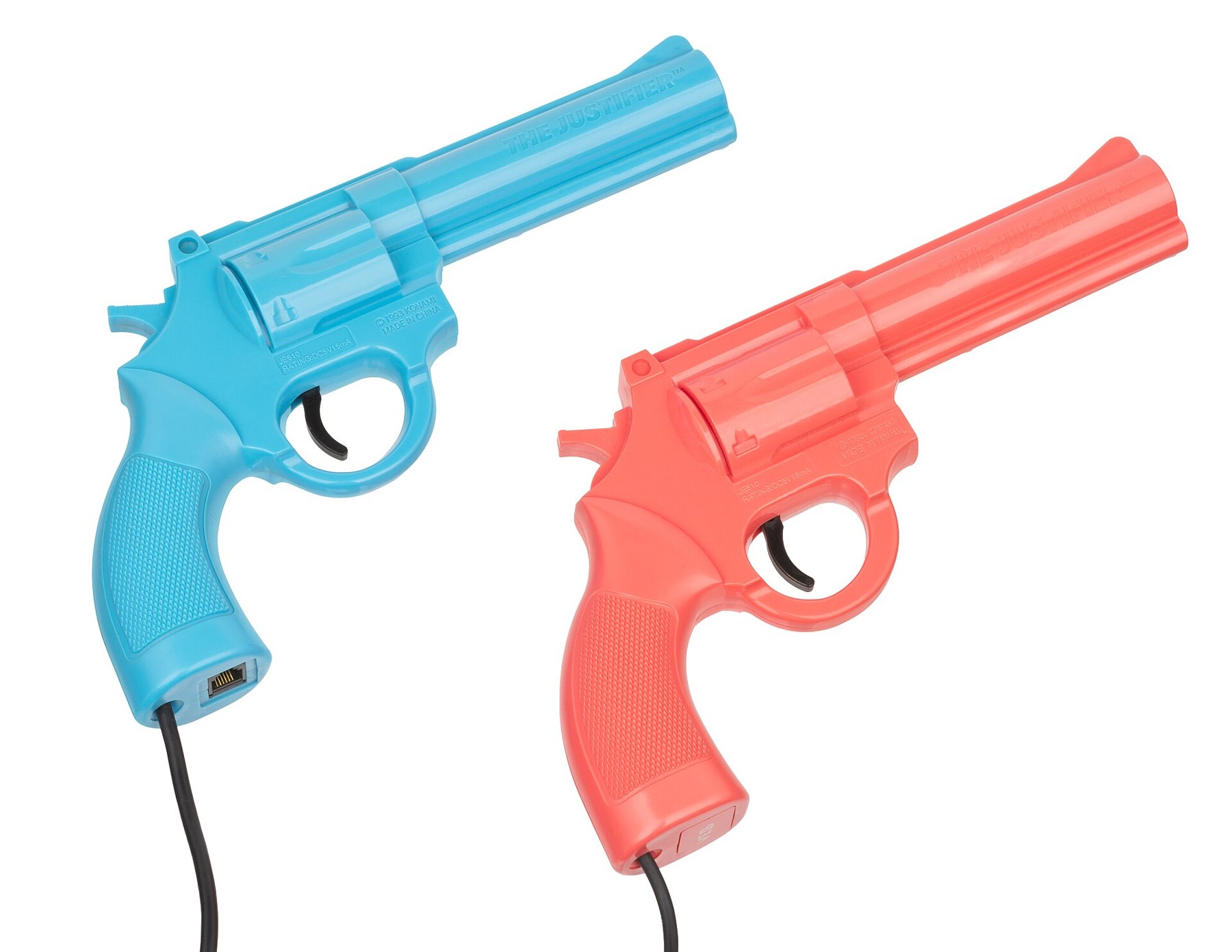
Table 3 — Konami Justifier for Mega Drive and Super NES
| Maker | Konami |
| First release | 1993, Japan, United States and Europe, bundled with Lethal Enforcers7 |
| System | Mega Drive / Genesis and Mega-CD; Super NES (a separate version of the player-1 gun) |
| Model numbers | SNES player-1 gun: “Special game gun JE507-S01” on Konami’s own specification8 |
| Connector | Player-1 gun: wired to controller port 2. Player-2 (pink) gun: plugs into the player-1 gun by a 6-pin modular phone-type cord7 |
| Sensing | Photodiode; beam timing. Konami’s specification: one custom LSI and one “light receiving element (with amp)“8 |
| Controls | Trigger; any further button names were not confirmed from a Konami document |
| Power | From the console: DC 5 V, 15 mA with the player-2 gun connected (Konami’s specification for the SNES gun)8 |
| Recoil | No |
| Range | 5 to 7 feet (Konami’s SNES manual) |
| Regional variants | Blue player-1 guns for each console; pink player-2 gun sold by Konami by mail order, in a box without platform branding, said to work with either console’s blue gun; a yellow gun was shown at trade shows in 19937 |
| Works today | The matching console, a CRT, and the Lethal Enforcers games, Snatcher or the other titles listed below |
| Price | PriceCharting, 19 Oct 2026: Genesis blue loose $41.35, complete $82.70, sales to 25 Sep 2026; Genesis pink loose $144.60, complete $289.10, last sale February 2024; Super NES loose $55.71, complete $161.56, sales to 27 Sep 2026; Japanese Mega-CD Justifier loose $95.00 |
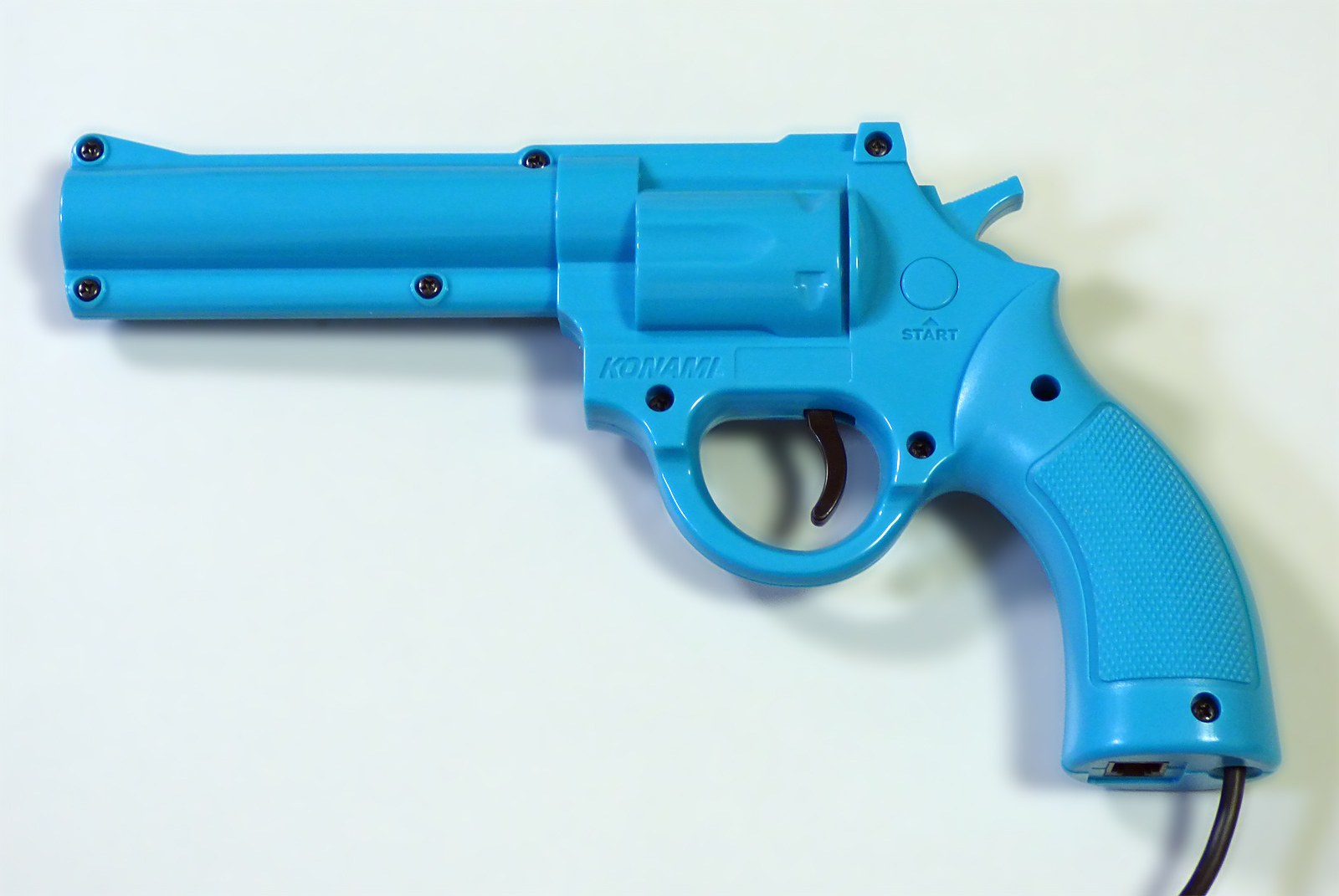
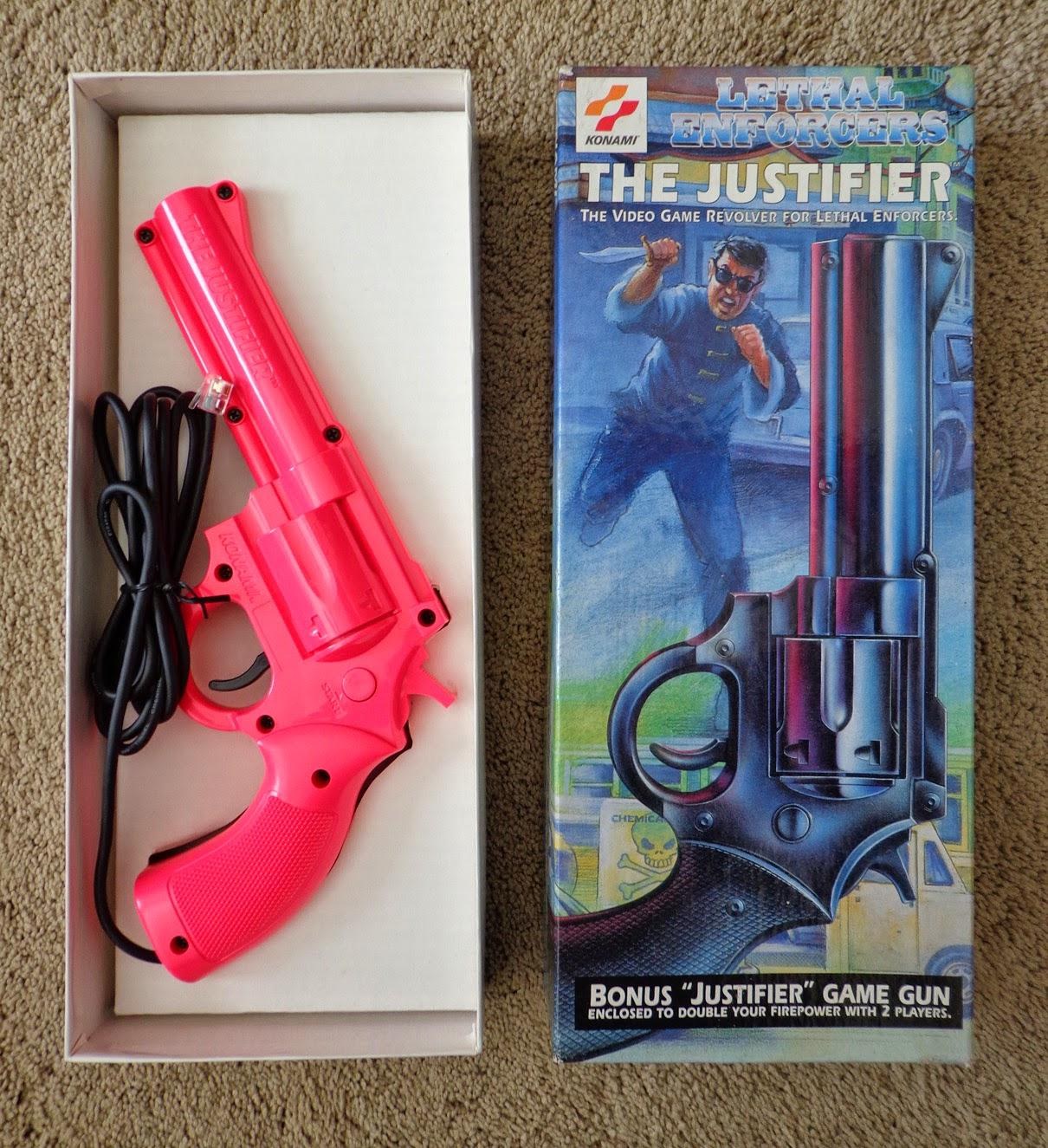
Konami’s own manual is the best source. The Lethal Enforcers Super NES manual gives the setup — a control pad in port 1, the “special Player-1 game gun” in port 2, then an automatic gun-adjust screen — and a troubleshooting page that every Justifier owner should read: adjust the screen brightness, stand 5 to 7 feet back, move or switch off a fluorescent light near the screen, re-centre the gun by pressing START and shooting the crosshairs, and “always remove the game gun from control port 2” when playing a game that does not use it. It includes the gun’s specification, quoted in the table above, and an order form for the player-2 gun.8
Telling Justifiers apart.
Table 4 — Telling Justifiers apart.
| Feature | Mega Drive blue | Super NES blue | Pink player 2 | Where to look |
|---|---|---|---|---|
| Plug | Sega DE-9 | Super NES controller plug | Modular phone-type plug | Cable end |
| Second socket | Modular socket for the pink gun | Modular socket for the pink gun | None | Butt or grip |
| Branding | Sega console | Nintendo console | None on the box | Box, labels |
| Rarity, by price | Common | Common | About three times the blue’s loose price | PriceCharting |
A claim not repeated here. Sega Retro says the Justifier is modelled on the Colt Python revolver.7 No Konami source for that was found, and it is left as the wiki’s claim.
3.5 Which Gun Plays Which Game
Table 5 — Which Gun Plays Which Game
| Game | Super Scope | Menacer | Justifier |
|---|---|---|---|
| Super Scope 6, Battle Clash, Yoshi’s Safari | Yes | — | — |
| T2: The Arcade Game | Yes (SNES) | Yes (Mega Drive) | — |
| Menacer 6-Game Cartridge, Body Count | — | Yes | — |
| Lethal Enforcers, Lethal Enforcers II | — | No | Yes (both consoles) |
| Snatcher (Mega-CD) | — | — | Yes |
| Mad Dog McCree, Mad Dog II, Who Shot Johnny Rock?, Crime Patrol (Mega-CD) | — | Yes | Yes |
| Corpse Killer (Mega-CD) | — | Yes | Not listed |
The table is assembled from the compatibility lists of SNES Central and Sega Retro;1 5 7 where neither lists a gun for a game, the cell is a dash, not a “no”. Before buying a game for a particular gun, check the game’s own manual.
3.6 Buying a 16-Bit Gun
Insist on the receiver. A Super Scope or Menacer without its receiver is a shell. The Super Scope receiver is sold separately on PriceCharting at about $15 loose; no comparable listing exists for the Menacer receiver.
Open the battery door. Six cells sitting for decades is the commonest fault in both wireless guns.
Count the Menacer’s parts. Pistol, stock, twin sight, receiver.
Match the Justifier’s plug to the console. The two blue guns look alike in photographs; the plug at the cable end decides which console it is for.
Test on a CRT, with port 2. All three guns use port 2, and all three need a CRT. Running them on anything else is the subject of the planned Original Consoles dive.
Footnotes
-
SNES Central, Super Scope article (id 0017). https://snescentral.com/article.php?id=0017 (read 2026-10-19). ↩ ↩2 ↩3 ↩4 ↩5
-
nindb.net, “Super NES Hardware and Accessories” (search summary, 2026-10-19). A collector database; not confirmed from a label. ↩
-
SNESLab wiki, “Super Scope”, citing the official Super NES development manual, Book I p. 2-24-2 and Book II p. 4-1-3. https://sneslab.net/wiki/Super_Scope (read 2026-10-19). ↩ ↩2
-
Nintendo of America, Super Scope 6 instruction booklet (US), “Super NES Super Scope Control” and “Aim Adjustment”. Scan: https://archive.org/details/snes_Super_Scope_6_USA (read 2026-10-19). ↩ ↩2
-
Sega Retro, “Menacer” (release table citing GamePro December 1992 p. 46, Computer Trade Weekly 414 p. 18 and others). https://segaretro.org/Menacer (read 2026-10-19). A fan wiki. ↩ ↩2 ↩3 ↩4 ↩5 ↩6 ↩7
-
the-liberator.net, “SEGA Mega Drive Menacer Light Gun” (receiver teardown). https://the-liberator.net/site-files/retro-games/hardware/SEGA-Mega-Drive-Menacer/sega-mega-drive-menacer-light-gun.htm (read 2026-10-19). ↩ ↩2
-
Sega Retro, “The Justifier”. https://segaretro.org/The_Justifier (read 2026-10-19). A fan wiki. ↩ ↩2 ↩3 ↩4 ↩5
-
Konami (America), Lethal Enforcers (Super NES, US) instruction manual: “Setting up”, “Cautions on use of the game gun”, “Troubleshooting the game gun” and the game gun specifications. Scan: https://archive.org/details/lethal-enforcers-usa (read 2026-10-19). ↩ ↩2 ↩3 ↩4
Comments (0)