Console Light Guns · Volume 4
The 32-Bit Guns — Virtua Gun, Hyper Blaster, GunCon and the Third-Party Crowd
Sega's Saturn gun in three colours, Konami's PlayStation gun under two names, Namco's GunCon and the video lead that made it accurate, the dual-format Predator family, and the 3DO's only gun
The 32-bit consoles brought arcade gun games home almost unchanged: Virtua Cop on the Saturn, Time Crisis and Point Blank on the PlayStation. The Saturn had one official gun, Sega’s own, and its games used it. The PlayStation never had a Sony gun. It had two incompatible guns from two game publishers, Konami and Namco, each of which made its games work with its own gun, and a crowd of third-party guns that tried to work with both. Knowing which standard a PlayStation gun follows is the most important thing to know about it.
4.1 Two Standards on One Console
The two PlayStation guns differ in how they find the beam, and the difference is in the cable.
Table 1 — Two Standards on One Console
| Konami Hyper Blaster / Justifier | Namco GunCon / G-Con 45 | |
|---|---|---|
| Connection | Controller port only | Controller port plus a composite video lead |
| How the position is found | The gun’s light pulse interrupts the console, and the game reads the console’s timers | The gun times the light against the sync it takes from the video lead, and reports the position itself |
| Controller ID (community documentation) | 5A31h | 5A63h |
| Games | Konami’s and those that adopted its standard | Namco’s and those that adopted its standard |
The middle rows come from the community PSX-SPX reference, which documents the Konami gun as driving the controller port’s lightgun interrupt line (pin 8, /IRQ10) and leaving the game to read timers 0 and 1, and the GunCon as “extracting Vsync/Hsync timings from the video signal (via a cinch adaptor)”, with X counted in 8 MHz clocks since horizontal sync and Y in scanlines since vertical sync.1 It is reverse-engineered documentation, not Sony’s or Namco’s, but it explains why the two are incompatible: a game written for one asks the console a question the other gun cannot answer.
4.2 Sega Virtua Gun and Stunner
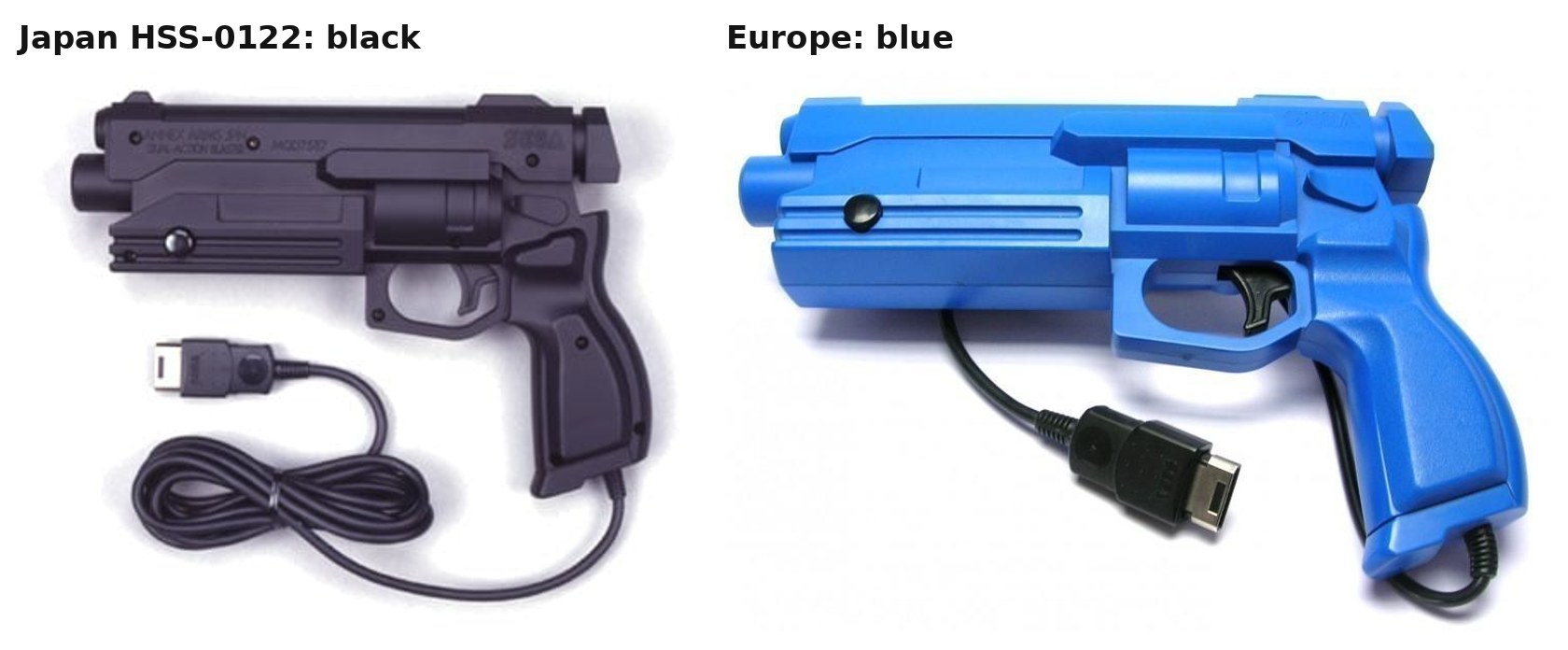
Table 2 — Sega Virtua Gun and Stunner
| Maker | Sega; designed by Sega AM2, the developers of Virtua Cop2 |
| First release | 24 November 1995, Japan, ¥2,900; revised model 20 September 1996, ¥2,900 (Sega’s own history page).3 1995, United States, $49.99; 8 December 1995, United Kingdom, £24.992 |
| System | Sega Saturn |
| Model numbers | HSS-0122 (Japan); HSS-0152 (Japan, revised); MK-80113 (US, Stunner); GS-9505J (South Korea, Samsung); MK-80318-40 (Asia)3 2 |
| Connector | Saturn controller plug; two guns for two players (the Virtua Cop manual advertises play “With 2 Stunner guns”) |
| Sensing | Photodiode; beam timing |
| Controls | Trigger and Start. Reload by pointing away from the screen and pulling the trigger (Sega’s Virtua Cop manual)4 |
| Power | From the console |
| Recoil | No |
| Regional variants | Black in Japan; blue in Europe; orange in North America as the Stunner. The revised Japanese HSS-0152 changed the start button and trigger from black to yellow3 |
| Works today | A Saturn and a CRT |
| Price | PriceCharting, 19 Oct 2026: US Stunner loose $51.94, complete $74.50, most recent sale April 2026; Japanese Virtua Gun loose $44.00, complete $62.85, sales to August 2026; PAL Virtua Gun loose $46.99, complete $174.51 |
Sega’s own Japanese hardware history describes the gun as designed after the “Guardian”, the pistol carried in Virtua Cop, and gives the yellow start button and trigger as the visible change in the 1996 model released alongside Virtua Cop 2.3 Sega Retro reports, citing the UK magazine Maximum, that the European guns were blue because of UK law and that North American guns were sold only in orange.2 The colour therefore identifies the market a gun was made for, and the yellow trigger identifies the later Japanese model.
From the Virtua Cop manual. The US manual calls the gun the “Sega Stunner arcade gun”. It has a GUN ADJUST screen for the Stunner only: shoot the centre of the target until the shots land where intended, then point away and pull the trigger to leave. Its advice for accuracy: “Remain the same distance from the screen at all times” and “Fire at the screen straight on”.4
Games. Sega Retro lists about twenty Saturn titles, including Virtua Cop and Virtua Cop 2, The House of the Dead, Area 51, Maximum Force, Crypt Killer, Die Hard Trilogy, Death Crimson, Mighty Hits and Policenauts.2
4.3 Konami Hyper Blaster and the PlayStation Justifier
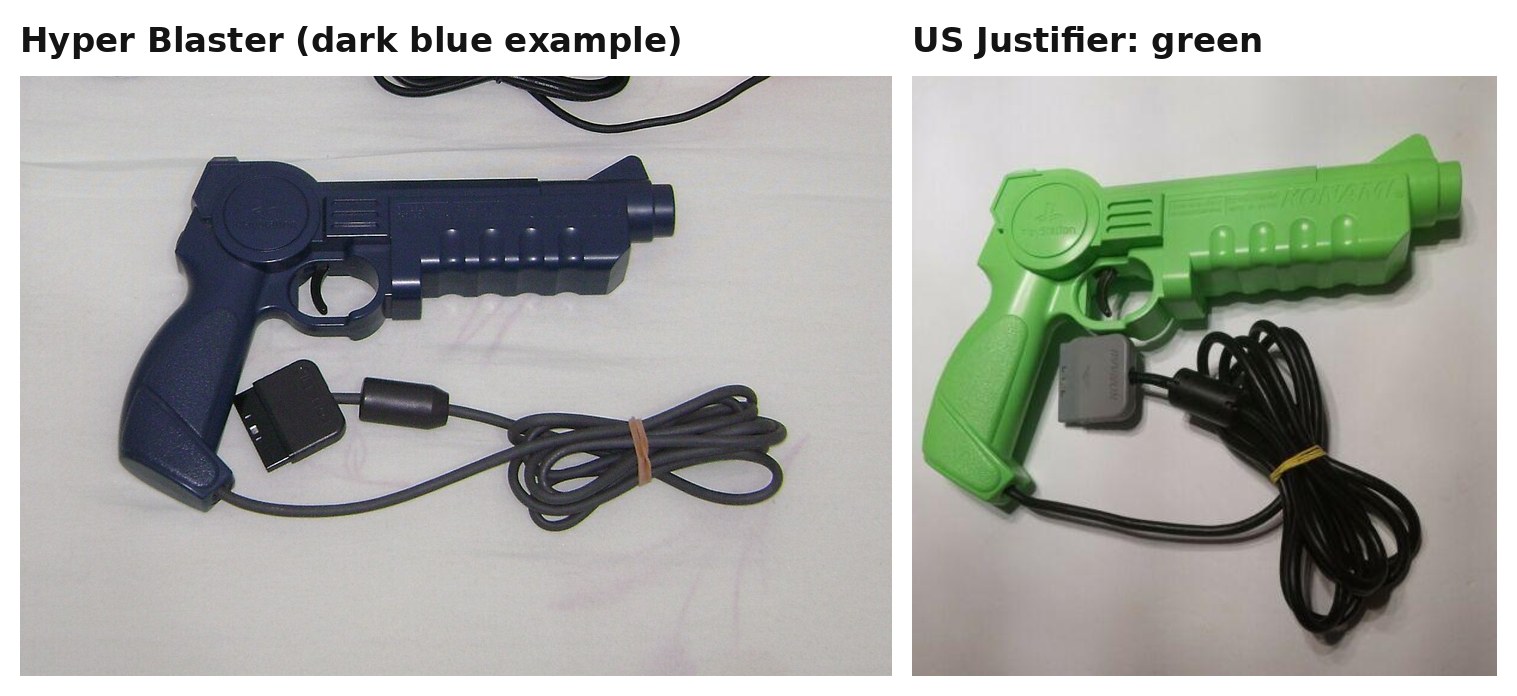
Table 3 — Konami Hyper Blaster and the PlayStation Justifier
| Maker | Konami |
| First release | Early 1996 (as reported by Sega Retro)2 |
| System | PlayStation |
| Model numbers | Sony licence codes SLPH-00014 (Japan), SLEH-00005 (Europe), SLUH-00017 (North America), as reported by secondary sources and marketplace listings5 |
| Names | Hyper Blaster (Japan and Europe); Justifier (North America) |
| Connector | PlayStation controller plug only, no video lead |
| Pinout | Community documentation: the light pulse drives controller-port pin 8, the lightgun interrupt line (/IRQ10)1 |
| Sensing | Photodiode; beam timing, read by the game from the console’s timers |
| Controls | Trigger; a button on the left side (start) and one at the rear (back), per the community documentation1 |
| Power | From the console |
| Recoil | No |
| Regional variants | Black in Japan, green in North America (secondary sources); a dark blue example is photographed above |
| Works today | A PlayStation, a CRT, and a game that supports the Konami standard |
| Price | PriceCharting, 19 Oct 2026: US Justifier loose $72.49, complete $93.78, sales to September 2026; Japanese Hyper Blaster loose $62.00, complete $73.76 |
The Konami gun’s games include Konami’s own Lethal Enforcers I & II and titles from other publishers that adopted its standard; Project Horned Owl, published by Sony, is reported as the first.5 Secondary sources report that a few games, Elemental Gearbolt among them, support both the Konami gun and the GunCon. Check the game’s own manual before buying a gun for it.
4.4 Namco GunCon and G-Con 45
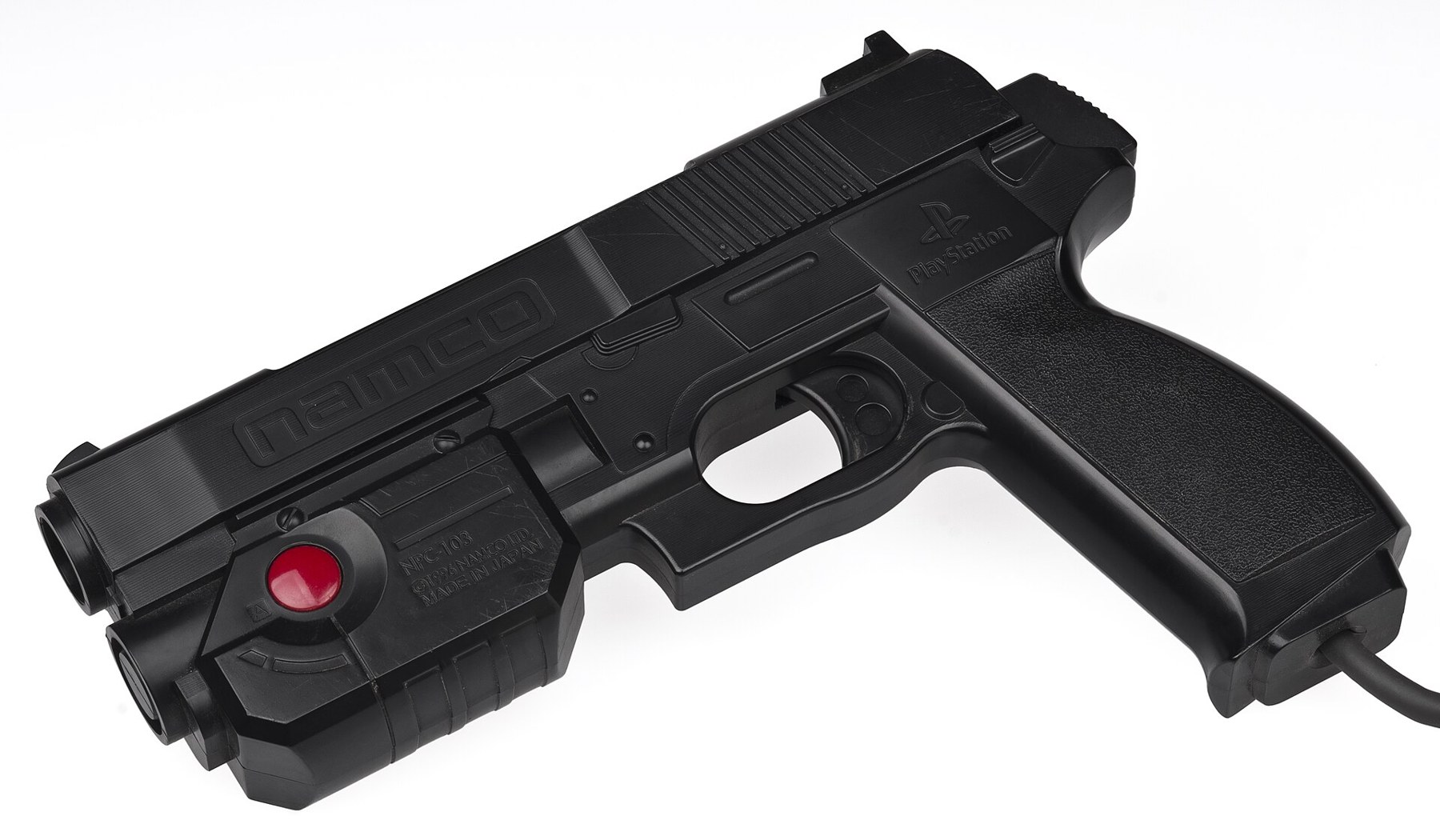
Table 4 — Namco GunCon and G-Con 45
| Maker | Namco |
| First release | 1997, Japan, with Time Crisis; then North America and Europe with the same game |
| System | PlayStation; also works on the PlayStation 2 with games that support it (Namco’s Time Crisis II manual gives the PlayStation 2 wiring)6 |
| Model number | NPC-103 (Japanese and marketplace listings); the label was not seen for this dive |
| Names | GunCon (Japan, North America); G-CON 45 (Europe), a registered trademark of Namco per the European Time Crisis manual7 |
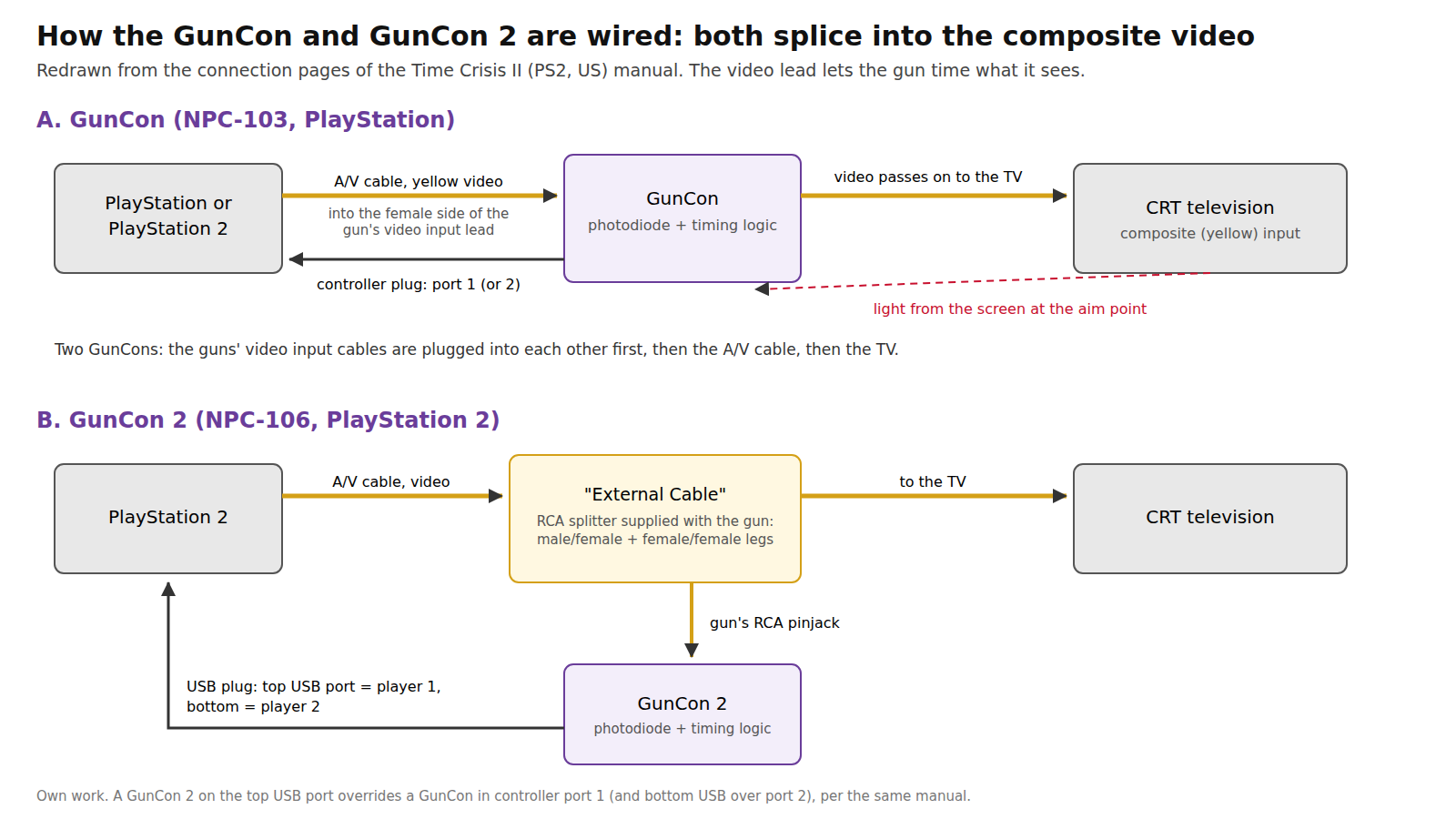
| Connector | PlayStation controller plug and a video input lead: the console’s A/V cable plugs into the female side of the gun’s lead, and the joined cables go to the television6 |
| Sensing | Photodiode; timed in the gun against the video it is fed |
| Controls | Trigger (shoot), A button (action: cover and reload in Time Crisis), B button (start and pause)7 |
| Power | From the console |
| Recoil | No |
| Works today | A PlayStation or PlayStation 2, composite video into a CRT that is not a 100 Hz set, and a GunCon-standard game |
| Price | PriceCharting, 19 Oct 2026: US loose $33.96, complete $39.48, sales to July 2026; Japanese loose $34.98, complete $50.34 |
Namco’s own warnings about televisions. The European Time Crisis manual says the G-CON45 “cannot be used” with LCD televisions and projectors, Hi-Vision sets, 100 Hz televisions, televisions with a screen-memory function, some wide-screen sets, small screens, magnetised sets, some old sets and projection televisions (“the screen may burn”).7 It also calls the gun “a highly sensitive light-peripheral” and “not a weapon”, and notes that a standard controller in port 2 can be used to reload. Before playing, the game’s calibration screen should be used: shoot the centre of the target until the red hit mark falls where the sights were.
Telling a GunCon from its imitators. A genuine GunCon says Namco, has the second (video) lead, and has the red-ringed side button visible in the photograph. A PlayStation gun with only a controller plug is either a Konami-standard gun or a third-party gun; neither is a GunCon, whatever its packaging claims, unless it also takes the video signal.
The commonly repeated story that Namco removed the arcade gun’s recoil. Secondary sources say Namco left out the arcade gun’s force feedback to keep the price down and added a button in place of the arcade pedal. No Namco statement was found; Vol 1 records this as unconfirmed.
4.5 The Predator Family of Dual-Format Guns
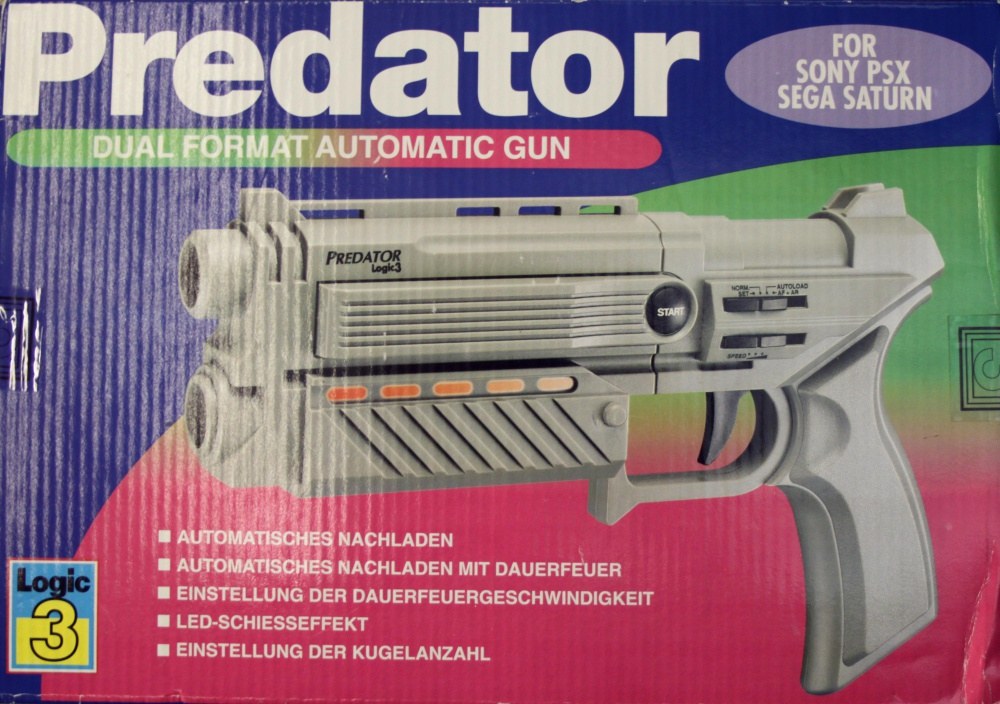
Table 5 — The Predator Family of Dual-Format Guns
| Maker | Logic 3 (and the same gun under other brands, below) |
| First release | 1996 (Centre for Computing History catalogue)8 |
| System | PlayStation and Sega Saturn, “dual format” |
| Model number | JT400 |
| Connector | How one gun meets two consoles’ plugs was not confirmed for this dive |
| Sensing | Photodiode. Which PlayStation standard a given Predator variant follows was not confirmed from Logic 3 documentation; one owner’s report of playing Time Crisis with one suggests some variants offered GunCon compatibility |
| Features | Configurable auto-fire and auto-reload, with a flashing LED effect8 |
| Recoil | No; the Predator 2 adds vibration for PlayStation users (Sega Retro) |
| Works today | Either console and a CRT; accuracy reports vary by console and game |
Sega Retro identifies the same gun under four names: the Predator (Logic 3), the Virtual Gun (Nuby), the Cobra Gun (Nyko) and the Judge Dredd (Esel).9 A period review page rates the Nuby Virtual Gun the best of the unlicensed guns and “the most accurate of all the non-Guncon light guns”, with an 8 ft cord, auto-fire, auto-reload and an optional reload pedal and scope sold separately; it mentions Nuby’s separately licensed “Heater” PlayStation gun as less accurate.10 A forum user reports that a Predator works well on the Saturn and the original PlayStation but misses shots on a PlayStation 2 running PlayStation games;11 that is one owner’s report, not a test.
What to know before buying one. These guns are cheap, common in mixed lots, and fine for the Saturn and for Konami-standard PlayStation games. Whether a particular one plays GunCon games depends on the variant: some third-party guns offered a switch between the two standards, and the packaging is the place to look. Treat any third-party gun as unproven until it has been tested with the specific game.
4.6 American Laser Games GameGun
The 3DO’s only light gun was American Laser Games’ own GameGun, released in 1994 for the company’s full-motion-video shooters (Mad Dog McCree and its successors). Secondary sources report a one-player version that could be daisy-chained with a 3DO controller and a two-player version of 1995 with a Y-connector, and a later version for the Mega Drive and Mega-CD that does not play Menacer or Justifier games. They also report that its styling matches the Peacekeeper Revolver, the gun American Laser Games sold for the Philips CD-i.12 No manual for either was read for this dive; both are listed as library candidates, and their identification tables are left for a later pass rather than filled from secondary sources.
4.7 Buying a 32-Bit Gun
Identify the standard first. On the PlayStation: one cable means Konami standard (or a third-party gun emulating it); a controller plug plus a video lead means GunCon. On the Saturn: the Virtua Gun’s colour tells the market and its trigger colour the Japanese revision.
Check the GunCon’s video lead. A GunCon with a cut or missing video lead will not work. The lead also has to sit in the composite video path, which rules out RGB SCART and S-Video connections to the television unless the composite signal is still taken to the gun.
Avoid 100 Hz CRTs for GunCon play. Namco’s own list excludes them.
Expect to test third-party guns game by game. The Predator family and its relatives are inexpensive, but no maker documentation of their compatibility survives in the sources read for this dive.
Getting a GunCon or Virtua Gun running on modern displays, and the converters that exist for it, is for the planned Original Consoles dive; fitting modern internals to a GunCon shell belongs to Modding Classic Light Guns and the Open-Source Firmware dive’s list of GunCon conversions.
Footnotes
-
Martin Korth (nocash), PSX-SPX, “Controllers and Memory Cards”, Konami Justifier/Hyperblaster and Namco GunCon sections. https://psx-spx.consoledev.net/controllersandmemorycards/ (read 2026-10-19). Community reverse-engineering. ↩ ↩2 ↩3
-
Sega Retro, “Virtua Gun” (release table and text, citing sega.jp, Maximum November 1995 pp. 116–117, Sega Saturn Magazine December 1995 p. 11 and a 1995-10-30 Sega press release). https://segaretro.org/Virtua_Gun (read 2026-10-19). A fan wiki. ↩ ↩2 ↩3 ↩4 ↩5 ↩6
-
SEGA, “関連・周辺機器 | セガサターン” (Saturn related and peripheral devices), entry for バーチャガン. https://www.sega.jp/history/hard/segasaturn/devices.html (read 2026-10-19). ↩ ↩2 ↩3 ↩4
-
Sega of America, Virtua Cop (Saturn, US) instruction manual, “Sega Stunner arcade gun” and “Gun Adjust Screen”. Scan: https://archive.org/details/Virtua_Cop_1995_U (read 2026-10-19). ↩ ↩2
-
Wikipedia, “Konami Justifier”, and marketplace listings giving SLUH-00017 (search summaries, 2026-10-19). Secondary. ↩ ↩2
-
Namco, Time Crisis II (PlayStation 2, US) instruction manual, “How to Connect your Guncon”, “How to Connect your Guncon2” and “Using Guncon and Guncon2 together”. Scan: https://archive.org/details/ps2_Time_Crisis_II_USA (read 2026-10-19). ↩ ↩2
-
Namco / Sony Computer Entertainment Europe, Time Crisis (PlayStation, PAL) instruction manual, G-CON45 sections. Scan: https://archive.org/details/18082024-002 (read 2026-10-19). ↩ ↩2 ↩3
-
Centre for Computing History, “Predator JT400 Lightgun”, Logic 3, 1996. https://www.computinghistory.org.uk/det/43605/Predator%20JT400%20Lightgun (read 2026-10-19). ↩ ↩2
-
Sega Retro, “Predator” (search summary, 2026-10-19; the page itself could not be read). ↩
-
“Light Gun Reviews: Virtual Gun”, undated period review page hosted at WPI. https://web.cs.wpi.edu/~gogo/ps2_io/virtualgun.htm (read 2026-10-19). ↩
-
Shmups forum (system11.org), “Light gun games compatibility” thread (search summary, 2026-10-19). One user’s report. ↩
-
Wikipedia, “Gamegun”, and Sega Retro, “GameGun” (search summaries, 2026-10-19). Secondary. ↩
Comments (0)